

What, exactly, is the Insurrection Act? Understanding the 1807 law Trump is threatening to invoke
As tensions flare over federal immigration operations in the Twin Cities, President Trump has threatened to deploy the military using a 219-year-old law. Here's how it works.


A massive federal immigration crackdown in the Twin Cities, dubbed "Operation Metro Surge," has brought Minneapolis to a breaking point. Following the fatal shooting of Renee Good by an ICE agent and subsequent clashes between protesters and federal officers, President Trump has threatened to intervene directly.
In the January 16th Truth Social post pictured below, the President warned he would "institute the INSURRECTION ACT" to "quickly put an end to the travesty" taking place in Minnesota—a move that would bypass the authority of Governor Tim Walz.
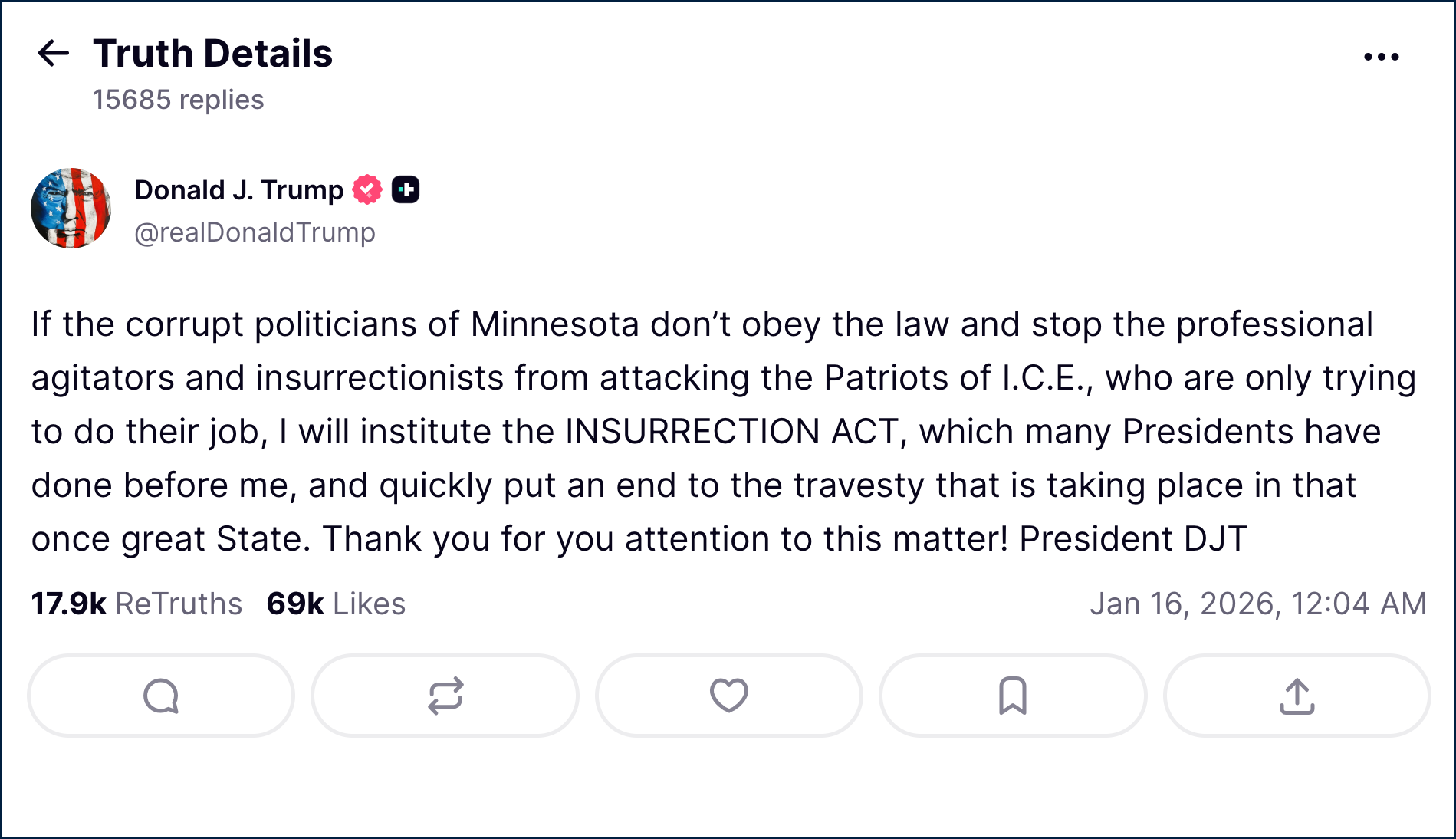
This is not the first time the current administration has tested these boundaries. We previously explored the legal and historical fallout when the President deployed Marines into Los Angeles without state approval, an event that serves as a critical backdrop to the current standoff in the Midwest. While the LA deployment relied on specific historical precedents, the threat to Minneapolis represents a new and potentially more expansive use of the 1807 law.
If you’re just tuning in, here’s a full rundown of what this law is, how it works, and why the threat of its use is so significant.
What the Insurrection Act Does
The Insurrection Act of 1807 is a set of federal laws that gives the President the authority to deploy the U.S. military and federalized National Guard troops within the United States for domestic law enforcement.
Under normal circumstances, a law called the Posse Comitatus Act prohibits the federal military from acting as a domestic police force. The Insurrection Act is the primary exception to that rule. It allows the President to send in the Army or Marines to suppress "insurrection," "domestic violence," or "unlawful combinations" that prevent the enforcement of law.
 Mac Douglass | Editor
The Three "Triggers" for Deployment
The law describes three specific scenarios where a President can legally deploy troops on U.S. soil:
- Federal Aid for State Governments (Section 331): The President can send troops if a state’s governor or legislature explicitly requests help to suppress an insurrection against the state government.
- Enforcing Federal Authority (Section 332): The President can act unilaterally (without a governor's request) if they determine that "unlawful obstructions, combinations, or assemblages" make it impossible to enforce federal law through the ordinary course of judicial proceedings.
- Protecting Civil Rights (Section 333): The President can intervene if domestic violence or "conspiracies" in a state so hinder the law that a class of people is deprived of their constitutional rights, and state authorities are unable or unwilling to protect them.
Has it been used before?
While rare, the Act has been invoked more than two dozen times in American history. Notable examples include:
- 1992 Los Angeles Riots: President George H.W. Bush deployed troops at the request of the California governor to restore order.
- 1957 Little Rock Integration: President Dwight D. Eisenhower federalized the National Guard to enforce school desegregation in Arkansas after the governor used the Guard to block it.
- 1965 Selma to Montgomery Marches: President Lyndon B. Johnson used the Act to protect civil rights marchers in Alabama.
In the case of Minneapolis, the current tension lies in the fact that the President is threatening to use the law without a request from Governor Walz, who has urged the administration to "turn the temperature down" rather than escalate.
Why It’s Controversial
While the Insurrection Act was originally designed as a tool for extreme emergencies, the primary controversy lies in its broad and vague language.
The 1807 law grants the President immense discretion. Specifically, Sections 332 and 333 allow the President to deploy troops whenever they "consider" it necessary to enforce federal authority or protect civil rights. Because this can be done without a request from a state’s governor, it creates a potential for a direct conflict between federal and state power.
Critics, including legal scholars and civil rights organizations, argue that the law provides no clear "check" on the executive branch. There is currently no statutory limit on how long a deployment can last, nor is there a requirement for the President to seek approval from Congress.
Impact on the Ground
The threat of a military surge comes at a time when Minneapolis and St. Paul are already operating under extraordinary conditions. The ongoing immigration crackdown has fundamentally altered daily life in the region:
- School Disruptions: Both St. Paul and Minneapolis Public Schools, serving over 60,000 students combined, have announced temporary shifts to online learning, citing student safety and the "impossible situation" created by the unrest.
- Massive Federal Presence: The Department of Homeland Security has surged nearly 3,000 agents into the Twin Cities—a force that significantly outnumbers the local Minneapolis Police Department.
- Community Climate: With more than 2,500 arrests reported since late November, groups like the ACLU of Minnesota allege that the "Metro Surge" has resulted in widespread racial profiling and warrantless searches, particularly affecting the state’s Somali and Hispanic populations.
What Happens Next?
If the President follows through on the threat to invoke the Act, the next battle will likely be in the courtroom.
Minnesota Attorney General Keith Ellison has already vowed to challenge any such order, arguing that a unilateral military deployment over the objections of state leaders would be a violation of the Constitution’s 10th Amendment.
However, because the Insurrection Act has historically been interpreted as giving the President nearly total authority to determine what constitutes an "insurrection," stopping a deployment once it begins remains a significant legal hurdle. For now, the Twin Cities remain in a state of high alert, caught between a massive federal operation and the threat of a full-scale military presence.


