

Can Trump actually use the "Insurrection Act" to deploy troops to Minneapolis? Here’s what the law says
President Trump’s threat to invoke the Insurrection Act faces a wall of legal challenges from Minnesota officials and a pending reform bill in the Senate. Here is why a federal deployment is legally and constitutionally complicated.


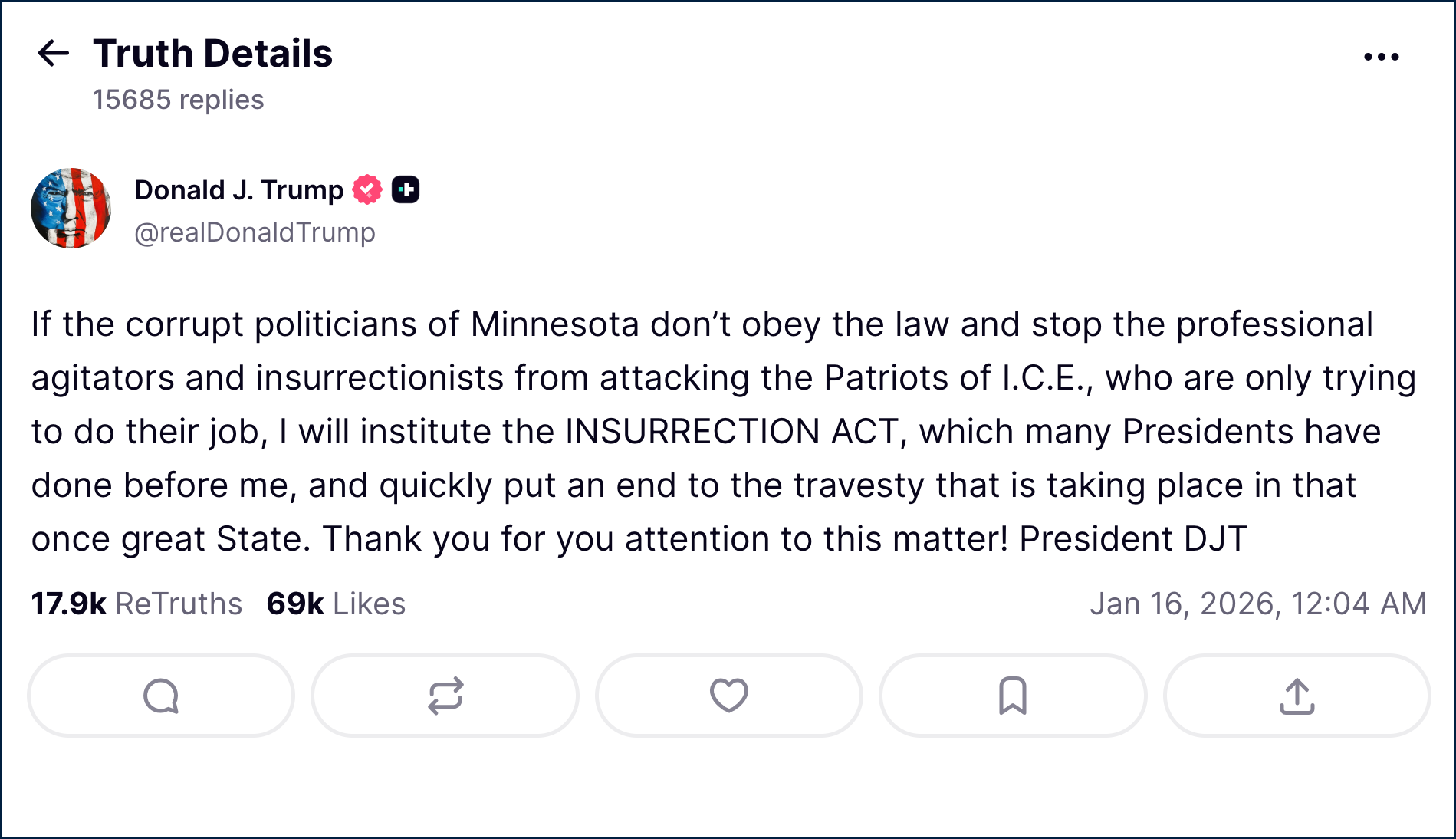
As President Trump ramps up his warnings to "institute the INSURRECTION ACT" in response to protests in the Twin Cities, a massive legal and constitutional standoff is brewing between the White House and Minnesota officials. The President’s threat follows weeks of unrest tied to "Operation Metro Surge," an immigration enforcement operation that has already pushed the region to its legal and social limit.
 Mac Douglass | Editor
This is not the first time we have examined the expansive reaches of this authority. Last June, we deep-dived the legal precedents used when Trump deployed Marines into Los Angeles without state approval. While that incident set a high-water mark for executive action, the current crisis in Minneapolis faces a much more complex web of modern legal hurdles, including a pending reform bill in the U.S. Senate.
Based on the existing 1807 statutes, the proposed Insurrection Act of 2025 (S. 2070), and the U.S. Constitution, a unilateral move by the President would face significant legal roadblocks. Here is what the law actually says.
The Limits of Presidential Power
The primary tension lies in whether the President can act over the explicit objections of a state’s governor. In Minneapolis, Governor Tim Walz has made a direct appeal to "turn the temperature down" and has not requested federal military assistance.
“I’m making a direct appeal to the President: Let’s turn the temperature down. Stop this campaign of retribution. This is not who we are,” Gov. Tim Walz, a Democrat, said on X. https://t.co/HLw32w5kwh
— WBTV News (@WBTV_News) January 15, 2026
The Consent Issue
Under current law (10 U.S.C. §§ 331-335), there are two ways the military can be deployed:
- With State Consent: Section 331 allows the President to send troops at the request of a State’s governor or legislature.
- Without State Consent: Sections 332 and 333 allow the President to act unilaterally if they "consider" it impracticable to enforce federal law or if they determine that domestic violence is depriving citizens of constitutional rights.
The phrase "whenever the President considers" has historically granted the executive branch nearly unchecked discretion to determine what constitutes an emergency. However, Minnesota Attorney General Keith Ellison has already signaled that any such move would be challenged as a violation of the 10th Amendment, which protects state sovereignty.
The "Metro Surge" Conflict
The current situation is further complicated by the sheer scale of the federal presence already on the ground. The Department of Homeland Security has deployed approximately 2,000 agents to the area—a force that dwarfs the local Minneapolis Police Department. This "surge" has already led to a class-action lawsuit from the ACLU alleging racial profiling of Somali and Hispanic U.S. citizens, adding a layer of civil rights litigation that could further complicate a formal military invocation.
Legal and Political Obstacles
| Question | Answer |
|---|---|
| Can Gov. Walz stop a deployment? | Technically no, if the President invokes Section 332 or 333 unilaterally. However, the Governor can challenge the "factual basis" of the insurrection in court. |
| What is Keith Ellison’s legal strategy? | The AG is already suing to stop the DHS "Metro Surge" and has vowed to seek an immediate injunction against any military deployment. |
| What role does the ACLU lawsuit play? | The ongoing class-action suit regarding racial profiling and warrantless arrests creates a legal record that could be used to argue the federal government is the source of the unrest, not the solution. |
| Does the President need a proclamation? | Yes. Under Section 334, the President must first issue a proclamation ordering "insurgents" to disperse within a "limited time." |
The first half of this legal battle is currently being fought in the headlines, but the second half will be fought in federal courtrooms. The outcome may depend not on the 1807 law, but on a reform bill currently sitting in the U.S. Senate.
The "Insurrection Act of 2025" (S. 2070) Factor
While the current standoff centers on the 1807 law, a significant legislative hurdle looms in the form of the Insurrection Act of 2025 (S. 2070). Introduced in June 2025 by a coalition of nearly 20 senators, the bill is a comprehensive attempt to overhaul Chapter 13 of Title 10—the very section of the U.S. Code the President is threatening to invoke.
If enacted, S. 2070 would transform the President’s domestic military authority from a broad, discretionary power into a time-limited, overseeable function of government. Key changes include:
- The 7-Day Expiration Date: Under the new bill, any authority to use the military domestically would automatically terminate after 7 days unless Congress passes a "joint resolution of approval" .
- Congressional Renewal: Even with initial approval, the authority would only last for 14-day increments, requiring a new vote for every extension.
- Mandatory Reporting: Within 24 hours of a deployment, the President would be required to submit a detailed report to Congress justifying the move and certifying that all other civilian options have been exhausted.
The "Last Resort" Standard and Judicial Oversight
Perhaps the most critical shift in the 2025 bill is the establishment of a "Last Resort" policy. The bill explicitly states that the armed forces should only be used if state, local, and federal civilian law enforcement are physically unable or have otherwise failed to address the situation .
Unlike the 1807 Act, which historically offered little room for judicial intervention, S. 2070 creates a direct path for legal challenges:
- Expedited Judicial Review: Section 257 would allow any individual or entity (including a state government) injured by the military's deployment to sue for an immediate injunction .
- The "Substantial Evidence" Test: For the first time, courts would be empowered to review the "factual basis" of the deployment. A President’s determination that an insurrection exists would only be upheld if supported by "substantial evidence"—a much higher bar than the current "whenever the President considers" standard.
- Supreme Court Fast-Track: The bill mandates that both district courts and the Supreme Court "expedite to the greatest possible extent" any legal challenges brought under the Act .
The Bottom Line
The situation in Minneapolis is a live-action test of a 219-year-old law in a modern political landscape. While the Insurrection Act of 1807 currently grants the President expansive authority to override state leaders like Governor Walz, the legal "blank check" that once defined the law is facing an unprecedented assault.
Between Attorney General Keith Ellison’s existing 10th Amendment challenges and the potential for S. 2070 to reorder the balance of power, any attempt to deploy the military to the Twin Cities will likely trigger a constitutional crisis that moves as quickly through the courts as the federal agents moved through Minneapolis.
As the ACLU’s class-action lawsuit highlights, the real-world impact of "Operation Metro Surge" has already created a volatile environment. Whether the Insurrection Act is the solution to that volatility—or a recipe for a deeper legal fire—is a question that may soon be answered by the highest court in the land.


