


Seamless access, total privacy: How Digital IDs will impact Californians in 2026
Explore California’s 2026 Digital ID, a secure, opt-in system for single sign-on access to state services with privacy-by-design at its core.

2026 marks a turning point for Californians as the state-wide Digital ID Framework replaces traditional physical cards with a secure, 'privacy-by-design' electronic identity.
The California Digital ID Framework, managed by the California Department of Technology (CDT), has officially moved from a series of successful pilots to a state-wide reality. This transition marks a new era where "identity" is no longer just a plastic card in your pocket, but a secure, electronic validation that grants you seamless access to the services you need.
The framework is built on four non-negotiable pillars: world-class security, privacy-by-design, access and equity, and openness and transparency. Whether you are renewing a professional license, applying for a green energy rebate, or simply catching a bus, this system is designed to verify your eligibility instantly without compromising your personal data.
Below, we explore how these advancements impact your daily life in 2026. From the convenience of a Mobile Driver’s License (mDL) to the "one-and-done" simplicity of the California Identity Gateway, you'll learn how is leveraging technology to create a faster, safer, and more inclusive digital experience for all.
Sources & References
The information in this guide is derived from the California Department of Technology (CDT) Digital ID Framework Strategy, the official roadmap for the state's transition to a federated digital identity system.
The 2026 Digital Identity Landscape
The Tipping Point
By 2026, the California Digital ID Framework has transitioned from a series of innovative pilots into a "recognized pillar of online trust" for both government and enterprise. What was once considered a niche technology is now a standard tool for Californians, providing an electronic validation of identity that is as reliable as a physical ID card but designed for the digital age. This evolution allows for a state-wide, federated identity service where online state services are seamlessly and securely accessible through a single, unified system.
Guiding Principles
The foundation of this landscape rests on four unwavering pillars established by the California Department of Technology (CDT):
- World-class Security: Utilizing robust technology infrastructure to ensure all digital interactions are protected against unauthorized access.
- Privacy-by-Design: Ensuring that privacy is not an afterthought but a core component of the system’s architecture, where no agency stores more personally identifiable information than is strictly necessary.
- Access and Equity: Building a system that is inclusive and provides equitable digital access for all Californians, regardless of their background or location.
- Openness and Transparency: Maintaining trust through open-source preferences and transparent governance of how data and technology are managed.
Opt-In Nature
Despite its integration into daily life, the Digital ID remains a choice. It is an opt-in service provided to residents, ensuring that individuals maintain control over how they interact with their government. Californians can choose to leverage these secure, convenient digital tools or continue using traditional methods, keeping the resident's preference at the center of the experience.
 Pat Sharyon | Editor
Streamlined Access to Benefits (The California Identity Gateway)
Single Sign-On (SSO)
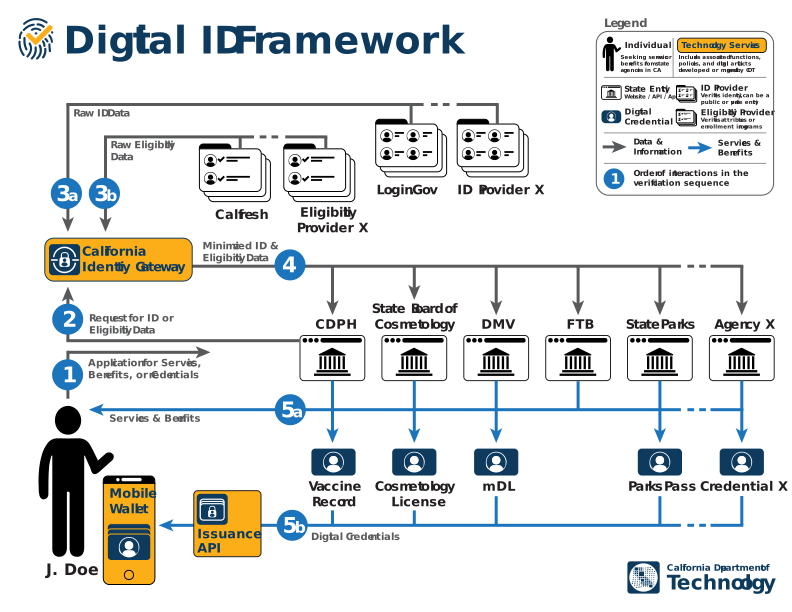
The California Identity Gateway serves as the central technology architecture that facilitates the interaction between various digital platforms. For Californians in 2026, this means the end of "password fatigue." The Gateway provides a robust Single Sign-On (SSO) solution, allowing residents to access a vast array of state services through a single, secure login. By leveraging identity information from trusted providers like Login.gov, the Gateway eliminates the need for residents to manage dozens of different accounts across various departments.
"One-and-Done" Verification
The Gateway revolutionizes how eligibility is determined. Instead of repeating the verification process for every single department, the system allows for a "one-and-done" approach. Once a resident’s identity and attributes are verified through the Gateway, that status can be used by various departments to determine eligibility for multiple programs. This interoperable system ensures that your "verified" status travels with you, securely confirming your identity to different agencies without requiring you to restart the process from scratch each time.
Reduced Bureaucracy
By utilizing Eligibility Verification APIs, the Gateway drastically reduces the bureaucratic hurdles traditionally associated with government benefits.
- Instant Verification: Agencies such as State Parks (for park passes) or the California Air Resources Board (CARB) (for Green Energy Rebates) can verify requirements like age, residency, or income status instantly via the Gateway.
- Seamless Delivery: This modular design allows departments to build services that meet their specific missions while providing residents with a faster, more secure way to receive necessary information and benefits.
- Diverse Use Cases: From confirming Veteran eligibility to CalFresh status, the API-driven framework ensures that benefits reach eligible individuals with unprecedented speed and minimal friction.
Daily Life & Transportation Impacts
The Mobile Driver’s License (mDL)
By 2026, the Department of Motor Vehicles (DMV) mDL project has evolved from a digital version of a physical card into a powerful tool for secure online authentication. Integrated fully with the California Identity Gateway, the mDL allows residents to store a valid, government-issued driver's license on their mobile device. This integration enables the mDL to be used not just for physical identity checks or age verification, but as a secure credential to unlock a wide range of digital services and licensure applications across the state.
Integrated Transit Discounts
Building on successful pilot programs, transportation has become more affordable and accessible for vulnerable populations.
- Automated Savings: Seniors and veterans in major districts, such as Sacramento Regional Transit and the Santa Barbara Transportation District, can now access transit discounts automatically.
- Simplified Access: By tapping their device, eligible residents can confirm their status via the Identity Gateway, eliminating the need to carry paper proof of eligibility or navigate complex application processes for fare reductions.
Digital Professional Credentials
The framework has digitized the way professionals prove their expertise and authority.
- Digital Artifacts: Professionals, including cosmetologists and others holding state-issued licenses, can now carry their credentials as secure digital artifacts on their mobile devices.
- Instant Verification: These digital licenses allow for instant verification by employers, clients, or state inspectors, ensuring that valid professional standing is easily demonstrable without the need for physical paperwork.
Enhanced Privacy and "Intelligent Trust"
Selective Disclosure
One of the most significant shifts in 2026 is the ability for Californians to prove facts about themselves without sharing their identity.
- Need-to-Know Basis: Through selective disclosure, a user can electronically confirm they meet a specific requirement—such as being over the age of 21—without revealing unrelated personal details like their home address or exact birthdate.
- User Control: This "Privacy-by-Design" approach puts the resident in control of their data, sharing only what is strictly necessary for the transaction at hand.
Data Minimization
The California Digital ID Framework is built on the principle that less is more when it comes to personal data.
- Limited Retention: The system ensures that no state agency or identity provider stores more personally identifiable information (PII) than is absolutely required to provide a service.
- Reducing Risk: By minimizing the amount of data collected and stored, the state reduces the potential impact of data breaches and ensures that resident privacy is protected at every step of the digital interaction.
Anti-Fraud Protections
In an era of increasingly sophisticated digital threats, the framework provides a robust defense against identity theft.
- Cryptographic Security: By using secure, verifiable digital artifacts, the framework creates a "chain of trust" that is much harder to forge than traditional IDs.
- Combating Synthetic Fraud: These cryptographically bound IDs help protect residents from synthetic impersonation and fraud, ensuring that the person accessing a benefit or service is truly who they claim to be.
The Evolution of the Digital Wallet
Seamless Integration
By 2026, the digital wallet has become the primary interface for managing state-issued credentials. The California Department of Technology (CDT) ensures these credentials integrate seamlessly with commonly used consumer wallet products, such as Apple Wallet or Google Wallet. This allows residents to maintain their digital identity within the apps they already use daily, ensuring a smooth and familiar user experience.
Beyond Identification
The 2026 digital wallet is more than just a storage space for digital cards; it is an active tool for transactions and verification.
- Integrated Transactions: Wallets can facilitate digital payments for goods and services while simultaneously verifying the user’s identity.
- Instant Eligibility: Users can confirm their eligibility for specific benefits or discounts directly through the wallet interface, combining payment and verification into a single step.
- Unified Credentials: Often, multiple features—such as an ID and a discount pass—can be combined into a single, efficient digital credential.
Decentralized Control
A key feature of the 2026 framework is the shift toward resident-centric data management.
- On-Device Storage: Digital credentials can be stored directly on a user’s device rather than solely in a centralized government database.
- Privacy Empowerment: By holding their own data, residents have greater control over when and with whom they share their information, aligning with the state's "Privacy-by-Design" mandate.
Roadmap & Future Outlook
Expansion of Attributes
The roadmap for 2026 and beyond focuses on increasing the "intelligence" of the Identity Gateway.
- New Eligibility Tiers: The state is expanding the Gateway's ability to verify complex statuses, such as Veteran eligibility and CalFresh status, to automate access to social safety net programs.
- State-Wide Federation: The ultimate goal is a fully federated identity service where every online state service—from professional licensing to tax filings—is accessible through this single, secure framework.
Infrastructure Maturity
As the framework matures, the CDT continues to refine the underlying technology and policy.
- Interoperability: Continuous efforts ensure that the California Identity Gateway remains compatible with a diverse range of use cases at both the state and local agency levels.
- Global Standards: By leveraging globally recognized standards and a preference for open-source software, California’s digital ID system is built to scale and adapt to future technological shifts.
- Unified Governance: The transition of projects like the Mobile Driver’s License (mDL) into the broader CDT governance structure ensures a consistent security and privacy experience across all digital interactions.
The California Digital ID Framework represents a fundamental shift in how residents interact with their government. By 2026, the transition from physical-first to digital-by-design systems will provide Californians with a faster, more secure, and more equitable way to access essential services. Through the California Identity Gateway and the expansion of the digital wallet, the State is not only reducing bureaucratic friction but also setting a global standard for privacy and "intelligent trust".
As this ecosystem continues to mature, it empowers individuals with greater control over their personal data while ensuring that California remains at the forefront of the digital age.


