

California opts for conservative "Dry Year" strategy: 10% water allocation to start 2026 with reservoirs at 114% average
State officials announced a conservative 10% water supply forecast for 2026, opting for caution despite record-breaking November storms that have pushed reservoir levels to 114% of their historical average.


The Department of Water Resources (DWR) has announced an initial State Water Project (SWP) allocation of 10 percent for the 2026 water year, erring on the side of conservatism despite the record-breaking storms that have swept through California in recent weeks.
The announcement presents a stark contrast to the immediate hydrological conditions. Just last week, we reported that recent deluges had virtually eliminated drought conditions for 96% of the state’s population.
However, state officials emphasized that the December 1 allocation is a contractual forecast that assumes dry conditions for the remainder of the winter, regardless of how wet the autumn has been. Per DWR Director Karla Nemeth:
“Recent history has shown us that anything can happen during a California winter, so it’s important that our early season allocation for the State Water Project is conservative.
Reservoirs in "Good Shape"
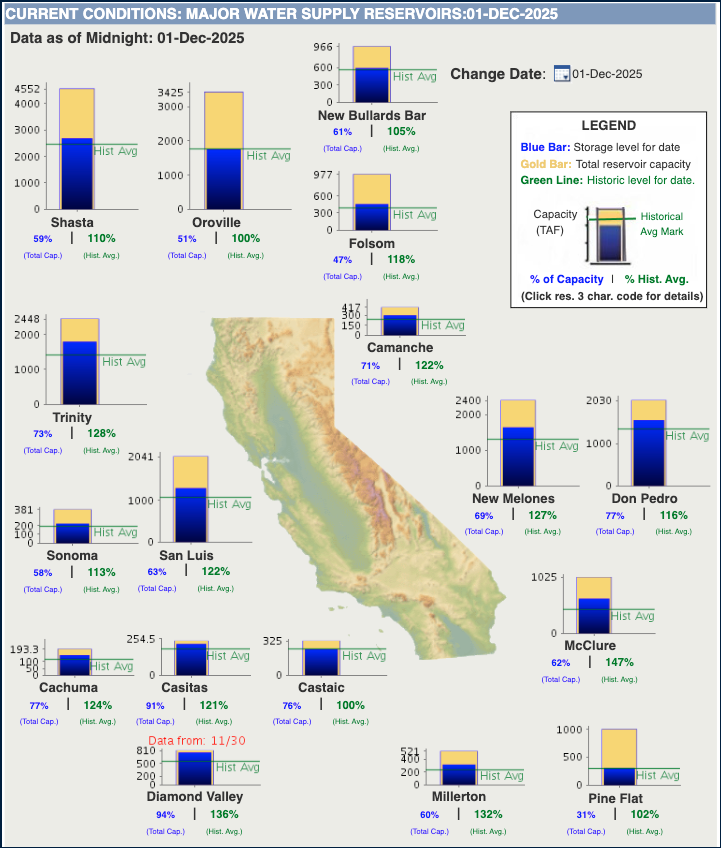
While the allocation forecast is low, the state’s physical water storage tells a different story. Statewide reservoir storage is currently at 114 percent of average, with key facilities holding significant carryover from the previous year.
According to current DWR data:
- Lake Oroville (SWP’s largest reservoir) is at 100% of its historical average.
- Shasta Lake is at 110% of its historical average.
- Diamond Valley Lake, a key Southern California reservoir, is at 136% of its historical average.
A Procedural Baseline
DWR Director Karla Nemeth described the allocation as a necessary precaution given the unpredictability of California's climate.
“Recent history has shown us that anything can happen during a California winter, so it’s important that our early season allocation for the State Water Project is conservative,” Nemeth said. “Traditionally our wettest months are yet to come”.
This 10 percent figure acts as a baseline to ensure essential health and safety needs are met. It is not a final verdict on the year's supply. For context, the 2025 water year began with an even lower 5 percent allocation in December 2024, but eventually climbed to 50 percent by April as storms continued.
DWR will update the allocation monthly as snowpack and runoff data provide a clearer picture of the winter ahead.


