

Michael Jackson biopic sequel gets $30.8 California film tax credit; "Michael 2" will film in CA
The California Film Commission has conditionally approved a $30.8 million tax credit for Lionsgate's Michael Jackson biopic sequel, the second-largest award in a $226.1 million round of 35 films announced by Gov. Gavin Newsom on October 7.


Lionsgate's sequel to Michael, the Micha el Jackson biopic that became one of the year's biggest box-office hits, is set to receive a $30.8 million California film tax credit, according to allocation figures from the California Film Commission. Michael 2 (working title) is one of 35 films in the commission's latest round, which Gov. Gavin Newsom announced on October 7, 2026.
I just enacted a new @FilmCalifornia Tax Credit to support Californians working in post-production, including editing, sound, visual, and audio effects.
— Governor Gavin Newsom (@CAgovernor) September 19, 2026
This industry just can't be replicated anywhere else — and we're boosting the extraordinary people who make it possible. pic.twitter.com/w8Kx42N5cV
The award is the second-largest in the round, behind an untitled Pixar animated film at $40.1 million. Across all 35 projects, the commission set aside about $226.1 million in credits against a projected $635 million in qualified California spending. The sequel's allocation is also roughly $9.8 million larger than the $21.1 million the first Michael received in 2023, even though the sequel is budgeting about a third less qualified spending in California. The difference comes from the rules: California's expanded Film and Television Tax Credit Program 4.0 pays non-independent feature films a 35% credit, about double what the first film's award worked out to.
The credit is a conditional allocation, not a payment. Lionsgate must start principal photography by late March 2027, spend the money in California, and have the spending audited before the state issues a final credit certificate, which can come in lower than the allocation but never higher.
Michael 2 California tax credit: $30.8 million on $86.7 million in qualified spending:
The California Film Commission's table of conditionally approved film projects for September 2026 lists Michael 2 (working title) from Lionsgate as a non-independent live-action feature with these commitments:
- Credit amount: $30,837,000
- Qualified California expenditures: $86,725,000
- California filming days: 55
- Cast hires: 65
- Crew members: 300
- Background performers: 5,220, measured in days worked
- Credit Allocation Letter date: September 21, 2026
The Governor's office described the project as "Michael 2 (working title) from Lionsgate, which released the blockbuster Michael Jackson biopic earlier this year." Deadline reported that the first film grossed $1.028 billion worldwide, and that Lionsgate Motion Picture Group Chairman Adam Fogelson said in August the sequel was "targeting a production start towards the end of this year or early next."
Qualified expenditures are not the same as a film's budget. The Program 4.0 guidelines define them as "the portion of production costs that qualify for a tax credit allocation": spending incurred and work performed in California, such as crew and staff wages, facility and equipment rentals, construction, wardrobe, food and lodging. The commission's figures do not show the sequel's full production budget.
California Film Commission's September 2026 round: 35 films and $226.1 million in credits:
The October 7 announcement covered 35 feature films. The state's release put the round's projected impact at:
- $1.08 billion in direct production spending in California
- $635 million in qualified spending, including $423 million in qualified wages
- 5,453 cast and crew jobs
- 24,842 background performer days
- 1,049 California shooting days, including 457 days filmed outside the Los Angeles studio zone
Twenty-eight of the 35 films are independent productions: eight with budgets over $10 million and 20 with budgets of $10 million or less. Together the independents are in line for about $71.2 million in credits. The seven non-independent studio features account for the remaining $154.9 million, or about two-thirds of the round.
Other headline projects include New Line Cinema's Friday sequel starring and produced by Ice Cube, untitled films from Paramount, Warner Bros., 20th Century Studios and Disney, an untitled Mike Mills film, and Leaves of Glass, set in Los Angeles' Chicano communities. The Governor's release calls the New Line project Last Friday; the commission's table lists it as "Untitled Friday Sequel."
"I'm thrilled to produce Last Friday right here in Southern California, where our cast and crew lives," Ice Cube said in the state's release, adding that the production would employ "more than 180 local cast and crew."
Non-independent feature films in the September 2026 round, by credit amount:
| Project | Company | CA filming days | Qualified spending | Credit |
|---|---|---|---|---|
| Pixar Film TBA (animation) | Pixar | 0 | $114,641,000 | $40,124,000 |
| Michael 2 (working title) | Lionsgate | 55 | $86,725,000 | $30,837,000 |
| Untitled Paramount Crime Thriller | Paramount Pictures | 70 | $83,621,000 | $29,345,000 |
| Untitled Disney Live Action 02 | Moose Lake Productions | 48 | $48,590,000 | $17,971,000 |
| Untitled WB Comedy | Warner Bros. Pictures | 36 | $37,154,000 | $13,004,000 |
| Untitled 20th Century Studios Horror | 20th Century Studios | 35 | $33,729,000 | $12,230,000 |
| Untitled Friday Sequel (Last Friday) | New Line Cinema | 40 | $32,677,000 | $11,437,000 |
Michael vs. Michael 2: A bigger credit on a smaller California budget:
The first Michael appears on the commission's approved projects list with a credit allocation dated March 6, 2023, in the state's 2022-23 fiscal year. Set side by side with the sequel's row, the two awards point in opposite directions:
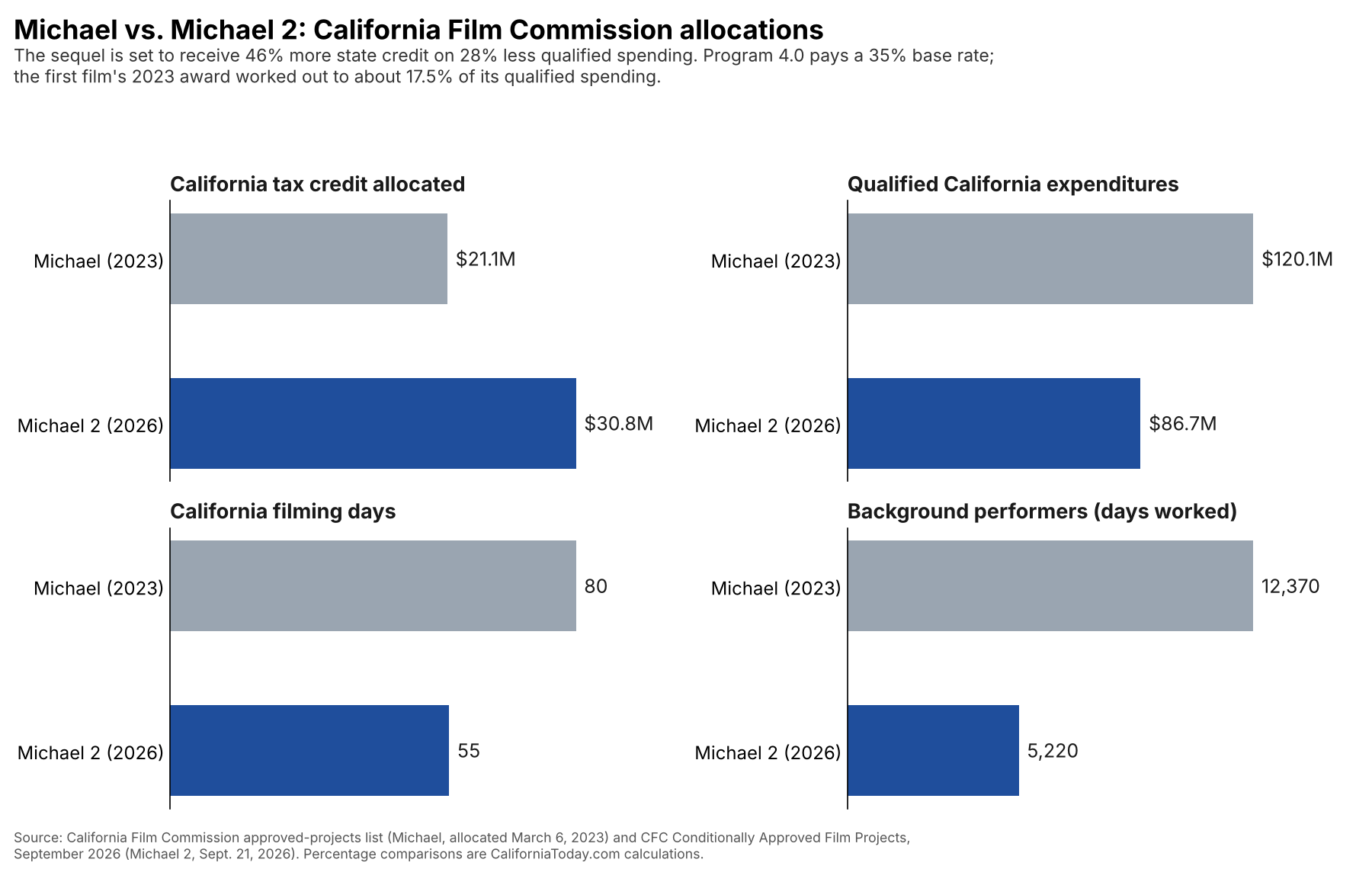
- Credit: $21,071,000 for the first film; $30,837,000 for the sequel, an increase of about 46%.
- Qualified California spending: $120,085,000 for the first film; $86,725,000 for the sequel, a decrease of about 28%.
- California filming days: 80 for the first film; 55 for the sequel.
- Cast and crew: identical on paper at 65 cast hires and 300 crew members.
- Background performers: 12,370 days worked for the first film; 5,220 for the sequel.
By our calculation, the first film's credit equaled about 17.5% of its qualified spending. The sequel's equals about 35.6%.
The 35% rate behind the sequel's larger award:
California's film incentive was rebuilt in 2025. The Governor's office said in September that the expansion "more than doubled the tax credit from $330 million to $750 million" a year. The commission's Program 4.0 overview describes a $3.75 billion program running five years, with a sunset date of June 30, 2030.
Under the Program 4.0 guidelines, dated January 1, 2026:
- Non-independent feature films such as Michael 2 receive a 35% refundable tax credit.
- The 35% applies to a maximum of $120 million in qualified expenditures, which the guidelines describe as "an effective cap on the tax credit amount of $42 million, excluding uplifts."
- Productions can earn uplifts: an extra 5% for qualified visual-effects spending, 5% for filming outside the Los Angeles zone, and 10% for wages paid to local hires working outside the zone.
- Non-independent credits cannot be sold or transferred. They offset state tax liability or are refunded by the state.
- Each fiscal year, $262.5 million of the program is reserved for non-independent feature films.
Michael 2's $30.8 million award is about $483,000 more than a flat 35% of its $86.7 million in qualified spending, which is consistent with a small amount of uplift-eligible spending. The commission does not publish uplift detail for individual projects. The award alone equals about 11.7% of the year's non-independent feature category.
The program changed again in September 2026, when Newsom signed SB 186, which the Governor's office said makes credits "more valuable through enhanced refundability" and exempts some independent productions' credits from a temporary credit limitation starting in 2027, along with AB 2319, which creates a separate credit for post-production work.
Michael 2's $30.8 million is a conditional allocation:
The commission's September 2026 table is titled "Conditionally Approved Film Projects." The Credit Allocation Letter dated September 21, 2026 starts a series of deadlines set out in the program guidelines:
- Filming must begin within 180 days. Projects with $100 million or more in qualified expenditures get 240 days. At $86.7 million, Michael 2 falls under the 180-day rule, which by our count runs to March 20, 2027. That window lines up with Fogelson's stated target of a production start late this year or early next.
- The final element must be delivered within 30 months.
- A certified public accountant must prepare an Agreed Upon Procedures report on the production's spending and jobs.
- The commission then issues a tax credit certificate. The guidelines say the final amount "may be less than the amount indicated on the credit allocation letter, but in no case may it exceed" it. A project whose jobs ratio drops more than 10% from its application faces a credit reduction.
In practice, the $30.8 million is the most Lionsgate can claim. The final figure depends on what the production actually spends and whom it actually hires in California.
California film tax credit returns: The state's figures and the LAO's 2025 review:
The state frames the program as an engine of jobs and investment. "We're making sure independent filmmakers and the next generation of storytellers and creators have a real shot to build, hire, and produce right here in California," Newsom said in the release. California Film Commission Director Colleen Bell said the round mixes "independent filmmaking and iconic stories that are part of California's cultural legacy."
According to the Governor's office, 179 projects approved since July 2025 have generated $7.2 billion in California production spending and nearly 38,000 cast and crew jobs. The office also cites returns, from earlier years of the program, of $24.40 in economic output, $16.14 in GDP and $8.60 in wages for every $1 of credit. Those are the state's own figures, drawn from its commissioned studies.
The Legislature's nonpartisan fiscal adviser reads the evidence differently. In its February 2025 review of the proposal to expand the credit to $750 million, the Legislative Analyst's Office found "weak evidence" that a larger credit would benefit the state's economy overall. Citing evaluations from other states, it wrote that every $1 of credit "returns significantly less than $1 in state revenue." It concluded that the expansion would somewhat increase the size of the industry in California but "likely would not result in economic benefits to the state as a whole," and recommended adopting it only if lawmakers saw keeping California's share of the industry as a priority in itself.
The LAO's analysis also cuts the other way on one key question. An earlier LAO study estimated that about two-thirds of credited projects would have filmed elsewhere without the credit, which supports the program's argument that the money changes where productions go. The Legislature adopted the expansion in 2025, and the October 7 round is part of its second year.
Michael 2's next California deadlines:
For Michael 2, the dates that matter now come from the program rules rather than the studio's release calendar:
- September 21, 2026: Credit Allocation Letter issued; qualified spending can count from this date.
- October 7, 2026: Round announced by the Governor's office.
- By March 20, 2027: Principal photography must begin in California.
- Within 30 months of the allocation letter: The final element must be delivered.
- After delivery: CPA review and the commission's final certificate, capped at $30,837,000.
The commission's public approved-projects list, last updated with July 2026 awards as of October 9, has not yet added the September round.
Status note: This article covers a conditional allocation. Figures are current as of October 9, 2026 and may change when the California Film Commission certifies final credits.
Sources & References
- Office of Governor Gavin Newsom, "Governor Newsom announces 35 new films coming to California as independent filmmaking surges and iconic franchises return," October 7, 2026. https://www.gov.ca.gov/2026/10/07/governor-newsom-announces-35-new-films-coming-to-california-as-independent-filmmaking-surges-and-iconic-franchises-return/ (also posted by the California Film Commission at https://film.ca.gov/governor-newsom-announces-35-new-films-coming-to-california-as-independent-filmmaking-surges-and-iconic-franchises-return/)
- California Film Commission, "Film and Television Tax Credit Program 4.0: Conditionally Approved Film Projects - September 2026" (table as published in Deadline, October 7, 2026). https://deadline.com/2026/10/michael-friday-sequels-california-tax-credits-2026-1237149125/
- California Film Commission, Film and Television Tax Credit Program Approved Projects List. https://film.ca.gov/film-and-television-tax-credit-program-approved-projects-list/
- California Film Commission, California Film and Television Tax Credit Program 4.0 Program Guidelines, January 1, 2026. https://cdn.film.ca.gov/wp-content/uploads/2025/08/4.0-Program-Guidelines-1.pdf
- California Film Commission, "The Basics 4.0." https://film.ca.gov/tax-credit/the-basics-4-0/
- Office of Governor Gavin Newsom, "Governor Newsom expands film and TV tax credits with new legislation, creates tax credit to support post-production jobs," September 19, 2026. https://www.gov.ca.gov/2026/09/19/governor-newsom-expands-film-and-tv-tax-credits-with-new-legislation-creates-tax-credit-to-support-post-production-jobs/
- Legislative Analyst's Office, "The 2025-26 Budget: California's Film Tax Credit," February 28, 2025. https://lao.ca.gov/Publications/Report/5000
- Deadline, "'Michael' & 'Friday' Sequels Among Films To Get California Tax Credits In Latest Funding Round," October 7, 2026. https://deadline.com/2026/10/michael-friday-sequels-california-tax-credits-2026-1237149125/
- Variety, "'Michael' Sequel to Get $31 Million in California Tax Credits," October 7, 2026. https://variety.com/2026/film/news/michael-2-california-tax-credits-1236903912/


