

California gas prices fall 12 cents after coming within 4.4 cents of the 2022 record
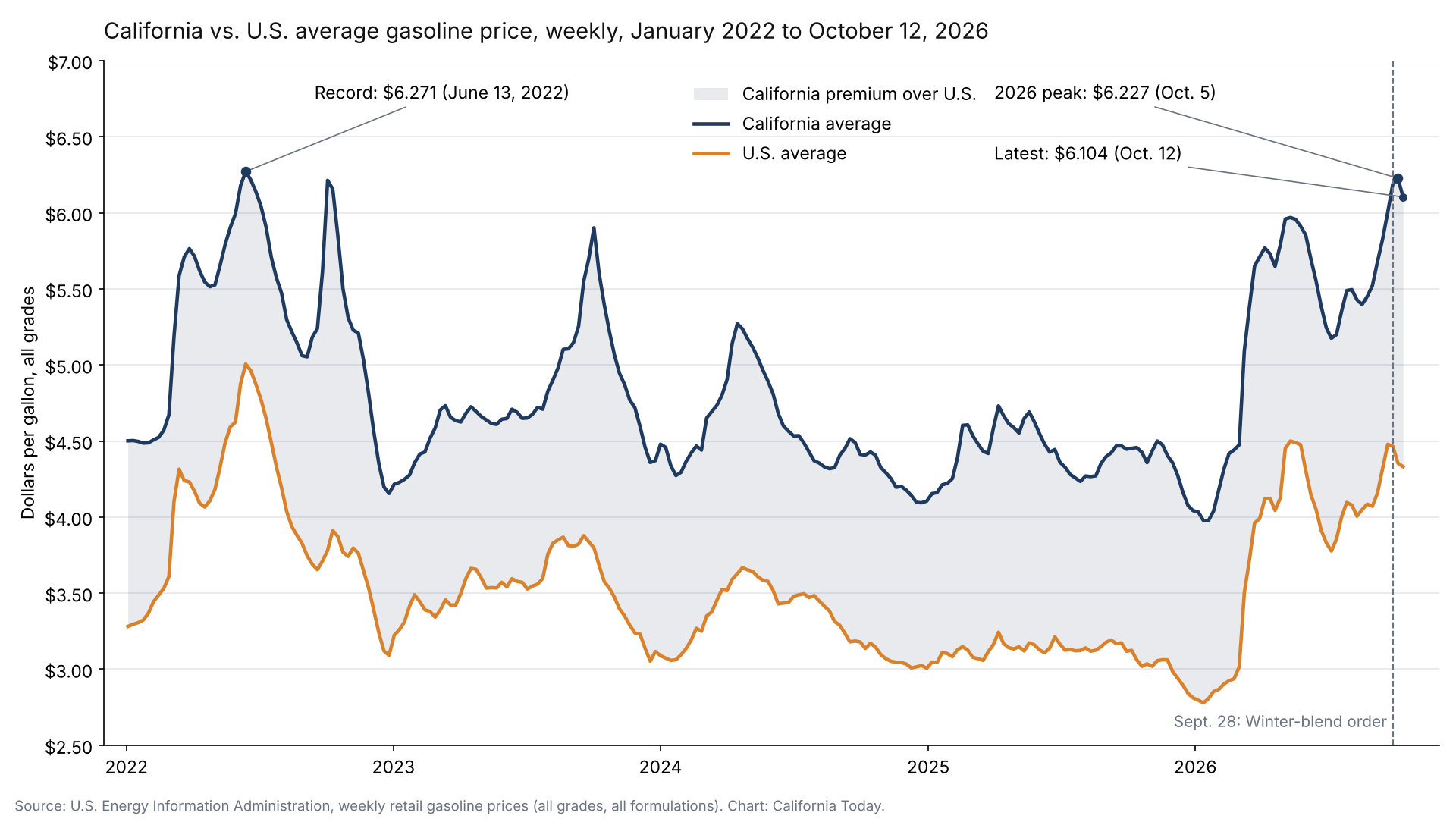
California gas prices averaged $6.227 a gallon the week of October 5, just 4.4 cents short of the June 2022 record, before falling to $6.104. California drivers are still paying $1.77 more than the U.S. average, and diesel set a new state record in September.


California gas prices came within 4.4 cents of their all-time record this month. In the U.S. Energy Information Administration's weekly survey, the statewide average for all grades of gasoline reached $6.227 a gallon the week of October 5. That is the second-highest reading since the series began in 2000, behind only $6.271 on June 13, 2022. A week later the average had slipped to $6.104, a drop of 12.3 cents, according to EIA's October 14 release.
The pullback is California's first weekly decline since mid-August, and it came two weeks after Governor Gavin Newsom suspended California's summer-blend gasoline rules on September 28. It leaves the state well above where it started the year, and well above the rest of the country. California drivers paid $1.77 a gallon more than the U.S. average the week of October 12, a gap wider than the one that existed the day the order was signed. Diesel, meanwhile, set a California record in September in EIA's survey, and another on October 15 in AAA's daily figures.
This article walks through the numbers from the primary sources: EIA's weekly price series, the Governor's signed letter, the California Energy Commission's refinery tables and the state's tax rates. It also covers what each source does and doesn't show.
Sources and References
- U.S. Energy Information Administration, California All Grades All Formulations Retail Gasoline Prices, weekly. https://www.eia.gov/dnav/pet/hist/LeafHandler.ashx?n=PET&s=EMM_EPMR_PTE_SCA_DPG&f=W
- U.S. Energy Information Administration, U.S. All Grades All Formulations Retail Gasoline Prices, weekly. https://www.eia.gov/dnav/pet/hist/LeafHandler.ashx?n=PET&s=EMM_EPMR_PTE_NUS_DPG&f=W
- U.S. Energy Information Administration, Gasoline and Diesel Fuel Update (release of October 14, 2026). https://www.eia.gov/petroleum/gasdiesel/
- U.S. Energy Information Administration, West Coast (PADD 5) Except California All Grades Retail Gasoline Prices, weekly. https://www.eia.gov/dnav/pet/hist/LeafHandler.ashx?n=PET&s=EMM_EPMR_PTE_R5XCA_DPG&f=W
- U.S. Energy Information Administration, Europe Brent Spot Price FOB, weekly. https://www.eia.gov/dnav/pet/hist/LeafHandler.ashx?n=PET&s=RBRTE&f=W
- U.S. Energy Information Administration, California No. 2 Diesel Retail Prices, weekly. https://www.eia.gov/dnav/pet/hist/LeafHandler.ashx?n=PET&s=EMD_EPD2D_PTE_SCA_DPG&f=W
- U.S. Energy Information Administration, U.S. No. 2 Diesel Retail Prices, weekly. https://www.eia.gov/dnav/pet/hist/LeafHandler.ashx?n=PET&s=EMD_EPD2D_PTE_NUS_DPG&f=W
- Office of the Governor, letter to CARB, CEC, DPMO and CDFA, September 28, 2026. https://www.gov.ca.gov/wp-content/uploads/2026/09/9.28.26-Letter.pdf
- Office of the Governor, "Governor Newsom takes action to help lower prices amid Trump's nationwide gas and diesel price spike," September 28, 2026. https://www.gov.ca.gov/2026/09/28/governor-newsom-takes-action-to-help-lower-prices-amid-trumps-nationwide-gas-and-diesel-price-spike/
- California Energy Commission, California's Oil Refineries (data as of July 8, 2026). https://www.energy.ca.gov/data-reports/energy-almanac/californias-petroleum-market/californias-oil-refineries
- California Energy Commission, California Oil Refinery History (current as of January 26, 2026). https://www.energy.ca.gov/data-reports/energy-almanac/californias-petroleum-market/californias-oil-refineries/california-oil
- California Energy Commission, Division of Petroleum Market Oversight. https://www.energy.ca.gov/programs-and-topics/programs/division-petroleum-market-oversight
- California Department of Tax and Fee Administration, Fuel Taxes rates. https://cdtfa.ca.gov/taxes-and-fees/special-taxes-and-fees-tax-rates/fuel-taxes.htm
- AAA, California Average Gas Prices (price as of October 15, 2026). https://gasprices.aaa.com/?state=CA
- California Today, "What, exactly, is the California mileage tax?" https://californiatoday.com/news/legal/what-exactly-is-the-california-mileage-tax/
California gas prices peaked at $6.227 on October 5, 4.4 cents short of the 2022 record:
EIA's weekly survey is dated each Monday, and its California average runs back to May 2000. Its five highest weekly readings in that span are:
| Rank | Week of | California average (all grades) |
|---|---|---|
| 1 | June 13, 2022 | $6.271 |
| 2 | October 5, 2026 | $6.227 |
| 3 | June 20, 2022 | $6.216 |
| 4 | October 3, 2022 | $6.213 |
| 5 | September 28, 2026 | $6.189 |
The 2026 climb has been steep. California's average stood at $3.977 the week of January 19, its low for the year. By October 5 it had risen $2.25 a gallon. After falling to $6.104 the week of October 12, it was $1.647 above the same week of 2025, an increase of 37%.
AAA, which publishes a daily average for regular unleaded, shows the same pattern from a higher base. AAA's California page put regular at $6.24 on October 15, down from $6.35 a week earlier. Its record for regular is $6.4375, set June 14, 2022. The two series measure different things, as the section on EIA and AAA below explains.
The national oil shock: Brent crude near $120 and a U.S. average up $1.27 in a year
Most of California's increase over the past year is shared with the rest of the country. Brent crude, the international benchmark, averaged $62.18 a barrel the week of January 2. It passed $124 in April and fell back to about $70 by early July, and then it climbed past $124 again in mid-September. It stood at $120.03 the week of October 2.
The U.S. average for all grades of gasoline was $4.331 the week of October 12. That is $1.270 above a year earlier, a 41.5% increase. California rose more in dollars ($1.647) but less in percentage terms, because it started from a higher base. Put another way, about $1.27 of California's $1.65 increase matches the national rise. The remaining 37.7 cents is the wider California premium, covered in the next section.
Newsom's letter attributes the national increase to the war in Iran. "President Trump's war in Iran has sent gas and diesel prices soaring across the country," the Governor wrote. His office's release estimated the cost at "$428 per California household," a figure the release does not show the arithmetic for.
California's gas premium over the U.S. average reached $1.87, The widest since 2023:
California gasoline always costs more than the national average. The size of that gap moves, and in 2026 it has grown. Subtracting EIA's U.S. average from its California average for the same week gives the California premium:
- One year ago (week of October 13, 2025): $1.396
- Week of September 28, 2026 (the day of the order): $1.724
- Week of October 5, 2026: $1.873, the widest since October 2, 2023 ($2.103)
- Week of October 12, 2026: $1.773
The widest premium in EIA's records is $2.431, the week of October 3, 2022. That autumn and the following one both produced premiums near or above $2, each in late September or early October.
Part of the premium is fixed by law. California's excise tax on gasoline rose to 63.4 cents a gallon on July 1, 2026, from 61.2 cents, according to the California Department of Tax and Fee Administration, whose rate table shows an increase every July 1 since 2019. That tax is a fixed charge per gallon, and the long-running debate over replacing it with a California mileage tax is a separate question. A 2.2-cent tax increase in July does not account for a premium that widened by 37.7 cents over the year.
California also sits well above its neighbors. EIA's average for the West Coast excluding California was $5.071 the week of October 12, about $1.03 below California's.
Two fewer California refineries and 284,000 barrels per day of capacity gone since October 2025:
What has changed is the number of refineries that make California's gasoline. The California Energy Commission's refinery history table records that Phillips 66's Wilmington refinery in Los Angeles, rated at 139,000 barrels a day, "ceased processing crude oil" on October 16, 2025. The same table, current as of January 26, 2026, says Valero intended to "cease refining operations by the end of April 2026" at its 145,000-barrel-a-day Benicia refinery.
The CEC's current list of operating refineries, with data as of July 8, 2026, no longer includes either plant. It shows 11 refineries with a combined crude capacity of 1,338,171 barrels a day. Seven of them produce CARB gasoline, the formulation California requires at its pumps. The two closures together removed 284,000 barrels a day, equal to about 17.5% of the capacity the state had before Phillips 66 stopped processing crude.
The CEC notes that its capacity figures measure crude oil processing, not gasoline output. As a rule of thumb, roughly half of total capacity goes to gasoline.
Newsom's September 28 winter-blend order: Four directives in the Governor's letter
Newsom's letter went to the heads of the California Air Resources Board, the California Energy Commission, the Division of Petroleum Market Oversight and the California Department of Food and Agriculture. Citing Health and Safety Code section 43830.5, it did four things.
- It suspended the summer-blend requirement. Summer gasoline must meet tighter vapor-pressure limits, and the requirement "would otherwise be in place until October 31 in most parts of the State." The Governor wrote that he had determined, after consulting CARB and the CEC, that prices had risen substantially within a 30-day period and that suspension was "necessary to protect consumers," quoting the statute's test. The suspension took effect immediately. His office's release says the authority comes from Senate Bill 237 (Grayson, 2025).
- It told CARB and CDFA to let winter-blend gasoline flow early. CARB is to give notice so winter-blend fuel can be made, imported, distributed and sold immediately. CDFA is to notify suppliers, transporters and retailers.
- It asked CARB to report on air quality. The report goes to the Governor's Office and the Department of Finance ahead of the January 10 budget and covers the air-quality and public-health effects of the suspension and possible mitigation funding.
- It ordered a public spot-market report. The CEC, consulting CARB and the Division of Petroleum Market Oversight, is to publish a "regular public spot-market report for gasoline and diesel." The letter argues that "a small number of spot-market trades can influence the price of far more gasoline and diesel sold across the state." It also asks the CEC to consider reporting renewable diesel prices separately.
The letter describes the move as an exception. "This is an extraordinary response to extraordinary prices," Newsom wrote, "and not a standing promise that the state will make an early transition whenever prices rise." It sets no date for the first spot-market report, and none had appeared on the Division of Petroleum Market Oversight's page as of October 15.
California gas prices in the two weeks after the order, down 8.5 cents, against 13.4 cents nationally:
EIA's survey day happened to fall on the day of the order, so the September 28 reading of $6.189 is the last before it. The sequence since then:
- Week of October 5: California rose 3.8 cents to $6.227, its 2026 peak. The U.S. average fell 11.1 cents.
- Week of October 12: California fell 12.3 cents to $6.104. The U.S. average fell 2.3 cents.
Over the two weeks, California is down 8.5 cents and the national average is down 13.4 cents. The California premium is therefore 4.9 cents wider than on the day of the order. AAA's daily figures show the same turn. California regular fell about 11 cents in the week to October 15.
Two weekly readings are not enough to measure the order's effect, and the price of crude oil also changed over the same period. The figures above are the sequence, not a verdict.
California diesel keeps setting records, $8.246 in EIA's survey and $8.45 in AAA's:
Diesel has gone further than gasoline. EIA's California diesel average reached $8.246 the week of September 21, a record. Before 2026 the highest reading had been $6.915, in June 2022. California diesel was $8.091 the week of October 12, against a U.S. diesel average of $6.179. By AAA's daily count, California diesel set a new record of $8.45 a gallon on October 15, passing the $8.4387 high from September 22. Unlike gasoline, diesel has not pulled back.
California's diesel excise tax rose to 48.2 cents a gallon on July 1, according to the CDTFA. The Governor's letter names truckers and farmers among those paying more.
EIA and AAA measure California gas prices differently: Two records, one trend
Readers will see two different "record" figures for California gas prices, and both are correct.
- EIA: takes a Monday survey and reports the average for all grades and formulations of gasoline. Its record is $6.271 (week of June 13, 2022).
- AAA: publishes a daily average for regular unleaded only. Its record for regular is $6.4375 (June 14, 2022).
One is a weekly snapshot of every grade and the other a daily figure for regular alone, so the numbers differ without either being wrong. What matters is that both series point the same way: a 2026 peak within a few cents of the 2022 record, followed by a pullback in the second week of October.
California gas prices after October 12: Dates to watch
- EIA's next weekly release: October 20, covering the week of October 19. It will show whether the pullback held.
- October 31: the date the summer-blend rules would have expired anyway in most of the state, per the Governor's letter.
- CEC spot-market report: no date has been set. When the first edition appears, it will be the first public view of the trades the Governor's letter says can influence prices for far more fuel.
- CARB's air-quality report: due before the Governor's January 10 budget.
- Crude prices and refinery supply: Brent crude was still above $120 a barrel in EIA's latest weekly reading, and California has two fewer refineries than it did a year ago.
Prices in this article are as of the week of October 12, 2026 (EIA) and October 15, 2026 (AAA). Both are updated regularly, and figures may have changed since publication.

