

Artemis II launches Wednesday: Everything you should know (including how to watch)
Four astronauts. Ten days. A quarter-million miles. The first crewed lunar flight since 1972 lifts off April 1—here's the full breakdown.


The countdown is running. As of Monday, NASA's launch teams at Kennedy Space Center in Florida began the formal pre-launch sequence for Artemis II—the first crewed mission to travel to the Moon in more than 50 years. Launch is targeted for 6:24 p.m. EDT on Wednesday, April 1, with a two-hour window. Backup opportunities run through April 6 if needed.
You can steam live coverage of NASA's Artemis II here.
The weather outlook is favorable: as of Sunday, forecasters were calling an 80% chance of acceptable conditions, with the main concerns being cloud coverage and elevated winds. Teams will continue monitoring through Wednesday morning.
Here's everything you need to know before liftoff.
Sources & References
- NASA Sets Coverage for Artemis II Moon Mission — NASA, March 25, 2026
- Final Preparations Underway for NASA's Moon Mission — NASA Blog, March 29, 2026
- Artemis II Crew Arrives at Launch Site, Shares Moon Mascot — NASA Blog, March 27, 2026
- NASA Artemis Program Overview
- Artemis II Press Kit, NASA, 2026
This article is based on publicly available NASA sources and the official Artemis II Press Kit. All times are Eastern. Launch schedules are subject to change based on weather and technical conditions.
What, Exactly, Is the Artemis II Mission?
Artemis II is NASA's first crewed mission under the Artemis program, the agency's effort to return humans to the Moon and build the foundation for eventual crewed missions to Mars. It follows Artemis I, an uncrewed test flight in November 2022 that sent the Orion spacecraft on a 25-day loop around the Moon.
This time, four astronauts are aboard. Their mission is not to land on the Moon — it's to prove the spacecraft can keep people alive in deep space. The crew will spend approximately ten days testing Orion's life support systems, navigation, communications, and manual piloting capabilities, all while traveling farther from Earth than any humans have ventured since the Apollo era.
If Artemis II succeeds, it clears the way for Artemis III: a planned crewed landing at the Moon's south pole.
The Launch Day Timeline
7:45 a.m. EDT — Coverage of tanking operations begins on NASA+. Teams load more than 700,000 gallons of liquid oxygen and liquid hydrogen into the SLS rocket.
~12:30 p.m. — The crew suits up at the Neil Armstrong Operations and Checkout Building.
~2:00 p.m. — Crew walkout and departure to Launch Complex 39B. This is the final time the astronauts touch the ground before splashdown.
12:50 p.m. EDT — Full live launch coverage begins on NASA+ and NASA's YouTube channel.
6:24 p.m. EDT — Launch window opens. The SLS rocket's four RS-25 engines and two solid rocket boosters generate more than 8.8 million pounds of thrust — more than any rocket ever flown. Orion clears the tower in seconds. The boosters separate over the Atlantic at two minutes. At eight minutes, the core stage engines cut off and the crew is in space.
~8:30–9:00 p.m. EDT — Post-launch news conference at Kennedy with NASA Administrator Jared Isaacman and senior mission leadership.
The Key Moments to Watch During the Mission
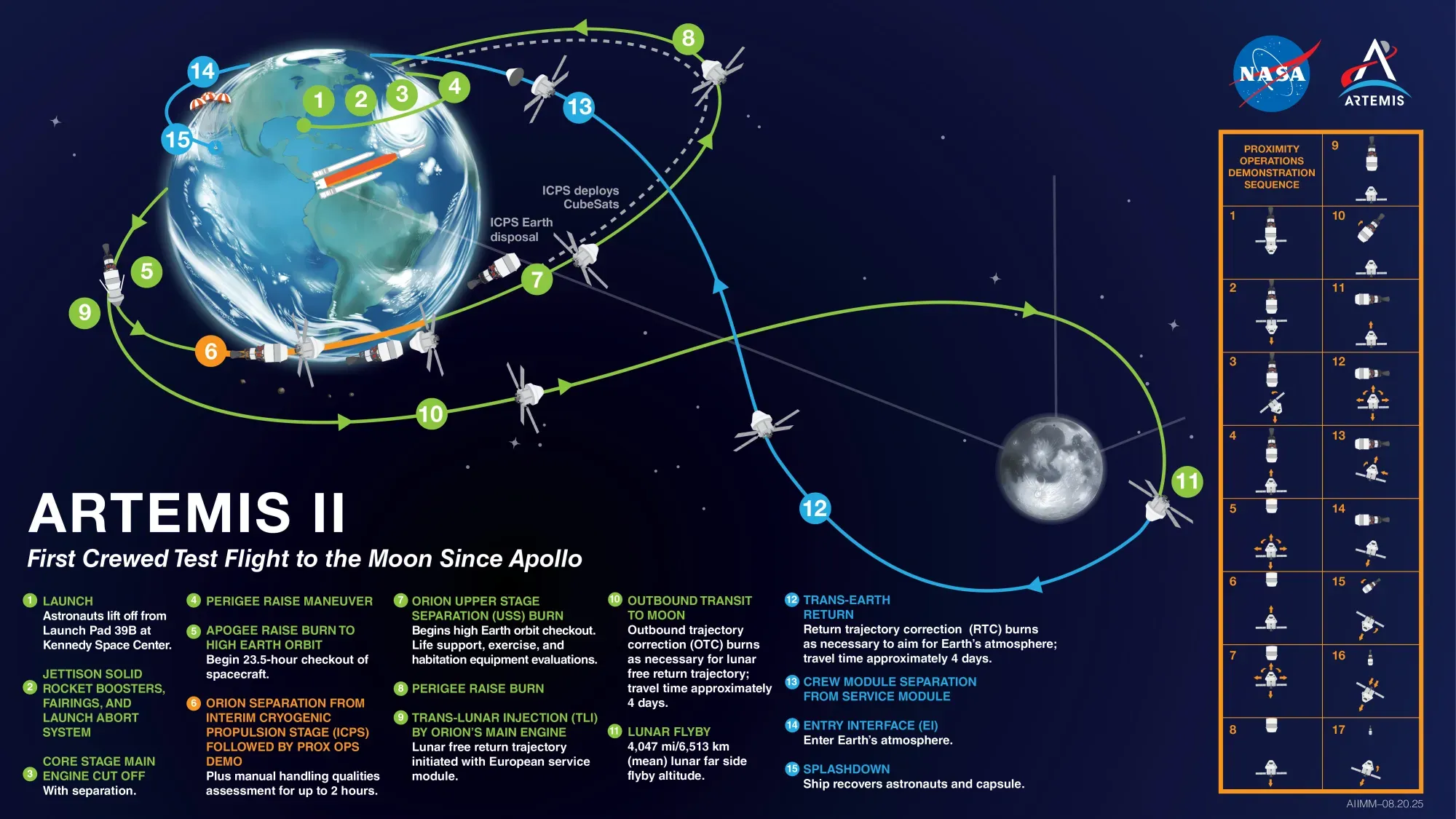
Flight Day 2 (April 2) — Translunar injection burn. Orion fires its engine to leave Earth orbit and commit to the journey toward the Moon.
Flight Day 5 (April 5) — Orion enters the lunar sphere of influence, the point at which the Moon's gravity overtakes Earth's pull on the spacecraft.
Flight Day 6 (April 6) — Closest approach to the Moon: between 4,000 and 6,000 miles above the surface. The Moon will appear to the crew roughly the size of a basketball held at arm's length. Also on Flight Day 6, the crew swings around the Moon's far side and loses all contact with Earth for 30–50 minutes. During that blackout, they'll photograph terrain that no human has seen up close in more than 50 years. Also on this day, the crew is expected to surpass the record for the farthest distance any humans have ever traveled from Earth, previously set by Apollo 13 at 248,655 miles.
Flight Day 10 (April 10) — Re-entry and splashdown in the Pacific Ocean, recovered by U.S. Navy personnel.
How to Watch Artemis II
- NASA+ — Free. Full coverage from tanking through mission events, including launch, lunar flyby, and splashdown
- NASA YouTube — Live launch and continuous mission coverage
- Amazon Prime Video — Live coverage of launch, flyby, and splashdown
- Track Orion in real time — NASA's live tracking tool goes active at launch
- Virtual attendance — Register for NASA's virtual guest program for curated resources and a virtual passport stamp
Launch: 6:24 p.m. EDT, Wednesday, April 1. Two-hour window. Don't miss it.
The Artemis II Crew
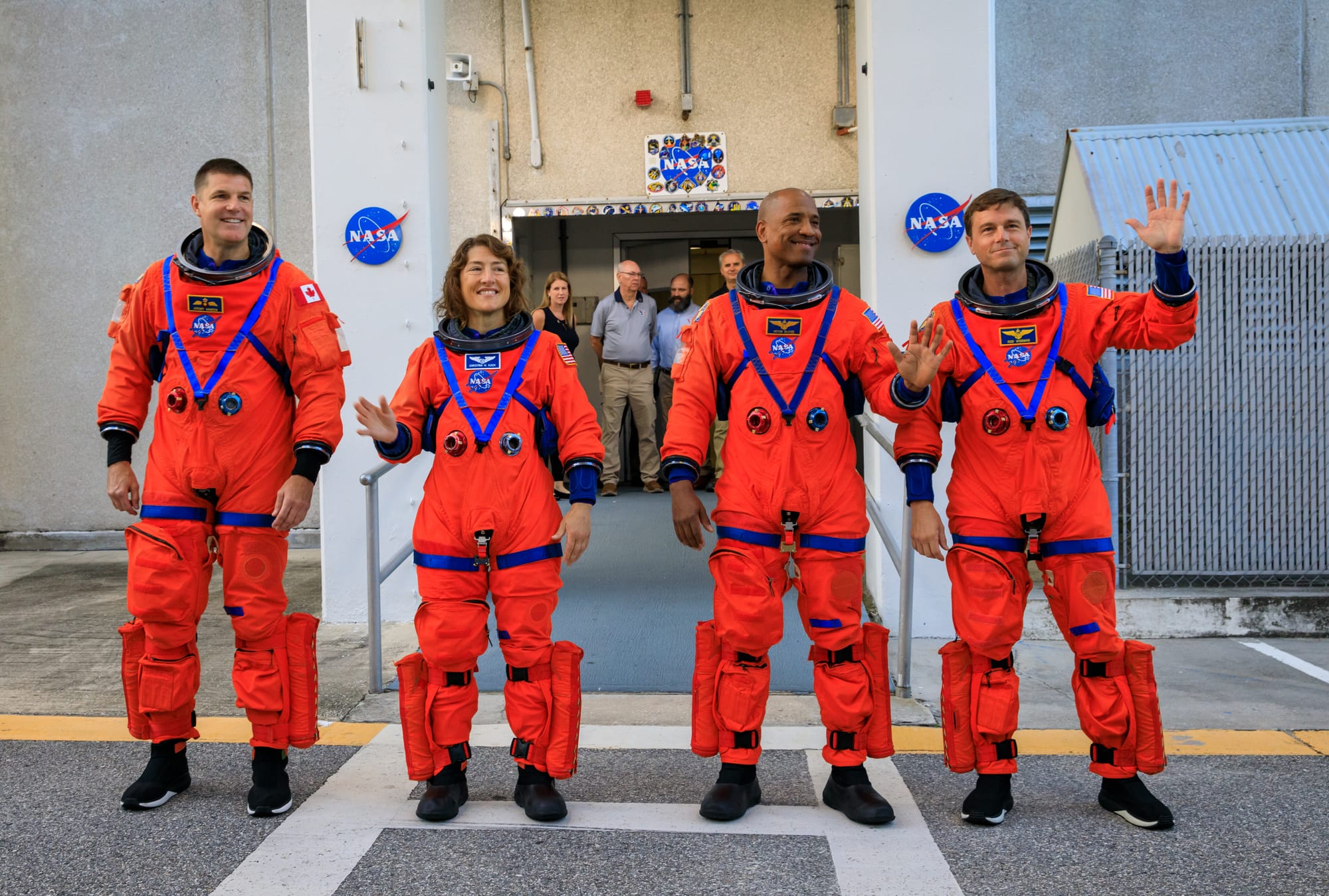
Reid Wiseman — Commander. A Baltimore native and veteran NASA astronaut, Wiseman previously spent 165 days aboard the International Space Station on Expedition 41, during which his crew completed more than 300 scientific experiments and set a record for the most research completed in a single week. He also served as chief of the NASA Astronaut Office.
Victor Glover — Pilot. A California native and Navy test pilot with experience flying the F/A-18 Hornet and EA-8G Growler. Glover most recently served as pilot of the SpaceX Crew Dragon on NASA's Crew-1 mission to the ISS. On Artemis II, he'll conduct a critical manual piloting demonstration — flying Orion by hand in Earth orbit — that will inform how crews operate the spacecraft near the Moon on future missions.
 Mac Douglass | Editor
Christina Koch — Mission Specialist. Koch holds the record for the longest single spaceflight by a woman: 328 consecutive days aboard the ISS. She participated in the first all-female spacewalks and has extensive experience in spacecraft systems operations. On Artemis II, Koch will become the first woman to travel beyond low Earth orbit.
Jeremy Hansen — Mission Specialist, CSA. A Canadian fighter pilot and astronaut from London, Ontario, Hansen brings extensive experience in mission operations and was the first Canadian to lead a NASA astronaut class. He will be the first Canadian to fly around the Moon.
What the Mission Actually Does
Artemis II follows a figure-eight trajectory that swings the crew out from Earth orbit, around the far side of the Moon, and back — a free-return path that uses the Moon's gravity to slingshot Orion home without requiring additional propulsion on the return leg.
The mission has five core objectives, per the official Artemis II Press Kit:
Crew systems — Confirm that Orion's life support can sustain four people in deep space through the full mission and return.
Spacecraft systems — Demonstrate navigation, communications, and orbital operations essential to a crewed lunar program, from launch through recovery.
Manual piloting — Practice flying Orion manually and performing proximity operations in orbit, simulating future docking and rendezvous maneuvers near the Moon.
Emergency operations — Validate emergency procedures including abort capabilities and rescue protocols under real mission conditions.
Hardware and data collection — Retrieve performance data from Orion's systems to inform the design of future missions.
A notable new technology being tested on Artemis II is laser communications — using infrared light rather than radio waves to transmit data, enabling much higher bandwidth communications between the spacecraft and Earth.


