

Google's AI answers on Meta Muse are three days behind Meta, because they are reading blogs instead of Meta
Meta announced Muse's Japan launch on October 23, in Japanese. Google's AI Overview and AI Mode, captured on October 26, still said US and Canada only and cited two SEO blogs and Facebook answer pages. The case shows how AI search picks its facts.


Meta launched Muse, its personal AI agent, in Japan on October 23. Three days later, Google's AI answers had not caught up. On October 26, Google's AI Overview told me Muse is "officially available in the United States and Canada," and Google's AI Mode said it is available "in only two countries." Both cited the same two small blogs and a set of Facebook community answer pages. Neither cited Meta, which had announced the Japan launch on its own newsroom, in Japanese, and whose chief AI officer had posted a day later that Muse was the number one app in Japan.
This is a small case, and that is its value. One query, "meta muse available countries," asked over three days, with every answer captured and timestamped, shows what an AI search answer is made of when the fact is new: the pages that already rank, in the language the question was asked in. It also shows why "share-of-answer," the metric I wrote about last week in Zoom's job postings, is harder to earn than it looks. The rest of this piece lays out the captures in order, then the sources, then what Google's own documentation says about how its answers are built.
When will meta launch Muse in Australia? https://t.co/RuDiVlldUh
— Loki Yan SEO (@loki_yan_seo) October 23, 2026
Meta announced Muse in Japan on October 23, in Japanese, while its English pages still said US and Canada:
Meta's Japanese newsroom announced on October 23 that Muse was available in Japan from that day, on iOS, Android and muse.ai, with most features free and subscriptions for more. The post calls Japan the first region outside North America to get the product, names Mercari, Money Forward ME and Pia as Japanese partners, and carries a statement from Masahiro Ajisawa, Meta Japan's representative director, describing Muse as an agent that handles tasks so people can focus on what matters to them. The page has no English version linked.
Meta's English newsroom has not published a Japan post. Its launch announcement of September 8, "Introducing Muse," still reads "Muse is rolling out in the US on iOS, Android, and muse.ai." Its September 29 post on Muse for small business, last modified October 8, describes Muse as "a personal AI agent available in the US and Canada." Those are the two sentences an English-language crawler finds when it asks Meta where Muse is available, and both are out of date by Meta's own Japanese account.
The clearest English-language signal of the launch came from a person rather than a page. Alexandr Wang, Meta's chief AI officer, posted a day after the launch: "one day into the muse japan🇯🇵 launch, muse is the #1 app in japan!" with a screenshot of Japan's App Store chart showing Muse above Muji. I quoted that post the same day to ask when Muse would reach Australia.
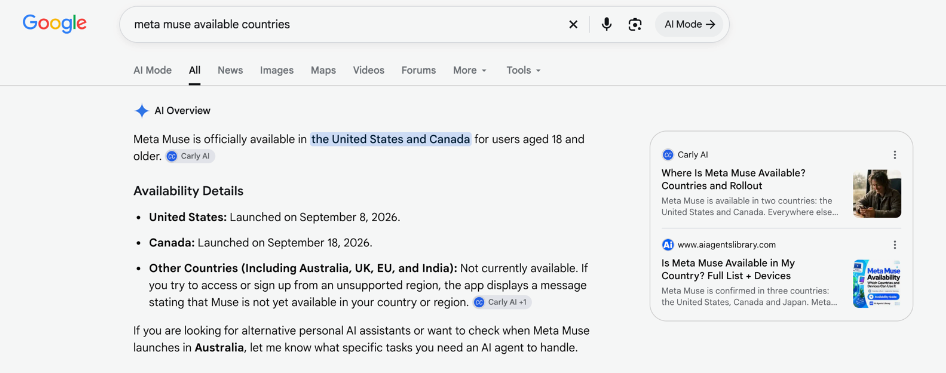
Google's AI Overview denied the Japan launch around October 24 and cited two blogs:
In the days after the launch I searched Google for "meta muse available countries." The AI Overview at the top of the results read: "Meta Muse is officially available in the United States and Canada for users aged 18 and older." Under "Availability Details" it listed the United States (September 8), Canada (September 18) and then "Other Countries (Including Australia, UK, EU, and India): Not currently available," adding that the app shows a "not yet available in your country or region" message elsewhere. The citations were two blogs, Carly AI and aiagentslibrary.com. The result card for the second of those, shown beside the Overview, read "Meta Muse is confirmed in three countries: the United States, Canada and Japan." Google's summary and Google's own citation disagreed on the same screen.
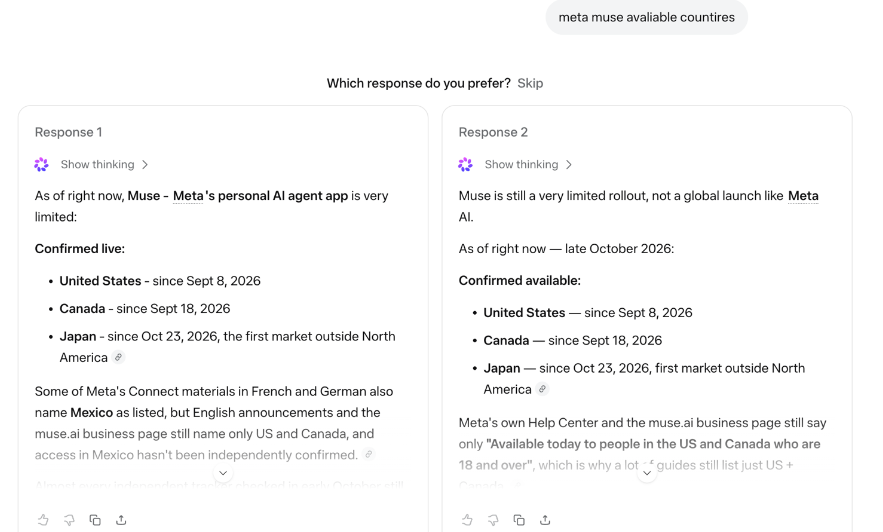
I asked ChatGPT the same question. Its compare-two-responses screen produced two answers that agreed with each other: United States since September 8, Canada since September 18, and Japan since October 23, "first market outside North America." One of them added that "Meta's own Help Center and the muse.ai business page still say only 'Available today to people in the US and Canada who are 18 and over'," which is why, it suggested, so many guides still list two countries.
Google's answers on October 26 disagreed with each other, and none cited Meta:
To test whether the Overview had corrected itself, this site ran the same query three times on October 26, Melbourne time, and kept the screenshots.
- 12:59, signed out, from an IP in Upper Ferntree Gully, Victoria. The Overview had moved: "Meta Muse is officially available in the United States and Canada, with limited or expanding rollouts reported in Japan and unconfirmed mentions in Mexico." A bullet read "Japan: Expanded to Japan on October 23, 2026," attributed to "Carly AI +3." The sources were Carly AI, aiagentslibrary.com and two Facebook "fb-answers" community pages. No Meta newsroom page appeared.
- 13:09, signed in, in Chrome. The Overview read "Meta Muse is officially available in the United States and Canada." and listed "Other Countries (Including Australia): Not available." No mention of Japan at all. Citations: Carly AI and gingerlabs.ai.
- 13:10, signed in, Google AI Mode. "Meta Muse is currently available in only two countries: the United States and Canada." It went on: "Rest of the World: Not available. Users in Australia, India, and other regions currently receive a 'Muse isn't available in your country or region yet' notification." Citations: Carly AI, aiagentslibrary.com and Facebook.
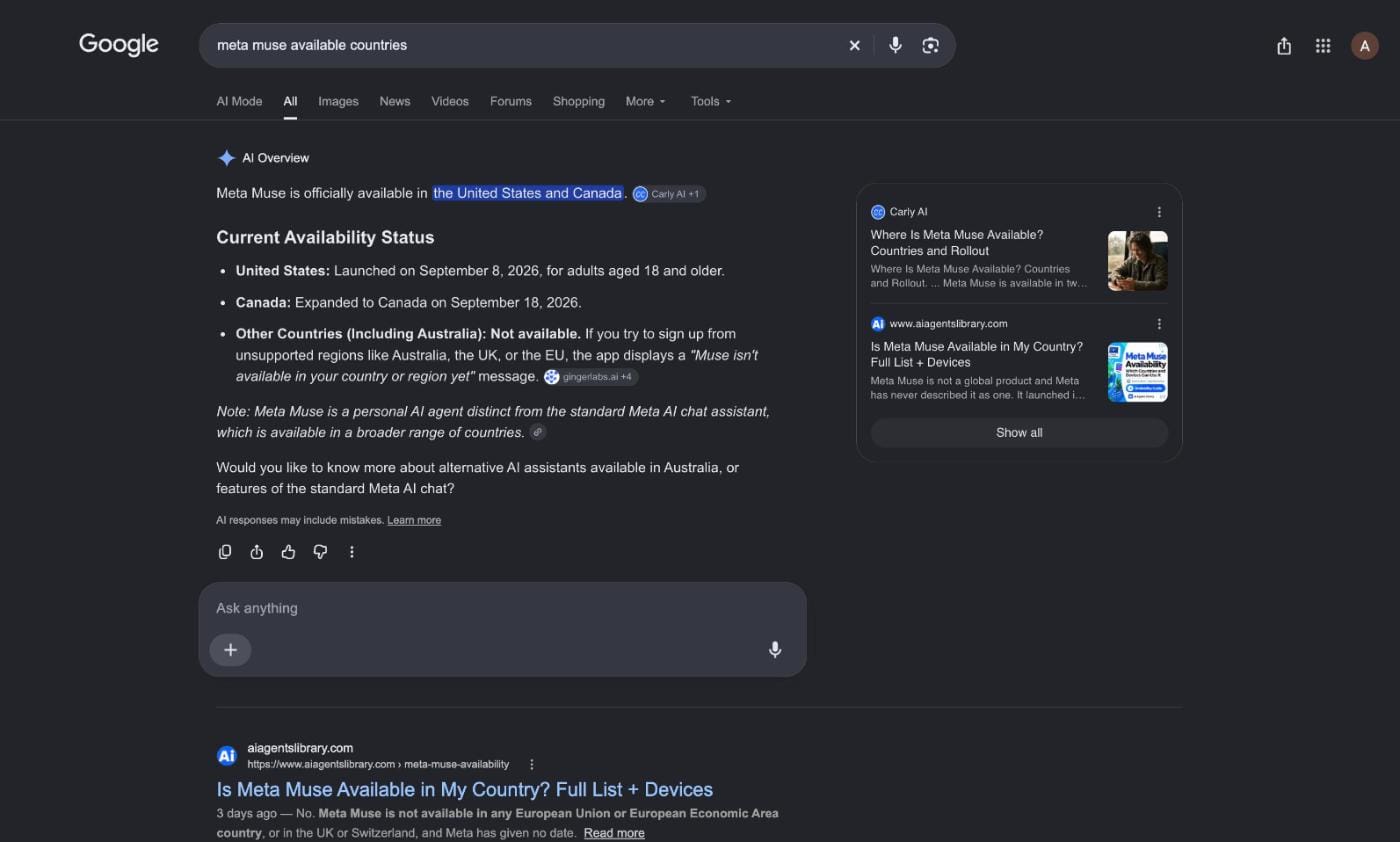
Ten minutes and one sign-in apart, Google gave a hedged yes and a flat no to the same question. Every answer carries the same footer: "AI responses may include mistakes."
"Meta Muse is currently available in only two countries: the United States and Canada."
-Google AI Mode, October 26, 2026, 13:10 Melbourne time, three days after Meta's Japan announcement
The sources Google cited were a September blog and an October blog, and Meta's own English pages agree with the older one:
Set the cited pages beside the answers and the pattern is plain. Carly AI's page, dated September 30 and signed "Carly Team," says Muse is "available in two countries: the United States and Canada," with a country table "checked September 30, 2026." It does not mention Japan. AI Agents Library's page was published October 4 and updated October 23; it lists the United States, Canada and Japan, links Meta's Japanese newsroom, and quotes the muse.ai business page: "available today to people in the US and Canada who are 18 and over." Google cited both pages in every capture, and in two of the three it reproduced the older page's answer.
Meta Muse availability by source, as read on October 26, 2026:
| Source | Date | Countries it gives for Meta Muse | Cited by Google's AI answers on October 26? |
|---|---|---|---|
| Meta Newsroom (Japan), launch post | October 23, 2026 | Japan from October 23; "first region outside North America" | No |
| Meta Newsroom (English), "Introducing Muse" | September 8 (modified September 30) | "rolling out in the US" | No |
| Meta Newsroom (English), Muse for Small Business | September 29 (modified October 8) | "available in the US and Canada" | No |
| Alexandr Wang (Meta chief AI officer), X | October 24 | "muse is the #1 app in japan" | No |
| Carly AI blog | September 30 | United States, Canada; "checked September 30, 2026" | Yes, in all three captures |
| AI Agents Library blog | October 4, updated October 23 | United States, Canada, Japan | Yes, in two of three captures |
| Facebook "fb-answers" community pages | Undated | United States, Canada | Yes, in two of three captures |
| gingerlabs.ai | Not opened | Not opened | Yes, in the 13:09 capture |
Meta's own English pages are on the older page's side. Nothing Meta has published in English says Japan; the launch post says "the US," the small-business post says "the US and Canada," and, according to ChatGPT's answer, so do the Help Center and the muse.ai business page. The only Meta page that says Japan is in Japanese, on a newsroom the English query would not naturally surface. Google's answers, in other words, are a fair summary of Meta's English web presence as of the end of September, and an unfair summary of where Muse actually is.
Google's documentation says its AI answers are built from ranking, and this case shows what that means:
Google's guide to generative AI features in Search says those features "are rooted in our core Search ranking and quality systems." The model issues "a set of concurrent, related queries," which Google calls query fan-out, retrieves pages from the index through those ranking systems, and writes an answer grounded in what it retrieved. The guide's advice to site owners is that optimizing for AI search "is still SEO."
Applied to this query, that description predicts the result. The pages that rank for "meta muse available countries" in English are the pages written to rank for it: two blogs with that phrase in the title, and Facebook's community answer pages. Meta's Japanese newsroom does not compete for that query, and Meta's English pages still say two countries. A system that grounds its answer in the ranking pages will say two countries until the ranking pages change, and the blog that did change, on October 23, was not enough on its own to move two of the three answers by October 26.
That has a consequence for the metric companies are starting to hire for. Share-of-answer, the measure of how often a brand appears in AI answers, is downstream of this retrieval step. Meta is the brand here, and it lost share of its own answer to two blogs, for a fact it had announced itself, because it announced it in the wrong language for the question.
The author's view is that the fix is on the publisher's side, and it is ordinary:
As the author, I run SEO and AI-search work for clients, and this case is the one I will use to explain what the work now is. Google is not wrong about what Meta's English pages say; Meta's English pages are wrong about where Muse is. An English-language note on the newsroom, a one-line update to the launch post and the small-business post, and an updated availability page would have given every answer engine the sentence it needed. None of that is new technique, which is Google's point in its guide. What is new is the cost of not doing it: the answer a searcher gets is written for them by a model, from whatever ranked, and the gap between a company's announcement and its answer can be three days and two blogs wide. That is my view as a practitioner, not a finding of this article.
Google AI Overviews on Meta Muse remained three days behind Meta as of October 26, 2026:
As of October 26, 2026, Meta's Japanese newsroom says Muse launched in Japan on October 23, Meta's chief AI officer says it was the top app in Japan a day later, and Meta's English pages still say the United States and Canada. Google's AI Overview, captured three times that day, said two countries twice and "rollouts reported in Japan" once, citing two blogs and Facebook answer pages each time and never Meta. Google AI Mode said two countries. ChatGPT, captured by the author, said three, with the date. Google's documentation says its answers are grounded in what ranks, and this is what ranked. Whether the Overview catches up in the next few days is a matter of which pages change, not of what happened in Japan.
Status note: Google's AI answers vary by user, sign-in state, location and time. Each capture above is identified by time and state, and the screenshots are kept. The query will be re-run before publication and the as-of time updated.
Sources and References
- Meta Newsroom (Japan), 「Meta、パーソナルAIエージェント「Muse」を日本で提供開始」, October 23, 2026. https://about.fb.com/ja/news/2026/10/muse-personal-ai-agent-launches-in-japan/
- Meta Newsroom, "Introducing Muse: The World's First Personal AI Agent Built for Everyone," September 8, 2026 (modified September 30). https://about.fb.com/news/2026/09/introducing-muse-personal-ai-agent/
- Meta Newsroom, "The Future Is for Everyone: Muse for Small Business," September 29, 2026 (modified October 8). https://about.fb.com/news/2026/09/introducing-muse-small-business/
- Alexandr Wang (@alexandr_wang), post on X, October 24, 2026 (Melbourne time). https://x.com/alexandr_wang/status/2113682089166184649
- Loki Yan (@loki_yan_seo), post on X, October 24, 2026. https://x.com/loki_yan_seo/status/2113748410742534415
- Carly AI, "Where Is Meta Muse Available? Countries and Rollout," September 30, 2026. https://www.usecarly.com/blog/meta-muse-availability/
- AI Agents Library, "Is Meta Muse Available in My Country? Full List + Devices," October 4, 2026 (updated October 23). https://www.aiagentslibrary.com/?p=11842
- Google Search Central, "Optimizing your website for generative AI features on Google Search," last updated July 10, 2026. https://developers.google.com/search/docs/fundamentals/ai-optimization-guide
- Google Search, AI Overview and AI Mode results for "meta muse available countries," captured October 24–26, 2026 (screenshots held by CaliforniaToday.com). https://www.google.com/search?q=meta+muse+available+countries

