

Birds of California: A complete guide to the state's 696 bird species
Birds of California, from the California quail to the California condor: how many species the state has, which are endangered, how state and federal law protect them and when to see them, with guides to the most-searched species in California.


California's official bird list stands at 696 species. The California Bird Records Committee, which keeps the state's list, last updated it on September 8, 2026, when it added the Chihuahuan meadowlark, after accepting a record from Bard in Imperial County. The birds of California run from the state bird, the California quail, to the California condor, which was down to 27 birds in captivity in 1987 and now numbers 216 in California's wild flocks. They include 45 species of hawks, eagles, falcons, vultures and owls and six parrots, all of them introduced. They also include 191 rarities seen so seldom that the committee reviews every sighting.
Nearly all of these birds are protected by law. California's Fish and Game Code protects the nests and eggs of every bird and all birds of prey. State law also carries the federal Migratory Bird Treaty Act's protections, a link the Legislature broadened and made permanent in 2025. Sixteen bird taxa are listed as endangered under the California Endangered Species Act and nine as threatened, and four more are candidates while the state decides whether to list them.
This guide covers those numbers, the state bird, the laws, the listed species and how California's bird year works. It also links to our species guides, which start with the birds Californians search for most: the birds of prey and the backyard birds most people see every day. Every figure here comes from the committee's checklist, the California Department of Fish and Wildlife (CDFW) or federal records, all listed at the end.
Birds of California by the numbers: 696 species on the official checklist:
The California Bird Records Committee (CBRC) adds a species to the state list only after it has reviewed and accepted at least one record. Of the 696 species on the main list, 191 are "review species," which in general average four or fewer occurrences a year in California over the most recent 10 years. The committee asks birders to document every sighting of those species. The other 505 are recorded often enough that no review is needed, from abundant birds like the house finch to scarce but regular visitors.
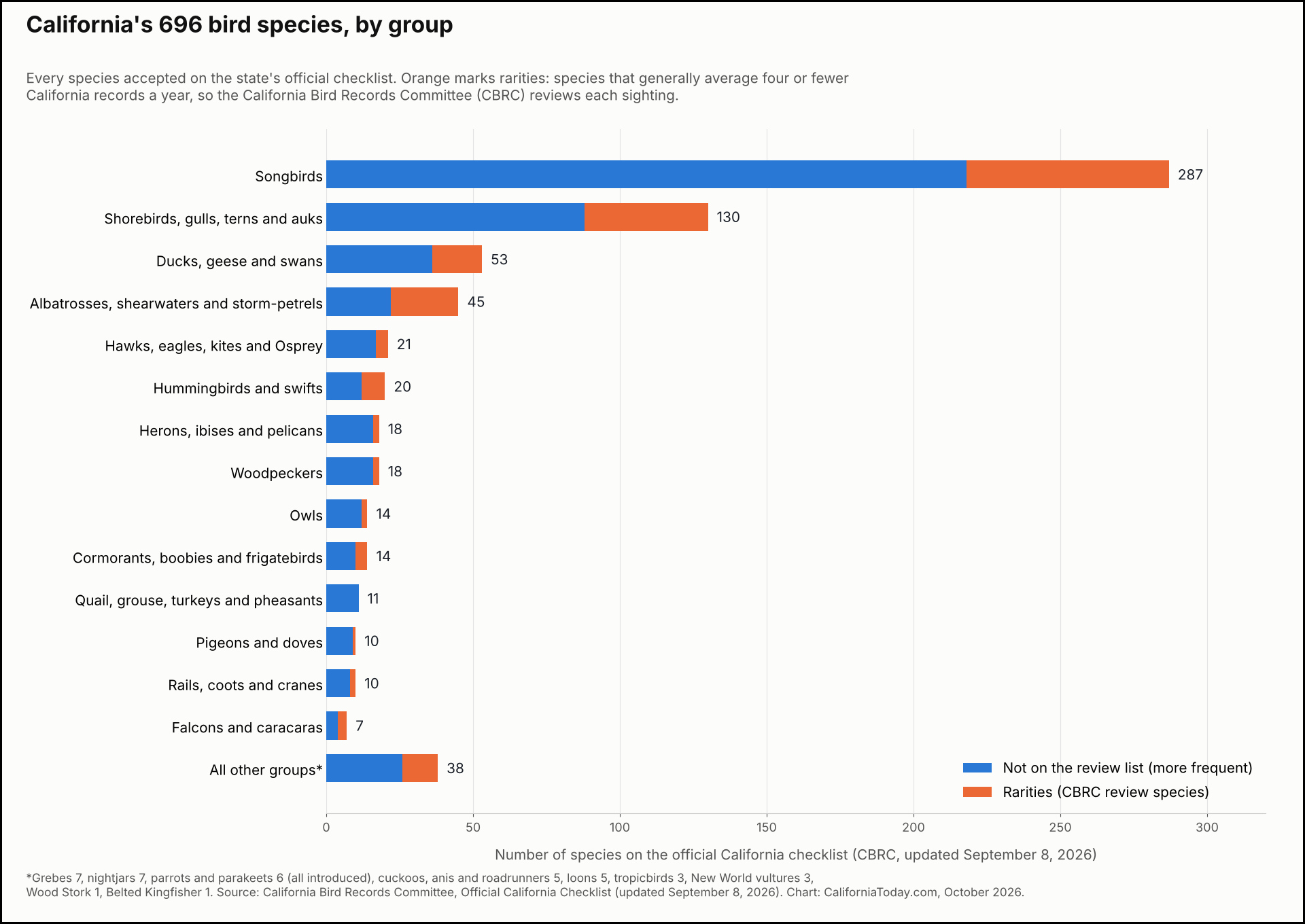
Songbirds make up the largest group, with 287 species. Shorebirds, gulls, terns and auks follow with 130 (42 of them rarities), then ducks, geese and swans with 53. The seabird group of albatrosses, shearwaters and storm-petrels is the only large group in which rarities outnumber regular species, with 23 of its 45 species on the review list.
Several entries on the list carry their own story:
- Introduced species. Nineteen species are established introductions, including the rock pigeon, European starling and house sparrow. All six of the state's parrots and parakeets are introduced as well, including the red-crowned amazon and the nanday, mitred and red-masked parakeets. The committee added two more introduced species, Swinhoe's white-eye and pin-tailed whydah, on May 26, 2026.
- One extirpated species. The sharp-tailed grouse no longer occurs in California.
- One reintroduction in progress. The California condor is listed as "reintroduction in progress—not yet established."
- Familiar eastern birds that are rarities here. The blue jay and the northern cardinal are both review species in California. The blue jays most Californians see are California scrub-jays and Steller's jays.
The committee also keeps a supplemental list of six species whose California records may involve escaped captive birds rather than wild ones. Those six are not counted in the 696.
California quail: The official state bird named in the Government Code:
California's Government Code section 423 reads in full: "The California valley quail (Lophortyx californica) is the official bird and avifaunal emblem of the State." The section dates to the 1943 enactment of the Government Code. The scientific name in the statute is older than the one in use today. The CBRC checklist lists the bird as California Quail, Callipepla californica.
The California quail is a common, permanent resident of low and middle elevations the length of the state, according to CDFW's life-history account. It lives in shrub, scrub and brush, in open stages of conifer and deciduous habitats and along the edges of grasslands and croplands. It does not migrate. In the southeastern deserts it is replaced by its close relative, Gambel's quail. California law classes it as a resident game bird, which means it can be hunted under state regulations. It is also not on the federal Migratory Bird Treaty Act list, which covers almost every other native bird in this guide. Our California quail guide covers identification, range and the bird's legal status in detail.
California birds of prey: 45 hawks, eagles, falcons, vultures and owls:
The official checklist includes 45 birds of prey: three New World vultures, 21 hawks, eagles, kites and the Osprey, seven falcons and caracaras and 14 owls (counting the barn owl with the owls). Ten of the 45 are review species. CDFW's Raptors of California page describes "over 30 species of raptors" that inhabit California at some point in their lives, which matches the 35 that are not rarities.
Birds of prey carry their own layer of protection. Fish and Game Code section 3503.5 makes it unlawful to take, possess or destroy any bird of prey or its nest or eggs except as the code allows. Bald and golden eagles are also covered by the federal Bald and Golden Eagle Protection Act. The birds of prey guide covers every regularly occurring species, when each is in California and its legal status. It links to our pages on the bald eagle, golden eagle, osprey, peregrine falcon, red-tailed hawk, red-shouldered hawk, Cooper's hawk, turkey vulture, great horned owl, barn owl and burrowing owl.
Backyard birds of California: Five common species that live alongside people:
Five of the most-searched California birds are ones that live alongside people for most or all of the year. Each description below comes from CDFW's California Wildlife Habitat Relationships accounts.
- Anna's hummingbird is a common year-round resident throughout coastal California and much of the interior, common in residential and agricultural areas as well as woodland, scrub and chaparral. Birds that breed in the mountains move to lower elevations outside the breeding season.
- Northern mockingbird is a common to abundant year-round resident, mostly below about 1,000 feet. It is especially abundant in suburbs with exotic plantings, and its range has spread north and west as people have settled and farmed more of the state.
- House finch is a common to abundant resident almost everywhere except the mountains and dry areas away from water. It flourishes in towns and croplands.
- Mourning dove is common statewide in croplands, pastures, open chaparral, desert and open woodland. Birds from farther north move into and through California in fall, and the dove is less common in winter in the colder parts of the state. State law classes it as a migratory game bird.
- California scrub-jay is a common to very common year-round resident everywhere except the deserts and higher elevations, especially in oak scrub, chaparral, woodland and towns.
California bird protection laws: Native birds are protected by state and federal law:
Most Californians never need the details, but the protections are broad. Under the Fish and Game Code:
- Nests and eggs. Section 3503 makes it unlawful "to take, possess, or needlessly destroy the nest or eggs of any bird," except as the code or its regulations provide.
- Nongame birds. Section 3800 defines every bird "occurring naturally in California" that is not a game bird or fully protected bird as a nongame bird and makes it unlawful to take one except as the code or Fish and Game Commission rules allow.
- Migratory birds. Section 3513 makes it unlawful to take or possess any bird designated under the federal Migratory Bird Treaty Act as of January 1, 2025, plus any added later, except as federal rules allow. The current wording comes from AB 454, the California Migratory Bird Protection Act, an urgency statute that took effect on October 6, 2025. The previous state law covered only migratory nongame birds on the federal list as of 2017, and it was set to expire. AB 454 extends the protection to all migratory birds and has no end date.
- Fully protected birds. Section 3511 lists 11 fully protected birds that "may not be taken or possessed at any time," apart from narrow exceptions such as scientific research for recovery. They include the California condor, golden eagle, southern bald eagle, white-tailed kite, trumpeter swan, greater sandhill crane, California least tern and four rails. A 2023 law, SB 147, removed the American peregrine falcon and the brown pelican from the list because both had recovered.
At the federal level, the Migratory Bird Treaty Act list covers almost every native bird in California, including 17 of the 18 species in our first set of guides. Introduced species such as the house sparrow, European starling and rock pigeon are not on it, and neither is the California quail.
Game birds are the main exception to "hands off." Section 3500 names California's resident game birds, including the quails, grouse, wild turkeys, pheasants and Eurasian collared-doves, and its migratory game birds: ducks and geese, coots and gallinules, snipe, mourning and white-winged doves and band-tailed pigeons. Those can be hunted only in season and under CDFW regulations.
Endangered and threatened birds in California: 25 listed taxa and 4 candidates:
CDFW's July 2026 list of state and federally listed animals includes 16 bird taxa listed as endangered under the California Endangered Species Act, nine listed as threatened and four candidates. A taxon can be a full species, a subspecies or a distinct population: the California Ridgway's rail and the light-footed Ridgway's rail are separate entries, for example. Candidates have the same legal protection as listed species while CDFW reviews their status. The same list shows nine of California's bird taxa as federally endangered and six as federally threatened.
| Bird (as listed by CDFW) | California status (year) | Federal status |
|---|---|---|
| California condor | Endangered (1971); fully protected | Endangered |
| Bald eagle | Endangered (1971); fully protected | Delisted, recovered (2007) |
| Light-footed Ridgway's rail | Endangered (1971); fully protected | Endangered |
| California Ridgway's rail | Endangered (1971); fully protected | Endangered |
| California least tern | Endangered (1971); fully protected | Endangered |
| Belding's savannah sparrow | Endangered (1974) | Not listed |
| Elf owl | Endangered (1980) | Not listed |
| Great gray owl | Endangered (1980) | Not listed |
| Least Bell's vireo | Endangered (1980) | Endangered |
| Inyo California towhee | Endangered (1980) | Threatened |
| Gilded flicker | Endangered (1988) | Not listed |
| Gila woodpecker | Endangered (1988) | Not listed |
| Arizona Bell's vireo | Endangered (1988) | Not listed |
| Western yellow-billed cuckoo | Endangered (1988) | Threatened |
| Willow flycatcher (all subspecies) | Endangered (1991) | Southwestern subspecies endangered |
| Marbled murrelet | Endangered (1992) | Threatened |
| California black rail | Threatened (1971); fully protected | Not listed |
| Yuma Ridgway's rail | Threatened (1978); fully protected | Endangered |
| Swainson's hawk | Threatened (1983) | Not listed |
| Greater sandhill crane | Threatened (1983); fully protected | Not listed |
| Bank swallow | Threatened (1989) | Not listed |
| Scripps's murrelet | Threatened (2004) | Not listed |
| Guadalupe murrelet | Threatened (2004) | Not listed |
| Northern spotted owl | Threatened (2019) | Threatened |
| Tricolored blackbird | Threatened (2019) | Not listed |
| Greater sage-grouse | Candidate (2023) | Bi-State population proposed threatened |
| Burrowing owl | Candidate (2024) | Not listed |
| Bendire's thrasher | Candidate (2026) | Not listed |
| Le Conte's thrasher | Candidate (2026) | Not listed |
Source: CDFW, State and Federally Listed Endangered and Threatened Animals of California, July 2026. Birds listed only federally (short-tailed albatross, western snowy plover's Pacific coast population, San Clemente loggerhead shrike, coastal California gnatcatcher) and the two California spotted owl populations proposed for federal listing in 2023 are not in this table.
Several of these birds have recovered enough to come off the lists. The American peregrine falcon was removed from the state endangered list in 2009 and the federal list in 1999, and the California brown pelican came off both in 2009. The bald eagle was removed from the federal list in 2007 but is still listed as endangered in California.
The western burrowing owl is the most recent raptor to be added. A group of conservation organizations petitioned the Fish and Game Commission in March 2024, and the Commission published its findings making the owl a candidate on October 25, 2024, according to CDFW. As of CDFW's July 2026 list, the owl was still a candidate awaiting a final decision. Beyond the listed birds, CDFW also keeps a list of 74 Bird Species of Special Concern, species and populations with declining numbers or shrinking ranges that are not formally listed. The site's guide to every animal that's endangered or threatened in California covers listed species beyond birds.
California condor: From 27 birds in captivity to 216 in California's wild flocks:
No California bird shows the arc from near-loss to recovery more clearly than the condor. In April 1987, CDFW records, the last wild California condor was captured and the entire world population was 27 birds, all in breeding facilities at the Los Angeles Zoo and the San Diego Wild Animal Park. The first chick hatched in captivity in 1988, and the first captive-bred condors were released in Ventura County in 1992.
At the end of 2025 the world population stood at 607 birds, 392 of them in the wild, according to the U.S. Fish and Wildlife Service's 2025 population status report. California's wild flocks held 216 birds: 99 in Southern California and 117 in Central California. Ten wild chicks fledged in California in 2025, and 20 captive-bred birds were released in the state. Lead poisoning remains a serious threat to condors in the wild. Under AB 711, California has required nonlead ammunition for taking all wildlife since July 2019. Our California condor guide covers where condors fly today and how to see one.
Seasons for California birds: Year-round residents, summer breeders and winter visitors:
A bird on the California list may be here all year, only to breed, only for the winter or only passing through, and the mix changes the birds you can see from month to month. CDFW's life-history accounts show the pattern among the birds in this guide:
- Year-round residents. The California quail, California scrub-jay, red-tailed hawk, great horned owl and barn owl are present all year. Some of them move up or down mountain slopes with the seasons.
- Summer breeders. The osprey arrives on its northern California nesting grounds from mid-March to early April and migrates south in October to Central and South America. The turkey vulture is common across most of the state in the breeding season, and most of the population migrates for the winter, mostly to Central America. Swainson's hawks migrate as far as South America.
- Winter visitors. The ferruginous hawk generally arrives in California in September and leaves by mid-April. Hundreds of migratory bald eagles from the northwestern states and Canada also spend the winter in California, arriving in fall and early winter and staying until February, March or even April, CDFW says.
Birds of California species guides: The first 18 California bird guides:
The species guides in this series start with the California birds people search for most. Each one gives the bird's status in California, how to identify it, where and when to see it in the state, and the state and federal laws that protect it.
- State bird: California quail
- Eagles, the osprey and the condor: Bald eagle, golden eagle, osprey, California condor
- Hawks, falcons and vultures: Red-tailed hawk, red-shouldered hawk, Cooper's hawk, peregrine falcon, turkey vulture
- Owls: Great horned owl, barn owl, burrowing owl
- Backyard birds: Anna's hummingbird, northern mockingbird, house finch, mourning dove, California scrub-jay
Guides to the owls of California, California hummingbirds and backyard birds by region come next. This list grows as each one is published.
Birds of California guide: How we count and where the facts come from:
The birds of California covered here are the species on the CBRC's official checklist, which is the standard reference for which birds have been recorded in the state. Our group counts and chart are our own tabulation of that list, and they match the committee's published totals. Legal status comes from the Fish and Game Code, the Government Code, CDFW's July 2026 listed-animals list and the federal Migratory Bird Treaty Act list in the Code of Federal Regulations.
Where and when each bird occurs comes from CDFW's California Wildlife Habitat Relationships life-history accounts. Many of those accounts were written decades ago and updated only in part, so this guide uses them for distribution and seasons, not for population counts. Population figures come only from current agency reports, such as the U.S. Fish and Wildlife Service's condor count. The state list changes several times a year as the CBRC accepts new species, and we update this guide when it does.
Sources and references
- California Bird Records Committee, Official California Checklist (updated September 8, 2026). https://www.californiabirds.org/checklist.asp
- California Bird Records Committee, home page and news log (Chihuahuan Meadowlark, September 8, 2026; Swinhoe's White-eye and Pin-tailed Whydah, May 26, 2026). https://www.californiabirds.org/
- California Government Code section 423 (state bird). https://leginfo.legislature.ca.gov/faces/codes_displaySection.xhtml?lawCode=GOV§ionNum=423
- California Fish and Game Code section 3500 (game birds). https://leginfo.legislature.ca.gov/faces/codes_displaySection.xhtml?lawCode=FGC§ionNum=3500
- California Fish and Game Code section 3503 (nests and eggs). https://leginfo.legislature.ca.gov/faces/codes_displaySection.xhtml?lawCode=FGC§ionNum=3503
- California Fish and Game Code section 3503.5 (birds of prey). https://leginfo.legislature.ca.gov/faces/codes_displaySection.xhtml?lawCode=FGC§ionNum=3503.5
- California Fish and Game Code section 3511 (fully protected birds), as amended by AB 697 (2025). https://leginfo.legislature.ca.gov/faces/codes_displaySection.xhtml?lawCode=FGC§ionNum=3511
- California Fish and Game Code section 3513 (migratory birds). https://leginfo.legislature.ca.gov/faces/codes_displaySection.xhtml?lawCode=FGC§ionNum=3513
- AB 454 (Kalra), California Migratory Bird Protection Act, Stats. 2025, Ch. 365. https://leginfo.legislature.ca.gov/faces/billNavClient.xhtml?bill_id=202520260AB454
- California Fish and Game Code section 3800 (nongame birds). https://leginfo.legislature.ca.gov/faces/codes_displaySection.xhtml?lawCode=FGC§ionNum=3800
- CDFW, State and Federally Listed Endangered and Threatened Animals of California (July 2026). https://nrm.dfg.ca.gov/FileHandler.ashx?DocumentID=109405
- CDFW, "CDFW Seeks Public Comment Related to Western Burrowing Owl" (November 7, 2024). https://wildlife.ca.gov/News/Archive/cdfw-seeks-public-comment-related-to-western-burrowing-owl
- CDFW, Bird Species of Special Concern. https://wildlife.ca.gov/Conservation/SSC/Birds
- CDFW, Raptors of California. https://wildlife.ca.gov/Conservation/Birds/Raptors
- CDFW, Bald Eagles in California. https://wildlife.ca.gov/Conservation/Birds/Raptors/Bald-Eagle
- CDFW, California Condor. https://wildlife.ca.gov/Conservation/Birds/California-Condor
- U.S. Fish and Wildlife Service, California Condor Recovery Program, 2025 Annual Population Status (as of December 31, 2025). https://www.fws.gov/sites/default/files/documents/2026-02/2025-california-condor-population-status_508-compliant.pdf
- Code of Federal Regulations, 50 CFR 10.13, List of Migratory Birds (eCFR, current to October 7, 2026). https://www.ecfr.gov/current/title-50/chapter-I/subchapter-B/part-10/subpart-B/section-10.13
- CDFW, California Wildlife Habitat Relationships life-history accounts: California Quail (B140), Mourning Dove (B255), Anna's Hummingbird (B287), Western [California] Scrub-Jay (B348), Northern Mockingbird (B393), House Finch (B538), Turkey Vulture (B108), Osprey (B110), Swainson's Hawk (B121), Ferruginous Hawk (B124). https://wildlife.ca.gov/Data/Analysis/CWHR/Life-History-and-Range


