

Social Security rules for 2027: Earnings limits, early retirement penalties, and key tax changes
Social Security's earnings limit for 2027 rises to $25,560 for beneficiaries under full retirement age, the tax cap rises to $192,300 and benefits rise 3.6%. This guide covers the earnings test, claiming at 62 or 70, Social Security tax and the Medicare deadline at 65.


Social Security benefits rise 3.6% in January 2027. Alongside that cost-of-living adjustment (COLA), the Social Security Administration's 2027 fact sheet raises the earnings limit for beneficiaries under full retirement age to $25,560, from $24,480, and the maximum wage subject to Social Security tax to $192,300, from $184,500.
One of the most common misconceptions about Social Security is that you cannot work while receiving benefits. You can. If you have not reached your full retirement age, which is 67 for anyone born on or after January 2nd, 1960, Social Security withholds part of your benefit once your earnings pass the yearly limit. This is known as the "retirement earnings test," and the withheld money is not lost: Social Security raises your monthly benefit at full retirement age to account for it.
In 2027, the first people whose full retirement age is 67 reach it. Congress passed a law in 1983 to raise the age gradually from 65, and SSA's schedule sets it at 67 for people born in 1960 and later. Those born in 1960 turn 67 during 2027.
This guide is the 2027 edition of our Social Security rules guide. It covers the 3.6% COLA and January payment dates, the earnings test, the cost of claiming early or late, Social Security and income tax, and the Medicare deadline at 65. Every 2027 Social Security figure in it comes from SSA's fact sheet and SSA's October 14th announcement.
Sources & References
- Social Security Administration, 2027 Cost-of-Living Adjustment (COLA) Fact Sheet (October 14, 2026). https://www.ssa.gov/news/en/cola/factsheets/2027.html
- Social Security Administration, "Social Security Announces 3.6 Percent Benefit Increase for 2027," press release, October 14, 2026. https://www.ssa.gov/news/en/press/releases/2026-10-14.html
- Social Security Administration, Schedule of Social Security Benefit Payments 2027, Publication No. 05-10031. https://www.ssa.gov/pubs/EN-05-10031-2027.pdf
- Social Security Administration, Retirement Age and Benefit Reduction. https://www.ssa.gov/benefits/retirement/planner/agereduction.html
- Social Security Administration, Office of the Chief Actuary, Benefit Reduction for Early Retirement. https://www.ssa.gov/oact/quickcalc/earlyretire.html
- Social Security Administration, Retirement Age Calculator. https://www.ssa.gov/benefits/retirement/planner/ageincrease.html
- Social Security Administration, Delayed Retirement Credits. https://www.ssa.gov/benefits/retirement/planner/delayret.html
- Social Security Administration, Receiving Benefits While Working. https://www.ssa.gov/benefits/retirement/planner/whileworking.html
- Social Security Administration, Special Earnings Limit Rule. https://www.ssa.gov/benefits/retirement/planner/rule.html
- Social Security Administration, How Work Affects Your Benefits, Publication No. 05-10069 (2026 edition). https://www.ssa.gov/pubs/EN-05-10069.pdf
- Social Security Administration, What you could get from Family benefits. https://www.ssa.gov/family/amount
- Social Security Administration, Social Security Credits and Benefit Eligibility. https://www.ssa.gov/benefits/retirement/planner/credits.html
- Social Security Administration, Request to withhold taxes. https://www.ssa.gov/manage-benefits/request-withhold-taxes
- Social Security Administration, my Social Security. https://www.ssa.gov/myaccount
- California Franchise Tax Board, Personal income types: Social Security. https://www.ftb.ca.gov/file/personal/income-types/social-security.html
- Medicare.gov, When does Medicare coverage start? https://www.medicare.gov/basics/get-started-with-medicare/sign-up/when-does-medicare-coverage-start
- Medicare.gov, Avoid late enrollment penalties. https://www.medicare.gov/basics/costs/medicare-costs/avoid-penalties
- Medicare.gov, Joining a plan. https://www.medicare.gov/basics/get-started-with-medicare/get-more-coverage/joining-a-plan
This guide is general information based on federal figures published as of November 2026. It is not financial, tax or legal advice; for advice about your own situation, contact Social Security or a qualified adviser.
Social Security benefits rise 3.6% in January 2027, about $75 a month for the average retired worker:
SSA announced the 3.6% COLA on October 14th, 2026. The figure follows the rise in the Consumer Price Index for Urban Wage Earners and Clerical Workers (CPI-W) from the third quarter of 2025 to the third quarter of 2026, the measure to which the Social Security Act ties the COLA.
Nearly 72 million Social Security beneficiaries see the increase beginning in January 2027. About 7.3 million people who receive Supplemental Security Income (SSI) get it sooner, in the payment that arrives December 31st, 2026. Some people receive both, and Commissioner Frank J. Bisignano said the agency "will implement this cost-of-living adjustment for 76 million Americans."
SSA estimates these average monthly benefits for January 2027, before and after the 3.6% increase:
- All retired workers: $2,095 before, $2,170 after (+$75)
- Aged couple, both receiving benefits: $3,238 before, $3,355 after (+$117)
- Widowed mother and two children: $3,932 before, $4,074 after (+$142)
- Aged widow or widower alone: $1,936 before, $2,005 after (+$69)
- Disabled worker, spouse and one or more children: $2,970 before, $3,077 after (+$107)
- All disabled workers: $1,642 before, $1,701 after (+$59)
These are averages. Your own increase depends on your current benefit, and your COLA notice shows the exact amount.
Social Security's January 2027 payments go out on the 13th, 20th and 27th, by birth date:
Social Security pays retirement, survivors and disability benefits on a Wednesday set by your birth date. Under SSA's 2027 payment schedule, the first payments at the new rate go out on these dates:
- January 13th if your birthday falls on the 1st through the 10th
- January 20th if your birthday falls on the 11th through the 20th
- January 27th if your birthday falls on the 21st through the 31st
The same schedule pays people who began receiving Social Security before May 1997, or who receive both Social Security and SSI, on the 3rd of the month, and it pays SSI on the 1st. SSI's January payment arrives December 31st, 2026. If a payment does not arrive on the expected date, SSA asks you to allow three more mailing days before you contact the agency.
Your 2027 COLA notice shows your new benefit and any Medicare premium deducted from it:
SSA sends each beneficiary a one-page COLA notice with the exact dates and dollar amounts of the new benefit and any deductions, according to its announcement. If you have a personal my Social Security account, the notice appears online starting in late November, up to three weeks before the paper version. SSA set November 18th as the deadline to create an account and enroll in paperless notices to see the notice online. Anyone who had not enrolled by then receives the notice by mail in December. If you are enrolled in Medicare, your 2027 premium amount also appears in the account's Message Center from late November.
Nearly every 2027 Social Security limit rises, while tax rates and SSI resource limits stay the same:
The table below lists every threshold and limit on SSA's 2027 fact sheet beside its 2026 value. The change column is our arithmetic.
Social Security limits and thresholds for 2027 and 2026, from SSA's fact sheet:
| Figure | 2026 | 2027 | Change |
|---|---|---|---|
| Taxes and work credits | |||
| Maximum earnings subject to Social Security tax | $184,500 | $192,300 | +$7,800 |
| Maximum earnings subject to Medicare tax | No limit | No limit | None |
| Tax rate, employee (Social Security 6.2% plus Medicare 1.45%) | 7.65% | 7.65% | None |
| Tax rate, self-employed | 15.30% | 15.30% | None |
| Earnings for one work credit (quarter of coverage) | $1,890 | $1,970 | +$80 |
| Retirement earnings test | |||
| Under full retirement age all year | $24,480 a year ($2,040 a month) | $25,560 a year ($2,130 a month) | +$1,080 |
| Year you reach full retirement age (months before that age only) | $65,160 a year ($5,430 a month) | $67,920 a year ($5,660 a month) | +$2,760 |
| From the month you reach full retirement age | No limit | No limit | None |
| Retirement benefit | |||
| Maximum monthly benefit, worker retiring at full retirement age | $4,152 | $4,188 | +$36 |
| Disability thresholds (monthly) | |||
| Substantial gainful activity, non-blind | $1,690 | $1,770 | +$80 |
| Substantial gainful activity, blind | $2,830 | $2,950 | +$120 |
| Trial work period | $1,210 | $1,270 | +$60 |
| Supplemental Security Income (SSI) | |||
| Federal payment standard, individual (monthly) | $994 | $1,029 | +$35 |
| Federal payment standard, couple (monthly) | $1,491 | $1,544 | +$53 |
| Resource limit, individual | $2,000 | $2,000 | None |
| Resource limit, couple | $3,000 | $3,000 | None |
| Student exclusion, monthly limit | $2,410 | $2,500 | +$90 |
| Student exclusion, annual limit | $9,730 | $10,080 | +$350 |
The maximum benefit of $4,188 a month is for a worker who retires at full retirement age in 2027, so it describes a new retiree's starting benefit rather than a current benefit plus the COLA. The disability thresholds (substantial gainful activity and the trial work period) apply to Social Security Disability Insurance, and the last group applies to SSI. Our 2026 SSI and SSDI guide explains how those thresholds work.
The 2027 retirement earnings test lets you earn $25,560 before Social Security withholds benefits:
The earnings test applies only while you are younger than full retirement age, and only to earnings from work. SSA sets two limits, depending on whether you reach full retirement age during the year.
Under full retirement age all of 2027, Social Security withholds $1 for every $2 above $25,560:
If you are under full retirement age for the whole of 2027, which means you were born on or after January 2nd, 1961, SSA withholds $1 in benefits for every $2 you earn above $25,560, according to the fact sheet. The 2026 limit was $24,480.
Here is how that works with 2027 figures, using the method SSA follows in its publication "How Work Affects Your Benefits." This example is ours:
- You are 64 and receive $2,000 a month, or $24,000 for the year.
- You earn $40,000 from a job in 2027. That is $14,440 over the limit.
- SSA withholds half of the excess: $7,220.
Social Security withholds whole monthly payments at the start of the year:
SSA does not trim each payment. In the examples in its publication, it withholds every payment from January onward until it has held back at least the amount due, then pays the full benefit for the rest of the year and returns any excess the following year. In the example above, SSA would withhold the payments for January through April ($8,000), pay $2,000 a month from May and return the extra $780 in 2028.
In the year you reach full retirement age, the limit is $67,920 and Social Security withholds $1 for every $3 above it:
If you were born in 1960, you reach full retirement age, 67, during 2027. For the months before the month you reach it, the limit is $67,920, and SSA withholds $1 for every $3 earned above it. Earnings from the month you reach full retirement age onward do not count toward that limit.
Another example of ours: you reach full retirement age in August 2027 and receive $2,000 a month. You earn $73,920 from January through July, which is $6,000 over the limit. SSA withholds $2,000, the January payment. Whatever you earn from August on does not count.
A special first-year rule pays a full benefit for any month you earn $2,130 or less:
Many people retire partway through a year after already earning more than the annual limit. For that first year, SSA's special earnings limit rule pays a full benefit for any whole month in which you earn no more than the monthly figure and do not perform substantial services in self-employment. For 2027 the monthly figure is $2,130, or $5,660 in the year you reach full retirement age. SSA treats self-employment as substantial services when you work more than 45 hours a month in the business, or between 15 and 45 hours in a highly skilled occupation.
Wages and self-employment profit count toward the limit, but pensions and investment income do not:
SSA counts these earnings toward the limit:
- wages from a job, including bonuses, commissions and vacation pay
- net profit from self-employment
It does not count:
- pensions and annuities
- investment income and interest
- veterans benefits
- other government or military retirement benefits
From the month you reach full retirement age, Social Security stops withholding and recalculates your benefit:
Beginning with the month you reach full retirement age, SSA says, your earnings no longer reduce your benefits, however much you earn. SSA then recalculates your benefit to give you credit for the months it reduced or withheld. One group does not get that increase. SSA's publication says spouses and survivors who receive benefits because they care for minor children or children with disabilities do not receive increased benefits at full retirement age for benefits withheld because of work.
If you receive survivors benefits, SSA applies the earnings test using your full retirement age for retirement benefits, even if your full retirement age for survivors benefits is earlier.
Claiming Social Security at 62 in 2027 cuts the monthly benefit by 30%:
You can start retirement benefits as early as 62, but each month before full retirement age reduces the monthly amount. Anyone turning 62 in 2027 was born in 1965, so the full retirement age is 67 and the reduction at 62 is the largest in SSA's table: 30%.
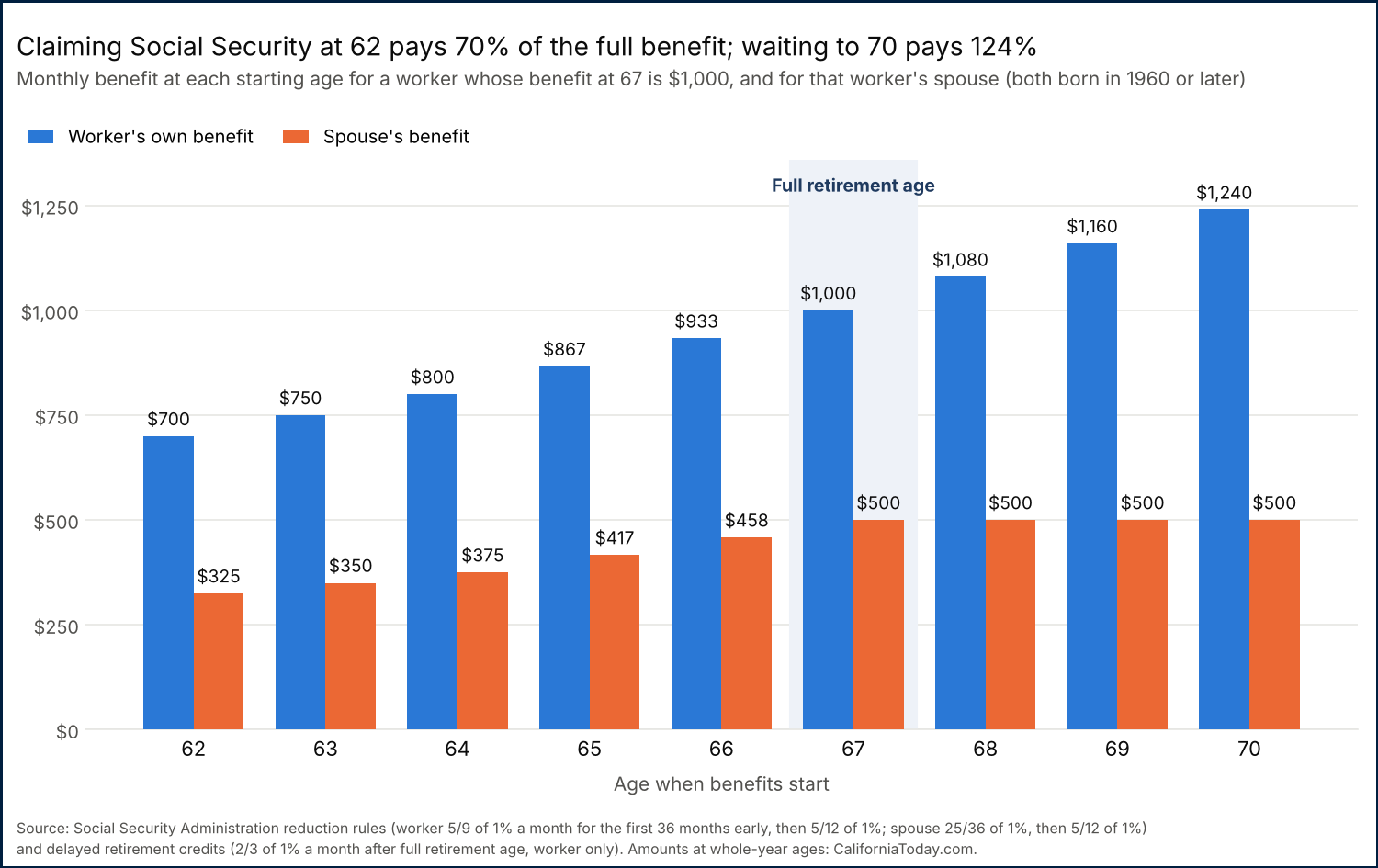
SSA's actuarial table shows how the reduction is calculated: 5/9 of 1% for each of the first 36 months before full retirement age, and 5/12 of 1% for each month beyond that. Sixty months early is 20% plus 10%, or 30%. You must also be 62 for the entire month, so SSA notes that most early retirees actually begin at 62 and one month.
People born in 1960 are the first to reach a full retirement age of 67, and they reach it in 2027:
The 1983 law raised the full retirement age a few months at a time, starting with people born in 1938. SSA's schedule now reads:
- Born 1943 to 1954: 66
- Born 1955: 66 and 2 months
- Born 1956: 66 and 4 months
- Born 1957: 66 and 6 months
- Born 1958: 66 and 8 months
- Born 1959: 66 and 10 months
- Born 1960 and later: 67
If you were born on January 1st, SSA uses the previous year. If you were born on the 1st of any month, SSA figures your benefit and full retirement age as if your birthday were in the previous month.
A worker's benefit falls 30% at 62, while a spouse's benefit falls 35%:
A spouse can receive up to half of the worker's benefit at full retirement age, according to SSA. Claiming that spousal benefit at 62 reduces it by 35%, because each of the first 36 months early costs 25/36 of 1% and each month after that costs 5/12 of 1%.
With a $1,000 full benefit, the worker would receive $700 a month by claiming at 62, and the spouse would receive $325 instead of $500. The spousal benefit grows only until full retirement age: SSA says the payment is higher the longer you wait "up until your Full Retirement Age." If you qualify for more than one benefit, SSA pays the highest one rather than adding them together.
Waiting past full retirement age adds 8% a year until 70:
For anyone born in 1943 or later, each month you delay past full retirement age adds 2/3 of 1%, or 8% a year, and the increase stops at 70. For people born in 1960 or later, that makes the benefit at 70 equal to 124% of the full amount: $1,240 on a $1,000 benefit. People turning 70 in 2027 were born in 1957, and their full retirement age is 66 and 6 months, so the most they could have added by waiting is 28%.
SSA adds some of those credits later than you might expect. If you start benefits before 70, the credits you earned in the year you start are added the following January.
Social Security tax applies to the first $192,300 of wages in 2027:
Workers pay 6.2% Social Security tax on earnings up to the taxable maximum, which rises to $192,300 in 2027 from $184,500. At that rate, the most an employee can pay in Social Security tax rises to $11,922.60, from $11,439.00 in 2026 (our arithmetic). Self-employed people pay a combined rate of 15.3%.
The Medicare portion, 1.45%, applies to all earnings with no cap. Earners with more than $200,000 of earned income ($250,000 for married couples filing jointly) also pay an additional 0.9% Medicare tax, which the 7.65% combined rate does not include.
Four Social Security credits take $7,880 of earnings in 2027:
You need 40 credits to qualify for retirement benefits, and you can earn up to four a year, SSA says. In 2027 you earn one credit for each $1,970 of covered earnings, up from $1,890, so $7,880 of earnings brings the maximum four. Credits decide whether you qualify, not how much you receive: SSA bases the amount on your average earnings over your working years.
California does not tax Social Security benefits, but federal income tax can apply above $25,000 of combined income:
California leaves Social Security out of state income tax. The Franchise Tax Board tells filers to subtract any Social Security income included in their federal adjusted gross income on Schedule CA (540).
The federal rules are different. SSA says you pay federal income tax on benefits if your combined income exceeds $25,000 when filing individually or $32,000 when filing jointly. Our Social Security tax thresholds guide explains how combined income is calculated and how the 50% and 85% tiers work, and our taxable benefits calculator guide walks through the IRS worksheet. To avoid a bill at tax time, you can ask SSA to withhold 7%, 10%, 12% or 22% of each payment.
Medicare's enrollment window opens three months before your 65th birthday, whatever your Social Security plans:
Anyone turning 65 in 2027 was born in 1962, so Social Security's full retirement age is still two years away. Medicare's sign-up window is set by your 65th birthday instead. The Initial Enrollment Period lasts seven months: it starts three months before the month you turn 65 and ends three months after it. SSA gives the same warning on its retirement planner: if you delay benefits past 65, you should still apply for Medicare "within 3 months of your 65th birthday."
If you sign up before the month you turn 65, Part B coverage starts in the month you turn 65. If you sign up in that month or during the three months after it, coverage starts the following month. If you have health insurance through your own or your spouse's current job, a Special Enrollment Period lets you sign up later without a penalty.
Missing the window adds 10% to the Part B premium for each full year you could have enrolled:
Medicare charges a late enrollment penalty of 10% of the standard Part B premium for each full 12-month period in which you could have signed up but did not, and it is usually charged for as long as you have Part B. Medicare's own 2027 example is someone who waited 24 months and did not qualify for a Special Enrollment Period: a 20% penalty on top of the $209.40 standard premium brings the monthly premium to $251.30.
The Part D drug-plan penalty works by the month. It is 1% of the national base beneficiary premium, $41.33 in 2027, for each month you went without a Medicare drug plan or other creditable drug coverage after you first became eligible, and it is added for as long as you have Medicare drug coverage.
If you already have Medicare, open enrollment for 2027 coverage runs through December 7th, according to Medicare.gov. Our 2027 California Medicare open enrollment guide compares the state's Part D plans and premiums.
 Dr. Jennifer Trimpey | Specialist

Social Security rules for 2027 call for five checks before January:
- Read your COLA notice. Find it in my Social Security or in the mail in December, and check the new amount and any Medicare premium deducted from it.
- Test your 2027 earnings against the limit. If you are under full retirement age and working, compare your expected earnings with $25,560, or with $67,920 if you reach full retirement age in 2027. SSA's earnings test calculator shows the effect on your benefits.
- Weigh 62 against 70. If you turn 62 in 2027, set the 30% reduction for claiming now beside the 24% increase for waiting until 70 before you file.
- Sign up for Medicare at 65. If you turn 65 in 2027, enroll during your seven-month window, whatever you decide about Social Security.
- Know your tax cap. As an employee, the most you can owe in Social Security tax for 2027 is $11,922.60, on the first $192,300 of wages.


