


2027 California Medicare Open Enrollment guide: Part D plans, premiums, and the new $2,400 drug cap
Medicare open enrollment runs October 15 to December 7, 2026. Here is every stand-alone Part D plan sold in California for 2027 with its new premium, the $700 deductible and $2,400 cap, Extra Help, 15 lower negotiated drug prices and Medicare Advantage plan counts by county.

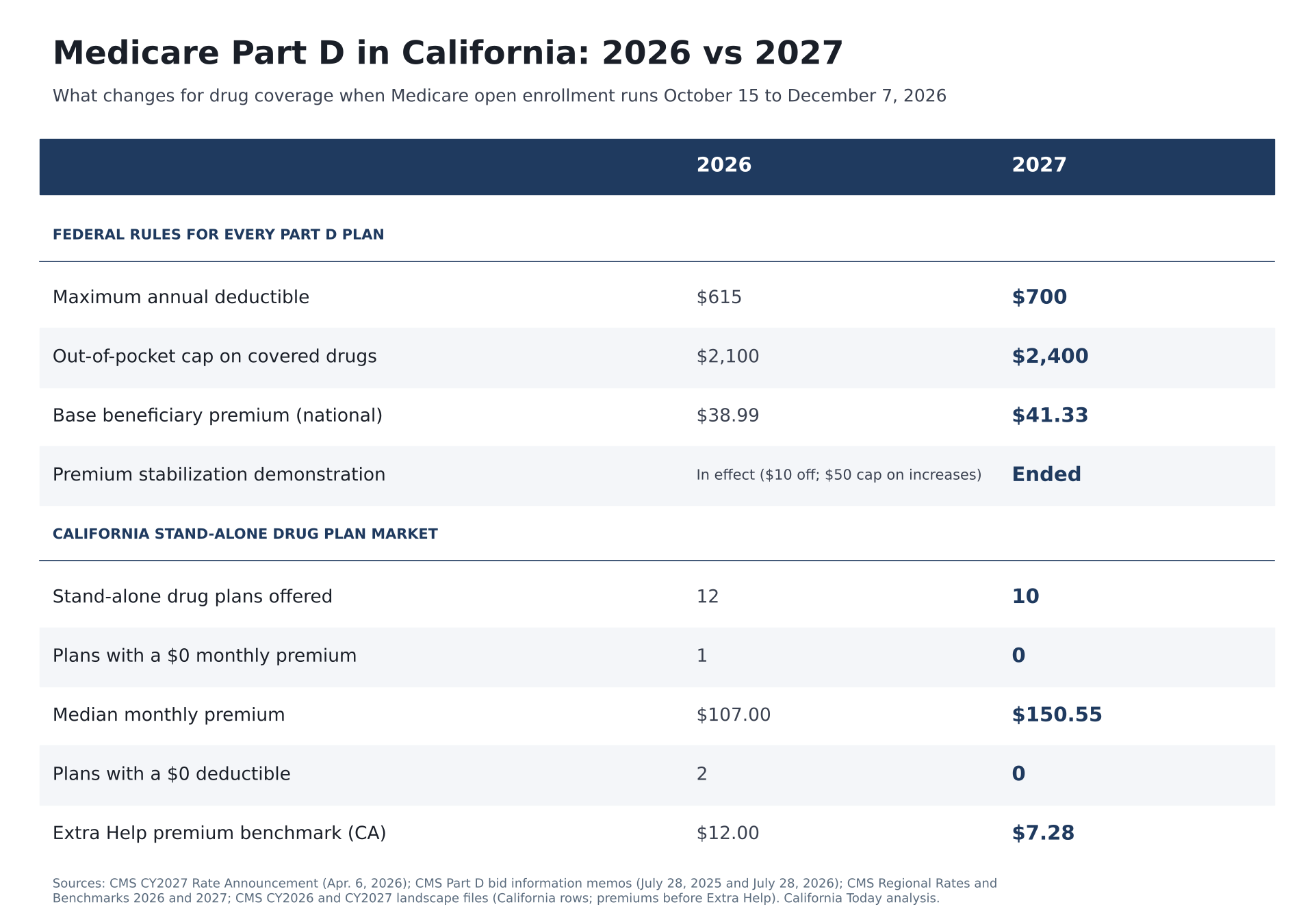
Medicare open enrollment for 2027 coverage runs from October 15 to December 7, 2026. For California's 7.2 million Medicare beneficiaries, this year's window brings several changes to prescription drug coverage. Part D's deductible rises to $700 and its out-of-pocket cap to $2,400. The federal program that held stand-alone drug plan premiums down for two years is ending. Lower negotiated prices for 15 widely used drugs, including Ozempic and Vraylar, take effect January 1. And the list of stand-alone drug plans sold in California has shrunk from 12 to 10.
We compared every stand-alone Part D plan in the Centers for Medicare & Medicaid Services' (CMS) 2027 plan landscape file with the same plan in 2026. Eight of the 10 remaining plans cost more each month, two cost less, and none has a $0 premium. The median monthly premium rises from $107.00 to $150.55, an increase of 41%. The same files show fewer Medicare Advantage plans with drug coverage in 25 of California's counties. Below is what changes, what each plan costs, what Extra Help covers, and where to get free, one-on-one advice. If you are new to Medicare, our 2026 Medicare enrollment guide explains the parts and the first-time sign-up rules.
Medicare open enrollment 2027 runs October 15 to December 7, 2026:
Open enrollment is the one window each year when anyone with Medicare can change plans. Medicare.gov lists what you can do in it:
- Join, drop or switch Medicare Advantage plans, with or without drug coverage.
- Move from Original Medicare to a Medicare Advantage plan, or from Medicare Advantage back to Original Medicare.
- Join, drop or switch a stand-alone Medicare drug plan if you have Original Medicare.
A change made during the window takes effect on January 1, 2027, and the plan must receive your request by December 7. People already in a Medicare Advantage plan get a second chance from January 1 to March 31, 2027, when they can switch to another Medicare Advantage plan or return to Original Medicare and add a stand-alone drug plan.
California's Medicare population is now split almost evenly between the two routes. CMS enrollment data for June 2026 count 7,243,867 beneficiaries in the state. Of those, 3,726,697 (51.4%) are in Medicare Advantage and other health plans. Of the 6,102,693 Californians with Part D drug coverage, 3,588,664 get it through a Medicare Advantage plan and 2,514,029 through a stand-alone plan. The stand-alone count includes employer-sponsored drug plans, which are not sold to the public and are not in the plan list below.
Medicare Part D in 2027: A $700 deductible and a $2,400 out-of-pocket cap:
Part D's two headline limits rise every year under a formula set by the Inflation Reduction Act. For 2027, CMS's annual rate announcement of April 6, 2026 sets them at:
- Deductible: up to $700, from $615 in 2026. This is the most a plan can charge before coverage begins; plans may set a lower one.
- Out-of-pocket cap: $2,400, from $2,100 in 2026. Once your own spending on covered drugs reaches this amount in a year, you pay nothing more for covered drugs for the rest of the year.
Several protections carry over unchanged. Insulin costs no more than $35 for a month's supply of each covered product, with no deductible, under both Part B and Part D, and Medicare.gov says "the $35 limit applies to everyone who takes insulin, even if you get Extra Help." The Medicare Prescription Payment Plan also continues. It lets anyone with Part D coverage pay out-of-pocket drug costs in monthly bills across the year instead of at the pharmacy counter. Every plan offers it and it is free, though Medicare.gov notes that it "doesn't save you money or lower your drug costs."
Premium stabilization demonstration ends: CMS's $10 discount and $50 cap expire:
Since 2025, CMS has run a voluntary "premium stabilization demonstration" for stand-alone drug plans. CMS created it "to address volatility and variation in standalone PDP premiums following benefit changes mandated by the Inflation Reduction Act." In 2025 it cut the base premium for participating plans by $15 and capped year-over-year increases at $35. For 2026 CMS scaled it back to a $10 reduction and a $50 cap.
On July 28, 2026, CMS said that drug plans "had sufficient experience under the redesigned Part D benefit to support their assumptions" and that it "will discontinue the demonstration at the end of CY 2026 to return the program to operating under traditional market conditions in CY 2027." The same memo sets the 2027 base beneficiary premium, the starting point for every plan's price, at $41.33, up 6% from $38.99. That is the largest increase the law allows. Without the 6% limit, the formula would have produced $94.06.
California's stand-alone Part D plans for 2027: 10 plans and no $0 premium:
The table lists every stand-alone Part D plan in CMS's 2027 landscape file for California (released September 22, 2026), alongside its 2026 price. Premiums are the full monthly premium before any Extra Help. Every plan is offered statewide, so the prices are the same in every county.
California stand-alone Medicare Part D plans, 2026 vs 2027 monthly premiums:
| Plan (company) | 2026 premium | 2027 premium | Change | 2027 deductible | 2027 premium with full Extra Help |
|---|---|---|---|---|---|
| Wellcare Value Script (Centene) | $5.70 | $5.30 | −$0.40 (−7%) | $700 | $5.30 |
| Wellcare Classic (Centene) | $6.20 | $7.30 | +$1.10 (+18%) | $700 | $0.00 |
| HealthSpring Assurance Rx (Health Care Service Corp.) | $0.00 | $9.30 | +$9.30 | $700 | $2.00* |
| Humana Basic Rx Plan | $132.20 | $118.30 | −$13.90 (−11%) | $700 | $111.00 |
| Humana Value Rx Plan | $104.60 | $130.30 | +$25.70 (+25%) | $687 | $123.00 |
| AARP Medicare Rx Saver from UHC (UnitedHealth) | $109.40 | $170.80 | +$61.40 (+56%) | $700 | $163.50 |
| Humana Premier Rx Plan | $172.90 | $191.20 | +$18.30 (+11%) | $350 | $183.90 |
| Blue Shield Rx Plus (Blue Shield of California) | $199.70 | $210.00 | +$10.30 (+5%) | $700 | $202.70 |
| AARP Medicare Rx Preferred from UHC (UnitedHealth) | $165.40 | $242.60 | +$77.20 (+47%) | $300 | $235.30 |
| Blue Shield Rx Enhanced (Blue Shield of California) | $227.80 | $252.60 | +$24.80 (+11%) | $200 | $245.30 |
| SilverScript Choice (CVS Health) | $103.60 | Not offered | — | — | — |
| HealthSpring Extra Rx (Health Care Service Corp.) | $70.60 | Not offered | — | — | — |
*HealthSpring Assurance Rx takes part in CMS's de minimis program, under which a plan waives a small amount above the Extra Help benchmark for members who get Extra Help. CMS's file still lists $2.00, so members should check the figure in their plan's notice.
Four patterns stand out in the table:
- The two AARP plans rise the most. AARP Medicare Rx Saver rises $61.40 a month and Preferred rises $77.20. A year of Saver now costs $2,049.60 in premiums, up from $1,312.80.
- The cheapest plans stay cheap but lose their $0 options. Wellcare's two plans and HealthSpring Assurance Rx still cost under $10 a month. In 2026 HealthSpring Assurance Rx cost nothing, and no 2027 plan has a $0 premium.
- No plan waives the deductible. In 2026 Blue Shield Rx Enhanced and Humana Premier Rx had $0 deductibles. In 2027 the lowest deductible is Blue Shield Rx Enhanced's $200, and eight of the 10 plans charge the full $700.
- Two plans fell. Humana Basic Rx is $13.90 a month cheaper, and Wellcare Value Script is 40 cents cheaper.
A low premium is not the same as a low total cost. A plan with a $700 deductible and a narrow drug list can cost a regular user of a brand-name drug more over a year than a plan with a higher premium. The way to compare is to enter your own prescriptions and pharmacy into Medicare's Plan Finder on Medicare.gov, which totals premiums and expected drug costs for each plan.
Two California drug plans missing from the 2027 list: SilverScript Choice and HealthSpring Extra Rx:
SilverScript Choice, CVS Health's stand-alone plan, and HealthSpring Extra Rx are in the 2026 California list but not the 2027 one. The change is not limited to California. Across the CMS files, SilverScript is offered in 23 states and territories for 2027, down from 50, and HealthSpring Extra Rx in five, down from 40. Neither company's reason is in the CMS data.
Medicare.gov says that when a plan's "contract with Medicare isn't renewed," members can switch to another plan "between December 8 and the last day in February of the following year." That is in addition to open enrollment. Choosing a replacement during open enrollment, by December 7, means the new plan starts on January 1.
Extra Help in California for 2027: One benchmark plan and a lower subsidy line:
Extra Help is the federal program that helps people with limited income and resources pay Part D premiums, deductibles and other drug costs. In California it reaches about one in three people with Part D: 1,966,888 of 6,102,693 in June 2026, according to CMS's enrollment data. Medicare.gov explains that people get it automatically if they have full Medicaid coverage (Medi-Cal), help with Part B premiums from a Medicare Savings Program, or Supplemental Security Income. Others can apply. The 2026 limits are $23,940 in income and $18,090 in resources for an individual, and $32,460 and $36,100 for a married couple.
Medicare.gov says that in 2027 Extra Help members pay a $0 premium and $0 deductible in a qualifying plan, up to $5.80 for each generic and $14.40 for each brand-name drug, and nothing once total drug costs reach $2,400. Members with full Medi-Cal and Qualified Medicare Beneficiary status pay no more than $4.90 per drug.
The detail that matters in California is the benchmark. Extra Help pays a stand-alone plan's premium in full only up to a regional amount. For California that amount falls from $12.00 a month in 2026 to $7.28 in 2027. In 2026, two California plans had basic premiums under the line. In 2027, under CMS's benchmark rules:
- Wellcare Classic ($7.30) is the region's benchmark plan, eligible for automatic enrollment, with a $0 premium for full Extra Help members.
- HealthSpring Assurance Rx ($9.30) is in the de minimis program, which means CMS will not move its Extra Help members out of it (see the table note).
- Every other plan leaves an Extra Help member paying a monthly premium, from $5.30 for Wellcare Value Script to $245.30 for Blue Shield Rx Enhanced.
Medicare says it mails a notice only if you lose Extra Help or are being moved to a different plan for next year. People with Extra Help can also change drug plans once a month, so a mid-year correction is possible. Our Medi-Cal guide covers the separate Medi-Cal rule changes for 2027. Those changes mostly affect adults under 65, not people on Medicare.
Negotiated Medicare drug prices take effect January 1, 2027: 15 drugs including Ozempic and Vraylar:
The second round of prices negotiated under the Medicare Drug Price Negotiation Program takes effect on January 1, 2027. CMS's fact sheet lists 15 drugs. Among the most used:
- Ozempic, Rybelsus and Wegovy (semaglutide): $274 for a 30-day supply, against a 2024 list price of $959. About 2.3 million Part D enrollees used them in 2024.
- Trelegy Ellipta (asthma, COPD): $175, against $654.
- Linzess (chronic constipation, IBS): $136, against $539.
- Breo Ellipta (asthma, COPD): $67, against $397.
- Tradjenta and Janumet (type 2 diabetes): $78 and $80, against $488 and $526.
- Vraylar (bipolar I disorder, major depressive disorder, schizophrenia): $770, against $1,376. About 118,000 enrollees used it in 2024.
The others are the cancer drugs Xtandi, Pomalyst, Ibrance and Calquence, plus Ofev, Austedo, Xifaxan and Otezla. CMS estimates that people with Part D will save $685 million in out-of-pocket costs once the prices take effect. It also estimates the prices would have cut net Medicare spending on these drugs by about $12 billion, or 44%, had they applied in 2024. The negotiated price is the price of the drug, not your copay. What you pay at the pharmacy still depends on your plan's cost-sharing, and the $2,400 cap still applies.
Mental health coverage outside the drug benefit is unchanged: Original Medicare charges $0 for a yearly depression screening.
Medicare Advantage in California for 2027: 252 plans with drug coverage, down from 264:
Medicare Advantage plans bundle hospital, medical and usually drug coverage through a private insurer, and unlike stand-alone drug plans they are sold county by county. Counting general-enrollment Medicare Advantage plans with drug coverage in the CMS files (special needs plans excluded), California has 252 for 2027, down from 264. Of those, 169 charge no premium beyond the Part B premium, down from 177. The highest in-network out-of-pocket limit among them rises from $9,250 to $9,850.
The count fell in 25 counties, rose in four and held steady in 27. San Diego County goes from 54 plans to 41, San Bernardino from 53 to 45, Riverside from 51 to 43, Yolo from 19 to 12, Santa Clara from 23 to 17 and Alameda from 20 to 14. Los Angeles County keeps the most choice, with 65. Kern, Kings, Sonoma and Sutter each gain plans. In Lake County, the only Medicare Advantage plan sold in 2026 does not appear in the 2027 file, leaving no Medicare Advantage plan there for 2027. Colusa and Trinity counties have had none in either year. These are counts of plan options, not of enrollment. A plan missing from 2027 may have been merged into another rather than ended, so a county's count can fall without its residents losing a plan.

The 2027 Part B premium: $202.90 now, $209.50 estimated:
Part B, which covers doctor visits and outpatient care, has its own premium. In 2026 it is $202.90 a month, with a $283 annual deductible. CMS had not published the 2027 premium as of October 12, 2026. The Medicare Trustees' June 2026 report estimates $209.50 a month and a $292 deductible. The official figure will be set by CMS, and this article will be updated when it is.
Free Medicare counseling in California: HICAP at 1-800-434-0222:
California's Health Insurance Counseling and Advocacy Program (HICAP), run by the California Department of Aging, provides "free, confidential one-on-one counseling, education, and assistance" on Medicare to people 65 and older, people under 65 on Medicare because of a disability, people about to become eligible, and their families. The department says its counselors "are trained in Medi-Cal and Medicare and can help you understand the complex insurance options to find the best fit for you," and that HICAP also provides legal assistance or referrals on Medicare problems. The statewide number is 1-800-434-0222, and the department's website finds the HICAP office for each county.
People under 65 who are not on Medicare shop on a different calendar. Covered California's open enrollment for 2027 runs November 1 to January 31, and our Covered California 2027 guide has every region's rate change.
Medicare open enrollment for 2027 closes December 7, 2026:
The changes that reach every Medicare beneficiary in California are the federal ones: a $700 deductible, a $2,400 cap, and 15 drugs with lower negotiated prices from January 1. The changes that depend on your choices are the California-specific ones. There are fewer stand-alone plans, none of them free, and the two AARP plans cost $61.40 and $77.20 a month more than last year. Medicare Advantage choice has narrowed across 25 counties. A Plan Finder comparison with your own prescriptions is the reliable way to see which plan costs least, and HICAP offers free help with it. Medicare open enrollment for 2027 coverage closes on December 7, 2026. Changes made by then take effect on January 1.
This article reflects CMS's 2027 plan landscape file released September 22, 2026 (notes revised September 30), Medicare.gov guidance and CMS enrollment data for June 2026, as of October 12, 2026. CMS says landscape data are "subject to change as contracts are finalized," and the 2027 Part B premium had not been announced at publication. Check Medicare.gov's Plan Finder for current plan details.
Sources and References
- Medicare.gov, Joining a plan (enrollment periods)—https://www.medicare.gov/basics/get-started-with-medicare/get-more-coverage/joining-a-plan
- Medicare.gov, Special Enrollment Periods—https://www.medicare.gov/basics/get-started-with-medicare/get-more-coverage/joining-a-plan/special-enrollment-periods
- CMS, Prescription Drug Plan Landscape (CY2027 and CY2026 landscape files)—https://www.cms.gov/data-research/statistics-trends-and-reports/medicare-advantagepart-d-contract-and-enrollment-data/prescription-drug-plan-landscape
- CMS, CY2027 Landscape file (released September 22, 2026; notes revised September 30, 2026)—https://www.cms.gov/files/zip/cy2027-landscape-202609-1.zip
- CMS, CY2026 Landscape file—https://www.cms.gov/files/zip/cy2026-landscape-202609.zip
- CMS, Announcement of Calendar Year 2027 Medicare Advantage Capitation Rates and Part C and Part D Payment Policies (April 6, 2026)—https://www.cms.gov/files/document/2027-announcement.pdf
- CMS, Annual Release of Part D National Average Monthly Bid Amount and Other Part C & D Bid Information (July 28, 2026)—https://www.cms.gov/files/document/july-28-2026-parts-c-d-announcement.pdf
- CMS, Annual Release of Part D National Average Monthly Bid Amount and Other Part C & D Bid Information, including the CY 2026 Part D Premium Stabilization Demonstration (July 28, 2025)—https://www.cms.gov/files/document/july-28-2025-parts-c-d-announcement.pdf
- CMS, Regional Rates and Benchmarks 2027—https://www.cms.gov/files/document/regional-rates-and-benchmarks-2027.pdf
- CMS, Regional Rates and Benchmarks 2026—https://www.cms.gov/files/document/regional-rates-and-benchmarks-2026.pdf
- CMS, Medicare Monthly Enrollment (data month June 2026)—https://data.cms.gov/summary-statistics-on-beneficiary-enrollment/medicare-and-medicaid-reports/medicare-monthly-enrollment
- Medicare.gov, Help with drug costs (Extra Help)—https://www.medicare.gov/basics/costs/help/drug-costs
- Medicare.gov, Insulin—https://www.medicare.gov/coverage/insulin
- Medicare.gov, The Medicare Prescription Payment Plan—https://www.medicare.gov/prescription-payment-plan
- CMS, Medicare Drug Price Negotiation Program: Negotiated Prices for Initial Price Applicability Year 2027 (fact sheet, November 2025)—https://www.cms.gov/files/document/fact-sheet-negotiated-prices-ipay-2027.pdf
- CMS, Medicare Drug Price Negotiation Program: Selected Drugs and Negotiated Prices—https://www.cms.gov/priorities/medicare-prescription-drug-affordability/overview/medicare-drug-price-negotiation-program/selected-drugs-negotiated-prices
- Medicare.gov, Medicare costs (2026 premiums and deductibles)—https://www.medicare.gov/basics/costs/medicare-costs
- Boards of Trustees, 2026 Annual Report of the Federal Hospital Insurance and Federal Supplementary Medical Insurance Trust Funds—https://www.cms.gov/oact/tr/2026
- California Department of Aging, Medicare Counseling (HICAP)—https://aging.ca.gov/Programs_and_Services/Medicare_Counseling/
- California Today, 2026 Medicare enrollment guide—https://californiatoday.com/guides/healthcare-access/2026-medicare-enrollment-guide/
- California Today, Medi-Cal work requirements, six-month renewals and immigrant eligibility: Every 2026–27 date you need to know—https://californiatoday.com/news/medi-cal/medi-cal-work-requirements-six-month-renewals-and-immigrant-eligibility-every-2026-27-date-you-need-to-know/
- California Today, Covered California premiums rise 9.9% for 2027—https://californiatoday.com/guides/health-insurance/covered-california-premiums-rise-9-9-for-2027-every-regions-rate-change-and-tips-to-lower-yours/

