


2026 Social Security tax thresholds (for '25 tax year): What California filers need to know
We explain exactly how the federal threshold system works, break down income levels for every filing status, and provide a reference table you can use right now to learn where you stand.

For many Californians collecting Social Security, the annual tax filing season brings a version of the same anxiety: "Am I going to owe money on these benefits?" The honest answer—and the one the IRS buries in worksheets and publications — is that it depends entirely on a single number called your combined income. Get that number right, compare it to the correct threshold for your filing status, and the question answers itself. Get it wrong, and you could either overpay or underpay, neither of which you want three weeks before the April 15 deadline.
 Dr. Jennifer Trimpey | Specialist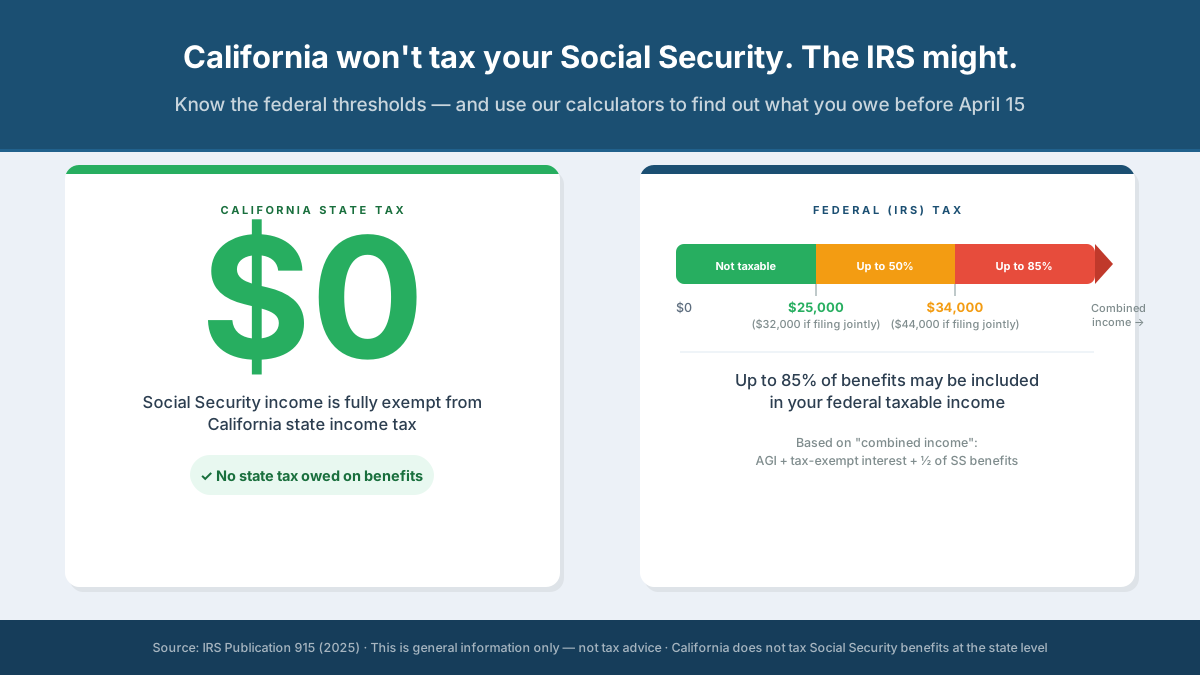
This guide explains exactly how the current federal threshold system works, breaks down the specific income levels that trigger taxation for every filing status, and gives you a reference table you can use right now to find where you stand.
Sources & Disclaimers
The tax guidelines presented in this article are derived directly from the Internal Revenue Service (IRS) and the California Franchise Tax Board (FTB) for the current filing season.
- Social Security and Equivalent Railroad Retirement Benefits (Publication 915) 2025– Internal Revenue Service
- Personal Income Types: Social Security–California Franchise Tax Board
- Instructions for Schedule CA (540)–California Franchise Tax Board
Thresholds shown are for the 2025 tax year. This article provides general information and does not constitute tax advice. Consult a qualified tax professional for guidance specific to your situation.
What the IRS means by "combined income"
The phrase "combined income" does not appear on your W-2 or your SSA-1099. It is a figure the IRS asks you to calculate yourself, and the formula has a component that surprises many first-time filers: half of your Social Security benefits counts toward it.
Specifically, combined income is defined as: Adjusted Gross Income (AGI) + Tax-Exempt Interest + ½ of your Social Security benefits
Your AGI includes wages, pension income, IRA withdrawals, dividends, and capital gains — essentially everything taxable before deductions. Tax-exempt interest, most commonly interest from municipal bonds, is added back in even though it does not appear in your AGI. And then half of your gross Social Security benefit (the Box 5 figure on your SSA-1099) is added on top.
The reason this formula catches people off guard is that a retiree with modest Social Security income and a small pension can easily find themselves over the threshold once all three components are combined. The IRS designed this calculation specifically to capture income from multiple sources, not just earned wages.
The 2025 federal thresholds, by filing status
Once you know your combined income, you compare it against a threshold determined by your filing status. There are two key thresholds per filing status: a lower one (called the base amount), below which none of your benefits are taxable, and an upper one, above which up to 85% of your benefits may be taxable.
The table below shows every filing status, its base amount, the point at which the higher 85% tier kicks in, and the maximum percentage of benefits that can be included in your taxable income. Use it to identify which row applies to you before doing anything else.
Federal Social Security Tax Thresholds by Filing Status
IRS Publication 915 (2025) · 2025 Tax Year
| Filing Status | Base Amount (where taxability begins) |
85% Tier Threshold (combined income above) |
Maximum Taxable (of benefits) |
| Single Head of Household Qualifying Surviving Spouse |
$25,000 0% below this |
$34,000 50% tier: $25K–$34K |
85% Above $34,000 |
| Married Filing Jointly | $32,000 0% below this |
$44,000 50% tier: $32K–$44K |
85% Above $44,000 |
| Married Filing Separately (lived apart all of 2025) |
$25,000 0% below this |
$34,000 50% tier: $25K–$34K |
85% Above $34,000 |
| Married Filing Separately (lived with spouse any time in 2025) |
$0 No exemption |
$0 No 50% tier |
85% Applies to all income |
What is the "base amount"? This is the combined income threshold below which none of your Social Security benefits are taxable. If your combined income falls below your base amount, you owe no federal tax on your benefits regardless of other income.
What does "up to 85%" mean? It means at most 85 cents of every dollar of Social Security benefits can be included in your taxable income — not that your tax rate is 85%. The actual tax you pay is determined by applying your regular income tax rate to that taxable portion.
These thresholds are not adjusted for inflation and have remained unchanged since 1993 for the 85% tier and since 1984 for the 50% tier.
How to use the table: finding your row
Single, head of household, or qualifying surviving spouse. Your base amount is $25,000. If your combined income stays below that figure, none of your Social Security benefits are federally taxable. Between $25,000 and $34,000, up to 50% of your benefits may be taxable. Above $34,000, the maximum of 85% applies.
Married filing jointly. Your base amount is higher, at $32,000, reflecting the fact that two incomes are being combined. The 50% tier runs from $32,000 to $44,000. Above $44,000, up to 85% of combined benefits may be taxable.
Married filing separately, lived apart all year. The rules here mirror the single filer thresholds: $25,000 base amount, 85% tier above $34,000. To qualify for this treatment, you and your spouse must have lived apart for the entire 2025 tax year.
Married filing separately, lived with your spouse at any time in 2025. This is the most disadvantageous scenario in the table. The base amount drops to $0, meaning there is no income floor below which your benefits are exempt. Up to 85% of your benefits is potentially taxable from the first dollar of combined income. If this filing status applies to you, the calculation is essentially predetermined — the only variable is how much of your benefits falls under that 85% ceiling.
Understanding the two tiers: 50% versus 85%
The threshold table shows two distinct taxation tiers, and it is worth understanding what each one actually means — especially because the 85% figure alarms people who misread it as a tax rate.
The 50% tier applies when your combined income falls between your base amount and the upper threshold. In this range, the IRS can include up to half of your Social Security benefits in your taxable income. It does not mean you pay 50% tax on them — it means up to 50 cents of every dollar in benefits is added to the income that gets taxed at your ordinary rate, which for most retirees is considerably lower.
The 85% tier applies once combined income exceeds the upper threshold. Here, up to 85 cents of every dollar in benefits can be included in taxable income. This is the statutory maximum — the federal government cannot tax more than 85% of your Social Security benefits regardless of how high your income goes.
To put it plainly: if you are in the 85% tier and your ordinary federal income tax rate is 22%, the effective federal tax rate on your Social Security benefits is at most 85% × 22% = 18.7%, not 85%.
Why these thresholds have not changed since the 1990s
One detail worth knowing for context: the base amounts ($25,000 for single filers, $32,000 for joint filers) have been fixed since 1984. The upper thresholds that trigger 85% taxation ($34,000 and $44,000) have been unchanged since 1993. Neither figure is adjusted for inflation.
That means that every year, as Social Security benefits and other retirement income rise with inflation, more recipients are pushed above the thresholds simply by cost-of-living adjustments — even when their real purchasing power has not changed. If your combined income is close to a threshold, it is worth checking whether a recent COLA has moved you across the line for 2025.
What California filers need to understand about state versus federal rules
California has its own position on Social Security taxation, and it is simple: the state does not tax Social Security benefits at all. There is no California equivalent to the federal combined income calculation. Whether your combined income is $10,000 or $100,000, your Social Security benefits are fully exempt from California state income tax.
This matters for the threshold table above, which reflects only your federal tax exposure. If the table shows that you fall into the 50% or 85% tier, that finding tells you what may be owed to the IRS — it says nothing about your California state return, where the answer is always zero.
The practical implication: California residents who focus only on their state return may incorrectly assume their Social Security income is untaxed at every level. The federal liability is separate, real, and governed entirely by the thresholds in the table above.
Before April 15: three things to do right now
1. Locate your SSA-1099. The Social Security Administration mails Form SSA-1099 in January. The figure you need is in Box 5, labeled "Net Benefits for 2025." If you received benefits from the Railroad Retirement Board, the equivalent is your RRB-1099. If you cannot find the form, you can retrieve a replacement at ssa.gov/myaccount.
2. Estimate your combined income. Add your adjusted gross income (from all non-Social Security sources), any tax-exempt interest you received in 2025, and half of the Box 5 figure from your SSA-1099. Compare that total against your row in the table above. This gives you an immediate read on whether you are below the threshold, in the 50% tier, or in the 85% tier.
3. If you are above the base amount, calculate your exact taxable amount. The threshold table tells you which tier you are in, but not the precise dollar figure to report on Form 1040, line 6b. That requires the IRS's full Worksheet 1 calculation. For a fast, guided version of that calculation, see our Social Security Taxable Benefits Calculator, which walks through all 19 IRS steps using your own numbers.
Conclusion
The federal Social Security threshold system is more structured than it first appears. There are fixed income levels, determined by filing status, below which your benefits are entirely exempt — and a hard ceiling of 85% above which the IRS cannot go regardless of income. Knowing which side of those lines you fall on is the first and most important step in accurately completing your federal return before April 15.
California's full state exemption means that any federal tax exposure you identify applies only to your IRS filing. Your state return is unaffected. That distinction is worth keeping clearly in mind as you work through both sets of forms over the coming weeks.


