

AB 1776 is on Newsom's desk: California's antitrust law would reach single companies for the first time
The COMPETE Act was presented to the Governor on September 10, giving him until September 30 to act. It would add a monopolization ban to a Cartwright Act that has required two or more conspirators since 1907.


California's antitrust law has had the same structural gap since 1907. The Cartwright Act reaches a "combination of capital, skill or acts by two or more persons"—cartels, price-fixing rings, conspiracies—and, as the California Law Revision Commission put it in the report that led to this bill, it "generally does not apply to conduct by a single firm to monopolize." A company acting alone has been answerable under federal law and not under California's.
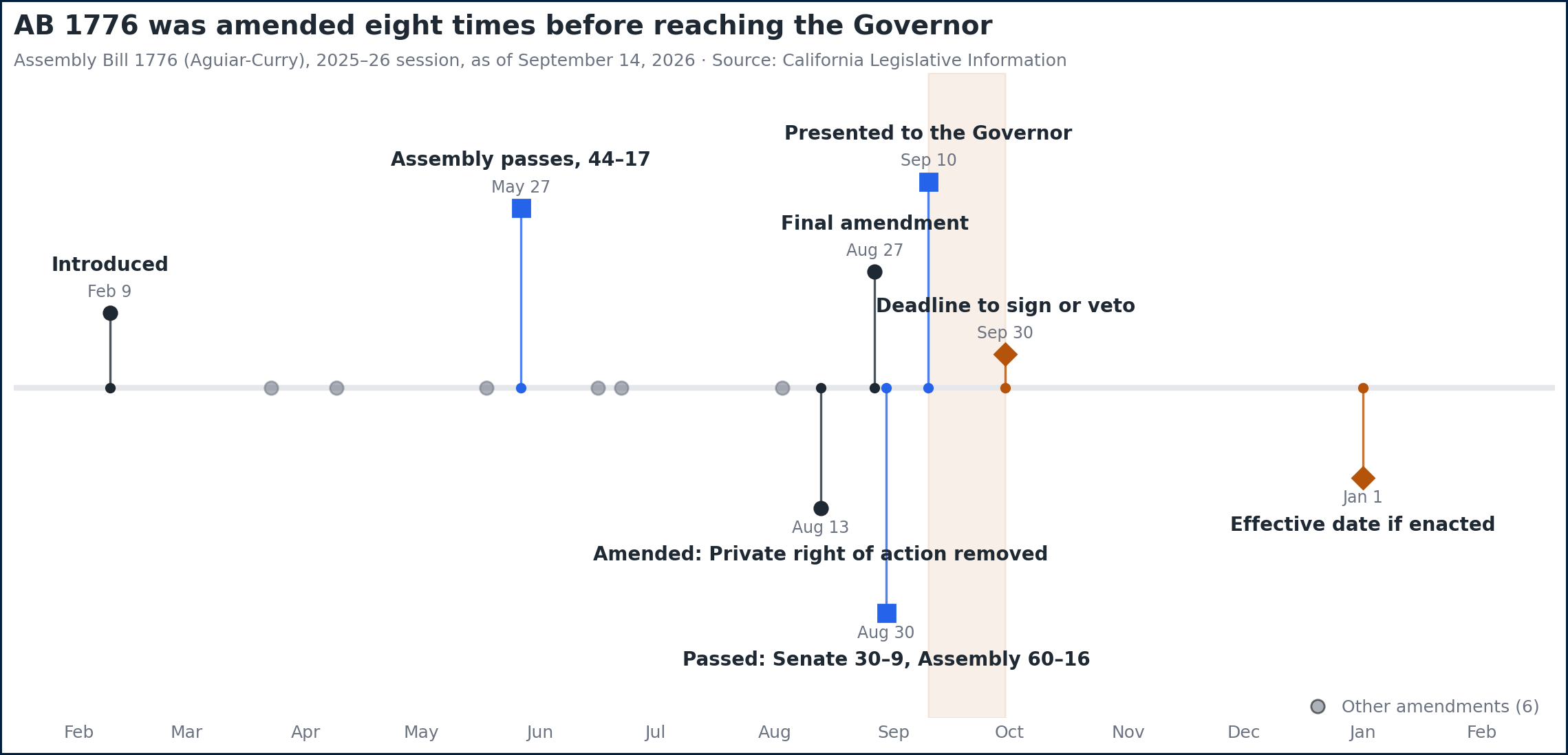
AB 1776, the Competition and Opportunity in Markets for a Prosperous, Equitable and Transparent Economy Act, would close that gap. The Legislature passed it on August 30, the Senate voting 30–9 and the Assembly concurring 60–16, and it was enrolled and presented to Governor Newsom on September 10 at 3 p.m. He has until September 30 to sign or veto it. If he does neither, it becomes law anyway.
The bill adds three sections to the Business and Professions Code. The central one makes it unlawful "to monopolize or monopsonize, attempt to monopolize or monopsonize, maintain a monopoly or monopsony, or combine or conspire with another person to monopolize or monopsonize any part of trade or commerce."
What sits on the Governor's desk is considerably narrower than what was introduced in February. Across eight amendments the bill lost a restraint-of-trade prong, a ten-factor evidence list, a rule about how courts weigh competitive harms, and the ability of any private party to sue under it. It gained a small business exemption and a requirement that plaintiffs prove substantial market power. The Assembly, which passed an earlier version 44–17 in May, concurred in the narrowed one 60–16 in August.
AB 1776 at a glance:
AB 1776 targets a gap the Cartwright Act has had since 1907:
California adopted the Cartwright Act in 1907, seventeen years after Congress passed the Sherman Act, and has never amended it to add a monopolization provision. Section 16720 defines the thing the statute prohibits—a "trust"—as a combination of two or more persons, and California courts have read that requirement literally.
The federal statute has no such limit. Section 2 of the Sherman Act, enacted in 1890, makes it a felony for "every person" to monopolize or attempt to monopolize any part of interstate trade. Most states followed Washington's lead rather than writing their own rule: the Commission noted that "most other states with a SFC provision mirror federal law," using the shorthand for single-firm conduct. California did neither, and the author's office describes the state as "one of only five states without this core antitrust protection." The Commission's own report does not give a count, so treat the number as the author's characterization and the absence itself as the established fact.
That is the hole the bill fills, and it fills it deliberately without copying Washington. Section 16730 as passed assembles legislative findings drawn from California Supreme Court decisions: that the Cartwright Act is "broader in range and deeper in reach" than the Sherman Act, that it was not modeled on federal law and federal interpretations are therefore "at most instructive," and that California already departs from federal practice on indirect purchaser recovery, antitrust standing, actionable market shares and burdens of proof. The Commission had rejected mirroring the federal statute for a stated reason: doing so would "effectively import the decades of federal jurisprudence that has diluted the Sherman Act Section 2's original scope and strength."
Section 16731 would make monopolizing and monopsonizing unlawful in California:
The operative provision is short. It covers monopolizing and monopsonizing—buyer-side power, where the harm runs to suppliers and workers rather than to customers—along with attempts, maintenance of an existing monopoly, and conspiracies to do any of it. Section 16730(b) is explicit that competition for workers counts, framing anticompetitive practices "that impede workers' freedom to choose employment" as a competition problem rather than only an employment one.
Three constraints ride along with it. Courts adjudicating a claim must use the framework the California Supreme Court laid out in In re Cipro Cases I & II (2015) 61 Cal.4th 116 at pages 146 to 147. A plaintiff has to allege, and prove at trial, substantial market power through direct or indirect evidence. And the Legislature wrote in an affirmative statement that a business may lawfully obtain and keep market power "through the superiority of its products, services, or business acumen."
The exemptions are narrower than the headline suggests but real. A small business is out of reach entirely: independently owned and operated, principal office in California, officers domiciled in California, 100 or fewer employees counting affiliates, and average annual gross receipts of $10 million or less over the three years before a complaint is filed. Government-granted exclusive franchises, contracts, licenses and permits are also excluded, along with conduct required or authorized by state or federal law—a carve-out that reaches cities, counties, special districts, sanitation districts and joint powers agencies.
Because a Cartwright Act violation is a crime, the new prohibition carries criminal exposure. Section 16755 punishes violations of the chapter with fines up to $6 million for a corporation, and for an individual up to $1 million and one to three years, or twice the gross gain or gross loss where that is greater. Legislative Counsel's digest flags this directly: because the bill expands what the Cartwright Act prohibits, and violating it is punishable as a crime, the bill creates a state-mandated local program.
The Senate stripped private lawsuits from AB 1776 on August 13:
The largest change over the bill's life is who gets to use it. Section 16731(f)(1) says an action under the section "may be initiated only by the Attorney General or a district attorney." California's antitrust law otherwise lets injured parties sue for treble damages under Section 16750, and federal law does the same under 15 U.S.C. § 15. Neither route is available for a single-firm claim under this bill.
That happened in one committee sitting. The Senate Appropriations Committee removed the private right of action on August 13, and the author's own announcement that afternoon did not present it as a refinement.
"I'm disappointed the private right of action was gutted and want to make sure that the bill still helps the consumers, workers, and businesses that have been harmed by mega-corporations," Aguiar-Curry said.
"We've been trying to modernize our antitrust laws for decades, and I worry we'll be waiting 10 or 20 years before there's another opportunity to give Californians the level of protection they would have had under a PRA."
The August 27 amendment tightened the limit further. It added subdivision (f)(2), barring an alleged violation of the new section from serving as a predicate for an Unfair Competition Law claim under Section 17200 except in an action brought by the Attorney General or a district attorney—closing the route by which a private plaintiff could otherwise borrow the violation. It added a savings clause confining the limit to this section. And it added subdivision (g), which excludes Sections 16756, 16756.1 and 16757 unless a claim alleges a conspiracy.
That last one is easy to miss and consequential. Section 16756.1 is the relaxed pleading standard the Legislature enacted last year in AB 325, which lets an antitrust complaint survive by alleging that a conspiracy is plausible without pleading facts that exclude independent action. It took effect January 1, 2026. Under AB 1776 it does not apply to single-firm monopolization claims at all—the easier pleading path and the new cause of action do not overlap. The same amendment requires any action under the section to be filed as a complex case under Government Code Section 70616, which carries a $1,000 complex-case fee, capped at $18,000 across all defendants, and routes the case into complex litigation management.
The Law Revision Commission recommended more than AB 1776 delivers:
The bill is routinely described, including by its author, as codifying the unanimous recommendation of the California Law Revision Commission, which the Legislature directed in 2022 to study whether state law should reach single-firm conduct. The Commission approved its recommendation on January 30, 2026 and published it as a preprint on March 30. Set the two documents side by side and the bill is the recommendation minus several of its load-bearing parts.
The Commission proposed four sections. Its Section 16731 reached conduct "in restraint of trade" as well as monopolization; the bill covers monopolization and monopsonization only. Its Section 16732 listed ten factors that "may constitute evidence of a violation" while stating that "establishing liability shall not require a finding" of any of them—including a market share at or above the federal threshold. That entire section is gone, and the bill moves in the opposite direction by requiring plaintiffs to prove substantial market power. The Commission's Section 16733, directing courts to interpret California's antitrust laws liberally, survives as the bill's Section 16732, the only one of the four to pass through essentially intact.
What the Law Revision Commission recommended, and what AB 1776 does
Commission preprint, March 30, 2026, compared with the bill as amended August 27, 2026
| Provision | Commission recommendation | AB 1776 as passed |
|---|---|---|
| Conduct covered | Restraint of trade and monopolization or monopsonization | Monopolization and monopsonization only |
| Market power | Listed as possible evidence; “establishing liability shall not require a finding” of a federal-level market share | Plaintiff must allege and prove substantial market power, by direct or indirect evidence |
| Evidence guidance | Ten-factor list in proposed § 16732 | Dropped; courts directed to the Cipro framework instead |
| Same relevant market | Procompetitive justifications weighed in the same market as the challenged conduct | In the bill until the August 27 amendment struck it |
| Who can sue | No limit in the recommended text | Attorney General or a district attorney only; private right of action removed August 13 |
| Unfair Competition Law | Not addressed | Cannot be a § 17200 predicate except in an action by the AG or a district attorney |
| Small businesses | No exemption in the recommended text | Exempt at 100 or fewer employees and $10 million or less in average annual gross receipts |
| Relaxed pleading (AB 325) | Not addressed | Does not apply unless the claim alleges a conspiracy |
| Court handling | Not addressed | Must be filed as a complex case; $1,000 fee, $18,000 cap across defendants |
| Federal law | Declined to mirror Sherman Act § 2 | Same: federal interpretations are “at most instructive” |
Comparison of the Commission’s recommended Business and Professions Code §§ 16730–16733 with the enacted text of AB 1776. Sources: California Law Revision Commission; California Legislative Information.
Two more items disappeared in the final week. The August 27 amendment struck the requirement that procompetitive justifications be evaluated "within the same relevant market as the conduct that is alleged to be unlawful," and it struck a legislative finding aligning California with the Department of Justice and Federal Trade Commission's 2023 merger guidelines. Aguiar-Curry addressed the deletions in a statement the day the bill passed. "As for anything removed from the bill, it is a normal part of the legislative process and does not mean the Legislature's support or opposition to a particular provision," she said. "When time is short, sometimes it is better to remove language—especially when you believe the case law supports your position—than it is to hurry amendments to very complex legal language."
AB 1776 and Sherman Act Section 2 reach different conduct with different penalties:
For a business working out what actually changes, the useful comparison is not the Cartwright Act as it stands but the federal statute companies already comply with. The two overlap on the core prohibition and diverge almost everywhere else.
California’s proposed monopolization ban compared with federal law
Statutory text as of September 14, 2026; California penalties are those already set by B&P Code § 16755
| AB 1776, B&P Code § 16731 | Sherman Act § 2 (15 U.S.C. § 2) | |
|---|---|---|
| In force since | January 1, 2027, if enacted | 1890 |
| Conduct reached | Monopolize or monopsonize, attempt, maintain, or combine or conspire to do so | Monopolize, attempt to monopolize, or combine or conspire to monopolize |
| Buyer-side power | Named explicitly; labor market conduct named in the findings | Not named in the statutory text |
| Who may sue | California Attorney General or a district attorney | Federal enforcers, state attorneys general, and private plaintiffs |
| Private damages | None under this section | Treble damages, costs and attorney’s fees under 15 U.S.C. § 15 |
| Corporate fine | Up to $6 million, or twice the gross gain or loss | Up to $100 million |
| Individual penalty | Up to $1 million and one to three years, or up to one year in county jail | Up to $1 million and up to 10 years |
| Interpretive guide | In re Cipro Cases I & II; federal precedent “at most instructive” | Federal case law |
Sources: California Legislative Information; United States Code.
The practical asymmetry runs in both directions. California's version explicitly names monopsony and explicitly counts labor market conduct, which the federal text does not. It also hands enforcement to two kinds of public office and forecloses the private bar, where federal law has a well-developed private damages system and California's own Cartwright Act allows private class actions for conspiracy claims. Whether that makes the new section a stronger or weaker instrument depends entirely on how aggressively the Attorney General and the state's county district attorneys choose to use it.
CalChamber spent millions against AB 1776, then dropped it from its cost drivers list:
The opposition campaign was among the year's largest. The California Chamber of Commerce launched a multimillion-dollar effort on July 21, including a 30-second advertisement and the message "tell Sacramento we can't afford AB 1776," and argued the bill would expose businesses "to a wave of frivolous lawsuits," "raise prices, kill customer discounts and price matching programs," and threaten "some $1 trillion of California's gross domestic product and 1.6 million jobs in the first decade."
Its position then moved twice with the bill. On August 21, a week after the private right of action came out, CalChamber welcomed that removal as "a welcome surprise after the bill's author repeatedly refused to remove the PRA provision" while staying opposed, and named three surviving objections: the same-relevant-market rule, the "substantial market power" threshold, and the absence of specific real-world examples of the conduct the bill targets. The August 27 amendment then struck the same-market rule, leaving one of the three answered and the market-power objection untouched.
The day after that amendment, CalChamber announced it was standing down partway. "While serious issues with the bill remain, new amendments have removed its most significant economic threats. As such, we are taking AB 1776 off the Cost Drivers list," the organization said, adding that "even with recent amendments, AB 1776 is a significant change to existing law, and we remain opposed." Aguiar-Curry's reply was that the bill never belonged there, since "the list is supposed to identify bills that drive up costs for businesses, and that is what market consolidation does."
The floor votes moved with the bill too. In May, before the Senate amendments, the Assembly passed AB 1776 44–17. In August, on the narrowed version, it concurred 60–16—sixteen more ayes on the same bill number. Every no vote in both houses came from a Republican member. The bill's supporters, as listed by the author's office at introduction, included the Consumer Federation of California, Teamsters Local 150, UFCW Western States and Local 1428, Small Business Majority and TechEquity.
AB 1776 sits with Newsom until September 30:
Because the Legislature passed AB 1776 on August 30, before the September 1 trigger in Article IV, Section 10 of the state Constitution, and it reached him on September 10, the Governor has until September 30 to return it with a veto. A bill in his possession on or after September 1 that is not returned by that date becomes a statute regardless. If it is enacted, the ordinary rule in Article IV, Section 8 applies and the new sections take effect January 1, 2027, about fifteen weeks from the deadline.
What happens after that is a question about enforcement capacity rather than statutory text. The law would give the Attorney General and district attorneys a tool neither has had, and it would do so without the private plaintiffs who bring most antitrust litigation. The author's argument for taking the narrowed version was that the alternative was waiting: the last major attempt at antitrust legislation in California came about twenty years ago, by her count, and "we can't wait another 20 years while mega-corporations destroy our main streets across the state." The first case brought under Section 16731 will say more about the COMPETE Act's reach than the eight amendments did.
Status: AB 1776 passed both houses on August 30, 2026 and was enrolled and presented to the Governor on September 10, 2026. As of September 14, 2026 it had been neither signed nor vetoed, and the constitutional deadline for him to act is September 30, 2026. Provisions described here are from the August 27, 2026 amended version, the text presented for enrollment. This article describes pending legislation and is not legal advice; businesses assessing their exposure should consult counsel.
Sources & References
- AB 1776 bill text, amended in Senate August 27, 2026 · California Legislative Information
- AB 1776 bill status and history · enrollment and presentment dates
- AB 1776 roll call votes
- Business and Professions Code § 16720 · Cartwright Act definition of a trust
- Business and Professions Code § 16750 · private treble damages action
- Business and Professions Code § 16755 · criminal penalties
- Business and Professions Code § 16756.1 · pleading standard added by AB 325 (Stats. 2025, ch. 338)
- Government Code § 70616 · complex case fees
- California Constitution, Article IV, Section 10 · the Governor's deadline
- California Constitution, Article IV, Section 8 · effective dates
- California Law Revision Commission, Antitrust Law: Single Firm Conduct, preprint March 30, 2026
- California Law Revision Commission, Study B-750 overview
- Aguiar-Curry on the Senate Appropriations amendments, August 13, 2026
- Aguiar-Curry statement on AB 1776, August 30, 2026
- Aguiar-Curry unveils the COMPETE Act, February 17, 2026
- CalChamber launches statewide campaign to oppose AB 1776, July 21, 2026
- CalChamber to Senate committee: reject risky antitrust plan, August 5, 2026
- CalChamber remains opposed to AB 1776 despite changes, August 21, 2026
- CalChamber statement on amendments to antitrust legislation, August 28, 2026
- 15 U.S.C. § 2 · Sherman Act monopolization
- 15 U.S.C. § 15 · federal private antitrust damages
- Internal: California's class action residual tracking system is broken


