


California's cannabis tax has raised $8 billion since 2018—So where's the money, and why is the legal market shrinking?
California has collected more than $8 billion in cannabis taxes since 2018 and just cut the rate to defend a legal market most buyers still skip. Here's how the tax works, where the money legally must go, and the tradeoff California can't escape.

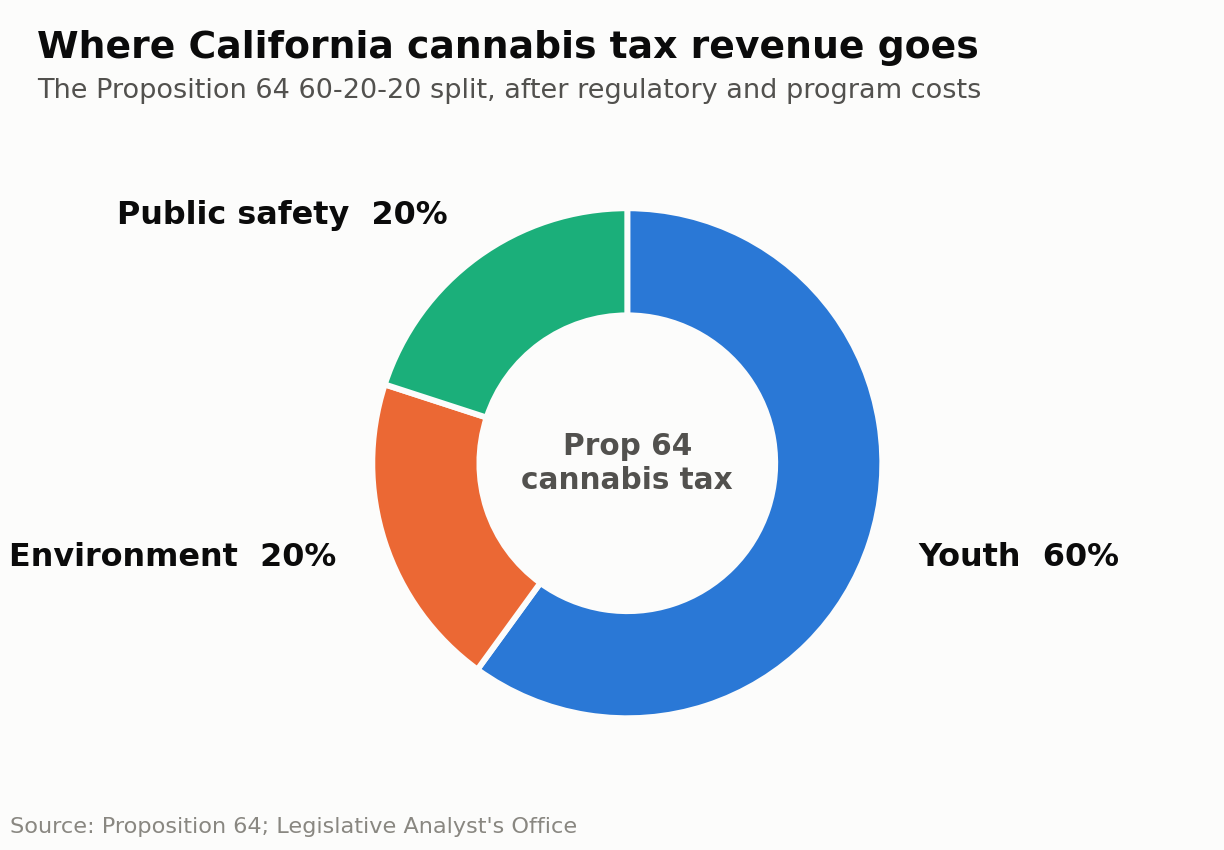
When Californians buy legal cannabis, they pay two separate state taxes: a retail excise tax and ordinary sales tax. Since legal sales began in 2018, the two together have raised more than $8.1 billion. That money does not go wherever the Legislature prefers; Proposition 64 sends it through a fixed order that ends in a locked 60-20-20 split: 60% to youth programs, 20% to the environment, 20% to law enforcement.
But the system built to collect it is straining. California just cut the excise rate from 19% back to 15%, legal sales have fallen four years running, and by most estimates a majority of the cannabis Californians buy still comes from untaxed illegal sellers. The state is now fighting on two fronts at once, lowering the tax to make legal cannabis competitive while spending heavily to seize illegal supply, and running straight into a tradeoff its own analysts spelled out years ago: tax cannabis harder and you raise money but shrink the legal market; tax it lighter and you grow the legal market but risk the revenue that funds those programs.
Here is how the tax actually works, where the money is legally required to go, and why there is no rate that solves every problem at once.
How California's 15% cannabis excise tax and sales tax work:
| Measure | Figure |
|---|---|
| State excise tax (from Oct 1, 2025) | 15% of retail gross receipts (down from 19%) |
| Sales tax | Standard state + local rate, applied on top |
| Local cannabis taxes | Vary by city/county; LAO estimates roughly 14% added across the supply chain |
| Total revenue since Jan 2018 | More than $8.1 billion ($4.34B excise, $3.28B sales, $0.5B former cultivation tax) |
| Q1 2026 collections | $143.6M excise + $104.3M sales = about $247.9M |
| Spending split (after costs) | 60% youth, 20% environment, 20% law enforcement |
When voters passed Proposition 64 in 2016, they created two separate state cannabis taxes. One was a cultivation tax, charged by weight at the farm, which in its final form ran $9.65 per ounce of dried flower. The other was a retail excise tax of 15%, charged on what customers pay at the register. Both stacked on top of regular state and local sales tax, plus any local cannabis tax a city or county chose to add. The Legislative Analyst's Office, the Legislature's nonpartisan fiscal adviser, estimated that local taxes alone add roughly a further 14% across the supply chain.
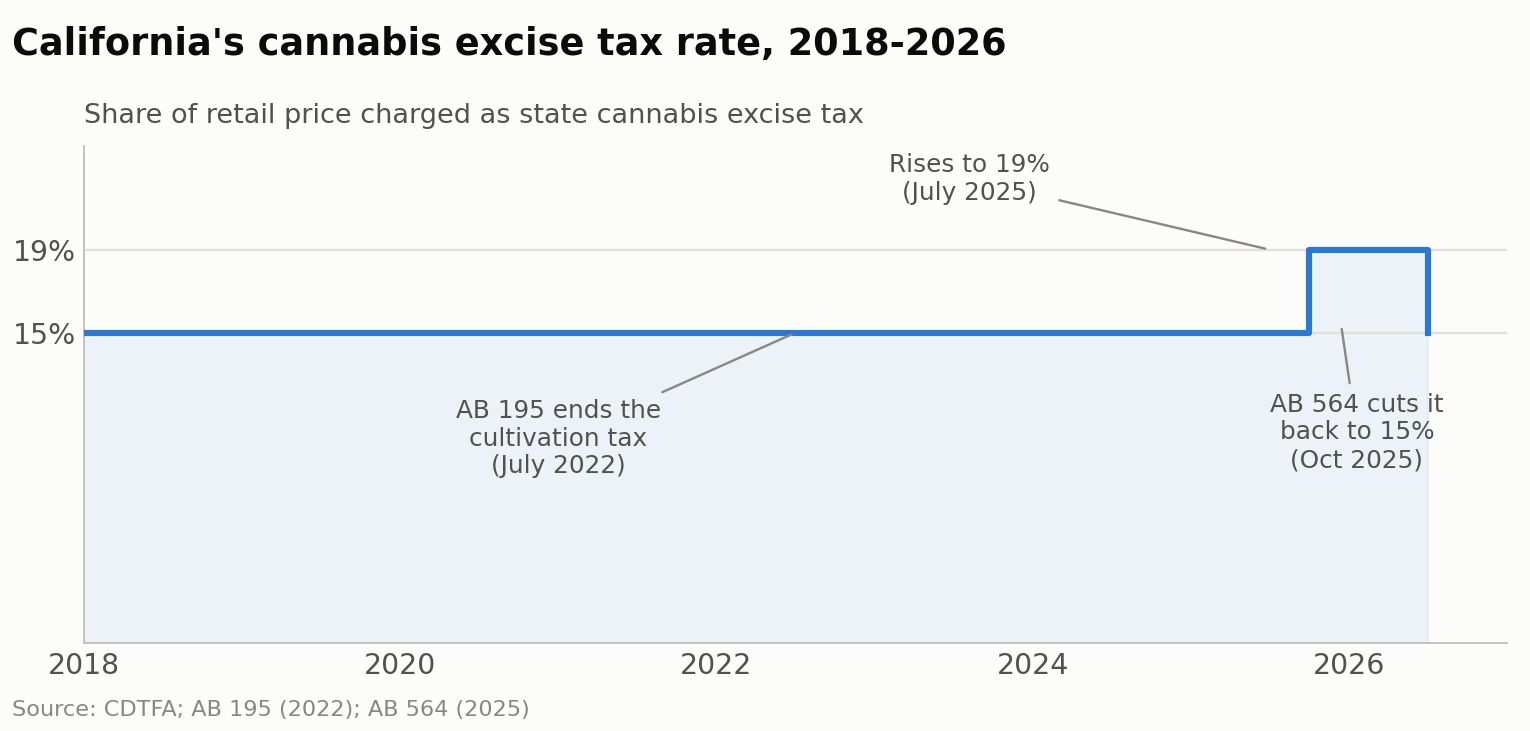
That stacked design proved unworkable for growers, and in 2022 the Legislature rewrote it. Assembly Bill 195 eliminated the cultivation tax entirely as of July 1, 2022, a levy that had raised about $501 million over its life. Eliminating a tax meant replacing the revenue, so AB 195 let the excise tax rise over time to make up the gap. That mechanism pushed the excise rate from 15% up to 19% on July 1, 2025.
The higher rate lasted three months. Arguing the increase would drive more sales into the illegal market, the industry backed Assembly Bill 564, which Governor Gavin Newsom signed into law as Chapter 127 of 2025. It rolled the excise tax back to 15% effective October 1, 2025, and delayed the next scheduled increase until the 2028-29 fiscal year. That 15% is the rate in effect today.
Where California's cannabis tax revenue goes: The 60-20-20 rule
Here is the part almost no one explains, and it is written directly into Proposition 64: cannabis tax money cannot be spent on whatever the Legislature prefers. It moves through a legally fixed order.
First, revenue covers the state's own cost of regulating cannabis: the licensing agencies, enforcement, lab-testing oversight, and tax collection. Next, a set of specified programs are funded, including cannabis research and community reinvestment. Only what remains, the large majority in a healthy year, reaches the split voters actually hear about, divided by a formula the initiative locked in place.
The 60-20-20 allocation:
| Share | Purpose | What it funds |
|---|---|---|
| 60% | Youth | Substance-use education, prevention and treatment; child care and early-childhood programs |
| 20% | Environment | Cleanup and restoration of public land damaged by illegal cultivation |
| 20% | Public safety | Grants to local law enforcement and the CHP; impaired-driving programs |
The rigidity is the point, and the catch. Because the 60-20-20 split is written into a voter-approved initiative, the Legislature cannot reweight it; if one category is oversubscribed and another underspent, the money cannot simply be moved. The LAO flagged exactly this in its review of the system, and its broader conclusion about the whole tax structure was blunt: "No individual type of tax performs best on all criteria."
California's cannabis sales have fallen for four straight years:
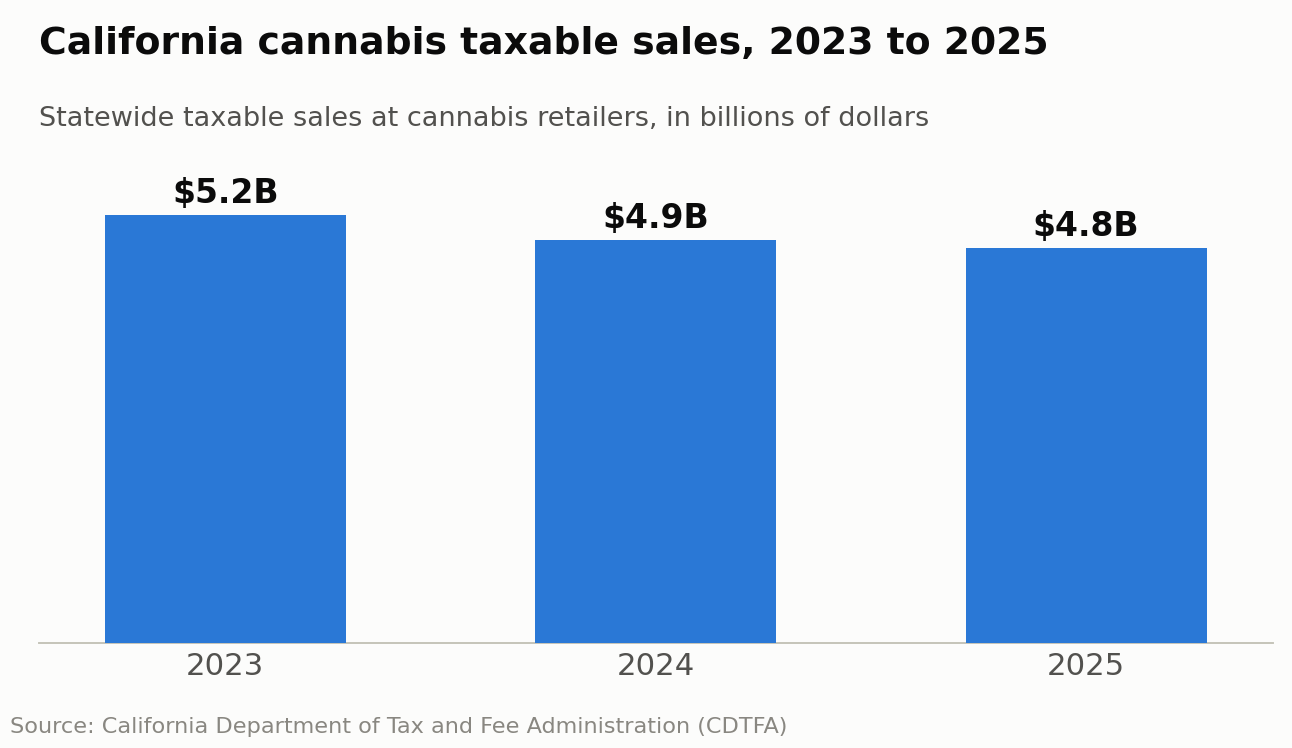
For its first few years, California's legal market grew quickly, and the tax take grew with it. Then it turned. Statewide taxable sales have now declined four years running, a trend we also traced in our earlier review of California cannabis sales.
Taxable-sales trajectory in California since 2023:
| Year | Taxable sales at cannabis retailers |
|---|---|
| 2023 | About $5.2 billion |
| 2024 | About $4.9 billion |
| 2025 | About $4.8 billion |
Measured as cannabis products alone, the slide is steeper: roughly $4.2 billion in 2024 to $3.9 billion in 2025. The state's own quarterly excise numbers tell the same story: $156.9 million in the third quarter of 2023 against $143.6 million in the first quarter of 2026, even as the cumulative since-2018 total climbed past $8.1 billion. Several forces pull the same way: falling wholesale prices, market saturation, high combined taxes, and the one the state is now spending hard to fight, a large illegal market that pays none of these taxes at all.
California's illegal cannabis market still outsells the legal one:
California's legal system competes every day with an illegal one that undercuts it precisely because it carries no tax, no testing, and no licensing cost. In its analysis, the LAO noted the illicit market "remains substantial," and that by some estimates the large majority of California-grown cannabis flows outside the legal channel. Industry analyses commonly put the legal market at only around 38% of what Californians actually consume, meaning roughly six in ten purchases happen off the books.
That single fact is what makes the tax question so hard, and it is why the state escalated enforcement in 2026:
- California's tax authorities have seized $168 million in illegal cannabis and tobacco since 2019, including nearly $22 million in the first half of 2026 alone.
- A multi-agency Unified Cannabis Enforcement Task Force has accounted for $1.3 billion in illicit cannabis seizures.
- In June 2026 the state announced $227 million in Proposition 64 grants, part of more than $350 million committed statewide, funding local enforcement, youth prevention, public health, and environmental cleanup. Prior grant operations eradicated nearly one million illegal plants and seized 295 illegal firearms; Humboldt County alone pulled more than 267,000 unpermitted plants.
"The voters created a legal, regulated cannabis market, and we have a responsibility to make sure it works as intended," Newsom said in announcing the June grants.
The cannabis tax tradeoff: Higher rates raise revenue but shrink the legal market
The most useful thing California's own analysts have said about cannabis taxes is that every option is a compromise. Before the 2022 reforms, the LAO modeled what different rates would do, and the results map the bind exactly. Lowering the tax makes legal cannabis more competitive and grows legal consumption, but can cut state revenue sharply, potentially below the thresholds that keep funded programs whole. Raising the tax does the reverse: more money per sale, but fewer legal sales as buyers defect.
LAO tradeoff scenarios:
| Illustrative rate change | Effect on legal consumption | Effect on state revenue |
|---|---|---|
| Cut excise to about 11% | +6% to +20% | −34% to −43% |
| Hold excise at 15% | +3% to +11% | −16% to −25% |
| Raise excise to 20% | −2% to +1% | −5% to +3% |
| Raise excise to 25% | −7% to −22% | +18% to +40% |
Source: Legislative Analyst's Office, pre-2022 analysis. Illustrative of the tradeoff, not current forecasts.
As the LAO put it, "Any tax rate change would help the state meet certain goals while likely making it harder to achieve others." The office raised a subtler catch about the youth-protection rationale, too: if young
Exanmop people can easily buy from the illegal market, taxing legal cannabis more heavily does not necessarily raise the price they actually pay, so a higher tax may not deliver the reduction in youth use it promises.
California's current bet, cutting the rate to 15% and then spending heavily to shrink the illegal market by force, is an attempt to win both sides of that tradeoff at once: a more competitive legal price and a smaller illicit competitor. Whether it works is an empirical question the next few quarters of CDTFA data will begin to answer.
What California's cannabis tax cut means going forward:
For a shopper, the October 2025 rate cut means a modestly lower tax at the register. For the programs Proposition 64 funds, youth treatment, environmental restoration, local public safety, the stakes are larger and less visible: their budgets ride on a legal market that has been shrinking, cushioned for now by a tax the state just chose to lower. California is wagering that a cheaper legal product and a costlier illegal one will finally move where people buy. The scoreboard is public and updated every quarter, in the CDTFA's cannabis revenue reports, the clearest place to watch whether California's decade-long experiment in taxing legal weed is stabilizing or still sliding.
Rates and cumulative figures reflect CDTFA data as of the Q1 2026 report and the current CDTFA rate schedule. The LAO rate scenarios are from its pre-2022 analysis and illustrate the tradeoff rather than forecasting current outcomes.


