

Newsom's commutations of California's 548 death sentences aren't in effect yet, and 382 need the California Supreme Court's recommendation first
Governor Gavin Newsom announced November 5 that he will commute every death sentence in California to life without parole. The Constitution requires the Supreme Court's recommendation for anyone twice convicted of a felony, and he asked the Court to act by the end of the year.


Governor Gavin Newsom announced on November 5 that he will commute every death sentence in California to life in prison without the possibility of parole. The plan covers 548 people. None of the commutations has taken effect yet, and 382 of them can't be granted unless the California Supreme Court recommends them first.
A commutation replaces a sentence with a lesser one. According to the Governor's fact sheet, this one releases no one, makes no one eligible for parole and leaves every conviction and restitution order in place. Everyone on the list would stay in prison for the rest of their life.
Timing is the open question. Newsom asked the Supreme Court in a November 5 letter to act by the end of the year, before his term ends. Governor-elect Xavier Becerra takes office on January 4, 2027. His stated commitment is to extend the execution moratorium Newsom imposed in 2019, which halts executions without changing anyone's sentence.
The Governor's office posted the letter, the fact sheet, its request to the Court and the full list of 548 names on its clemency page. Our count of that list shows how long people have been under sentence of death and which counties prosecuted them.
Newsom's November 5 letter commits to commuting all 548 California death sentences:
In his open letter to Californians, Newsom wrote that he had "decided to exercise my constitutional clemency authority to commute all California death sentences to life without the possibility of parole." He called state-sanctioned killing "incompatible with California's values" and said California's system for administering the death penalty "is a failure."
He also wrote that he had considered treating some crimes or offenders differently and decided against it. Attempting to distinguish among them, he wrote, "would inadvertently create two classes of murder victims." Every person on the list would get the same sentence.
"These offenders will die in prison but not by our hand."
Governor Gavin Newsom, open letter to Californians, November 5, 2026
The letter is explicit about what the action leaves alone. It "does not repeal the death penalty," Newsom wrote, and "the discretion to seek, impose, and uphold death sentences in individual cases remains, as ever, in the hands of prosecutors, juries, and courts." Prosecutors can still seek death sentences, and juries can still return them.
Newsom put the number under sentence of death at 548 and called it "the largest death row in the Western Hemisphere." The fact sheet says 529 are men and 19 are women, and that California's last execution took place on January 17, 2006. The Death Penalty Information Center, which tracks clemency nationally, said that other governors "have granted universal clemencies" but "none have been at this scale."
A commutation changes the sentence and leaves the conviction in place:
Article V, section 8 of the California Constitution lets the governor "grant a reprieve, pardon, and commutation, after sentence." They are three different tools. The difference explains why Newsom's 2019 moratorium needed no court involvement and this action does.
Reprieve, commutation and pardon under California's Constitution:
| Form of clemency | What it does | Where it appears in this story | Needs a Supreme Court recommendation for someone twice convicted of a felony |
|---|---|---|---|
| Reprieve | Halts an execution and leaves the sentence in place | Newsom's March 13, 2019 moratorium, issued as a reprieve for everyone sentenced to death | No |
| Commutation | Replaces a sentence with a lesser one and leaves the conviction in place | The November 5, 2026 plan to change all 548 death sentences to life without the possibility of parole | Yes: 382 of the 548 |
| Pardon | Relieves punishment and restores some civic rights, usually for people who have completed their sentences | Not part of this action | Yes |
Newsom's 2019 executive order imposed the moratorium "in the form of a reprieve for all people sentenced to death." The order said it "does not provide for the release of any person from prison or otherwise alter any current conviction or sentence." All 548 death sentences on the current list are still in force, and a commutation would replace them.
The fact sheet lists what the commutations would not do. They would not:
- release anyone from prison;
- make anyone eligible for parole;
- pardon anyone or find anyone innocent;
- change any conviction;
- erase any restitution order.
The fact sheet also says the people on the list are "specifically excluded" from the Board of Parole Hearings' new commutation and resentencing rules. Those rules took effect October 1, 2026, and let people who have served 25 continuous years in prison be assessed for a commutation or resentencing recommendation. Their text makes ineligible anyone "sentenced to death" and anyone "who received a commutation of sentence during their current term of incarceration."
382 of the 548 commutations need a California Supreme Court recommendation:
The same section of the Constitution sets a condition. The governor "may not grant a pardon or commutation to a person twice convicted of a felony except on recommendation of the Supreme Court, 4 judges concurring."
Newsom's staff checked state Justice Department criminal history records for everyone under sentence of death, and federal records for those with one California felony, according to the explanatory statement the Governor sent the Court. They found 382 people with more than one felony conviction. Those 382 are marked with an asterisk on the full list of 548 and listed separately in the list sent to the Court. That is 70% of everyone under sentence of death. The other 166 have one felony conviction, and the Constitution doesn't require the Court's recommendation for them.
Four justices have to concur. The Court has six sitting justices, according to its roster: Chief Justice Patricia Guerrero and Associate Justices Carol Corrigan, Goodwin Liu, Leondra Kruger, Joshua Groban and Kelli Evans. The seventh seat is vacant. Groban and Evans are winning their retention votes in the November 3 count.
The Court has described its role narrowly. In a 2018 statement of its procedures for these requests, quoted in the Governor's filing, it said its recommendation is "not a recommendation that the Governor grant" clemency. It is an "acknowledgment that the Governor may legitimately consider granting" it. The Court has said its job is to decide whether a grant would be "an abuse of that power."
Newsom's statement argues that his reasons, which apply equally to everyone sentenced to death, are "neither arbitrary nor an abuse of power." Unlike most of his earlier requests to the Court, this one includes no clemency applications and no records about individual rehabilitation. The statement says those records aren't relevant because the action is the same for everyone and no one would be released.
The Criminal Justice Legal Foundation, a Sacramento legal nonprofit, urged the justices to "review each of these cases, one at a time." "The Constitution gives the Supreme Court a real role here, not a rubber stamp," said Anne Marie Schubert, its president and CEO.
Newsom asked the Court to act by the end of 2026, before Becerra takes office January 4, 2027:
Newsom's letter to the Court asks it to "issue its recommendation by the end of this year so that I may act before the end of my term." Under article V, section 2 of the Constitution, a governor's term starts "the Monday after January 1 following the election." In 2027 that Monday is January 4, when Governor-elect Xavier Becerra takes office.
None of the Governor's documents says what happens to the request if the Court hasn't acted by then. The clemency page says only that "the commutations will not go into effect until the necessary legal steps are completed." The notice to victims' families from the prison system's Office of Victim and Survivor Rights and Services says those steps, "including review by the California Supreme Court for certain cases," must be completed first. "We do not know when this will be completed," it adds.
Becerra's public commitment is to the moratorium. In a post on X in May, he wrote: "As Governor, I will extend California's moratorium on executions and continue moving our state away from a costly, flawed system that disproportionately impacts Black and brown communities and too often gets it wrong." The moratorium is the 2019 reprieve, which stops executions and leaves death sentences in place. His platform as a candidate is covered in our governor's race guide.
The dates that matter:
- January 17, 2006: California carries out its last execution, according to the fact sheet.
- March 13, 2019: Newsom's executive order halts executions with a reprieve, repeals the lethal injection protocol and closes San Quentin's execution chamber.
- October 1, 2026: The parole board's new commutation and resentencing rules take effect.
- November 5, 2026: Newsom releases his letter, the list of 548 and his request to the Supreme Court.
- December 31, 2026: The end of the year, the date by which Newsom asked the Court to act.
- January 4, 2027: Becerra takes office.
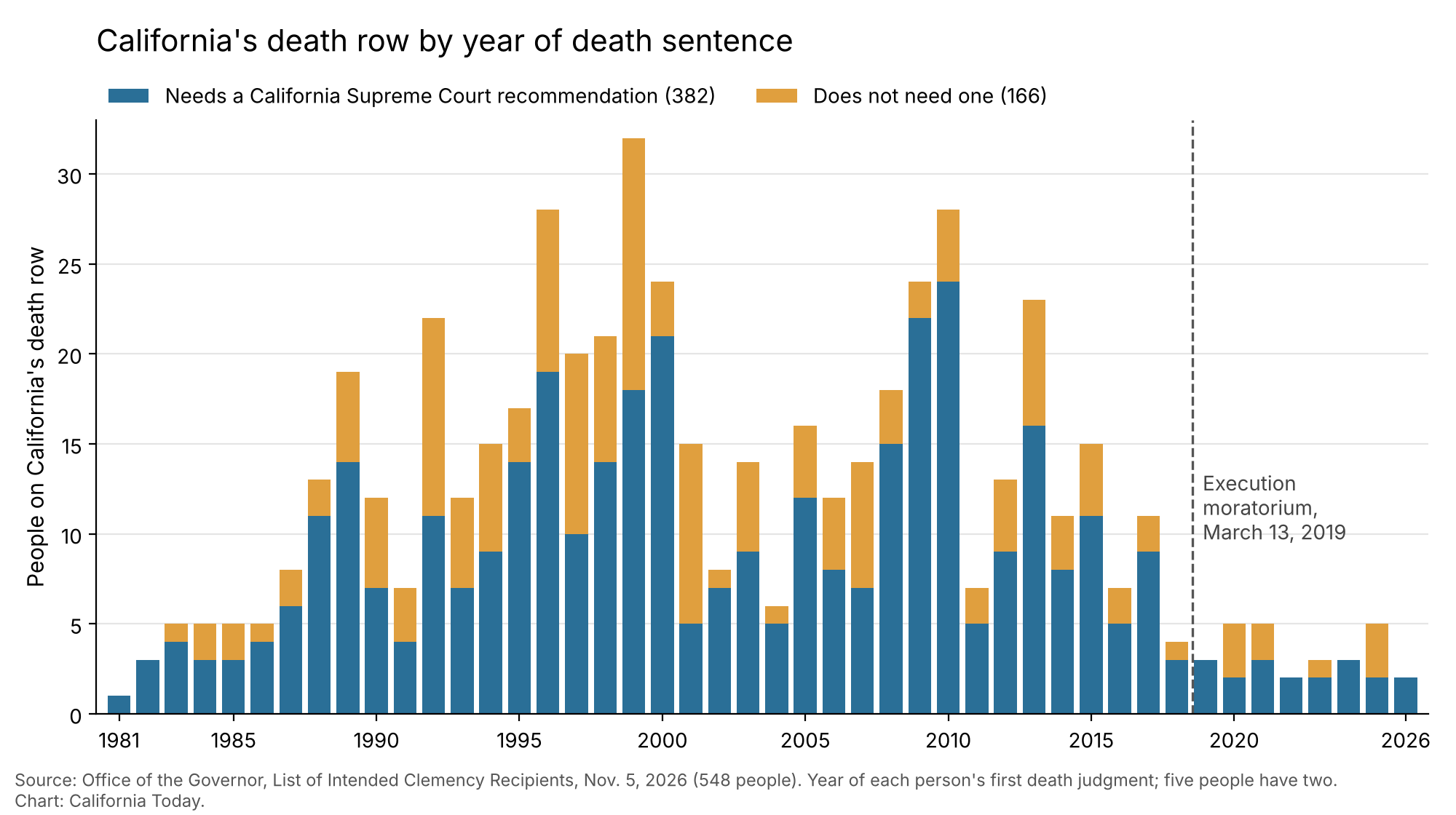
California's death row holds 548 people sentenced between 1981 and 2026:
The Governor's list gives each person's prosecuting county, trial county, trial case number and the date of each death judgment. We counted every entry. Five people have two death judgments from separate cases, so the list holds 553 judgments in all.
Measured from each person's first death judgment to November 5, 2026, the median person on the list has been under sentence of death for about 26 years. Of the 548, 343 (63%) were sentenced 20 or more years ago, 173 at least 30 years ago and 23 at least 40 years ago. The oldest judgment dates from July 28, 1981, in Los Angeles County. The newest dates from August 21, 2026, in Riverside County.
Death sentences on the list peaked in the 1990s, which account for 188 of the 553 judgments. The 2000s account for 152 and the 2010s for 123. The 2020s so far account for 25. Courts have kept imposing them since the moratorium: 28 people on the list were sentenced to death after March 13, 2019.
Many of the 548 are still in the legal process. The fact sheet says 376 are waiting for state habeas corpus counsel, the lawyers who bring post-conviction challenges, or for funding for that counsel. It says 220 have waited 15 years or more. Without the moratorium, 45 people would be "immediately subject to execution," according to the fact sheet.
Los Angeles and Riverside counties prosecuted 244 of the 548 people on California's death row:
Forty-two of California's 58 counties prosecuted at least one person on the list. Los Angeles County prosecuted 157 and Riverside County prosecuted 87, together about 45% of the total. Orange (48), San Bernardino (40) and San Diego (30) follow. Four people were sentenced to death in cases from two different counties, and the counts include them under both.
Riverside County stands out since the moratorium. It prosecuted 12 of the 28 people sentenced to death after March 13, 2019, and San Bernardino County prosecuted five, so the two Inland Empire counties account for 17 of the 28. Los Angeles County accounts for two.
In 22 judgments, the trial took place in a different county from the one that brought the charges.
California death row by county of prosecution, from the Governor's November 5 list:
| County | People on death row from this county's cases | Need a Supreme Court recommendation | Sentenced since the March 2019 moratorium |
|---|---|---|---|
| Los Angeles | 157 | 111 | 2 |
| Riverside | 87 | 58 | 12 |
| Orange | 48 | 30 | 0 |
| San Bernardino | 40 | 31 | 5 |
| San Diego | 30 | 21 | 1 |
| Kern | 23 | 17 | 1 |
| Sacramento | 19 | 13 | 2 |
| Alameda | 14 | 12 | 0 |
| Tulare | 14 | 10 | 3 |
| Ventura | 14 | 8 | 0 |
| Fresno | 11 | 9 | 0 |
| Contra Costa | 10 | 6 | 0 |
| Stanislaus | 10 | 5 | 1 |
| Shasta | 7 | 5 | 0 |
| Kings | 6 | 5 | 0 |
| San Joaquin | 6 | 4 | 0 |
| San Mateo | 6 | 5 | 0 |
| Santa Clara | 5 | 3 | 0 |
| El Dorado | 4 | 2 | 0 |
| Monterey | 4 | 3 | 0 |
| Sonoma | 4 | 3 | 0 |
| Marin | 3 | 3 | 0 |
| Placer | 3 | 1 | 0 |
| Santa Barbara | 3 | 3 | 0 |
| Butte | 2 | 2 | 0 |
| Imperial | 2 | 2 | 0 |
| Lake | 2 | 2 | 0 |
| Madera | 2 | 1 | 0 |
| San Luis Obispo | 2 | 2 | 0 |
| Yolo | 2 | 1 | 0 |
| Amador | 1 | 1 | 0 |
| Calaveras | 1 | 1 | 0 |
| Lassen | 1 | 0 | 0 |
| Mariposa | 1 | 1 | 0 |
| Merced | 1 | 1 | 1 |
| Modoc | 1 | 0 | 0 |
| Santa Cruz | 1 | 1 | 0 |
| Solano | 1 | 1 | 0 |
| Sutter | 1 | 1 | 0 |
| Tehama | 1 | 0 | 0 |
| Tuolumne | 1 | 1 | 0 |
| Yuba | 1 | 0 | 0 |
| California (548 people; four are counted under two counties) | 548 | 382 | 28 |
A person sentenced to death in cases from two counties appears under both, so the county rows add up to 552 while the total is 548.
Richard Allen Davis, sentenced to death for Polly Klaas's murder, is on the Supreme Court list:
Richard Allen Davis, convicted of murdering 12-year-old Polly Klaas, was sentenced to death on September 26, 1996, according to the Governor's list. The case was charged in Sonoma County and tried in Santa Clara County, and the California Supreme Court upheld the judgment in 2009. Davis is marked on the list as having more than one felony conviction, so his commutation is one of the 382 that need the Court's recommendation.
The Klaas family is divided. Polly's father, Marc Klaas, called the decision a "knife in the back" to victims' families. "I was told that when this guy was sentenced to death that this was a system we can trust," he told NBC News. "But here we are, 33 years later, and it's a system we can't trust."
Jess Nichol, Polly's sister, supported it. She said in a statement released by supporters of the clemency campaign that "whether he's executed has absolutely nothing to do with my recovery or with real public safety."
District attorneys are divided over Newsom's commutation plan:
Orange County District Attorney Todd Spitzer called the commutations "mercy for the wolves." He said his office will keep seeking death sentences in cases he considers heinous enough.
Spitzer also pointed to the parole board's new rules and wrote that people sentenced to death are now "one step closer to also being eligible for release from prison." The Governor's fact sheet says those commuted under this action would not become eligible for parole or for those rules. The rules' own text excludes anyone who has received a commutation during their current prison term.
San Bernardino County District Attorney Jason Anderson called the decision "arrogant and political showmanship." He said "the people of California have consistently and repeatedly voted in favor of the death penalty."
Contra Costa County District Attorney Diana Becton backed the plan. "By commuting death sentences, Governor Newsom will save California taxpayers hundreds of millions of dollars over the long term," she said in the clemency campaign's release. Gil Garcetti, a former Los Angeles County district attorney whose office sought death in some of the affected cases, said in the same release that he now sees the death penalty as "a failed policy that detracts from real public safety solutions."
California voters kept the death penalty in 2012 and 2016:
Newsom's letter acknowledges that "California voters have voted to keep the death penalty on the books." In 2012, Proposition 34, which would have repealed the death penalty, failed with 48.0% of the vote, according to the Secretary of State's 2012 results. In 2016, voters rejected another repeal, Proposition 62, with 46.8% voting yes. The same year they approved Proposition 66, listed as "Death Penalty Procedure Time Limits," with 51.1%, according to the 2016 results.
The commutations don't change those results. The death penalty remains California law, and prosecutors and juries can still use it.
California's 548 death sentences remain in place until Newsom issues the commutations:
Until the commutations are issued, every sentence on the list stays in force, with executions halted under the 2019 moratorium. For 382 people, Newsom needs the Supreme Court's recommendation first, and he has asked for it by December 31. The other 166 don't need the Court, but the Governor's office says none of the commutations takes effect until the legal steps are complete. Becerra takes office January 4. We will update this guide when the Court acts and when the commutations are issued.
Sources & References
- Office of the Governor, "Governor Newsom releases letter to California on the death penalty," November 5, 2026: https://www.gov.ca.gov/2026/11/05/governor-newsom-releases-letter-to-california-on-the-death-penalty/
- Office of the Governor, Governor Newsom's Open Letter Regarding Commutation of All Death Sentences, November 5, 2026: https://www.gov.ca.gov/wp-content/uploads/2026/11/2026-11-5-26-GGN-Open-Letter-FINAL.pdf
- Office of the Governor, Clemency page (Death Penalty section): https://www.gov.ca.gov/clemency/
- Office of the Governor, Fact Sheet: California Commutations: https://www.gov.ca.gov/wp-content/uploads/2026/11/11-5-26-External-Fact-Sheet-Clemency-Action.pdf
- Office of the Governor, Letter to the Supreme Court of California, Request for Clemency Recommendation, November 5, 2026: https://www.gov.ca.gov/wp-content/uploads/2026/11/2026-11-5-26-GGN-Letter-to-Court-FINAL.pdf
- Office of the Governor, Explanatory Statement, Proposed Death Penalty Clemency Action: https://www.gov.ca.gov/wp-content/uploads/2026/11/2026-11-5-26-GGN-Explanatory-Statement-FINAL.pdf
- Office of the Governor, List of Intended Clemency Recipients: https://www.gov.ca.gov/wp-content/uploads/2026/11/List-of-Intended-Clemency-Recipients.pdf
- Office of the Governor, List of Intended Clemency Recipients Twice Convicted of a Felony: https://www.gov.ca.gov/wp-content/uploads/2026/11/FOR-COURTS-2026-11-5-26-CA-List-of-Intended-Clemency-Recipients.pdf
- California Department of Corrections and Rehabilitation, Office of Victim and Survivor Rights and Services, Notice of Death Penalty Sentence Change, November 5, 2026: https://www.gov.ca.gov/wp-content/uploads/2026/11/Notice-from-OVSRS-Victim-Services.pdf
- Executive Order N-09-19, March 13, 2019: https://www.gov.ca.gov/wp-content/uploads/2019/03/3.13.19-EO-N-09-19.pdf
- California Constitution, article V, section 8: https://leginfo.legislature.ca.gov/faces/codes_displaySection.xhtml?lawCode=CONS§ionNum=SEC.%208.&article=V
- California Constitution, article V, section 2: https://leginfo.legislature.ca.gov/faces/codes_displaySection.xhtml?lawCode=CONS§ionNum=SEC.%202.&article=V
- Supreme Court of California, Justices of the Court: https://supreme.courts.ca.gov/about-court/justices-court
- Board of Parole Hearings, Regulatory Changes (Commutation and Recall of Sentence Recommendation Assessment Process): https://www.cdcr.ca.gov/bph/statutes/reg-revisions/
- Board of Parole Hearings, Final Approved Regulation Text, filed July 9, 2026: https://www.cdcr.ca.gov/bph/wp-content/uploads/sites/161/2026/07/2026-0528-01S-Approved-1.pdf
- Xavier Becerra, post on X, May 2026: https://x.com/XavierBecerra/status/2060056603462865166
- People v. Davis (2009), Supreme Court of California, S056425: https://scocal.stanford.edu/opinion/people-v-davis-32972
- NBC News, "California Gov. Gavin Newsom plans to commute all death sentences," November 5, 2026: https://www.nbcnews.com/news/us-news/california-gov-gavin-newsom-commutes-death-sentences-rcna607727
- Clemency coalition release on Governor Newsom's decision, November 5, 2026: https://clemencyca.org/release-newsom-decision-commute-death-sentences/
- Orange County District Attorney, statement on Governor Newsom's commutation of all death sentences, November 5, 2026: https://ocdistrictattorney.gov/press/orange-county-district-attorney-todd-spitzer-issues-statement-on-governor-newsoms-commutation-of-all-death-sentences-in-california/
- San Bernardino County District Attorney, statement on Governor Newsom's death penalty commutations, November 5, 2026: https://da.sbcounty.gov/2026/11/05/statement-from-san-bernardino-county-district-attorney-anderson-on-governor-newsoms-death-penalty-commutations/
- Criminal Justice Legal Foundation, press release, November 5, 2026: https://cjlf.org/press-releases/newsom-death-row-commutations-newsom-breaks-2019-promise-erases-548-death-sentences-on-his-way-out-of-office
- Death Penalty Information Center, November 5, 2026: https://deathpenaltyinfo.org/news/governor-gavin-newsom-grants-largest-mass-commutation-in-u-s-history-to-death-sentenced-prisoners-in-california
- California Secretary of State, Statement of Vote, November 6, 2012, summary: https://elections.cdn.sos.ca.gov/sov/2012-general/06-sov-summary.pdf
- California Secretary of State, Statement of Vote, November 8, 2016, summary: https://elections.cdn.sos.ca.gov/sov/2016-general/sov/06-sov-summary.pdf


