

California's Prop 40 billionaire tax could pass and still be blocked if Prop 41 or 42 gets more yes votes
Prop 40 needs a majority to pass, but if Prop 41 or Prop 42 gets more yes votes, the billionaire tax could be stopped in court. The constitutional rule, each measure's conflict clause, the three possible outcomes, the October polls and the dates in the count.


California's billionaire tax has to clear two bars today, not one. Proposition 40, the one-time 5% tax on the net worth of the state's billionaires, passes if it gets more yes votes than no votes. It survives only if it also collects more yes votes than Proposition 41 and Proposition 42, two measures on the same ballot that each declare a tax of Prop 40's kind "in conflict" with them and "null and void" if they win more yes votes.
The rule behind that is Article II, Section 10(b) of the California Constitution, and the state's Voter Information Guide warns on Prop 40's page that the measure "could be stopped from becoming law even if it gets yes votes from a majority of voters." The two most recent polls both put Prop 42 ahead of Prop 40 in yes support: PPIC's October survey has Prop 42 at 51% yes and Prop 40 at 46%, and the Berkeley IGS Poll released on October 29 has them at 43% and 42%, with none of the three measures above 50% in that survey.
This page explains the rule, each measure's conflict clause, the three ways the count can end, the polls and the money, the 60-day lawsuit clock written into Prop 40's own text, and the dates to watch between tonight's first report and certification on December 11. Our 2026 California ballot cheat sheet puts all 14 measures on one page with a printable PDF, our 2026 California propositions master guide covers each one in depth, and the voting master guide covers where and how to vote until 8 p.m.
Article II, Section 10(b) scores conflicting measures by yes votes, not percentages:
The California Constitution provides, in Article II, Section 10(b): "If provisions of two or more measures approved at the same election conflict, the provisions of the measure receiving the highest number of affirmative votes shall prevail." Article XVIII, Section 4 applies the same rule to constitutional amendments, and all three of these measures amend the Constitution.
Three features of the rule matter today. It applies only to measures that are "approved," so a measure that fails is out of the comparison. It counts "affirmative votes," meaning raw yes votes, not the yes percentage; a measure that more voters skip can post a higher percentage on fewer votes. And it applies only to provisions that "conflict," a question the Constitution leaves to the courts when the measures' own texts do not settle it.
Props 41 and 42 each declare a tax like Prop 40's "in conflict" with them:
Proposition 41 and Proposition 42 were filed with the Attorney General on January 12, 2026 by the same proponent, attorney Kurt R. Oneto, two months after SEIU-United Healthcare Workers West filed the billionaire tax. Neither text names Prop 40, billionaires or a wealth tax. Each instead describes a category of tax, states that it applies to measures "on the ballot at the same election," and attaches a conflict clause.
Prop 41's text says that any same-ballot initiative that "contains a state tax that is exempted or excluded from the Government Spending Limitation," meaning the Article XIII B appropriations limit, "shall be deemed to be in conflict with this measure," and that if Prop 41 "receives a greater number of affirmative votes, the provisions of this measure shall prevail in their entirety, and all the provisions of the other measure shall be null and void." Prop 40's text places its revenue outside that limit.
Prop 42's text uses the same most-votes and null-and-void wording against any same-ballot initiative that would impose "a tax on the ownership or control of retirement holdings, individually owned assets, and other forms of personal savings," a phrase it defines to include "financial assets, investment accounts, business interests, digital assets, intellectual property," or a tax based on "a status that occurred or was present prior to the effective date." Prop 40 taxes securities, business interests and intellectual property, and it fixes liability on residency as of January 1, 2026 and net worth as of December 31, 2026.
Prop 40's own conflict clause is narrower. It reaches only another measure that taxes "net worth, not income, of billionaires" or spends the money from such a tax, and neither 41 nor 42 does either. Prop 41 and Prop 42 do not describe each other either, so by our reading of the three texts the only conflicts on the table run between Prop 40 and each of the other two. Both 41 and 42 also carry a revival clause: if either is approved, loses to a conflicting measure on yes votes, and that measure "is later held invalid," it "shall be self-executing and given full force and effect."
The Voter Information Guide puts the consequence in a box on all three measures' pages. Prop 40's reads:
"If Proposition 41 or 42 on this same ballot receive more 'yes' votes than Proposition 40, then Proposition 40 could be stopped from becoming law even if it gets yes votes from a majority of voters. This is because the courts could find that Proposition 41 or 42 conflict with Proposition 40."
Source: California Voter Information Guide, Proposition 40 analysis
The count on Props 40, 41 and 42 can end three ways:
The three outcomes for Props 40, 41 and 42:
| Outcome | Vote result | Result for the billionaire tax | Result for Props 41 and 42 | Decided by |
|---|---|---|---|---|
| 1 | Prop 40 gets fewer yes than no votesThe conflict rule never comes into play | No tax. The 2026 Billionaire Tax Act fails. | Each passes or fails on its own majority. | The count, certified December 11 |
| 2 | Prop 40 passes with more yes votes than both Prop 41 and Prop 42Whether or not 41 and 42 also pass | Takes effect the fifth day after certification (December 16). By its own terms, its provisions prevail over any conflicting provision of 41 or 42. | If approved, each still takes effect except for any provision a court finds in conflict with Prop 40; both say they revive in full if Prop 40 is later held invalid. | The count, then any validation suit filed within 60 days |
| 3 | Prop 40 passes, but Prop 41 or Prop 42 passes with more yes votesRaw yes votes, not percentages | The Voter Information Guide's warning applies: Prop 40 "could be stopped from becoming law even if it gets yes votes from a majority of voters." | The measure with more yes votes declares Prop 40's provisions "null and void" if a court agrees the two conflict. | Sacramento County Superior Court, then the California Supreme Court on direct appeal |
| Rule: California Constitution, Article II, Section 10(b): "If provisions of two or more measures approved at the same election conflict, the provisions of the measure receiving the highest number of affirmative votes shall prevail." Conflict clauses: Prop 40 text, Sec. 8; Prop 41 text, Sec. 5; Prop 42 text, Sec. 5. Validation clock and venue: Prop 40 text, Revenue and Taxation Code §50314. | ||||
- Prop 40 fails. There is no billionaire tax, and the conflict rule never comes into play. Props 41 and 42 pass or fail on their own majorities.
- Prop 40 passes with more yes votes than both Prop 41 and Prop 42. The 2026 Billionaire Tax Act takes effect on the fifth day after the Secretary of State certifies the result on December 11, which is December 16, and its provisions prevail over any conflicting provision of 41 or 42. If 41 or 42 also passed, each still takes effect except where a court finds it conflicts with Prop 40.
- Prop 40 passes, but Prop 41 or Prop 42 passes with more yes votes. The guide's warning applies. The measure with more yes votes declares Prop 40's provisions "null and void," and whether the two actually conflict is decided in court. The word in the guide is "could," not "will."
The third outcome is the one the two measures were drafted to produce, and it turns on raw yes votes. On results night that means the number to watch is the yes-vote column on the Secretary of State's ballot-measures page, read across all three lines, rather than Prop 40's percentage alone.
Prop 42 outpolls the billionaire tax in both October surveys:
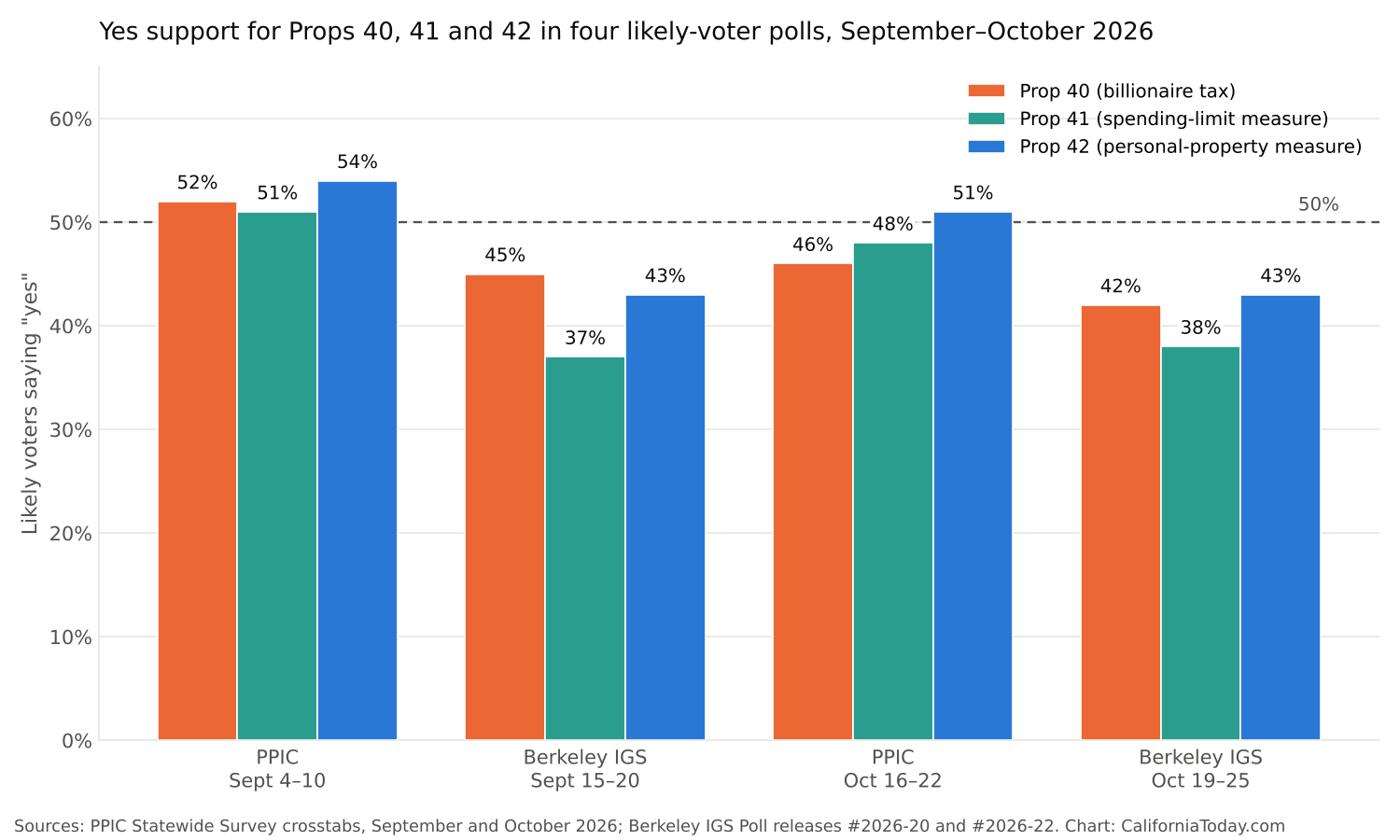
The Public Policy Institute of California's October survey, fielded October 16–22 among 1,728 adults with a likely-voter subgroup of 1,086 and a margin of error of ±3.8 points, found 46% of likely voters voting yes on Prop 40 and 52% no. The same survey found 48% yes on Prop 41 (49% no) and 51% yes on Prop 42 (47% no). In PPIC's September survey the three measures stood at 52–46, 51–44 and 54–43. Asked which of the 14 propositions they are most interested in, 22% of likely voters named Prop 40, second only to Proposition 39's voter ID requirement at 23%. Another 13% named Prop 42 and 4% named Prop 41.
The Berkeley IGS Poll, conducted online October 19–25 among 2,787 registered voters with a weighted likely-voter subset of 1,477 and a margin of error of about ±3 points, found 42% yes and 50% no on Prop 40, with 8% undecided. It put Prop 41 at 38% yes, 47% no and 16% undecided, and Prop 42 at 43% yes, 45% no and 12% undecided. In IGS's mid-September poll the yes figures were 45%, 37% and 43%. The release's headline finding was that "just one of seven state ballot propositions polled is receiving majority support," and it was not one of these three.
IGS also asked whether voters knew that Props 41 and 42 "were placed on the ballot by opponents of the billionaires tax." Just 55% said they were aware, and the release reports that "opposition to both counter initiatives was greater among voters who were aware of their connection to the opponents of Proposition 40 than those who were not." Eric Schickler, the institute's co-director, said in the release: "These results suggest that neither the advocates of the wealth tax nor those seeking to block future taxes have managed to persuade a majority of voters to their sides."
Read against the Constitution's rule, the two polls agree on one thing and differ on another. Both put Prop 42's yes share above Prop 40's, by five points in PPIC and one in IGS. On Prop 41, PPIC has it two points above Prop 40 and IGS has it four points below. The gaps run from one to five points, too small for either poll to settle the order. Polls also measure percentages of respondents, not the raw vote totals the rule counts.
Building a Better California has put $355.45 million behind the three lines:
The money has grown since September. The Fair Political Practices Commission's top-contributor list, last modified October 30, shows Building a Better California, the committee whose top donors are Sergey Brin and L. John Doerr III, at $140,000,000 to the main No on Prop 40 committee, $58,350,000 to Yes on 41 and $157,100,000 to Yes on 42. Adding the three lines gives $355.45 million from one committee across the three measures, against $56.5 million, $58.35 million and $73.8 million when we first reported the figures on September 29.
On the other side, the Yes on 40 – Billionaire Tax Now – No on 41 & 42 committee reports $32.4 million from its top contributors, $31.8 million of it from SEIU-UHW and its two political committees. The FPPC lists the same committee under all three measures because it was formed to support Prop 40 and oppose 41 and 42 at once; it is one pot of money. A second No on 40 committee, Golden State Promise, reports $10.45 million, $5 million each from Ripple Labs and Chris Larsen. The FPPC figures are totals from each committee's top contributors, not total receipts.
Prop 40's text sets a 60-day validation clock and sends appeals straight to the Supreme Court:
If Prop 40 passes, the litigation path is already written into its text. Revenue and Taxation Code Section 50314, which the measure adds, provides for "expedited, conclusive resolution of the facial validity of this act through a validation action" and sets the terms:
- "A validation action shall not be filed more than 60 days after the approval of the act by the voters." If none is filed in that window, the tax "shall be held to be facially valid and in every respect legal and incontestable."
- The sole venue is the Sacramento County Superior Court, where all actions are consolidated.
- Any appeal goes "directly to the California Supreme Court, without intermediate appellate review."
- The Superior Court "shall make every effort to resolve any validation action by April 1, 2027, and the California Supreme Court shall make every effort to resolve any review proceeding by November 1, 2027, or as soon as possible thereafter."
- The state, its agencies, the proponent "or in the absence of a proponent, any citizen of this state" can take part as an interested person.
The text does not say whether "approval of the act by the voters" means Election Day or the Secretary of State's certification. Counted from November 3, the 60 days run to January 2, 2027; counted from the December 11 certification, they run to February 9, 2027. Either way, the window closes before the tax's first payment is due with 2026 income-tax returns in 2027. The April 1 and November 1 target dates in the text are aspirations the courts are asked to meet, not deadlines they must.
The count on Props 40, 41 and 42 runs from tonight's first report to December 11:
The first numbers arrive after polls close at 8 p.m. Pacific time, when counties begin reporting to the Secretary of State and, by the state's key dates, keep reporting "at least every two hours until completed" on election night. That first report covers mail ballots received before Election Day and ballots cast in person. Everything else, including every ballot mailed in the final days, is added over the following weeks. Two days after the November 2024 general election, 33.8% of ballots were still uncounted by our math from the Secretary of State's unprocessed-ballot report, and 39.1% two days after this June's primary; our voting master guide has the full timeline.
- November 3, 8 p.m.: polls close; first semi-official results.
- November 10: last day for a ballot postmarked by Election Day to arrive and count.
- November 16: counties must report the count of all ballots except listed exceptions, or notify the Secretary of State of an extension, per the Secretary of State's results-site FAQ.
- November 25: last day for a voter to fix a missing or mismatched signature.
- December 3: counties certify; December 11: the Secretary of State files the Statement of Vote.
- December 16: the fifth day after certification, when approved measures take effect.
Three things to watch in that stretch. First, the ranking of raw yes votes across the three lines, which can change as late mail ballots are added. Second, the undervote: the yes percentage on each measure is a share of votes cast on that measure, and a measure more voters leave blank can lead in percentage while trailing in votes. Third, whether Prop 40 clears 50% at all, which IGS's October numbers say it was not doing among voters who had already returned a ballot (40% yes, 53% no) or those who had not (43% yes, 48% no).
California's billionaire tax after the polls close:
The California billionaire tax is decided today on two counts at once: whether Prop 40 wins a majority, and whether its yes votes outnumber those for Props 41 and 42. If it fails, there is no tax. If it passes and outpolls both rivals, the 2026 Billionaire Tax Act takes effect on December 16 and its provisions prevail. If it passes but either rival draws more yes votes, the courts decide whether the measures conflict and whether the billionaire tax survives. The yes-vote column on all three lines, not Prop 40's percentage, is the number that answers it.
Sources and References
- California Constitution, Article II, Section 10 https://leginfo.legislature.ca.gov/faces/codes_displaySection.xhtml?lawCode=CONS§ionNum=SEC.%2010.&article=II
- California Constitution, Article XVIII, Section 4 https://leginfo.legislature.ca.gov/faces/codes_displaySection.xhtml?lawCode=CONS§ionNum=SEC.%204.&article=XVIII
- California Secretary of State, Voter Information Guide, Proposition 40 analysis and "Potential Interactions With Other Propositions" https://vig.cdn.sos.ca.gov/2026/general/pdf/prop40.pdf
- Voter Information Guide, Text of Proposed Laws, Proposition 40 (2026 Billionaire Tax Act), Sec. 8 and Revenue and Taxation Code §50314 https://vig.cdn.sos.ca.gov/2026/general/pdf/prop40-text-proposed-laws.pdf
- Voter Information Guide, Proposition 41 analysis https://vig.cdn.sos.ca.gov/2026/general/pdf/prop41.pdf
- Voter Information Guide, Text of Proposed Laws, Proposition 41, Sec. 5 https://vig.cdn.sos.ca.gov/2026/general/pdf/prop41-text-proposed-laws.pdf
- Voter Information Guide, Proposition 42 analysis https://vig.cdn.sos.ca.gov/2026/general/pdf/prop42.pdf
- Voter Information Guide, Text of Proposed Laws, Proposition 42, Sec. 5 https://vig.cdn.sos.ca.gov/2026/general/pdf/prop42-text-proposed-laws.pdf
- Office of the Attorney General, active measures list (initiatives 25-0024A1, 25-0040A1, 25-0041A1) https://oag.ca.gov/initiatives/active-measures
- Public Policy Institute of California, Statewide Survey: Californians and Their Government, October 2026, likely-voter crosstabs (fieldwork October 16–22, 2026) https://www.ppic.org/wp-content/uploads/crosstabs-likely-voters-1026.pdf
- PPIC, Statewide Survey, October 2026, publication page https://www.ppic.org/publication/ppic-statewide-survey-californians-and-their-government-october-2026/
- PPIC, September 2026 likely-voter crosstabs (fieldwork September 4–10) https://www.ppic.org/wp-content/uploads/crosstabs-likely-voters-0926.pdf
- Berkeley IGS Poll, Release #2026-22, "California voters turning against Proposition 40, the Billionaires Tax," October 29, 2026 https://escholarship.org/content/qt72722408/qt72722408.pdf
- Berkeley IGS Poll, tabulations on state ballot propositions, October 29, 2026 https://escholarship.org/content/qt1vp9q3f9/qt1vp9q3f9.pdf
- Berkeley IGS Poll, Release #2026-20, September 25, 2026 (fieldwork September 15–20) https://escholarship.org/content/qt3w14s99c/qt3w14s99c.pdf
- Fair Political Practices Commission, Top 10 Contributors, November 2026 General Election (last modified October 30, 2026) https://www.fppc.ca.gov/search-filings/top-10-contributors-list/november-2026-general-election/
- California Secretary of State, General Election November 3, 2026, key dates and deadlines https://www.sos.ca.gov/elections/upcoming-elections/general-election-november-3-2026/key-dates-deadlines
- California Secretary of State, Election Night Results, ballot measures https://electionresults.sos.ca.gov/returns/ballot-measures
- California Secretary of State, Election Night Results, frequently asked questions https://electionresults.sos.ca.gov/frequently-asked-questions


