


Most treatment beds planned under California's 2024 Prop 1 mental health bond aren't due to be ready until Becerra is governor
State award files show the 2024 bond has awarded money for 6,919 residential treatment beds in 177 projects. Grantees expect 740 to be ready by the end of 2026, 5,837 between 2027 and 2030 and the last 342 in 2031.

California has awarded money from its 2024 mental health bond, Proposition 1, for 6,919 residential treatment beds, according to state award files. Most of those beds are in projects due to be finished while Xavier Becerra is governor. AP and NBC News projected Becerra the winner of the November 3 governor's race, and he takes office on January 4, 2027.
The 2024 measure is not this year's Proposition 1, the $11.25 billion housing bond AP projects voters approved on November 3. The 2024 Prop 1 authorized $6.38 billion in borrowing: about $4.4 billion to build places for mental health and addiction treatment and about $2 billion for housing. The state's voter guide estimated the treatment money would create "places for 6,800 people to receive mental health care and drug or alcohol treatment at any one time."
The question now is when the beds will be ready. Grantees, the organizations that won the awards, report a completion date for each project in files published by the state Department of Health Care Services (DHCS). By those dates, 740 beds, about one in nine, are due by the end of 2026. Another 5,837, or 84%, are due between 2027 and 2030, and the last 342 are due in 2031.
Becerra has made the bond part of his platform. His campaign's homelessness plan pledges to "implement every reform Proposition 1 authorizes" and "build thousands of treatment beds." The state's own records show what has been awarded, where it is going and when it is due.
Find your county: Prop 1 treatment beds and outpatient slots in all 48 counties with a project
Prop 1 awards cover 6,919 residential treatment beds in 177 projects:
DHCS awards the treatment money through its Behavioral Health Continuum Infrastructure Program, known as BHCIP. It has awarded bond money in two rounds so far and publishes a row for every project on the state's open data portal.
- Round 1, "Launch Ready," awarded in May 2025: 111 projects, $2.99 billion, 4,365 residential beds and 23,288 outpatient slots, according to the department's program summary.
- Round 2, "Unmet Needs," awarded March 11, 2026: 66 projects, $1.18 billion, 2,554 residential beds and 4,273 outpatient slots.
The two rounds total about $4.17 billion of the roughly $4.4 billion set aside for treatment. Our count from the two files matches the department's published bed and slot totals. This piece follows the residential beds, where patients stay during treatment.
The awards are conditional, which means a project can still shrink, change or drop out before the money is spent. DHCS has also made more awards since the files were posted. On October 30 it conditionally awarded more than $146 million in bond money to three projects: 107 beds by Signature Healthcare Services in Shasta County; a 50-bed facility by Cangress in Los Angeles County; and 30 residential addiction-treatment beds plus 120 outpatient slots by Compatior, also in Los Angeles County. Those three are not in this piece's totals.
His homelessness plan says "Bond funds are flowing, beds are being built." The award files show that the money is committed. They don't record payments or construction, so they can't confirm either half of that sentence.
Prop 1 projects holding 84% of the treatment beds are due between 2027 and 2030:
Every project in the files carries a "Project Completion" date supplied by the grantee. Grouped by year, the beds break down like this:
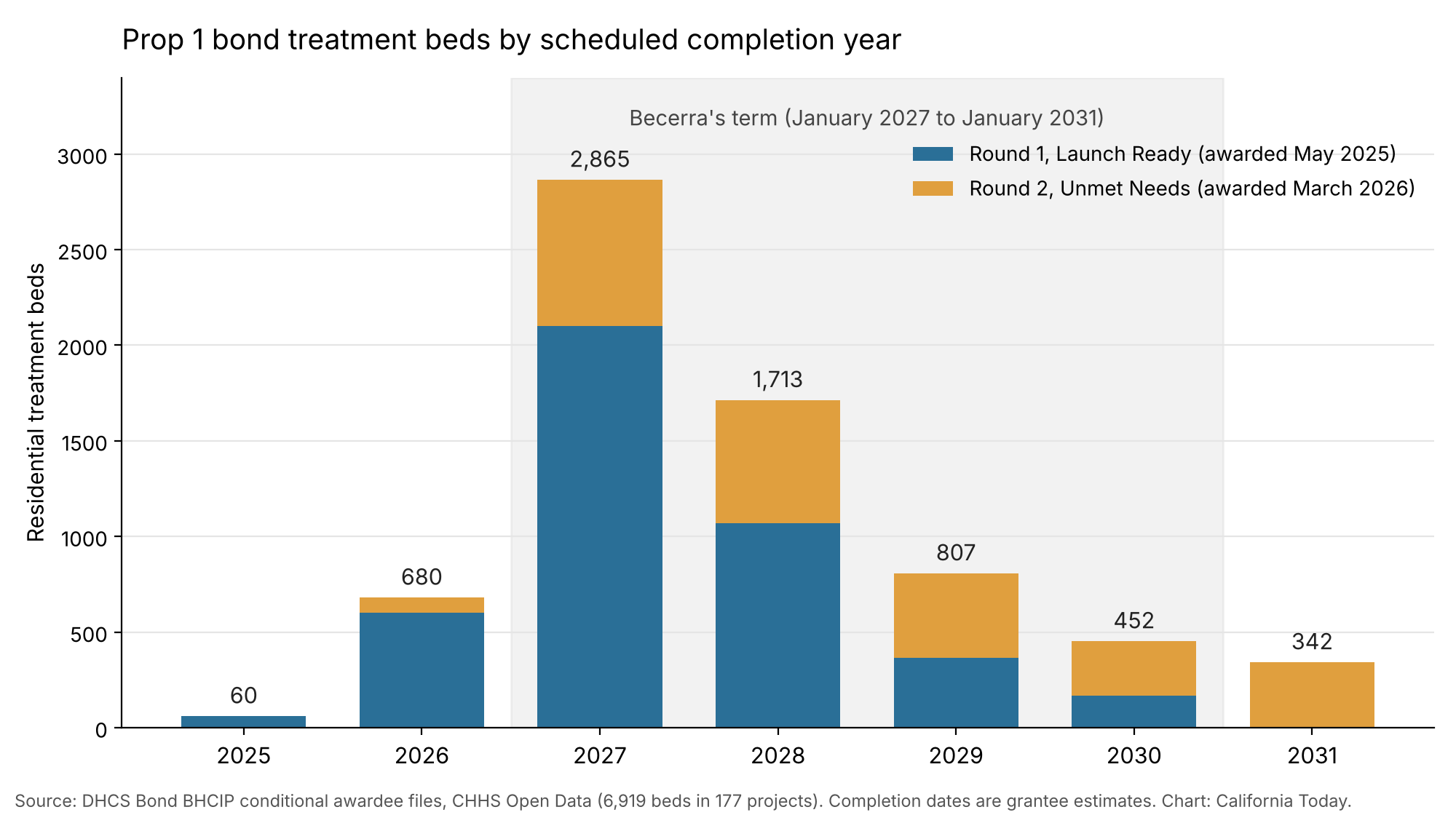
- 2025: 60 beds
- 2026: 680 beds
- 2027: 2,865 beds
- 2028: 1,713 beds
- 2029: 807 beds
- 2030: 452 beds
- 2031: 342 beds
The 2027 peak is mostly Round 1, whose projects were "launch ready" when they applied. Round 2 projects are due later. The last of them, including San Diego County's 160-bed Behavioral Health Wellness Campus ($99.5 million, due May 2031), come after Becerra's four-year term ends in January 2031.
These dates are estimates. DHCS's data dashboard, last updated July 28, 2026, calls its project figures "preliminary grantee-reported estimates" that can change. A completion date is a target, and the files don't say which of the 2025 and 2026 projects are finished or taking patients.
Addiction treatment accounts for 53% of the Prop 1 beds:
Prop 1 is known as a mental health measure, but more than half of the beds in the files, 3,692 of 6,919, are for treating substance use disorders. That count adds four DHCS categories: adult, perinatal and adolescent residential facilities for substance use disorders, plus chemical dependency recovery hospitals.
The largest mental health categories are:
- Mental health rehabilitation centers: 1,318 beds in residential programs for adults with serious mental illness.
- Social rehabilitation facilities: 440 beds in community residential programs for adults with mental illness.
- Peer respite: 376 beds for short stays in homelike settings run by people with their own experience of mental illness.
- Psychiatric hospital care: 226 beds in acute psychiatric hospitals, 180 in psychiatric health facilities and 156 in general hospitals that serve behavioral health patients only.
The other 531 beds are in smaller categories: nursing facilities with special treatment programs (216), crisis stabilization units (130), four kinds of residential programs for children and teenagers (177) and one adult residential program (8). DHCS counts all of them as residential, and we follow its categories.
The largest projects mix both kinds of beds. The Behavioral Sciences Academy of Lancaster in Los Angeles County lists 240 mental health beds across three facility types. The St. Vincent Behavioral Health Campus North Pavilion in Los Angeles lists 195 beds and a $76.8 million award, due September 2027. Tarzana Treatment Centers has two addiction-treatment projects: 180 beds in the Antelope Valley, due spring 2027, and 144 in the San Fernando Valley, due summer 2028.
Los Angeles County has 38% of the Prop 1 treatment beds, and 20 counties have none:
Los Angeles County has 45 of the 177 projects and 2,657 of the beds. San Diego (547 beds), Kern (351), San Bernardino (347) and San Joaquin (240) follow.
Forty-eight of California's 58 counties have at least one project, but only 38 have beds. Ten have only outpatient projects, among them Marin (1,412 slots), Merced, Stanislaus and Mendocino. The other 10 have no project in either bond round: Alpine, Amador, Calaveras, Lassen, Madera, Modoc, Mono, Plumas, Sierra and Tehama. The files record where each facility is, and some facilities serve neighboring counties, so a county without a project isn't necessarily without access.
Prop 1's two bond rounds put treatment beds or outpatient slots in 48 California counties:
| County | Projects | Residential beds | Beds due by end of 2026 | Beds due 2027 or later | Outpatient slots |
|---|---|---|---|---|---|
| Los Angeles | 45 | 2,657 | 283 | 2,374 | 8,211 |
| San Diego | 9 | 547 | 89 | 458 | 382 |
| Kern | 8 | 351 | 65 | 286 | 626 |
| San Bernardino | 8 | 347 | 0 | 347 | 62 |
| San Joaquin | 4 | 240 | 0 | 240 | 1,861 |
| San Francisco | 5 | 233 | 60 | 173 | 207 |
| Santa Clara | 3 | 228 | 60 | 168 | 0 |
| Riverside | 5 | 204 | 20 | 184 | 445 |
| Shasta | 3 | 195 | 0 | 195 | 65 |
| Santa Cruz | 4 | 178 | 8 | 170 | 2,198 |
| Ventura | 5 | 176 | 42 | 134 | 0 |
| Alameda | 5 | 175 | 0 | 175 | 220 |
| Humboldt | 8 | 141 | 59 | 82 | 767 |
| Fresno | 7 | 139 | 0 | 139 | 2,765 |
| Orange | 3 | 111 | 0 | 111 | 379 |
| Sonoma | 2 | 104 | 0 | 104 | 50 |
| Sacramento | 4 | 97 | 0 | 97 | 917 |
| Solano | 4 | 96 | 0 | 96 | 208 |
| Napa | 2 | 79 | 31 | 48 | 18 |
| Tulare | 1 | 76 | 0 | 76 | 0 |
| Contra Costa | 4 | 75 | 15 | 60 | 155 |
| Imperial | 2 | 60 | 0 | 60 | 2,150 |
| Butte | 2 | 56 | 0 | 56 | 0 |
| San Mateo | 1 | 53 | 0 | 53 | 16 |
| Placer | 1 | 44 | 0 | 44 | 0 |
| Monterey | 2 | 40 | 0 | 40 | 101 |
| Santa Barbara | 1 | 32 | 0 | 32 | 0 |
| Sutter | 1 | 32 | 0 | 32 | 0 |
| San Luis Obispo | 1 | 26 | 0 | 26 | 0 |
| Kings | 1 | 24 | 0 | 24 | 0 |
| Glenn | 1 | 18 | 0 | 18 | 0 |
| Lake | 2 | 16 | 0 | 16 | 2,419 |
| Nevada | 1 | 16 | 0 | 16 | 0 |
| Yuba | 1 | 16 | 0 | 16 | 0 |
| Yolo | 1 | 14 | 0 | 14 | 0 |
| Tuolumne | 1 | 11 | 0 | 11 | 0 |
| Del Norte | 3 | 8 | 8 | 0 | 254 |
| El Dorado | 2 | 4 | 0 | 4 | 176 |
| Marin | 1 | 0 | 0 | 0 | 1,412 |
| Merced | 2 | 0 | 0 | 0 | 312 |
| Mendocino | 2 | 0 | 0 | 0 | 301 |
| Mariposa | 1 | 0 | 0 | 0 | 240 |
| Colusa | 1 | 0 | 0 | 0 | 185 |
| Siskiyou | 2 | 0 | 0 | 0 | 185 |
| Stanislaus | 1 | 0 | 0 | 0 | 100 |
| Inyo | 1 | 0 | 0 | 0 | 74 |
| Trinity | 2 | 0 | 0 | 0 | 60 |
| San Benito | 1 | 0 | 0 | 0 | 40 |
| California (48 counties) | 177 | 6,919 | 740 | 6,179 | 27,561 |
Prop 1 passed by 26,223 votes and costs about $310 million a year to repay:
Prop 1 passed in March 2024 with 50.2% of the vote, a margin of 26,223 votes out of more than 7.2 million cast on it, according to the Secretary of State's count. The voter guide put the cost of repaying the bond at "about $310 million annually over a 30-year period" from the General Fund, the state's main budget account.
The measure also changed how counties spend the state's tax on incomes above $1 million, which "typically raises between $2 billion and $3.5 billion each year," according to the guide. That change is separate from the bed awards and isn't covered here. Neither is the bond's $2 billion for housing, which runs through a different program.
Most Prop 1 treatment beds are due during Becerra's term, which starts January 4, 2027:
Becerra's campaign calls homelessness "a mental health crisis." "California's voters passed Proposition 1 to get people suffering from mental illness and addiction off the streets and into treatment," his homelessness plan says. His health-care plan opens with his early career: "I started as a legal advocate for people with mental illness who had no voice."
The two bond rounds have committed most of the treatment money, and DHCS added more awards on October 30. Grantees, not the governor, set the completion dates, and 84% of the beds are due between 2027 and 2030. Becerra's plan doesn't say how he would keep projects to those dates. Its broadest promise is to "use every lever the law provides to hold local governments accountable." We will update this count when DHCS posts new award files.
Sources & References
- California Department of Health Care Services, Bond BHCIP Round 1 (Launch Ready) and Round 2 (Unmet Needs) conditional awardee files, CHHS Open Data Portal: https://data.chhs.ca.gov/dataset/bhcip-awardees
- DHCS, BHCIP Outcomes Overview (as of March 2026): https://www.dhcs.ca.gov/wp-content/uploads/2026/06/BHCIP-Outcomes-Overview-Infographic.pdf
- DHCS, Behavioral Health Continuum Infrastructure Program home page (October 30, 2026 conditional awards): https://www.dhcs.ca.gov/BHCIP/Pages/BHCIP-Home.aspx
- DHCS, BHCIP data dashboards: https://www.dhcs.ca.gov/behavioral-health-continuum-infrastructure-program/data-dashboards/
- California Secretary of State, Official Voter Information Guide, March 5, 2024 Primary, Proposition 1 analysis: https://vigarchive.sos.ca.gov/2024/primary/propositions/1/analysis.htm
- California Secretary of State, Statement of Vote, March 5, 2024 Primary, ballot measure summary: https://elections.cdn.sos.ca.gov/sov/2024-primary/ssov/ballot-measure-summary.pdf
- Xavier Becerra for Governor 2026, "Homelessness": https://www.xavierbecerra2026.com/priorities/homelessness/
- Xavier Becerra for Governor 2026, "Health Care": https://www.xavierbecerra2026.com/priorities/health-care/
- California Constitution, article V, section 2: https://leginfo.legislature.ca.gov/faces/codes_displaySection.xhtml?lawCode=CONS§ionNum=SEC.%202.&article=V


