

2026 California Prop 1 guide: Affordable rentals get $7.2 billion of the $11.25 billion housing bond
Prop 1’s supporters stress “no new taxes,” which is true. The General Fund would still repay $10 billion at $500 million to $600 million a year for about 25 years. Here is what that money buys, and why the $1.25 billion veterans’ share costs the state nothing directly.


Proposition 1 would let California borrow $11.25 billion by selling general obligation bonds. Ten billion dollars would go to 11 existing state housing programs and be repaid from the General Fund, mostly to build and preserve apartments rented to low-income households, with the rest for homebuyer help, infrastructure, and farmworker, student and tribal housing. The other $1.25 billion would fund CalVet home loans, which veterans repay through their mortgage payments. The Legislative Analyst's Office puts the cost at $500 million to $600 million a year for about 25 years, roughly a quarter of 1% of the General Fund, and estimates the money would subsidize up to 40,000 rental units and help up to 40,000 households with homeownership. The measure creates no new tax; the debt is paid from the state's existing revenue.
Prop 1, the Veterans and Affordable Housing Bond Act of 2026, is a legislative statute placed on the ballot by SB 417, which the Legislature passed and Governor Gavin Newsom signed on June 25. It is one of 14 measures in this year's guide and the third California measure numbered Proposition 1 to borrow for housing since 2018, following the $4 billion veterans and affordable housing bond of 2018 and the $6.38 billion behavioral health bond voters approved by 26,223 votes in March 2024. PPIC's September survey found 55% yes and 43% no. No argument against it was filed and no opposition committee exists; the Yes side reports $7.9 million from top donors, including Airbnb, two carpenters' councils, Building a Better California and nonprofit housing developers. This explainer covers where each dollar goes, the veterans' loan bond, the Legislature's power to move money between programs, the cost, the earlier Prop 1s, the money, the argument and the polling.
 Mac Douglass | Editor
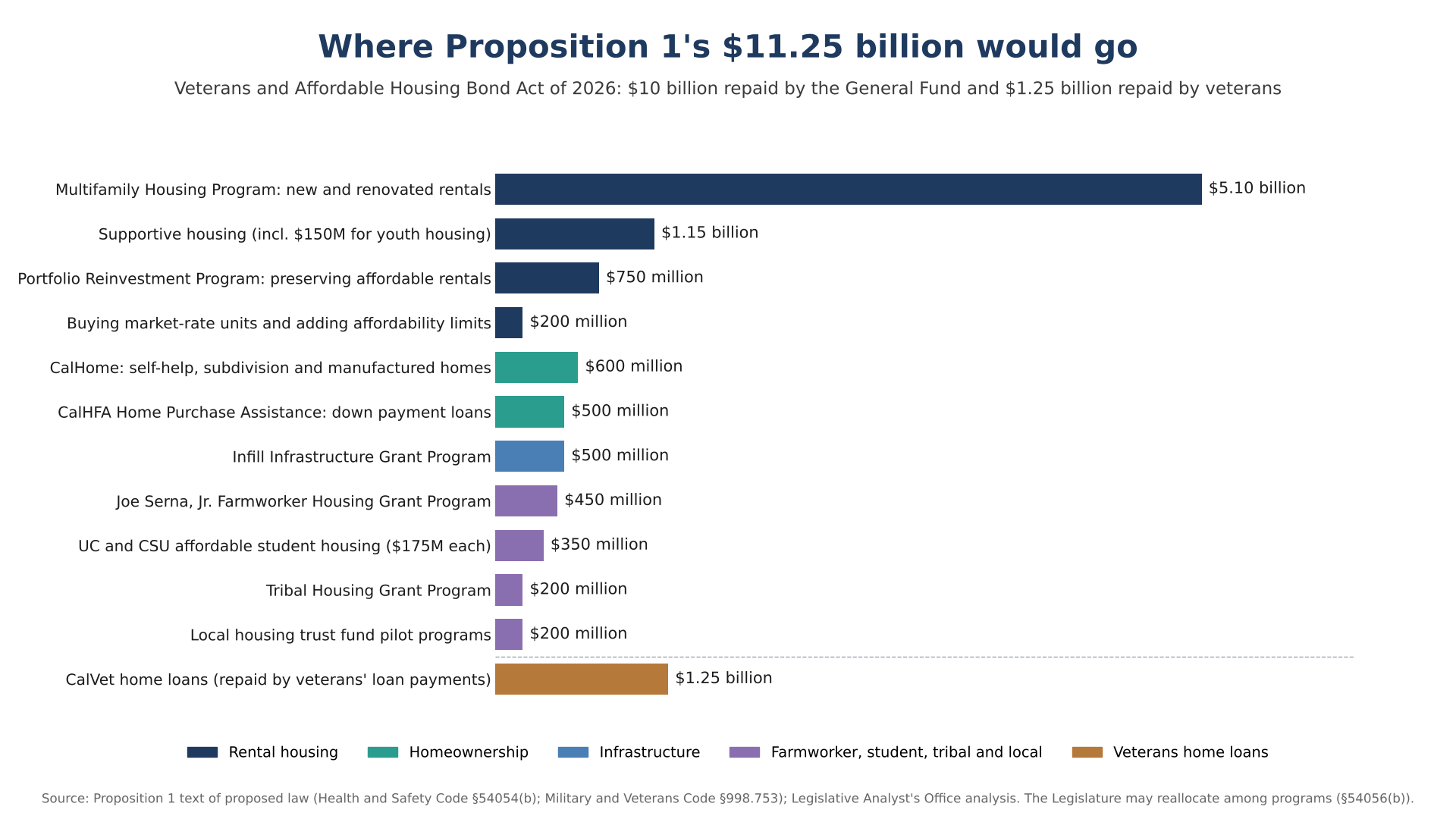
Proposition 1 would borrow $10 billion for 11 state housing programs and $1.25 billion for veterans' home loans:
The text of the measure has two parts. The first adds Part 16.1 to the Health and Safety Code, creating the Affordable Housing Bond Act Trust Fund of 2026 and authorizing $10 billion in bonds that are "a valid and binding general obligation of the state," with "the full faith and credit of the state … pledged" to repay them. The second adds an article to the Military and Veterans Code authorizing $1.25 billion in veterans' bonds for the farm and home loan program the Department of Veterans Affairs runs under the Veterans' Farm and Home Purchase Act of 1974. Both sets of bonds are sold over time by state finance committees as programs ask for cash, so the state does not borrow the full amount at once.
Section 54054 divides the $10 billion into 11 lines, each assigned to a program already in state law. The Attorney General's summary groups them as $5.1 billion for multifamily rental housing, $2.1 billion to acquire, rehabilitate or preserve affordable housing and provide supportive housing, $1.1 billion for homeownership, $1 billion for farmworker, tribal and student housing, $500 million for infrastructure and $200 million for local programs. The LAO's analysis combines the first two into a single $7.2 billion for affordable multifamily housing. The summary also notes that the money can finance "housing development projects seeking federal tax credits," and the LAO expects most of it to be "used together with other government monies."
Prop 1's $7.2 billion for rental housing runs mostly through the Multifamily Housing Program:
The largest line, $5.1 billion, goes to the Department of Housing and Community Development's Multifamily Housing Program, which lends to developers of new and renovated apartments in exchange for rent limits. The LAO describes these as "low-interest loans to fund part of the project cost," with units generally reserved for low-income households "for a period of 55 years." Prop 1 adds one condition of its own: at least 10% of the assisted units in each development must be affordable to extremely low-income households.
A further $1.15 billion is set aside for supportive housing, where residents get on-site services such as mental health and substance use counseling. The administering agency must offer capitalized operating subsidy reserves for those units, money set aside up front to cover the gap between what very low-income tenants can pay and what the building costs to run. Up to 15% of the line can be granted to convert interim housing into permanent housing for people who are homeless or at risk of homelessness, and $150 million is reserved for youth housing for current and former foster youth and homeless or at-risk young people, usable only for construction and acquisition and returned to the general program if not committed within three years.
The other two rental lines are about keeping existing housing affordable. The Portfolio Reinvestment Program gets $750 million; its statute, Health and Safety Code section 50606, says it exists to "maintain the supply and quality of the affordable rental housing units for which there has already been a significant public investment," including older state-funded buildings whose affordability periods are ending. Another $200 million funds a new program to buy apartments with no rent restrictions and attach long-term affordability limits, "while safeguarding against the displacement of current residents."
The McClatchy editorial board, which recommends a yes vote, cites Enterprise Community Partners' count of "nearly 40,000 affordable rental homes" that are designed and approved but waiting for financing, and the California Budget & Policy Center's estimate that each state dollar draws $4 from federal, local and private sources. Those are the board's and those groups' figures; the LAO's own estimate is that the bond would subsidize "up to 40,000 multifamily rental units," with the money "used together with other government monies."
Proposition 1 puts $1.1 billion into homeownership through CalHome and CalHFA:
Two lines make up the homeownership money. The CalHome Program receives $600 million for "direct, forgivable loans" to developments with multiple ownership units, including single-family subdivisions, self-help housing where buyers help build their own homes, and manufactured homes. The California Housing Finance Agency receives $500 million for its Home Purchase Assistance Program, which state law (section 51341) aims at making homes "affordable to low- and moderate-income buyers who intend to occupy the homes as their primary residences." That money is continuously appropriated, so CalHFA can spend it without waiting for an annual budget act. The LAO says part of the homeownership money would go to first-time buyers "through loans that generally do not have to be paid back until the home is sold or paid off."
This is a different kind of help from the Proposition 37 loan on the same ballot. Prop 1's homeownership money is a General Fund-backed subsidy aimed at low- and moderate-income buyers and generally deferred until sale. Prop 37 would have CalHFA sell up to $25 billion in revenue bonds for second mortgages on new homes that buyers repay monthly, with no General Fund backing.
 Pat Sharyon | Editor
Farmworker, student, tribal and infrastructure money makes up $1.7 billion of Proposition 1:
The Joe Serna, Jr. Farmworker Housing Grant Program gets $450 million for grants and loans to build or rehabilitate housing for agricultural workers and their families, including manufactured housing for families displaced from labor camps and mobile home parks. The LAO estimates the money would fund about 2,500 farmworker units. The Infill Infrastructure Grant Program gets $500 million for the water, sewer, street and park work that high-density affordable and mixed-income projects in already built-up areas need.
The University of California and California State University split $350 million, $175 million each, for new affordable student housing under the terms of Education Code section 17201; the LAO estimates about 1,200 beds. Tribes can apply for $200 million in Tribal Housing Grant Program money "to rebuild and reconstitute their communities." The last $200 million goes to the Local Housing Trust Fund Matching Grant Program for pilot projects testing "innovative, cost-saving approaches to creating or preserving affordable housing," available only to local trust funds that have their own ongoing private or public revenue.
The CalVet home loan bond in Prop 1 is repaid by veterans rather than the General Fund:
The $1.25 billion veterans' portion works differently from the rest of the measure. The state sells bonds to investors and lends the money to eligible veterans to buy homes, farms or mobile homes, and the veterans' mortgage payments flow back to the fund that pays the bondholders. The LAO notes that these payments "have always covered the amount owed on the bonds, meaning the program has always operated at no direct cost to the state," and estimates the new money would help about 2,100 veterans.
They are still general obligation bonds. The text pledges the state's full faith and credit and requires the Director of Finance to transfer any shortfall from the General Fund, which the fund then repays with interest. It also requires an independent public accountant to survey the finances of CalVet's Division of Farm and Home Purchases every year while any of the bonds are outstanding. The last veterans' home loan bond was the $1 billion approved in 2018.
The Legislature could move Proposition 1 money between programs after voters approve it:
The split in the chart is a starting point. Section 54056 lets the Legislature amend the laws governing any of the funded programs "for the purposes of improving the efficiency and effectiveness of those programs," and states that it "may amend this chapter in order to reallocate the proceeds of bonds issued and sold pursuant to this part among the programs to which funds are to be allocated … as necessary to effectively promote the development of affordable housing in this state." A separate clause lets the Business, Consumer Services and Housing Agency, with legislative appropriation, "align or streamline" the programs "to improve efficiency and accelerate the deployment of funds," as long as spending stays within the purposes voters approved.
Unspent money also moves on its own schedule. Most lines revert to the Multifamily Housing Program if not committed by November 3, 2036; the youth housing set-aside, the $200 million acquisition program and the local pilots revert after three years. Agencies may write their own program guidelines without going through the Administrative Procedure Act, the bonds may be issued as taxable bonds and can mature in up to 35 years, and the administering agency must publish an annual report on how the bond money was invested under Health and Safety Code section 50408.
Proposition 1 would cost the General Fund $500 million to $600 million a year for about 25 years:
The LAO estimates repaying the $10 billion housing bond at "$500 million to $600 million annually for about 25 years," or about 0.25% of the General Fund budget. "Since the state has to pay interest on the money it borrows," it adds, "the total cost of the bond would be about 15 percent more (after adjusting for inflation) than if the state paid up front with money it already has." A share of the bond money would cover the administrative costs of the agencies running the programs, and the veterans' bond carries no direct state cost as long as loan payments keep covering it.
The Voter Information Guide's Overview of State Bond Debt puts Prop 1 alongside the Proposition 38 immunology research bond as the two General Fund-supported bonds on this ballot, about $1 billion a year combined, against the roughly $6 billion a year the state already pays on about $80 billion of outstanding bonds. For scale, the LAO's analysis of the 2018 housing bond put the cost of its $3 billion General Fund portion at about $170 million a year for 35 years.
California has passed two other bonds called Proposition 1 since 2018 and both funded housing:
Voters have seen the number before. In November 2018, Proposition 1 was a $4 billion veterans and affordable housing bond built on the same template, with $3 billion for state housing programs and $1 billion for CalVet loans. It passed with 56.2%. In March 2024, Proposition 1 was a $6.38 billion behavioral health bond, which paid for treatment facilities and $2 billion of housing for homeless people with mental health or substance use challenges, just over half of it for veterans, and also changed how the Mental Health Services Act tax is spent. It passed with 50.2%, by 26,223 votes out of more than 7.2 million. The LAO counts that 2024 measure as "the last statewide general obligation bond for affordable housing."
California's three Proposition 1 bonds compared:
| Feature | Proposition 1 (November 2018) | Proposition 1 (March 2024) | Proposition 1 (November 2026) |
|---|---|---|---|
| What it funds | Veterans and affordable housing | Behavioral health treatment facilities and housing, plus changes to the Mental Health Services Act | Veterans and affordable housing |
| Total borrowing | $4 billion | $6.38 billion | $11.25 billion |
| Repaid by the General Fund | $3 billion | $6.38 billion | $10 billion |
| Veterans home loans | $1 billion, repaid by veterans | None (veterans get just over half of the $2 billion housing share) | $1.25 billion, repaid by veterans |
| Rental housing | $1.8 billion | $2 billion for housing people who are homeless or at risk and have mental health or substance use challenges | $7.2 billion |
| Homeownership | $450 million | None | $1.1 billion |
| Housing infrastructure | $450 million | None | $500 million |
| Farmworker housing | $300 million | None | $450 million |
| Other uses | None | $4.4 billion for mental health and addiction treatment facilities | $350 million for UC and CSU student housing, $200 million for tribal housing and $200 million for local pilots |
| LAO repayment estimate | About $170 million a year for 35 years | About $310 million a year for 30 years | $500 million to $600 million a year for about 25 years |
| Estimated reach | Up to 30,000 multifamily and 7,500 farmworker households; about 15,000 down payment loans; about 3,000 veteran home loans (LAO) | Up to 4,350 housing units, 2,350 of them for veterans (state estimate cited by the LAO) | Up to 40,000 rental units, about 2,500 farmworker units and about 1,200 student beds; up to 40,000 homeownership households, about 2,100 of them veterans (LAO) |
| Result | Passed, 56.2% yes | Passed, 50.2% yes (a 26,223-vote margin) | On the November 3, 2026 ballot |
| Compiled by California Today from each election's Voter Information Guide (Legislative Analyst's analysis) and the Secretary of State's Statements of Vote. Dollar categories follow each measure's own allocation; the 2024 measure's housing money went to a single homelessness-focused program, so it is shown under rental housing. | |||
The 2026 bond is nearly three times the size of the 2018 one, with the rental share up from $1.8 billion to $7.2 billion. It also funds lines the 2018 bond did not have, including UC and CSU student housing, tribal housing, preservation of existing affordable buildings and capitalized operating reserves for supportive housing.
SB 417 cleared the Legislature 61–7 and 29–2 on June 25, 2026:
SB 417, by Senator Monique Limón, was introduced in February 2025 and passed the Senate 30–9 on January 27, 2026 with an urgency clause. The Assembly amended it on June 22 and passed it 61–7 on June 25. That same day the Senate concurred 29–2 and Governor Newsom signed it as Chapter 16 of the Statutes of 2026. As a bond act, it takes effect only if voters approve it on November 3.
CalMatters' voter guide lists "some Republican state lawmakers" as the opposition and summarizes their objections: that the bill uses veterans to build support while doing little for them, and that it borrows more for housing without addressing why housing is so expensive to build.
Proposition 1's Yes side reports $7.9 million from Airbnb, carpenters and housing developers with no opposition committee:
The Fair Political Practices Commission's top-contributor list, last updated October 14, shows $7.89 million in support of Prop 1 across two committees and no opposing committee large enough to appear. The main committee, "Yes on Prop 1 Californians for Homes, Jobs and Affordability 2026," sponsored by affordable housing organizations, lists $6.8 million from its top ten: $1 million each from Airbnb, the Western States Regional Council of Carpenters' issues committee, the North Coast States Regional Council of Carpenters' PAC and Building a Better California, the Sergey Brin and John Doerr-funded committee that is also the main opponent of the billionaire tax; $700,000 from a second Yes committee sponsored by NPH Action Fund; $500,000 each from Anthropic PBC and Pacific West Communities of Idaho; $400,000 from Housing Trust Silicon Valley; and $350,000 each from Eden Housing and MidPen Housing. The NPH committee lists $1.09 million of its own, mostly from its sponsor's issues committee, plus $150,000 each from Scott D. Cook and H. Signe Ostby. Because the NPH committee's $700,000 transfer appears on both lists, the FPPC's combined figure counts that money twice.
The Secretary of State's contribution tally, which counts all contributions rather than only top donors and runs through October 6, shows $12.8 million across three Yes committees, including a third formed by the California Homeless and Housing Coalition Action Fund, and "No committees identified" in opposition.
The argument for Prop 1 promises no new taxes and no argument against was filed:
The argument in favor, signed by Anni Chung of Self-Help for the Elderly, Jeffery Freitas of the California Federation of Teachers and John H. Ing of US Vets, is headed "Affordable homes for veterans, seniors, people with disabilities and working families—without raising taxes." It says "more than half of renters spend over 30% of their income on rent and only 22% of households can afford a median-priced home, yet only 1% of California's state budget goes to housing," that the CalVet Home Loan Program "has already helped almost a million veterans and their families," and that the bond "unlocks federal matching funds." It quotes Michael Blecker of the California Association of Veteran Service Agencies: "After their service, our veterans deserve a place to call home." The guide's index lists US Vets, the California Federation of Teachers, Self-Help for the Elderly, Habitat for Humanity California and the California Alliance of Child and Family Services as supporters.
The page for the argument against reads: "NO ARGUMENT AGAINST PROPOSITION 1 WAS SUBMITTED." The guide notes that arguments "have not been checked for accuracy by any official agency."
Proposition 1 leads 55% to 43% with Newsom, Becerra and Democrats in support and editorial boards split:
PPIC's September survey of likely voters, fielded September 4–10, found 55% yes, 43% no and 2% undecided. Democrats back it 75% to 23% and independents 56% to 41%, while Republicans oppose it 79% to 19%. Renters support it 72% to 27%, and homeowners split evenly at 49% each. Support falls with age and income: voters under 35 back it 69% to 29% and those 55 and older oppose it 51% to 46%, while households earning under $40,000 back it 78% to 18% and those earning $100,000 or more split 49% to 49%. Five percent named it the measure they are most interested in. UC Berkeley's September poll did not ask about it, and PPIC's October survey had not been released as of October 18.
Governor Newsom announced his support on October 9 as part of his ballot slate, and Xavier Becerra listed "YES on Prop 1" among his positions on July 31. The California Democratic Party supports it and the California Republican Party is neutral, one of two measures on which it takes no side; the other is Proposition 37. CalMatters also lists the California Apartment Association and AFL-CIO California among supporters.
The McClatchy board recommends yes and asks the state to use the bond to learn "precisely why affordable housing costs what it does," calling for standardized cost data on every funded project and a public dashboard of money awarded and spent, units built and cost per unit. The San Francisco Chronicle recommends yes, according to CalMatters' roster of editorials. The Orange County Register recommends no under the headline "More debt won't fix California's housing shortage," opening: "Is the answer to California's housing crisis more bonds and more debt? Of course not."
Proposition 1 after November 3 would start a decade of housing bond awards:
If Prop 1 passes, the Housing Finance Committee and the Veterans' Finance Committee would decide when to sell bonds as HCD, CalHFA and CalVet ask for cash, and the money would reach projects through each program's competitive rounds over several years; most lines have until November 3, 2036 to be committed before reverting to the Multifamily Housing Program. The Legislature could reshuffle the split between programs in later budget years, and each year's awards would appear in the agencies' annual bond reports. If it fails, the state's most recent housing bond money remains the 2024 measure's $2 billion for homelessness-focused housing and the only other homeownership measure on this ballot is Proposition 37's revenue-bond loan program.
This article reflects the Voter Information Guide as published, the text of SB 417 (Chapter 16, Statutes of 2026), campaign-finance data as of October 14, 2026 (FPPC) and October 6, 2026 (Secretary of State), party and candidate positions as of October 18, 2026, and polling fielded September 4–10, 2026.
Sources and References
- Voter Information Guide, Proposition 1—https://voterguide.sos.ca.gov/propositions/1/
- Voter Information Guide, Proposition 1, Official Title and Summary—https://voterguide.sos.ca.gov/propositions/1/title-summary.htm
- Voter Information Guide, Proposition 1, Legislative Analyst's analysis—https://voterguide.sos.ca.gov/propositions/1/analysis.htm
- Voter Information Guide, Proposition 1, arguments—https://voterguide.sos.ca.gov/propositions/1/arguments-rebuttals.htm
- Text of Proposed Laws, Proposition 1 (pp. 100–105)—https://vig.cdn.sos.ca.gov/2026/general/pdf/prop1-text-proposed-laws.pdf
- Voter Information Guide, Proposition 1 (title, summary, analysis and arguments, print edition)—https://vig.cdn.sos.ca.gov/2026/general/pdf/prop1.pdf
- Voter Information Guide, Overview of State Bond Debt—https://voterguide.sos.ca.gov/voter-info/overview-state-bond-debt.htm
- California Legislative Information, SB 417 bill history—https://leginfo.legislature.ca.gov/faces/billHistoryClient.xhtml?bill_id=202520260SB417
- Health and Safety Code §50606 (leginfo)—https://leginfo.legislature.ca.gov/faces/codes_displaySection.xhtml?lawCode=HSC§ionNum=50606
- Health and Safety Code §51341 (leginfo)—https://leginfo.legislature.ca.gov/faces/codes_displaySection.xhtml?lawCode=HSC§ionNum=51341
- Voter Information Guide, November 6, 2018, Proposition 1, Legislative Analyst's analysis—https://vigarchive.sos.ca.gov/2018/general/propositions/1/analysis.htm
- California Secretary of State, Statement of Vote, November 6, 2018 General Election, summary—https://elections.cdn.sos.ca.gov/sov/2018-general/sov/07-summary.pdf
- Voter Information Guide, March 5, 2024, Proposition 1, Legislative Analyst's analysis—https://vigarchive.sos.ca.gov/2024/primary/propositions/1/analysis.htm
- California Secretary of State, Statement of Vote, March 5, 2024 Presidential Primary, ballot measure summary—https://elections.cdn.sos.ca.gov/sov/2024-primary/ssov/ballot-measure-summary.pdf
- Fair Political Practices Commission, Top 10 Contributors List, November 2026 General Election (last modified October 14, 2026)—https://www.fppc.ca.gov/search-filings/top-10-contributors-list/november-2026-general-election/
- California Secretary of State, 2026 Ballot Measure Contribution Totals, Proposition 1 (through October 6, 2026)—https://www.sos.ca.gov/campaign-lobbying/helpful-resources/measure-contributions/2026-ballot-measure-contribution-totals/proposition-1-sb-417-limon-veterans-and-affordable-housing-bond-act-2026-ch-16-2026
- Public Policy Institute of California, September 2026 likely-voter crosstabs—https://www.ppic.org/wp-content/uploads/crosstabs-likely-voters-0926.pdf
- ABC10 via Yahoo News, "Gov. Newsom announces position on statewide ballot propositions" (October 9, 2026)—https://www.yahoo.com/news/politics/articles/gov-newsom-announces-position-statewide-185935591.html
- Xavier Becerra for Governor, ballot measure positions (July 31, 2026)—https://www.xavierbecerra2026.com/?p=551
- California Democratic Party, 2026 General Election Endorsements—https://cadem.org/wp-content/uploads/2026/08/FINAL-2026-General-Election-Endorsements.pdf
- California Republican Party, 2026 endorsements—https://cagop.org/endorsements/
- CalMatters, "Proposition 1: Housing bond," 2026 Voter Guide—https://calmatters.org/california-voter-guide-2026/proposition-1-housing-bond/
- McClatchy California editorial board, Proposition 1 endorsement (September 30, 2026)—https://www.sacbee.com/opinion/article317326136.html
- San Francisco Chronicle editorial board, Proposition 1 endorsement—https://www.sfchronicle.com/opinion/editorials/article/prop1-california-housing-vote-22442444.php
- Orange County Register editorial board, "Endorsement: No on Prop. 1. More debt won't fix California's housing shortage" (September 23, 2026)—https://www.ocregister.com/2026/09/23/endorsement-no-on-prop-1-more-debt-wont-fix-californias-housing-shortage/
More November 2026 California Election Guides:
 Dr. Jennifer Trimpey | Specialist
 Mac Douglass | Editor
 Dr. Jennifer Trimpey | Specialist
 Mac Douglass | Editor
 Mac Douglass | Editor
 Mac Douglass | Editor
 Mac Douglass | Editor
 Mac Douglass | Editor


