

Yes, "Voter ID laws" are on the California ballot: Proposition 39's rules, costs, and court fights
Proposition 39 would make California the latest state to require ID to vote, replacing signature checks on 13 million mail ballots with a four-digit ID match. Here is how voting works today, exactly what the measure changes, what it would cost, and who is paying for each side.


Proposition 39 asks California voters to write a voter identification requirement into the state Constitution. If it passes, every voter would present government-issued identification to vote in person, and every mail voter, which in November 2024 meant about 13 million of the 16 million who voted, would write the last four digits of a designated ID number on the ballot envelope, where today they sign their name. The measure, placed on the ballot by petition and sponsored by Reform California's Carl DeMaio, is one of the 14 statewide propositions in this year's guide, and it is the one whose polling the campaigns dispute most.
 Mac Douglass | Editor
The measure is short, about 400 words of operative text, and much of the argument around it concerns what those words leave out. This explainer sets out how voting in California works now, what Prop 39's text actually requires, what the Legislative Analyst says it would cost, how two Sacramento judges ruled on the campaigns' language in August, and who is funding each side.
Proposition 39 adds one section to the Constitution with three requirements
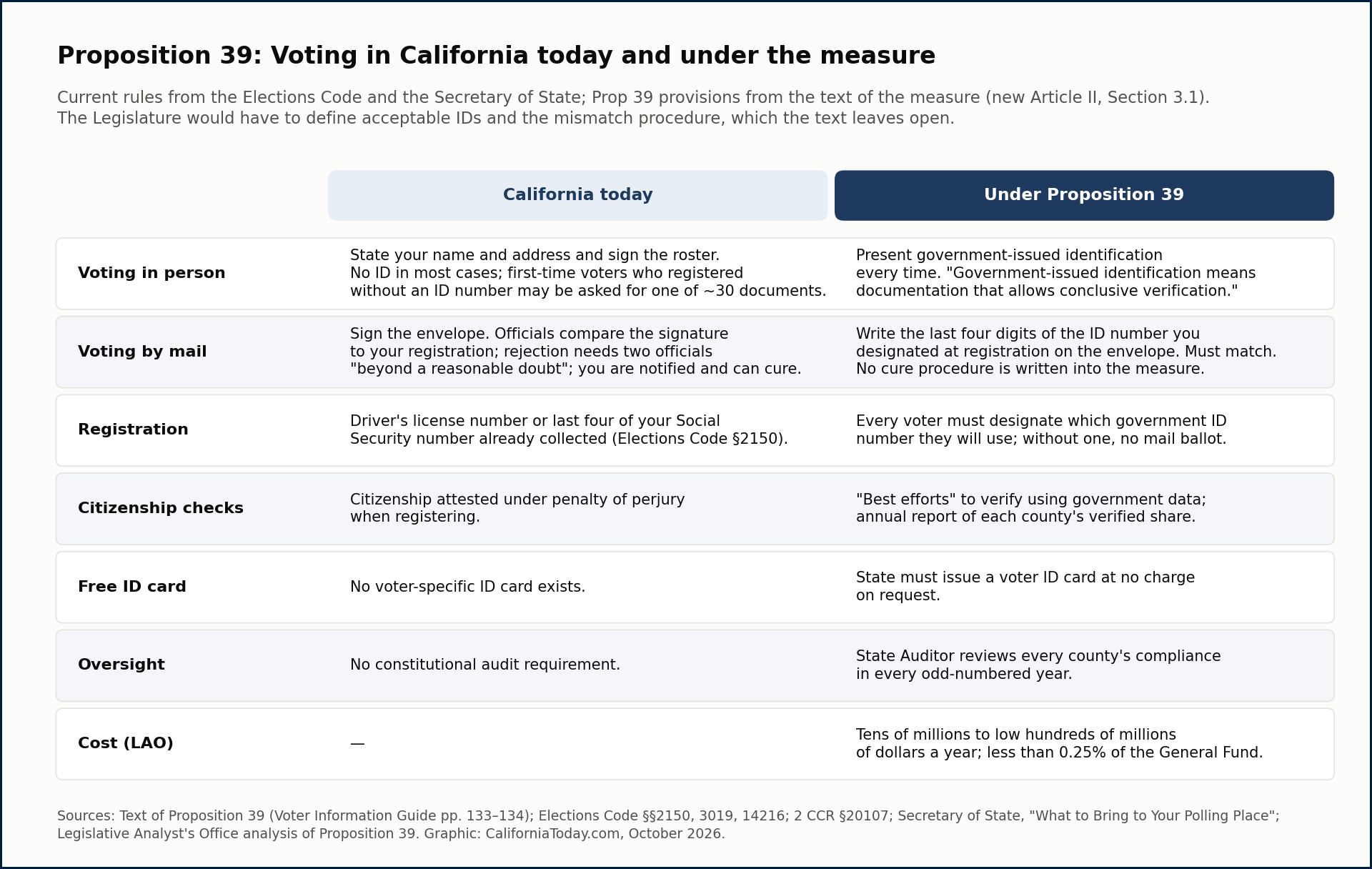
The measure's text adds Section 3.1 to Article II of the California Constitution. Its findings say the purpose is "to deter and detect voter fraud by maintaining accurate voter registration records and confirming eligibility to vote" and "to minimize the risk of voter impersonation by requiring proof of identity to vote." The operative provisions are three.
First, citizenship verification: the Secretary of State and county elections officials "shall use best efforts to verify citizenship attestations using government data, and shall annually report what percentage of each county's voter rolls have been citizenship-verified."
Second, identification at the ballot: "Each time a voter casts a ballot in person in any election in the State, the voter shall present government-issued identification, or if voting by mail, the voter shall provide the last four digits of a unique identifying number from government-issued identification that matches the one designated by the voter for their voter registration." The type of ID each voter designates must be recorded in their registration and printed on their mail-ballot envelope. Officials "shall only count a regular or provisional ballot after verifying the identity of the person voting pursuant to the requirements of this section." The measure's only definition of acceptable ID is that it "means documentation that allows conclusive verification of the voter's identity," and it requires the state to provide "at no charge, a voter ID card" to any eligible voter who asks.
Third, enforcement: the section is "self-executing," the Legislature "shall also promptly enact laws to implement" it, citizens may seek judicial review of any county's compliance, and in every odd-numbered year the State Auditor must audit the state and every county and report publicly.
The Attorney General's summary draws out a consequence the text implies but does not spell out: the measure "invalidates mail ballots if envelope does not include last four digits of a government-issued identification number matching the number designated in the voter's registration (e.g., if voter designates Social Security number for registration, but provides driver's license number on envelope, their ballot would not count)." Nothing in the measure describes what happens next. There is no notice-and-cure provision of the kind that exists today for signature mismatches, and no list of which documents qualify. The LAO's analysis says the Legislature "would need to clarify several details that are not defined in the proposition, like which forms of identification could be used and what steps would be considered best efforts to verify the citizenship status of registered voters."
Voting in California today runs on signatures, not identification
The Secretary of State's own guidance to voters begins: "In most cases, a California voter is not required to show identification to a polling place worker before casting a ballot." Under Elections Code section 14216, an in-person voter states their name and address, the poll worker finds them in the roster, and the voter signs. The exception is federal: a first-time voter who registered by mail without supplying a driver's license number or the last four digits of a Social Security number may be asked for identification, and the state regulation implementing that rule, 2 CCR section 20107, accepts roughly 30 kinds of document, from a passport to a utility bill, a sample ballot or a student ID, and directs that "any doubt as to the sufficiency of proof or a document presented shall be resolved in favor of permitting the voter or new registrant to cast a regular ballot."
Mail ballots are verified by signature. Elections Code section 3019 requires officials to compare the envelope signature to the voter's registration record, with "a presumption… that the signature on the identification envelope… is the voter's signature and that the vote will be counted," and states that "an exact match is not required." A signature can be rejected only if two additional officials "each find beyond a reasonable doubt that the signature differs in multiple, significant, and obvious respects," and the voter must then be notified by mail and, where a phone number or email is on file, by call, text or email, with the chance to cure.
The registration record already holds an identifying number. Elections Code section 2150 requires a registrant's driver's license number or, failing that, the last four digits of their Social Security number, or a state-assigned number if they have neither. Prop 39 would make that number, rather than the signature, the thing that decides whether a mail ballot counts.
The vote-by-mail mechanics: A four-digit match with no written cure process
For the 13 million Californians who vote by mail, the practical change is the envelope. Today it carries a signature line; under Prop 39 it would carry the type of ID the voter designated and a space for the last four digits of that ID's number. The number must match the registration record. The measure's own words set the consequence, "election officials shall only count… after verifying the identity of the person voting," and the Attorney General's summary states the result as invalidation on mismatch.
The No campaign's central claim follows directly: "Get one digit wrong, and a valid ballot could get thrown out," its ballot argument says, and "if you don't take extra steps to tell officials which ID you want to use for voting—you may not get a mail ballot at all." The Yes campaign's argument answers that the current system is the problem: "In the last election, more than 100,000 ballots were rejected due to signature mismatches—and more than 200,000 voters endured hassles just to get their vote to count," and voter ID "keeps mail ballots, extended polling hours and all other conveniences in place." Both are campaign claims, printed with the guide's standard note that they "have not been checked for accuracy by any official agency." The text's silence on mismatches is not a claim; it is what the measure says, and the Legislature, which the measure directs to "promptly enact laws to implement this section," would decide whether a cure process exists.
Costs: Tens of millions to low hundreds of millions of dollars a year
The LAO's September 2025 letter to the Attorney General estimated "one-time costs of tens of millions of dollars and ongoing annual costs of between tens of millions of dollars and the low hundreds of millions of dollars," and its ballot analysis repeats the range, noting it is "less than one-quarter of 1 percent (0.25 percent) of the state's total General Fund budget." The cost "would depend on future decisions by the Legislature, state departments, local governments, and voters," including the design of the free ID card and how many people request one. The LAO also notes a possible offset it does not expect to be large: "some amount of savings… due to fewer people registered to vote—for example, due to the removal of ineligible voters or eligible voters lacking government-issued identification."
Two Sacramento rulings on August 6 went against the Yes campaign's language
The measure reached the ballot under a title its proponents fought. The Attorney General's circulating title, issued September 19, 2025, read "Establishes Additional Voter Identification and Citizenship Verification Requirements." The certified ballot title, issued July 3, 2026, reads "Prohibits Citizens from Voting Unless They Present Government-Issued Identification." DeMaio called the change an attempt "to rig the election by putting a biased and dishonest title on this common-sense measure," and the Yes committee sued.
Sacramento Superior Court Judge Jennifer K. Rockwell denied the petition on August 6. "Proposition 39 is therefore not merely 'a verification rule,' as it imposes substantive restrictions on the submission of ballots by citizens," her order reads. "Because Proposition 39 would prohibit the counting of ballots not submitted in compliance with the identification requirements, there is nothing misleading or inaccurate about the statement that the measure 'prohibits citizens from voting unless they present government-issued identification.'"
The same day, in a separate case brought by Assembly Speaker Robert Rivas and Senate President pro Tempore Monique Limón, the court struck several statements from the Yes campaign's draft ballot argument, including "Voter ID makes it easier to vote" and "Prop. 39 saves millions of dollars each election." "It is hard to conceive how it would be 'easy' or 'easier' to vote if a voter has to take the extra step of either bringing government-issued identification when voting in person or search for their government-issued identification and supply the last four digits if they vote by mail," the ruling says, and it found the savings claim "objectively untrue." The argument printed in the guide is the rewritten version.
Huntington Beach tried a local voter ID rule, and the courts struck it down
Prop 39 arrives after a two-year fight over whether a city could do the same thing locally. Huntington Beach voters approved a charter amendment in March 2024 allowing the city to require ID in municipal elections. The Legislature responded with SB 1174, now Elections Code section 10005: "A local government shall not enact or enforce any charter provision, ordinance, or regulation requiring a person to present identification for the purpose of voting… unless required by state or federal law." The Court of Appeal held on November 3, 2025 that voter identification is "a matter of statewide concern" and that the statute preempts the city's charter, and the California Supreme Court declined review; Attorney General Rob Bonta said on January 28, 2026 that the city's measure "won't be taking effect—ever."
That outcome turned on state law outranking a city charter. Prop 39 is a constitutional amendment, which would outrank the statute; it would make voter ID the state rule that section 10005 defers to. The measure's text does not mention section 10005 or Huntington Beach.
Proposition 39's supporters, opponents and funders: Uihlein's $17 million against the Democratic Party's $5.5 million
The guide lists the Transparency Foundation, the Latino American Political Association, the Howard Jarvis Taxpayers Association and the California Women's Leadership Association as supporters, and ACLU California Action, Common Cause and the League of Women Voters of California as opponents. The argument in favor is signed by the Yes committee's Democratic, Republican and independent coalition chairs; the rebuttal against it by Senator Alex Padilla, the California Nurses Association and the California School Employees Association. The proponents of record are DeMaio, former state senator Tony Strickland and Donald J. DiCostanzo; the measure qualified on April 24, 2026.
The money is close to even and concentrated on both sides. The Fair Political Practices Commission's list, updated October 5, shows the Yes committee, Californians for Voter ID, with $21.98 million from its top ten contributors, $17 million of it from Richard Uihlein, the Illinois-based chief executive of the packaging company Uline, and $3.1 million from DeMaio's Reform California ballot-measure committee; the rest comes from Nicole Shanahan, Sequoia Capital's Douglas Leone, and Cameron and Tyler Winklevoss, among others. Against: three committees reporting $21.0 million in aggregate, led by the California Democratic Party ($5.45 million across two committees), the Federated Indians of Graton Rancheria ($2 million), Netflix co-founder Reed Hastings ($1 million), SEIU affiliates, and Patty Quillin and M. Quinn Delaney ($1.5 million each) through a committee sponsored by the California Donor Table and the ACLU of Northern California.
Polls on Proposition 39 disagree, and the governor's candidates split
The Public Policy Institute of California's September survey, which read likely voters the ballot title, found 43% yes and 55% no. UC Berkeley's Institute of Governmental Studies, polling September 15–20, found 39% yes, 52% no, a wider deficit than its August reading. Two polls that described the measure in plain language rather than by its title found the reverse: an NBCUniversal/Telemundo survey of September 21–24 reported by NBC had it 49–42 in favor, and a survey sponsored by the Independent Voter Project, an advocacy group, found 43–40 in favor with 17% undecided. The gap between the title-based and description-based polls is the campaign in miniature: the Yes side argues the title is prejudicial; the court found it accurate.
At the September 30 gubernatorial debate, Xavier Becerra said the measure "would make it harder for Californians to vote" and urged a no vote; Steve Hilton, who supports it, said "there's a majority in this state who agree that it's reasonable to show ID when you vote."
Proposition 39 on November 3, and the questions it leaves for 2027:
If Prop 39 passes, the section takes effect under the Constitution's standard rule for initiatives, the fifth day after the Secretary of State certifies the vote, which this year is December 11, and it declares itself self-executing. The questions it does not answer, which documents count, what happens to a mail ballot with a wrong or missing number, and how "best efforts" at citizenship verification are measured, would go to a Legislature whose leaders sued to strike the Yes campaign's claims, under a constitutional duty to "promptly enact laws to implement this section." The State Auditor's first compliance report would be due in 2027. Proposition 39 is, in that sense, two measures: the one voters read, and the implementing law that follows.
This article reflects the Voter Information Guide as published, the FPPC contributor list as of October 5, 2026, and polling fielded through October 2, 2026.
Sources & References
- Voter Information Guide, Proposition 39—https://voterguide.sos.ca.gov/propositions/39/
- Voter Information Guide, Proposition 39, title and summary—https://voterguide.sos.ca.gov/propositions/39/title-summary.htm
- Voter Information Guide, Proposition 39, Legislative Analyst's analysis—https://voterguide.sos.ca.gov/propositions/39/analysis.htm
- Voter Information Guide, Proposition 39, arguments and rebuttals—https://voterguide.sos.ca.gov/propositions/39/arguments-rebuttals.htm
- Text of Proposed Laws, Proposition 39 (pp. 133–134)—https://vig.cdn.sos.ca.gov/2026/general/pdf/prop39-text-proposed-laws.pdf
- Legislative Analyst's Office and Department of Finance, fiscal review of initiative 25-0007A1, September 4, 2025—https://www.lao.ca.gov/ballot/2025/250376.pdf
- Office of the Attorney General, circulating title and summary, initiative 25-0007A1 (September 19, 2025)—https://oag.ca.gov/system/files/initiatives/pdfs/Title%20and%20Summary%20%2825-0007A1%29.pdf
- Elections Code §14216 (in-person voting)—https://leginfo.legislature.ca.gov/faces/codes_displaySection.xhtml?lawCode=ELEC§ionNum=14216
- Elections Code §3019 (vote-by-mail signature verification and cure)—https://leginfo.legislature.ca.gov/faces/codes_displaySection.xhtml?lawCode=ELEC§ionNum=3019
- Elections Code §2150 (registration affidavit)—https://leginfo.legislature.ca.gov/faces/codes_displaySection.xhtml?lawCode=ELEC§ionNum=2150
- Elections Code §10005 (SB 1174, local voter ID prohibition)—https://leginfo.legislature.ca.gov/faces/codes_displaySection.xhtml?lawCode=ELEC§ionNum=10005
- 2 CCR §20107, HAVA identification standards—https://elections.cdn.sos.ca.gov/regulations/hava_id_regs_from_barclays_3_3_06.pdf
- California Secretary of State, What to Bring to Your Polling Place—https://www.sos.ca.gov/elections/voting-resources/voting-california/what-bring
- California Secretary of State, Proposition 39 eligible for the ballot (April 24, 2026)—https://www.sos.ca.gov/administration/news-releases-and-advisories/2026-news-releases-and-advisories/california-secretary-state-shirley-n-weber-phd-announces-new-measure-eligible-november-2026-general-election-ballot-establishes
- Court of Appeal, Fourth District, People ex rel. Bonta v. City of Huntington Beach, G065589 (November 3, 2025)—https://www.courts.ca.gov/opinions/archive/G065589.PDF
- Office of the Attorney General, statement on Supreme Court denial of review (January 28, 2026)—https://oag.ca.gov/news/press-releases/attorney-general-bonta-and-secretary-state-weber-california-supreme-court
- Sacramento Superior Court, Californians for Voter ID v. Weber, 26WM000193, minute order of August 6, 2026 (hosted copy)—https://www.democracydocket.com/wp-content/uploads/2026/08/CALIFORNIANS-FOR-VOTER-ID-Prop-39-tentative-ruling.pdf
- Sacramento Superior Court, Rivas v. Weber, 26WM000195, ruling of August 6, 2026 (hosted copy)—https://www.democracydocket.com/wp-content/uploads/2026/08/RIVAS-Prop-39-tentative-ruling.pdf
- Reform California, statement on the ballot title (July 21, 2026)—https://reformcalifornia.org/news/demaio-accuses-ca-attorney-general-of-changing-ballot-title-on-the-prop-39-voter-id-initiative-to-rig-the-election
- Fair Political Practices Commission, Top 10 Contributors List, November 2026 General Election (last modified October 5, 2026)—https://www.fppc.ca.gov/search-filings/top-10-contributors-list/november-2026-general-election/
- Public Policy Institute of California, September 2026 likely-voter crosstabs—https://www.ppic.org/wp-content/uploads/crosstabs-likely-voters-0926.pdf
- UC Berkeley IGS, Release #2026-20 (September 25, 2026)—https://escholarship.org/content/qt3w14s99c/qt3w14s99c.pdf
- NBC News, NBCUniversal/Telemundo poll (September 30, 2026)—https://www.nbcnews.com/politics/2026-election/california-poll-voters-back-billionaire-tax-proposal-falls-short-major-rcna600354
- Independent Voter Project / IVC Media survey (October 4, 2026)—https://ivn.us/new-ca-poll-voter-id-measure-leads-today-its-undecided-voters-point-the-other-way/
- CNN, California gubernatorial debate coverage (September 30, 2026)—https://www.cnn.com/2026/09/30/politics/live-news/california-governor-debate-midterms
- California Today, guide to all 14 November 2026 propositions—https://californiatoday.com/guides/elections/2026-california-propositions-master-guide/


