


2026 California propositions master guide: All 14 measures on the November 3 ballot
California's November 3, 2026 ballot carries 14 propositions, from an $11.25 billion housing bond to a one-time billionaire tax. This guide covers each measure's rules, its cost according to the Legislative Analyst, who is funding both sides, and where the polls stand as ballots arrive.

County elections offices have mailed ballots for the November 3, 2026 general election to all of California's record 23.2 million registered voters, the Secretary of State confirmed on October 6, and every one of them carries 14 statewide propositions. Five were placed on the ballot by the Legislature and nine by petition. Together they would authorize $19.65 billion in general obligation bonds, make a 2012 income-tax increase permanent, impose a one-time tax on billionaires and, through two companion measures, possibly cancel that tax, change how recalls work, require voter ID, and rewrite California's environmental review law for most housing and infrastructure.
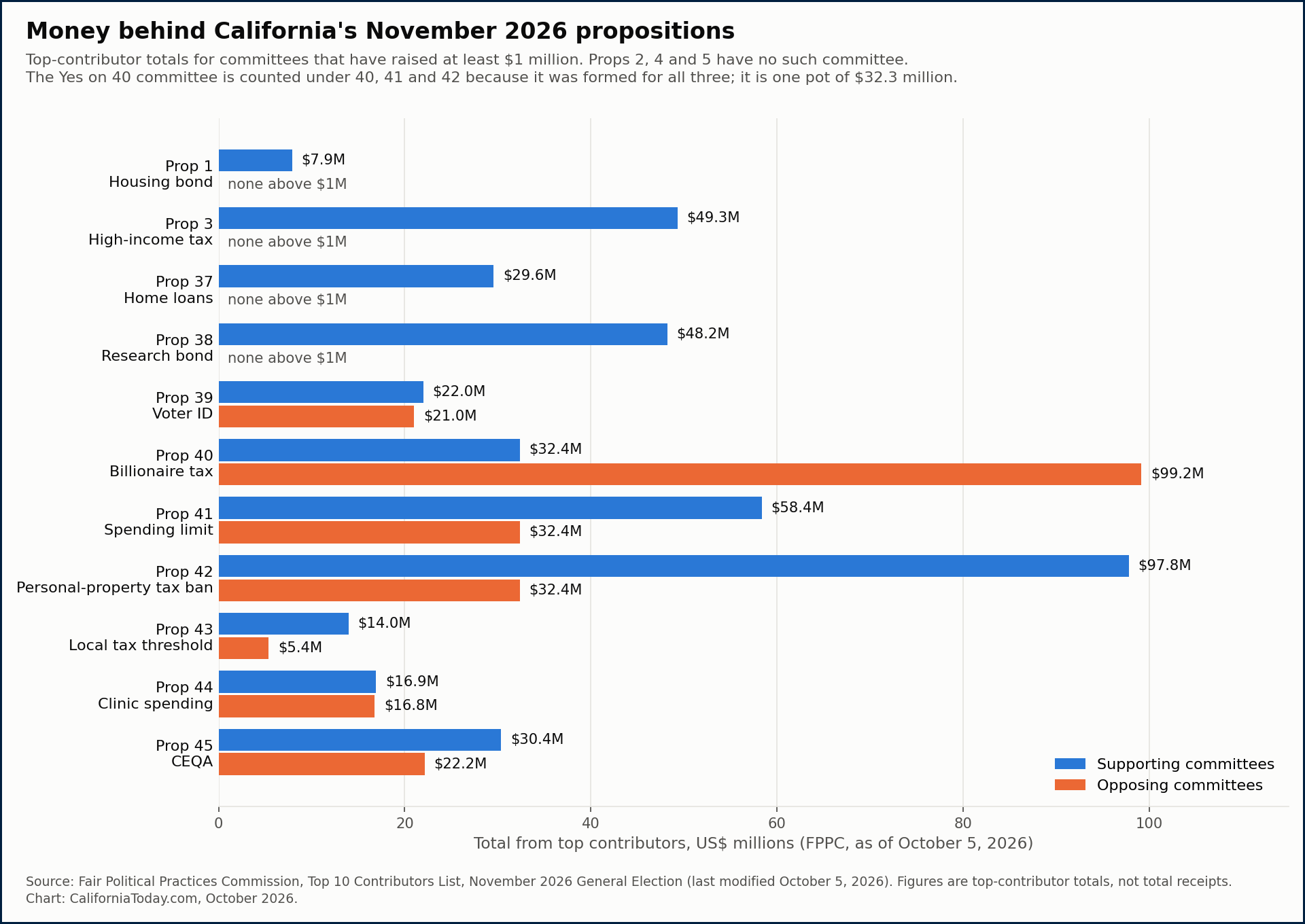
This guide takes the measures in ballot order. For each, the mechanics and fiscal estimates are the Legislative Analyst's Office's, as printed in the Secretary of State's Voter Information Guide; supporters and opponents are the ones listed there; the money is from the Fair Political Practices Commission's top-contributor list, last updated October 5; and the polling is the Public Policy Institute of California's September survey of 1,103 likely voters (fielded September 4–10, margin of error ±3.8 points), with later polls noted where they exist. Registration closes October 19; same-day registration runs October 20 through Election Day; polls are open 7 a.m. to 8 p.m. on November 3, and mailed ballots count if postmarked by that day and received by November 10.
California propositions 2026: The 14 measures at a glance
The table gives each measure's type, the LAO's one-line fiscal summary and the PPIC September result. Money is in the chart that follows.
| Prop | Subject | Placed by | LAO fiscal effect | PPIC Sept (yes–no) |
|---|---|---|---|---|
| 1 | $11.25B veterans and affordable housing bond | Legislature | $500–600M a year for ~25 years | 55–43 |
| 2 | Rainy-day fund cap 10% → 20% | Legislature | Higher reserves | 60–39 |
| 3 | Prop 30/55 high-income tax rates made permanent | Petition | Keeps $5–15B a year after 2030 | 58–40 |
| 4 | Allows public campaign financing | Legislature | Few hundred thousand dollars a year | 42–53 |
| 5 | Removes replacement question from recalls | Legislature | Unknown; millions per recall either way | 35–59 |
| 37 | $25B revenue bond for middle-income home loans | Petition | No direct state cost | 61–35 |
| 38 | $8.4B immunology research bond | Petition | $500–600M a year for ~20 years | 55–42 |
| 39 | Voter ID and citizenship verification | Petition | Tens of millions to low hundreds of millions a year | 43–55 |
| 40 | One-time 5% billionaire tax | Petition | Tens of billions, once; up to $1B a year less income tax | 52–46 |
| 41 | Bars taxes exempt from spending limit; audits | Petition | Unknown | 51–44 |
| 42 | Bars new personal-property and retroactive taxes | Petition | Revenues may not rise as much | 54–43 |
| 43 | Two-thirds vote for voter-initiated local special taxes | Legislature | Local revenues may not rise as much | 43–51 |
| 44 | Clinics must spend 90% of revenue on services | Petition | Low tens of millions, fee-funded | 34–61 |
| 45 | Expedited CEQA track for nine project types | Petition | High tens of millions to $100M+ a year initially | 49–46 |
One funder shapes the chart.
Building a Better California, whose top donors the FPPC identifies as Google co-founder Sergey Brin and venture capitalist L. John Doerr III, has given $88.5 million to the main No on 40 committee, $58.35 million to Yes on 41 and $97.8 million to Yes on 42, a combined $244.65 million aimed at the billionaire tax by our count (up $23 million in the four days between the FPPC's October 1 and October 5 updates), plus $10 million to Yes on 45, $6 million to Yes on 37 and $1 million to Yes on 1.
Proposition 1: An $11.25 billion housing bond with no organized opposition
Prop 1 (SB 417, Chapter 16 of 2026) authorizes $11.25 billion in general obligation bonds. Ten billion goes to state housing programs: $7.2 billion for affordable multifamily rental housing (including $150 million for youth housing), $1.1 billion for homeownership assistance, $500 million for infrastructure, $450 million for farmworker housing, $350 million split between UC and CSU student housing, $200 million for tribal housing and $200 million for local pilot programs. The remaining $1.25 billion funds veterans' home loans and is repaid by the veterans themselves; the LAO notes those payments "have always covered the amount owed on the bonds."
The LAO puts the General Fund cost at "$500 million to $600 million annually for about 25 years," about a quarter of one percent of the budget, and says the funds would subsidize "up to 40,000 multifamily rental units." Supporters listed are US Vets, the California Federation of Teachers, Self-Help for the Elderly, Habitat for Humanity California and the California Alliance of Child and Family Services. No argument against was submitted. Supporting committees report $7.9 million from top contributors, including $1 million each from Airbnb, two carpenters' councils and Building a Better California, and $500,000 from Anthropic; no opposing committee has raised $1 million. PPIC: 55% yes, 43% no.
Proposition 2: Doubling the rainy-day fund cap to 20%
Prop 2 (ACA 20, Chapter 130 of 2026) changes the Budget Stabilization Account rules voters set in 2014. Today the state must deposit 0.75% of General Fund taxes each year until the fund reaches 10% of General Fund taxes, after which the money goes to infrastructure. Prop 2 raises that ceiling to 20%, adds larger deposits "in years when revenues from taxes on investment gains are very high," and extends the state's required extra debt payments from 2030 to 2040 while widening what they can cover, including payments owed to schools and repayment of federal loans. Deposits would no longer count toward the state appropriations limit until withdrawn. The state currently holds about $20 billion in general-purpose reserves.
The LAO's fiscal line is simply "State budget reserves would be higher." Supporters listed are the California Professional Firefighters, the Los Angeles Area Chamber of Commerce, Governor Newsom, Xavier Becerra and Assembly Budget Chair Jesse Gabriel. The guide's index page lists no opponents, but an argument against is printed, signed by Assembly Budget Vice Chair David Tangipa, Senator Steven Choi and Reform California's Carl DeMaio. No committee on either side has raised $1 million. PPIC: 60% yes, 39% no.
Proposition 3: Making the 2012 high-income tax rates permanent
Prop 3 is a citizen initiative, not a legislative measure. It makes permanent the higher income-tax brackets voters approved in Proposition 30 (2012) and extended in Proposition 55 (2016), which are set to run through 2030. Those rates are 10.3% on single-filer income from $371,000 to $446,000, 11.3% from $446,000 to $743,000 and 12.3% above $743,000 (double those thresholds for joint filers); without Prop 3, income above $371,000 would revert to 9.3% after 2030. The LAO says the top 2% of taxpayers pay these rates and "pay about half of all state income taxes."
The LAO estimates Prop 3 "would bring in between $5 billion and $15 billion each year" after 2030, with "roughly 40 percent" going to schools and community colleges and the rest to other state programs and reserves. The Attorney General's summary describes the education portion as split 89% to K–12 and 11% to community colleges; the two figures describe different things, the share of the total and the split within education, and both are in the guide. Supporters listed are the California Teachers Association, the California School Nurses Organization, the California State PTA and Planned Parenthood Affiliates of California; opponents are the California Taxpayers Association, the Family Business Association of California and the California Hispanic Chambers of Commerce. The yes side reports $49.3 million from top contributors, $33.3 million of it from CTA and $7.5 million from the National Education Association; no opposing committee has reached $1 million. PPIC: 58% yes, 40% no. UC Berkeley's IGS poll of September 15–20 found 54% yes, 34% no. CNN reported during the September 30 debate that Xavier Becerra "previously said he would support" Prop 3.
Proposition 4: Lifting the ban on public campaign financing
Prop 4 (SB 42, Chapter 245 of 2025) repeals the state law that bars governments from using public funds for candidates' campaigns, a ban that already does not apply to charter cities such as Los Angeles, San Francisco, Long Beach, Oakland and Berkeley. The LAO is explicit that "Proposition 4 does not create a public campaign finance system"; it lets the state and local governments create one, subject to limits: no money earmarked for education, transportation or public safety, no public funds for legal defense or fines or repaying personal loans, and candidates must "show broad-based support in their district and agree to spending limits." The Fair Political Practices Commission would issue guidance but is not required to administer local programs. It also triples the maximum fine for campaign contributions by foreign entities.
State cost: "a few hundred thousand dollars each year" for FPPC guidance; the cost of any future program "could be significant for governments that choose to create them." Supporters listed are the League of Women Voters of California, the California Nurses Association, Mental Health Advocacy, Social Security Works and Consumer Watchdog; opponents are the California Taxpayers Association, the Howard Jarvis Taxpayers Association, the Family Business Association of California and United Latinos Action. Former FPPC chair Dan Schnur signs the argument against, and the San Francisco Chronicle's editorial board came out against it on October 6. No committee on either side has raised $1 million. PPIC: 42% yes, 53% no; IGS: 35% yes, 35% no, 30% undecided.
Proposition 5: Taking the replacement question off recall ballots
Prop 5 (SCA 1, Chapter 204 of 2024) removes the second question, who should replace a recalled official, from recall elections. If a governor is recalled, the lieutenant governor serves either until the next statewide election or, if the recall comes late in the term, for the rest of it; vacancies in other offices are filled the way they are now, by special election for legislators and by gubernatorial appointment for other state offices. A recalled official could run in the resulting special election. The LAO notes the title's "statewide officers" understates the scope: the analysis applies the change to legislative recalls too.
The LAO's background: 11 state recalls have qualified since 1913 and six succeeded; the 2003 governor's recall drew 135 replacement candidates and 2021's drew 46. Fiscal effect is "unknown," with possible savings or costs "of millions of dollars" per recall. The index page lists no supporters or opponents, but arguments are printed: the League of Women Voters, California Common Cause and Dan Schnur in favor; Senate Minority Leader Brian Jones and Assemblymember Joe Patterson against. The yes campaign's contact is former senator Josh Newman, himself recalled in 2018. No committee has raised $1 million. PPIC: 35% yes, 59% no, the weakest position of any measure on the ballot.
Proposition 37: A $25 billion state loan program for middle-income homebuyers
Prop 37, the "California Middle-Class Home Ownership and Family Home Construction Act," authorizes the California Housing Finance Agency to sell up to $25 billion in revenue bonds and lend buyers up to 17% of a home's price as a fixed-rate second loan, with the buyer putting down at least 3%. Borrowers must have lived in California for a year, occupy the home, and earn no more than twice the area median income; the home must be newly built or the first sale of a converted nonresidential property, priced below roughly $1 million to $1.5 million depending on county. Developers may opt into a "qualified builder option" that trades higher labor standards for more flexible construction-defect rules.
Because borrowers' payments repay the bonds, the LAO finds "no direct state or local costs," while flagging that investor appetite and whether the program actually increases construction are unknown. Proponent is former Senate leader Robert Hertzberg. Supporters listed are the United Nurses Associations of California, the California Conference of Carpenters and Treasurer Fiona Ma; no argument against was submitted. Supporting committees report $29.55 million from top contributors, led by the California Association of Realtors ($14.85 million through its Homeownership for Families committee, plus $7 million directly) and Building a Better California ($6 million). PPIC: 61% yes, 35% no, the strongest position on the ballot.
Proposition 38: An $8.4 billion bond for immunology research
Prop 38, the "California Immunology Research and Cures Initiative," authorizes $8.4 billion in general obligation bonds for immunology and immunotherapy research, at least $4.2 billion of it on cancer, heart disease and Alzheimer's. Half goes to a single research institute, selected by the Department of Public Health and affiliated with a UC campus; half goes to competitive grants awarded by a council of seven UC campuses and 10 to 15 other California institutions. Any treatment developed with the money must be sold in California at a 20% discount, and 10% of resulting revenue goes to the state until the bond is repaid.
The LAO's cost: "$500 million to $600 million annually for about 20 years," with the state possibly recovering "part or all of this cost in subsequent decades if the funded research leads to discoveries that generate revenue." The guide's bond overview notes that Props 1 and 38 together would cost "about $1 billion each year." Proponent is billionaire spinal-surgery inventor Gary K. Michelson, whose entities account for $31.2 million of the yes side's $48.2 million. Supporters listed are the Michael J. Fox Foundation, Alzheimer's Los Angeles, the Kidney Cancer Association and the American Nurses Association of California; the sole listed opponent is Stanford's Robert M. Kaplan, who signed the argument against, and the San Francisco Chronicle editorialized against it on October 3. PPIC: 55% yes, 42% no.
Proposition 39: Voter ID, mail-ballot ID numbers and citizenship checks
Prop 39 amends the Constitution to require voters to present government-issued identification to vote in person, to designate a government ID number in their registration in order to vote by mail, and to write the last four digits of that number on the mail-ballot envelope, with a mismatch invalidating the ballot. It directs elections officials to make "best efforts" to verify registered voters' citizenship using government data, report each county's verified share annually, create a free state voter ID card, and have the State Auditor review compliance every odd year. The LAO notes it "requires the Legislature to pass additional laws to implement the measure," including which IDs qualify. In November 2024, about 13 million of California's 16 million voters voted by mail.
Cost: "tens of millions of dollars to low hundreds of millions of dollars" a year, depending on those future decisions. Proponents are Carl DeMaio, Tony Strickland and Donald DiConstanzo. Supporters listed are the Transparency Foundation, the Latino American Political Association, the Howard Jarvis Taxpayers Association and the California Women's Leadership Association; opponents are ACLU California Action, Common Cause and the League of Women Voters of California, with Senator Alex Padilla signing a rebuttal. The yes side reports $22 million from top contributors, $17 million of it from Illinois shipping-supply billionaire Richard Uihlein; the no side's three committees report $21.0 million, led by the California Democratic Party ($5.45 million across two committees), the Federated Indians of Graton Rancheria ($2 million) and Netflix co-founder Reed Hastings ($1 million). PPIC: 43% yes, 55% no; IGS: 39–52; an NBCUniversal/Telemundo poll of September 21–24 reported by NBC found 49–42 in favor, and a survey sponsored by the Independent Voter Project, an advocacy group, fielded September 23–October 2 found 43–40 in favor with 17% undecided.
At the September 30 debate, Becerra said the measure "would make it harder for Californians to vote"; Hilton, who supports it, said "there's a majority in this state who agree that it's reasonable to show ID when you vote."
Proposition 40: The one-time 5% billionaire tax
Prop 40, the 2026 Billionaire Tax Act, imposes a one-time tax of 5% on the net worth of anyone who was a California resident on January 1, 2026 and is worth $1 billion or more, measured as of December 31, 2026, payable with 2026 income taxes or in five annual installments with a 7.5% deferral charge.
 Mac Douglass | Editor
Real estate and most retirement accounts are excluded; businesses, securities, art, collectibles and intellectual property worldwide count. Ninety percent of the money goes to health care and 10% to education and food assistance, and the revenue is exempt from the Prop 98 school guarantee, reserve rules and the state spending limit. The LAO expects "tens of billions of dollars spread over several years" and a possible ongoing loss of "less than $1 billion per year" in income tax as some billionaires leave. Our full explainer is here.
The guide's analysis carries a warning that applies to the next two measures: "If Proposition 41 or 42 on this same ballot receive more 'yes' votes than Proposition 40, then Proposition 40 could be stopped from becoming law even if it gets yes votes from a majority of voters." Proponent is SEIU-United Healthcare Workers West, whose entities supply $31.8 million of the yes committee's $32.3 million. The main opposition committee reports $88.7 million, $88.5 million of it from Building a Better California, and a second, Golden State Promise, $10.45 million from Ripple Labs and Chris Larsen. Supporters listed are Senator Bernie Sanders and SEIU-UHW; opponents listed are the California Primary Care Association, the California School Boards Association and the California Taxpayers Association, and the argument against states that Governor Newsom and both candidates for governor oppose it, which both confirmed at the September 30 debate. PPIC: 52% yes, 46% no; IGS: 45–42 with 13% undecided, down from 48–41 in August; NBC-reported: 48–38; the Independent Voter Project's advocacy-sponsored survey: 38–42 against after respondents heard the LAO's fiscal estimate.
Proposition 41: Audits for special taxes, and a bar on taxes exempt from the spending limit
Prop 41 does two things. It requires the State Auditor to review programs funded by any new voter-initiated special tax before the initiative reaches the ballot, with the summary printed in the Voter Information Guide, and to audit programs funded by new special taxes every four years, paid from the tax. And it provides that "no state tax that is enacted or takes effect on or after January 1, 2026, shall be exempted or excluded from the Government Spending Limitation," the appropriations limit voters adopted in 1979. Prop 40 exempts its revenue from that limit, which is why the guide flags the conflict; Prop 41's text does not mention Prop 40 but applies to measures "on the ballot at the same election."
Fiscal effect: "unknown," with audit costs "in the range of the low millions of dollars per year" and higher guide printing costs. Supporters listed are the California Society of CPAs, the CalAsian Chamber of Commerce and the California Taxpayers Association; the sole listed opponent is SEIU-UHW. The yes committee reports $58.4 million, $58.35 million of it from Building a Better California; the only opposition is the Yes on 40 committee. PPIC: 51% yes, 44% no; IGS: 37–33 with 30% undecided.
Proposition 42: A constitutional ban on new personal-property and retroactive taxes
Prop 42, the "Retirement and Personal Savings Protection Act," bars any new state tax "on the ownership or control of retirement holdings, individually owned assets, and other forms of personal savings," a term its text defines to include financial assets, investment accounts, business interests, digital assets and intellectual property, and bars retroactive taxes, including any "imposed on a taxpayer based upon their residency status on a date prior to the effective date of the tax." Both provisions apply to taxes enacted or taking effect on or after January 1, 2026, including measures on the same ballot. The LAO's background notes that today "there is no tax for simply owning" financial assets; the measure would keep it that way.
Fiscal effect: a "possibility that tax revenues will be lower in the future." Supporters listed are the California Professional Firefighters, the State Building and Construction Trades Council and AMVETS; the sole listed opponent is SEIU-UHW. The yes committee reports $97.8 million, all but $22,537 of it from Building a Better California, the largest single-committee total on the ballot. PPIC: 54% yes, 43% no; IGS: 43–34. On PPIC's numbers Prop 42 outpolls Prop 40, which is the scenario in which the courts would decide whether the billionaire tax takes effect.
Proposition 43: A two-thirds vote for voter-initiated local special taxes
Prop 43 (ACA 22, Resolution Chapter 132 of 2026) is the Legislature's answer to court decisions that let local special taxes placed on the ballot by citizen petition pass with a simple majority, while taxes placed by local governments need two-thirds. From January 1, 2027, voter-initiated special taxes would need two-thirds as well. It passed the Senate 35–1 and the Assembly 68–2.
Fiscal effect: "possibility that local government tax revenues will not go up as much in the future." Supporters listed are the California Taxpayers Association, the Family Business Association of California and the California Hispanic Chambers of Commerce, with Howard Jarvis Taxpayers Association as the campaign contact; opponents are the California Professional Firefighters, the California Federation of Teachers and SEIU's Nurse Alliance. The yes side reports $14 million, $9.85 million of it from the California Business Roundtable Issues PAC (top donors Peter Thiel and Kim DeGeorge); the no side $5.4 million, led by SEIU. PPIC: 43% yes, 51% no; IGS: 31–40 with 29% undecided.
Proposition 44: Requiring nonprofit clinics to spend 90% of revenue on services
Prop 44, the "Clinic Funding Accountability and Transparency Act," requires private nonprofit Federally Qualified Health Centers to spend at least 90% of annual revenue on "program services," with the Attorney General defining the term. Clinics that fall short pay the shortfall to the state as a penalty, refundable if they comply within five years; the state keeps unrefunded penalties for clinic workforce programs. The LAO counts "about 2,000 safety net clinics" in California and says they "currently report spending an average of about 80 percent of their revenue on providing health care services."
Enforcement would cost "the low tens of millions of dollars per year," charged back to clinics as fees; the LAO adds that "some clinics that could not meet the minimum spending requirement might close instead."
Proponents are Shawna Brown and Sean Fleming; the yes campaign's contact is SEIU-UHW, and its committee's $16.9 million comes entirely from an SEIU-UHW political issues committee. The index page lists no organizational supporters. Opponents listed are the American Academy of Pediatrics California, the California School Nurses Organization, the California Academy of Family Physicians and the California Medical Association; the clinics' own committee reports $16.8 million, led by AltaMed ($5.5 million). PPIC: 34% yes, 61% no.
Proposition 45: An optional fast track through CEQA for nine project types
Prop 45, the "Building an Affordable California Act," creates an optional set of procedures under the California Environmental Quality Act for projects it defines as essential: housing, water systems (excluding Delta conveyance), clean energy (excluding nuclear), health facilities, fire and police stations, wildfire risk reduction, broadband, education facilities and transportation (excluding high-speed rail). For those projects it sets binding time limits, including a 365-business-day limit to finish an environmental impact report, lets the applicant propose a single alternative instead of requiring the agency to develop several, freezes the applicable standards at the date of application, limits tribal consultation to federally recognized tribes, caps public comment periods, and bars courts from halting an entire project over a CEQA violation; they could stop only the deficient part while the agency fixes it. Applicants choose between the new track and existing law.
Initial state and local costs would be "in the high tens of millions of dollars annually, potentially exceeding $100 million annually," partly offset by fees; the long-term effect is "uncertain, but potentially more significant," in either direction. Proponent is attorney Kurt Oneto, who also filed Props 41 and 42. Supporters listed are the California Children's Hospital Association, the California Water Association and the California Council for Affordable Housing; opponents are the Coalition for Clean Air, California Environmental Voters, Physicians for Social Responsibility Los Angeles and the National Wildlife Federation. The yes side reports $30.4 million, led by Building a Better California ($10 million), the California Building Industry Association and its committee ($7.9 million combined, with KB Home and Lennar as top donors), CalChamber and Edison International ($2 million each); the no side $22.2 million, led by Clean and Healthy California ($7.1 million), Wendy Schmidt ($5 million) and the building trades and laborers' unions. PPIC: 49% yes, 46% no, the closest race on the ballot.
California propositions 2026 and the dates that decide them:
Ballots are in the mail. The next reads on these measures come from PPIC's October survey, expected late in the month, and from the FPPC's weekly contributor updates, where the billionaire-tax contest has already absorbed more than a third of all reported money. Three mechanics are worth carrying to the ballot box: Props 40, 41 and 42 are scored against each other, and the measure with the most yes votes prevails where they conflict; Props 1 and 38 together commit about $1 billion a year of General Fund money for two decades; and Props 4, 5, 39 and 45 each depend on later action, by the Legislature or by local governments, before they change anything on the ground. The Secretary of State certifies the results on December 11.
This guide reflects the Voter Information Guide as published, the FPPC contributor list as of October 5, 2026, and polling fielded through October 2, 2026. The FPPC list updates weekly during the campaign.
Sources & References
The information in this guide was sourced from:
- California Secretary of State, Qualified Statewide Ballot Measures—https://www.sos.ca.gov/elections/ballot-measures/qualified-ballot-measures
- California Secretary of State, Voter Information Guide, November 3, 2026 (per-measure pages at /propositions/{N}/; print PDFs at https://vig.cdn.sos.ca.gov/2026/general/pdf/prop{N}.pdf)—https://voterguide.sos.ca.gov/
- Voter Information Guide, Proposition 1—https://voterguide.sos.ca.gov/propositions/1/
- Voter Information Guide, Proposition 2—https://voterguide.sos.ca.gov/propositions/2/
- Voter Information Guide, Proposition 3—https://voterguide.sos.ca.gov/propositions/3/
- Voter Information Guide, Proposition 4—https://voterguide.sos.ca.gov/propositions/4/
- Voter Information Guide, Proposition 5—https://voterguide.sos.ca.gov/propositions/5/
- Voter Information Guide, Proposition 37—https://voterguide.sos.ca.gov/propositions/37/
- Voter Information Guide, Proposition 38—https://voterguide.sos.ca.gov/propositions/38/
- Voter Information Guide, Proposition 39—https://voterguide.sos.ca.gov/propositions/39/
- Voter Information Guide, Proposition 40—https://voterguide.sos.ca.gov/propositions/40/
- Voter Information Guide, Proposition 41—https://voterguide.sos.ca.gov/propositions/41/
- Voter Information Guide, Proposition 42—https://voterguide.sos.ca.gov/propositions/42/
- Voter Information Guide, Proposition 43—https://voterguide.sos.ca.gov/propositions/43/
- Voter Information Guide, Proposition 44—https://voterguide.sos.ca.gov/propositions/44/
- Voter Information Guide, Proposition 45—https://voterguide.sos.ca.gov/propositions/45/
- Voter Information Guide, Overview of State Bond Debt—https://voterguide.sos.ca.gov/voter-info/overview-state-bond-debt.htm
- Office of the Attorney General, Active Measures (initiative file numbers and proponents)—https://oag.ca.gov/initiatives/active-measures
- Fair Political Practices Commission, Top 10 Contributors List, November 2026 General Election (last modified October 1, 2026)—https://www.fppc.ca.gov/search-filings/top-10-contributors-list/november-2026-general-election/
- California Secretary of State, 2026 Ballot Measure Contribution Totals (through August 2, 2026)—https://www.sos.ca.gov/campaign-lobbying/helpful-resources/measure-contributions/2026-ballot-measure-contribution-totals
- Public Policy Institute of California, Statewide Survey, September 2026, likely-voter crosstabs—https://www.ppic.org/wp-content/uploads/crosstabs-likely-voters-0926.pdf
- UC Berkeley Institute of Governmental Studies, Release #2026-20, September 25, 2026—https://escholarship.org/content/qt3w14s99c/qt3w14s99c.pdf
- NBC News, "California poll: Voters back billionaire tax proposal…," September 30, 2026—https://www.nbcnews.com/politics/2026-election/california-poll-voters-back-billionaire-tax-proposal-falls-short-major-rcna600354
- CNN, live coverage of the California gubernatorial debate, September 30, 2026—https://www.cnn.com/2026/09/30/politics/live-news/california-governor-debate-midterms
- California Secretary of State, General Election November 3, 2026, key dates and deadlines—https://www.sos.ca.gov/elections/upcoming-elections/general-election-november-3-2026/key-dates-deadlines
- California Today, "What, exactly, is California's 'billionaire tax'?" (September 29, 2026)—https://californiatoday.com/news/elections/what-exactly-is-the-california-billionaire-tax/


