


Covered California premiums rise 9.9% for 2027: Every region's rate change, and tips to lower yours)
Covered California announced a 9.9% average premium increase for 2027, ranging from 8% in parts of the Bay Area to 14.9% in the Imperial Valley. Here's what's driving it, the new $300 million in state subsidies, and how enrollees can cut the increase.

Health insurance premiums for the roughly 1.8 million Californians who buy coverage through Covered California will rise 9.9% on average in 2027, the exchange announced on July 21. The i ncrease is far from uniform: depending on where you live, the average change runs from 8.0% in Marin, Napa, Solano, and Sonoma counties to 14.9% in the region covering Imperial, Inyo, and Mono counties.
Two forces are pushing in opposite directions. Covered California attributes the increase to rising health care and pharmacy costs plus a set of federal changes, most consequentially the expiration of the enhanced federal premium tax credits at the end of 2026. Against that, the state is raising its own subsidy program to $300 million for 2027, up from $190 million, which the exchange projects will reach more than 500,000 enrollees and hold nearly 200,000 of them at $0 monthly premiums.
For most enrollees the practical question is not the statewide average but their own bill, and there the details matter: 60% of enrollees are projected to be shielded from the increases by federal and state assistance, renewal begins October 1, and open enrollment for everyone else runs November 1 through January 31, 2027. The region-by-region numbers, the subsidy rules, and the ways to blunt the increase are below.
 Dr. Jennifer Trimpey | Specialist
Covered California's 9.9% average increase is lower than the national trend:
The 9.9% figure is a weighted average across the exchange's 12 carriers and 19 pricing regions, and Covered California notes it sits well under the preliminary national median of about 14% for 2027 individual-market filings. It follows a period of unusual stability for the exchange: enrollment stood at 1,785,900 in March 2026, the second-highest in Covered California's history.
An average, though, conceals the spread that determines what any one household pays. Carrier increases for 2027 range from 5.6% at Inland Empire Health Plan to 20.4% at Valley Health Plan, and the regional averages vary by nearly seven percentage points. Where you live, which carrier you hold, and your income—which controls subsidy eligibility—together matter more than the headline number.
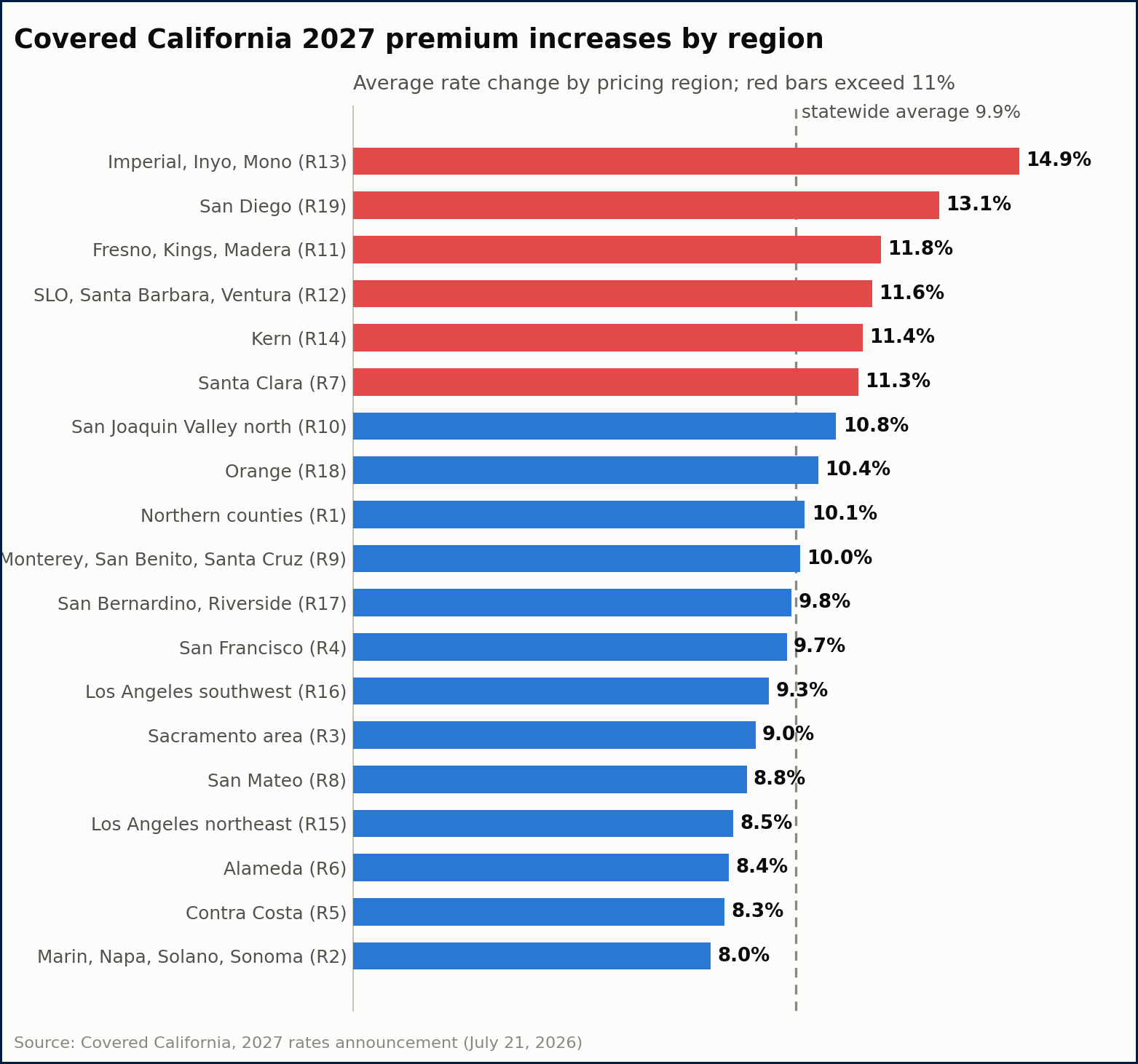
Premiums rise most in the Imperial Valley, San Diego, and the Central Valley:
The 2027 increases land hardest outside the state's coastal metros. The region covering Imperial, Inyo, and Mono counties faces the largest average increase at 14.9%, followed by San Diego County at 13.1% and the Fresno, Kings, and Madera region at 11.8%. The San Luis Obispo–Santa Barbara–Ventura region (11.6%), Kern County (11.4%), and Santa Clara County (11.3%) also land above the state average.
The smallest increases cluster in the Bay Area: 8.0% in the Marin-Napa-Solano-Sonoma region, 8.3% in Contra Costa County, and 8.4% in Alameda County. Los Angeles, split into two rating regions, comes in below average at 8.5% and 9.3%. The full table:
| Region | Counties / area | 2027 average change |
|---|---|---|
| 1 | Northern counties | 10.1% |
| 2 | Marin, Napa, Solano, Sonoma | 8.0% |
| 3 | Sacramento area | 9.0% |
| 4 | San Francisco | 9.7% |
| 5 | Contra Costa | 8.3% |
| 6 | Alameda | 8.4% |
| 7 | Santa Clara | 11.3% |
| 8 | San Mateo | 8.8% |
| 9 | Monterey, San Benito, Santa Cruz | 10.0% |
| 10 | San Joaquin, Stanislaus, Merced, Mariposa, Tulare | 10.8% |
| 11 | Fresno, Kings, Madera | 11.8% |
| 12 | San Luis Obispo, Santa Barbara, Ventura | 11.6% |
| 13 | Imperial, Inyo, Mono | 14.9% |
| 14 | Kern | 11.4% |
| 15 | Los Angeles (northeast) | 8.5% |
| 16 | Los Angeles (southwest) | 9.3% |
| 17 | San Bernardino, Riverside | 9.8% |
| 18 | Orange | 10.4% |
| 19 | San Diego | 13.1% |
Expiring federal tax credits are the largest stated driver of the 2027 increase:
Covered California attributes the increase to ordinary cost growth—medical and pharmacy prices—compounded by federal policy. The enhanced premium tax credits, which since 2021 have lowered monthly costs for most exchange enrollees nationwide, expire at the end of 2026. The exchange also cites reduced eligibility for lawfully present immigrants and new administrative requirements that make it harder for families to claim assistance, including annual income-recalculation burdens that fall hardest on gig workers.
"The federal government and this administration have made it more difficult for hard-working Americans to access high-quality health insurance," said Covered California executive director Jessica Altman in announcing the rates.
Those are the exchange's characterizations of federal policy; what is arithmetic rather than argument is that when a subsidy shrinks, the premium a household actually pays rises even if the sticker price were flat—and for 2027, both are moving.
California is spending $300 million on state subsidies to soften the increase:
The state's counterweight is its own subsidy program, funded from the Health Care Affordability Reserve Fund at $300 million for 2027, up from $190 million this year. The assistance goes to Californians earning up to 200% of the federal poverty level—$31,920 for an individual, $66,000 for a family of four.
Covered California projects the expanded program will reach more than 500,000 enrollees, roughly 30% of its membership, and open eligibility to about 200,000 people who previously received no state help. Nearly 200,000 enrollees are expected to qualify for Silver plans at $0 monthly premium, and the exchange estimates the program will keep about 90,000 Californians from dropping coverage altogether.
"Investing in the health of our residents is good for people. It's also good policy."
Molina exits Los Angeles and Orange County as CalOptima joins for 2027:
Twelve carriers will sell on the exchange in 2027, with two changes. Molina Healthcare is leaving Regions 15 and 18 (northeast Los Angeles and Orange County); the roughly 1,600 affected enrollees will be offered either a plan switch or the lowest-cost alternative in their current metal tier. CalOptima Health, Orange County's public plan, enters Region 18 for the first time.
Competition remains broad by exchange standards: 92% of consumers can choose among three or more carriers, and nearly 75% among four or more. That matters directly for what households pay, because the increases vary so widely by carrier:
| Carrier | 2027 average change |
|---|---|
| Inland Empire Health Plan | 5.6% |
| Kaiser Permanente | 6.7% |
| L.A. Care Health Plan | 8.1% |
| Western Health Advantage | 9.6% |
| Sharp Health Plan | 12.3% |
| Blue Shield of California | 12.5% |
| Anthem Blue Cross | 13.0% |
| Health Net | 13.2% |
| Balance by CCHP | 14.6% |
| Molina Healthcare (exiting Regions 15 & 18) | 16.9% |
| Valley Health Plan | 20.4% |
CalOptima Health enters Orange County (Region 18) as a new carrier for 2027. Source: Covered California.
Covered California enrollees can reduce the 2027 increase by shopping plans:
The most effective lever available to most enrollees is switching plans rather than passively renewing. Covered California estimates that consumers statewide can hold their increase down by moving to the lowest-cost plan in their current metal tier—and with carrier increases ranging from 5.6% to 20.4%, the gap between staying and switching can exceed the entire average increase. Twenty-six percent of enrollees remain eligible for $0-premium plans without changing anything.
The exchange's own examples give a sense of what subsidized coverage costs in 2027: a Los Angeles couple earning about $38,000 can hold a Bronze plan at $0 per month; an Orange County family of three earning about $41,000 can hold a Silver plan under $240 per month; a Sacramento family of four earning about $82,000 can hold Silver coverage under $580 per month.
The dates: current enrollees can renew or switch starting October 1, and open enrollment for new sign-ups runs November 1 through January 31, 2027. Enrollees over 65 or approaching eligibility are generally shopping a different system entirely—Medicare's open enrollment runs October 15 through December 7, and our Medicare enrollment guide covers that process.
The 2027 Covered California rates test whether state subsidies can offset federal cuts:
The 2027 rate season is the first in which California's expanded state subsidies operate without the enhanced federal credits behind them, and the outcome is measurable: enrollment. The exchange enters the year near record membership, projects its state program will keep roughly 90,000 people insured who would otherwise leave, and will report enrollment through the winter. Those figures, along with whether the regional gaps persist into 2028 filings, will show whether a state program a third the size of the expiring federal one can hold coverage steady. The rates themselves are set; what households do between October 1 and January 31 decides what they mean.
All figures are from Covered California's July 21, 2026 rate announcement. Individual premiums depend on region, carrier, plan tier, household size, and income; the exchange's shop-and-compare tool at CoveredCA.com gives household-specific quotes.
