

Medi-Cal work requirements, six-month renewals and immigrant eligibility: Every 2026–27 date you need to know
Medi-Cal work requirements start January 1, 2027, six-month renewals March 1, and federal funding for refugees and asylees ends October 1, 2026. A dated guide to the H.R. 1 changes, California's state-law overlay, the exemptions, and the coverage-loss estimates.


Medi-Cal, which covered 13.9 million Californians as of April 2026, begins a staggered series of eligibility changes on October 1, 2026. They come from H.R. 1, the federal budget law signed on July 4, 2025, layered on top of cuts California made in its own 2025–26 budget and adjusted again in this year's health trailer bill. The Department of Health Care Services (DHCS) maintains a tracking page, last updated September 21, 2026, that lists each change by date.
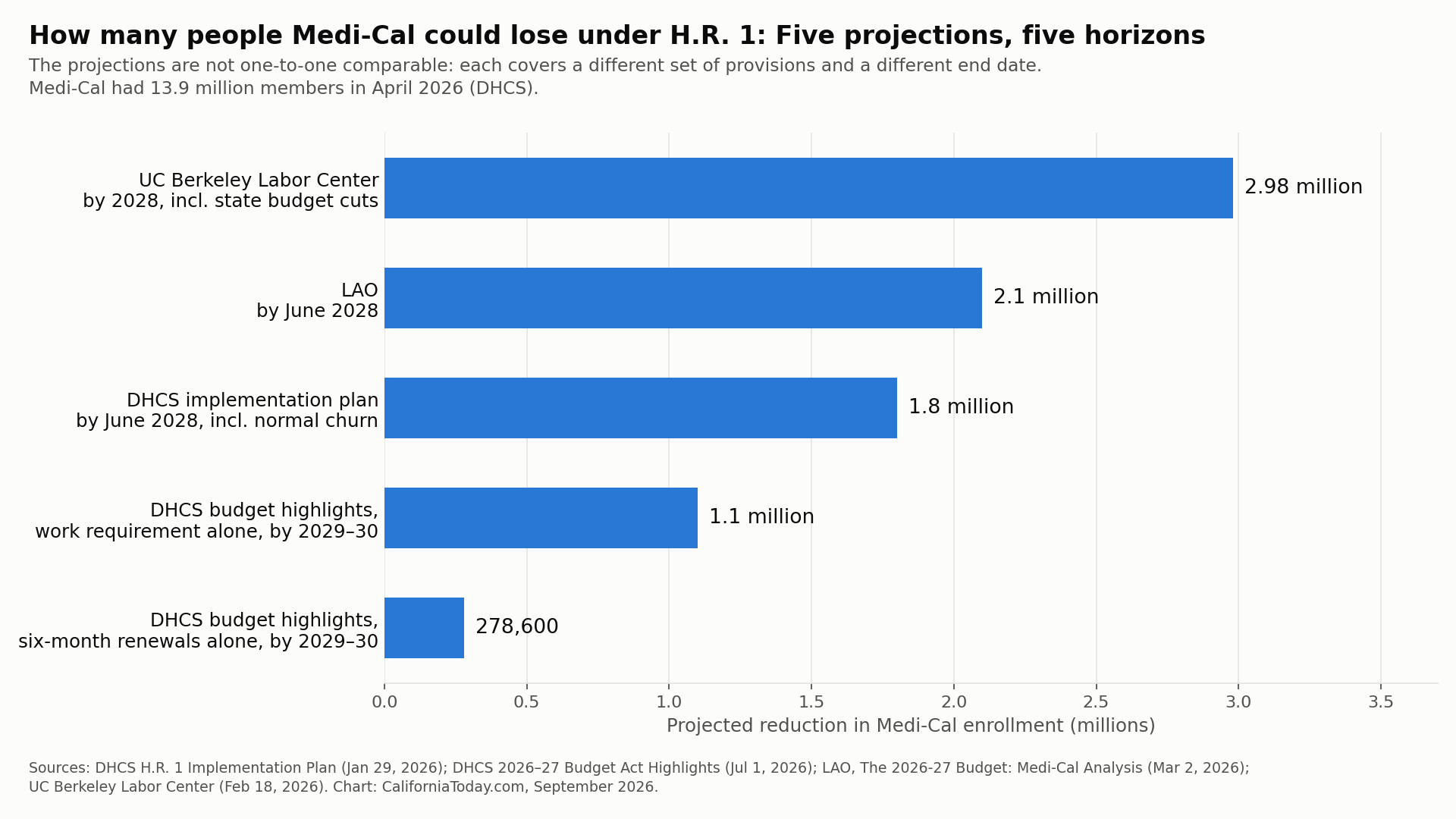
Three of those dates fall in the next five months. On October 1, 2026, federal funding ends for refugees, asylees and several other lawfully present groups, though California will keep them covered with state money until June 30, 2027. On January 1, 2027, work requirements take effect for adults aged 19 to 64 who are covered through the Affordable Care Act expansion, and retroactive coverage shrinks. On March 1, 2027, those same adults move from annual to six-month renewals. DHCS's January 2026 implementation plan projects "up to an estimated total of 1.8 million" disenrollments by June 2028 once everything is in force; the Legislative Analyst's Office (LAO) puts the figure at about 2.1 million.
Here is what each date changes, who is exempt, and what the state says members should do.
 Dr. Jennifer Trimpey | Specialist
Medi-Cal eligibility changes under H.R. 1: The full timeline
The table lists every dated change on DHCS's tracking page and in the state's budget legislation, in order. Sections below take the next three in turn.
Medi-Cal eligibility changes by date (as of September 27, 2026:
| Date | Change | Who is affected | Source of the rule |
|---|---|---|---|
| Jan 1, 2026 | Enrollment freeze: no new full-scope enrollment | Adults 19+ without satisfactory immigration status | State (AB 116, 2025) |
| Oct 1, 2026 | Federal funding ends; state-funded full scope continues to June 30, 2027 | Refugees, asylees, parolees, trafficking victims and other “qualified non-citizen” groups (about 148,000) | Federal §71109; state SB 164 |
| Jan 1, 2027 | Work or community engagement requirement (80 hours a month) | ACA expansion adults 19–64, minus exemptions | Federal §71119; state AB 2161 |
| Jan 1, 2027 | Retroactive coverage cut to one month (expansion adults) or two months (everyone else) | New applicants | Federal §71112 |
| Jan 1, 2027 | Move from managed care to fee-for-service | Members without satisfactory immigration status | Federal guidance (2025) |
| Mar 1, 2027 | Renewals every six months instead of annually | ACA expansion adults 19–64, minus exemptions | Federal §71107 (DHCS date) |
| Jul 1, 2027 | Monthly premium of $30–$50; dental ends; refugee/asylee groups move to emergency and pregnancy care only | Full-scope adults 19–59 without satisfactory immigration status; the Oct 1 groups | State SB 164 |
| Oct 1, 2028 | Copays up to $35 per service, capped at 5% of family income | ACA expansion adults with income above the poverty line | Federal §71120 |
October 1, 2026: Federal funding ends for refugees, asylees and other lawfully present groups
Section 71109 of H.R. 1 rewrites who the federal government will pay for. From October 1, 2026, federal Medicaid matching funds are limited to citizens and nationals, lawful permanent residents, Cuban and Haitian entrants, and residents under the Compacts of Free Association. DHCS's implementation plan lists the groups that lose federal eligibility: "Refugees. Asylees. Amerasian Immigrants. Individuals granted withholding of deportation or removal. Conditional entrants granted before April 1980. Individuals paroled into the United States for one year or more. Battered non-citizens, or the parent or child of a battered non-citizen. Victims of human trafficking. Individuals granted humanitarian parole, such as certain Afghans who aided U.S. operations in Afghanistan or people fleeing violence in the Ukrainian war."
California chose to keep paying. This year's health trailer bill, SB 164 (Chapter 27, Statutes of 2026), provides that "Beginning October 2, 2026, and until June 30, 2027," these members "shall be eligible for the full scope of Medi-Cal state-funded benefits," and that from July 1, 2027 they are eligible only for pregnancy-related services and emergency care. DHCS's Budget Act highlights put the cost at $365 million General Fund in 2026–27 and say "The Budget projects 148,000 individuals will be impacted by this change." The governor's January proposal would have moved this group to restricted-scope coverage immediately; the enacted budget bought them nine months.
A related change lands the same day with no member-facing effect: the federal match for emergency services provided to expansion adults without satisfactory immigration status drops from 90% to 50%, which DHCS costs at $669 million General Fund a year.
January 1, 2027: Medi-Cal work requirements begin
Section 71119 of H.R. 1 makes "community engagement" a condition of eligibility for the ACA expansion group, adults aged 19 to 64 with incomes up to 138% of the federal poverty level, "beginning not later than the first day of the first quarter that begins after December 31, 2026." DHCS Fast Facts count 4,682,045 expansion adults as of April 2026, a third of all Medi-Cal members. The LAO estimates that "after accounting for potential exemptions, an estimated 3.5 million people are expected to become subject to the work requirement in Medi‑Cal beginning in January 2027." The statute forbids waivers, and the good-faith delay some states are seeking expires December 31, 2028.
What counts as meeting the requirement
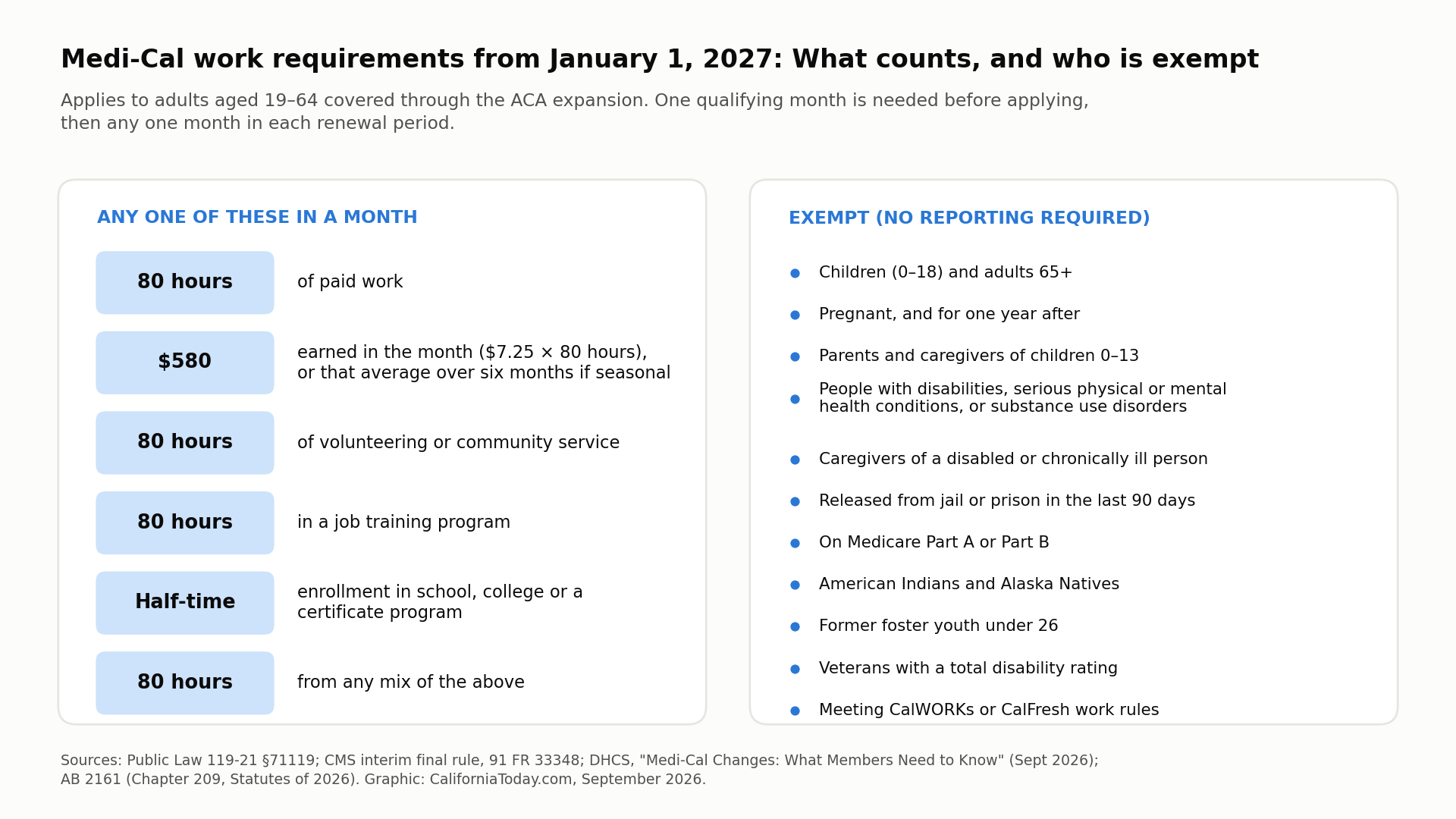
DHCS's member page translates the statute into plain terms. In any qualifying month, a member must do one of the following:
- Work at a job and earn at least $580 a month (the federal minimum wage of $7.25 multiplied by 80 hours), or be a seasonal worker averaging $580 a month over the last six months.
- Volunteer or do community service for at least 80 hours a month.
- Be in a job training program for at least 80 hours a month.
- Go to school at least half-time, which DHCS describes as "usually two or three classes, or about six to eight credits each semester."
- Do a mix of the above totalling at least 80 hours or $580.
Applicants must show one qualifying month immediately before the month they apply. Existing members must show any one month between their last eligibility determination and their next renewal, which, once six-month renewals begin, means one qualifying month in six.
Who is exempt
The exemptions are written into the statute, the CMS interim final rule of June 3, 2026, and state law. DHCS lists them as: children (0–18); adults 65 and older; pregnant people during pregnancy and for one year after; parents and caregivers of children aged 0–13; people with disabilities; people with serious physical or mental health conditions or substance use problems; people released from jail or prison in the last 90 days; people on Medicare Part A or Part B; American Indians and Alaska Natives; and people under 26 who were in foster care on their 18th birthday. Veterans with a total disability rating, people meeting CalWORKs or CalFresh work rules, and people in drug or alcohol treatment programs are also exempt under the statute.
What AB 2161 adds in California
Newsom signed AB 2161 by Assemblymember Mia Bonta, chaptered September 15, 2026 as Chapter 209, which amends the state's implementing statute. Its declared intent is to run the requirement "in ways that are least administratively burdensome to applicants and beneficiaries." Concretely, DHCS must confirm that its systems verify compliance "through interfaces with data sources that include, but are not limited to, wage data, Medi-Cal eligibility aid codes, Medi-Cal claims and encounter data, and data from the State Department of Social Services" before the requirement takes effect, so that most members are cleared without being asked for anything. Where data sources conflict, the county must ask the member to confirm before taking adverse action. A member the county cannot verify gets a notice of non-compliance and 30 calendar days to respond, with coverage continuing; the notice is deemed received five days after its date, and a member's statement that they never received it counts as good cause. If the 30 days pass without a satisfactory showing, DHCS must consider every other basis of eligibility before ending coverage. The bill also widens the caregiver exemption to parents and caregivers of anyone "with a chronic or other health condition, disability, or functional limitation."
DHCS says members will get letters "by mail, text, or email" before the rule starts. The CMS rule requires states to notify affected members at least three months before January 1, 2027.
Retroactive coverage and the fee-for-service move, same day
Two smaller changes share the date. Section 71112 cuts retroactive coverage, which pays medical bills incurred before an application, to one month before the application month for expansion adults and two months for everyone else, down from three, for applications made on or after January 1, 2027. And under 2025 federal guidance, members without satisfactory immigration status move from Medi-Cal managed care plans to fee-for-service Medi-Cal on January 1, 2027, which changes how they get care but not whether they are covered.
March 1, 2027: Six-month renewals replace annual ones
Section 71107 of H.R. 1 requires states to redetermine expansion adults' eligibility "once every 6 months" for redeterminations "scheduled on or after the first day of the first quarter that begins after December 31, 2026." DHCS's January 29 implementation plan carried that as an effective date of January 1, 2027. Its current tracking page and member page both say the change is "Effective March 1, 2027." DHCS has not published an explanation for the two-month difference; the practical reading is that the first six-month cycle begins with renewals due in March. Either way, the same people are affected: expansion adults aged 19 to 64, including those covered under the new immigrant rules. Members outside the expansion group, pregnant and postpartum members, American Indians and Alaska Natives, and former foster youth under 26 keep annual renewals.
DHCS says it will apply its existing "ex parte" process to the six-month cycle, checking data already on file first, "including automated verification processes to the maximum extent possible," so that "Members who successfully go through the automated ex parte process have no contact with the county to complete their renewals." The member page's own summary of the risk is one sentence: "If you miss deadlines, you could lose your Medi-Cal coverage."
July 1, 2027 and October 1, 2028: Premiums, dental and copays
The next state date is July 1, 2027. SB 164 requires full-scope adults aged 19 to 59 without satisfactory immigration status to pay a monthly premium "no less than thirty dollars ($30) and no greater than fifty dollars ($50)," with the amount to be set in the governor's May 2027 budget revision; DHCS's July budget highlights assume $50. Ninety days of non-payment moves a member to restricted scope. The same date ends dental coverage, other than emergency treatment, for those adults, a cut the 2025 budget had scheduled for July 1, 2026 and this year's budget delayed a year. It is also the date the October 1 refugee and asylee groups lose state-funded full scope.
The last federal date is October 1, 2028, when Section 71120 requires states to charge expansion adults with incomes above the poverty line copays of more than zero and no more than $35 per service, capped at 5% of family income, with primary care, mental health and substance use services, and community-clinic care excluded.
How many people Medi-Cal expects to lose
The state's estimates depend on the horizon. DHCS's January plan says the renewals and work requirement, "combined with normal churn of individuals transitioning from Medi-Cal coverage to Covered California," will produce "up to an estimated total of 1.8 million" disenrollments, "with significant spikes expected in months when major provisions go into effect; full implementation is expected by June 2028." The LAO's March analysis says "we estimate total coverage losses could reach about 2.1 million by June 2028." DHCS's July budget highlights, on a longer horizon, project the work requirement alone will remove 43,000 members in 2026–27 and 1.1 million by 2029–30, and six-month renewals about 278,600 by 2029–30. The UC Berkeley Labor Center, counting the state's own cuts as well, projects 2.98 million fewer Medi-Cal enrollees by 2028. None of these is a count of people who become uninsured; some will move to Covered California or employer coverage.
Counties do the eligibility work. The 2026–27 budget includes $420 million in one-time funding for county Medi-Cal and CalFresh eligibility staff, according to the California State Association of Counties, which says the budget provides nothing for indigent care for people who lose coverage.
Public charge: A separate rule that arrived first
On September 18, 2026, a Department of Homeland Security rule took effect that rescinds the 2022 public-charge regulations. Under the USCIS guidance implementing it, "government-funded health coverage" received on or after that date can count against applicants for admission or a green card, though benefits "received by the applicant's relatives, including children" are not attributed to the applicant. California's Health and Human Services Agency stresses that public charge "does not apply to most immigrants already in the United States," that it "is an immigration rule, not a benefits eligibility rule," and that families should "Get trusted advice before you change health care, food aid, or other support." Attorney General Rob Bonta sued to block the rule on September 14, co-leading a coalition of 19 states, the District of Columbia and the governor of Pennsylvania.
What Medi-Cal members are told to do now
DHCS's instructions are short: keep your contact information current with the county, open every letter from Medi-Cal or the county office, and respond quickly to renewal packets. Members who will be subject to the work requirement will be told so by letter before January 1; the member page says "Medi-Cal will send more information before this rule starts, including ways to help you meet the rules." People who lose Medi-Cal because of income can apply to Covered California, where open enrollment for 2027 runs November 1 to January 31; the enhanced federal premium credits ended on December 31, 2025, and the state has put $300 million into its own subsidy program for 2027.
What comes next for Medi-Cal eligibility under H.R. 1:
The October 1 change is the quietest of the three, because California is paying to make it invisible until July 2027. January 1 is the largest, with 3.5 million people subject to a monthly requirement that the state intends to verify mostly from data it already holds. March 1 doubles the renewal frequency for the same group. The numbers to watch are DHCS's monthly enrollment reports through 2027, which will show whether the disenrollment "spikes" the department predicted arrive on those dates, and the 2027–28 May Revision, which sets the premium. Medi-Cal eligibility under H.R. 1 will not be fully settled until the last federal provision takes effect on October 1, 2028.
This article describes rules in effect and scheduled as of September 27, 2026, based on DHCS's tracking page (updated September 21, 2026), the federal statute and California's 2026 trailer bills. DHCS updates its pages as guidance changes; check dhcs.ca.gov for the current version.
Sources & References
- DHCS, Tracking Federal Impact: Medi-Cal Eligibility (updated September 21, 2026)—https://www.dhcs.ca.gov/tracking-federal-impact-medi-cal-eligibility/
- DHCS, Medi-Cal Changes: What Members Need to Know—https://www.dhcs.ca.gov/medi-cal/help/medi-cal-changes/
- DHCS, Implementation Plan for New Federal Eligibility and Enrollment Changes Under H.R. 1 (January 29, 2026)—https://www.dhcs.ca.gov/file/file-193968-pdf/
- DHCS, Medi-Cal Monthly Eligible Fast Facts, July 2026 edition (data month April 2026)—https://www.dhcs.ca.gov/file/fast-facts-pdf/
- DHCS, 2026–27 Budget Act Highlights (July 1, 2026)—https://www.dhcs.ca.gov/wp-content/uploads/2026/07/DHCS-FY-2026-27-Budget-Act-Highlights.pdf
- Public Law 119-21 (H.R. 1), Title VII, Subtitle B, Chapter 1 (§§71107, 71109, 71110, 71112, 71119, 71120)—https://www.govinfo.gov/content/pkg/PLAW-119publ21/html/PLAW-119publ21.htm
- CMS, Medicaid Program; Community Engagement Requirement for Certain Individuals, interim final rule, 91 FR 33348 (June 3, 2026)—https://www.govinfo.gov/content/pkg/FR-2026-06-03/pdf/2026-11094.pdf
- SB 164 (Chapter 27, Statutes of 2026), health omnibus trailer bill—https://leginfo.legislature.ca.gov/faces/billTextClient.xhtml?bill_id=202520260SB164
- AB 2161 (Chapter 209, Statutes of 2026), Medi-Cal eligibility: work or community engagement—https://leginfo.legislature.ca.gov/faces/billTextClient.xhtml?bill_id=202520260AB2161
- Governor of California, legislation signed September 14, 2026—https://www.gov.ca.gov/2026/09/14/governor-newsom-signs-legislation-9-14-2026/
- LAO, The 2026-27 Budget: Medi-Cal Analysis (March 2, 2026)—https://www.lao.ca.gov/Publications/Report/5146
- LAO, The 2026-27 Budget: County Administration and H.R. 1 Implementation (March 5, 2026)—https://lao.ca.gov/Publications/Report/5149
- DHCS, Medi-Cal Eligibility Division Letter 25-33 (December 30, 2025)—https://www.dhcs.ca.gov/services/medi-cal/eligibility/letters/Documents/25-33.pdf
- UC Berkeley Labor Center, Projected reduction in Medi-Cal coverage due to federal H.R.1 and 2025-26 State Budget, by county, 2028 (February 18, 2026)—https://laborcenter.berkeley.edu/projected-reduction-in-medi-cal-coverage-due-to-federal-h-r-1-and-2025-26-state-budget-by-county-2028/
- California State Association of Counties, Final Budget Protects Many County Priorities—with One Critical Gap (June 29, 2026)—https://www.counties.org/news-and-media-article/final-budget-protects-many-county-priorities-with-one-critical-gap/
- Department of Homeland Security, Public Charge Ground of Inadmissibility, final rule, 91 FR 45324 (July 20, 2026)—https://www.federalregister.gov/documents/2026/07/20/2026-14539/public-charge-ground-of-inadmissibility
- USCIS, Policy Alert PA-2026-09, Public Charge Ground of Inadmissibility (August 18, 2026)—https://www.uscis.gov/sites/default/files/document/policy-manual-updates/20260818-PublicChargeFinalRule.pdf
- California Health and Human Services Agency, Public Charge—https://www.chhs.ca.gov/public-charge/
- Office of the Attorney General, Attorney General Bonta Sues to Block Trump Administration's Cruel New Public Charge Rule (September 14, 2026)—https://oag.ca.gov/news/press-releases/attorney-general-bonta-sues-block-trump-administration%E2%80%99s-cruel-new-public-charge
- Covered California, Rates and Plans for 2027 (July 21, 2026)—https://www.coveredca.com/press-releases/2026/07/21/covered-california-rates-and-plans-for-2027-california-continues-fight-for-health-insurance-affordability-and-access
- Covered California, Important Changes—https://www.coveredca.com/important-changes
- California Today, 2026-27 California health budget guide—https://californiatoday.com/guides/state-budget/2026-27-california-health-budget-guide-medi-cal-updates-cuts-coverages-and-timelines/
- California Today, Covered California premiums rise 9.9% for 2027—https://californiatoday.com/guides/health-insurance/covered-california-premiums-rise-9-9-for-2027-every-regions-rate-change-and-tips-to-lower-yours/


