

The FAA's nationwide ground stop lasted 4 hours and 23 minutes after a telecommunications failure
The FAA ordered a nationwide ground stop at 12:53 p.m. Pacific time on November 13 and lifted it at 5:16 p.m. Here is the timeline from the FAA's advisories, what officials have said about the cause, and how far the FAA's telecom rebuild has reached at California's two air traffic control centers.


The Federal Aviation Administration stopped departing flights at airports across the United States on Friday afternoon, November 13, after what it called a "temporary telecommunications outage." The nationwide ground stop took effect at 12:53 p.m. Pacific time, according to the FAA Command Center's advisory. It was cancelled at 5:16 p.m., 4 hours and 23 minutes later.
The cause is still under investigation. The FAA's statement on the ground stop describes "communication issues impacting multiple Air Route Traffic Control Centers," the regional facilities that guide planes between airports. The agency calls that information "preliminary and subject to change." Transportation Secretary Sean Duffy wrote that the problems began at 12:36 p.m. Pacific time at FAA facilities and approach control centers across the country. He added that the FAA "did not lose all radar or telecom."
Two of those regional centers handle air traffic over California: Oakland Center in Fremont and Los Angeles Center in Palmdale. Both are partway through the FAA's $12.5 billion rebuild of air traffic control, and telecommunications is the part of that rebuild with the most progress, by the agency's own count. The FAA's own progress tracker shows 67% of the old telecom connections it plans to replace converted to digital by September 30. It lists radio and voice-switch upgrades at both California centers as "in progress." The FAA has not said which equipment failed on Friday or whether any of it was due for replacement.
This article sets out Friday's timeline from the FAA's own advisories, what California airports posted, what officials have said about the cause, and where the FAA's tracker says California's air traffic control upgrades stand.
The FAA's nationwide ground stop lasted 4 hours and 23 minutes on November 13:
The FAA's Air Traffic Control System Command Center records each order it sends to airlines and air traffic facilities as a numbered advisory. Those advisories, posts by the FAA and Duffy, and airport posts give this sequence, in Pacific time:
- 12:36 p.m.: Telecommunications problems begin at FAA facilities and approach control centers nationwide, according to Duffy's timeline.
- 12:54 p.m.: The Command Center sends Advisory 111, effective from 12:53 p.m. It cites "extraordinary circumstances" and orders that "all departing traffic should remain ground stopped until further notice." Inbound international flights are to be handled case by case.
- 1:16 p.m.: Duffy posts that the stop followed "a communication issue impacting all Air Route Traffic Control Centers" and that FAA technicians are investigating.
- 1:20 p.m.: Advisory 116 warns aircraft operators to expect airborne holding "to any and all airports" because of equipment outages.
- 2:02 p.m.: The FAA posts that "every flight has been accounted for."
- 2:46 p.m.: Advisory 120 gives the reason as "communications failure." It says flights will be allowed to depart as the en route centers recover, through coordination with the Command Center.
- 3 p.m.: San Francisco International Airport says Pacific-bound flights are cleared to depart, including flights to Hawaii and Asia.
- 5 p.m.: Fewer than 400 aircraft remain in U.S. airspace, down from more than 3,500 when the stop began, according to Duffy.
- 5:16 p.m.: The Command Center cancels the nationwide ground stop. Duffy gave the time as 8:15 p.m. Eastern.
- 5:30 p.m.: SFO confirms the stop has ended and says it is returning to normal operations.
Some flying never stopped. Duffy wrote that the FAA made exceptions for medical evacuation, life-saving cargo and law enforcement flights.
The FAA has not published a count of affected flights. Flight-tracking data from FlightAware put Friday's U.S. cancellations near 5,000, ABC News reported.
The last nationwide ground stop, on January 11, 2023, followed the failure of the FAA's system for sending safety notices to pilots. It lasted about two hours and was the first since the September 11, 2001, attacks, the Government Accountability Office noted in a September report. That outage led to more than 1,300 cancellations and almost 10,000 delays, GAO wrote. Friday's stop lasted more than twice as long.
LAX warned of continued delays after the ground stop ended:
California's largest airports spent the afternoon telling travelers to check with their airlines. At SFO, Pacific-bound flights were cleared to depart more than two hours before the nationwide stop was cancelled. The airport's 3 p.m. post said flights to Hawaii and Asia could leave, and its 5:30 p.m. post confirmed the end of the stop.
FAA Nationwide Ground Stop Update
— San Francisco International Airport (SFO) ✈️ (@flySFO) November 13, 2026
3:00pm PST Friday, Nov. 13th, 2026: SFO confirms Pacific-bound flights are now cleared to depart from SFO, including destinations in Hawaii and Asia. Please check directly with your airline for the latest information on your flight and schedule! pic.twitter.com/6rTa6VOve7
Los Angeles International Airport posted that the FAA had lifted the stop but warned that travelers "may experience continued delays." Duffy made the same point after the airspace reopened. "It will take us time" to return to normal operations, he wrote, and he asked travelers to keep checking with their airlines.
Airlines posted travel waivers for Friday and Saturday flights, with different rebooking windows. Our refund rights explainer sets out what United, Delta and Alaska are offering and how a waiver differs from the cash refund federal rules require for a canceled flight.
 Pat Sharyon | Editor
The FAA and Secretary Duffy have described a telecommunications failure, with the investigation still open:
The FAA has described the cause in several ways. Its newsroom statement refers to "communication issues." Its post on X refers to "a temporary telecommunications outage," and Advisory 120 gives "communications failure." The statement says the problem affected "multiple" Air Route Traffic Control Centers. Duffy's first post said "all" of them were affected, and his later timeline described problems "at facilities & TRACONs across the country." A TRACON, or terminal radar approach control, handles planes climbing out of and descending into busy airports.
"The FAA confirms they did not lose all radar or telecom."
Secretary Sean Duffy, on X, November 13
Duffy gave more detail at a White House briefing on Friday evening, according to NBC News. He described the affected equipment as analog "TDM" telecommunications and said older switches and routers had failed while newer ones worked. "Our switches, our routers, actually got overloaded with data," Duffy told reporters. Homeland Security Secretary Markwayne Mullin said there was "no indication yet that this was a nefarious attack," The Washington Post reported.
As of Friday evening, the FAA had not named the equipment that failed or said why the problem reached so many facilities at once. Its statement says technicians are investigating and that it "will provide updates."
Oakland Center in Fremont and Los Angeles Center in Palmdale guide flights across California's skies:
Air Route Traffic Control Centers are what the FAA's advisories call en route facilities. They handle flights in the cruise stage, between the hand-off from controllers around the departure airport and the hand-off to controllers around the arrival airport. California has two.
Oakland Center (ZOA) is at 5125 Central Ave. in Fremont, according to the FAA's facility listing. The FAA's page for the center says it does two different jobs. One is normal en route air traffic control. The other is an oceanic operation that manages "the largest volume of international airspace in the world at one facility."
Los Angeles Center (ZLA) has been in Palmdale since March 1963, according to an FAA history of the center. The FAA's orientation guide for the facility says it is responsible for air traffic over parts of California, Arizona, Nevada and Utah, about 177,000 square miles.
The FAA's own tracker shows its telecom line conversion 67% complete:
The FAA is partway through what it calls the Brand New Air Traffic Control System. Duffy announced it in May 2025, and Congress appropriated $12.5 billion for it in July 2025, including $4.75 billion for telecommunications, GAO reports. The first phase is due by December 2028.
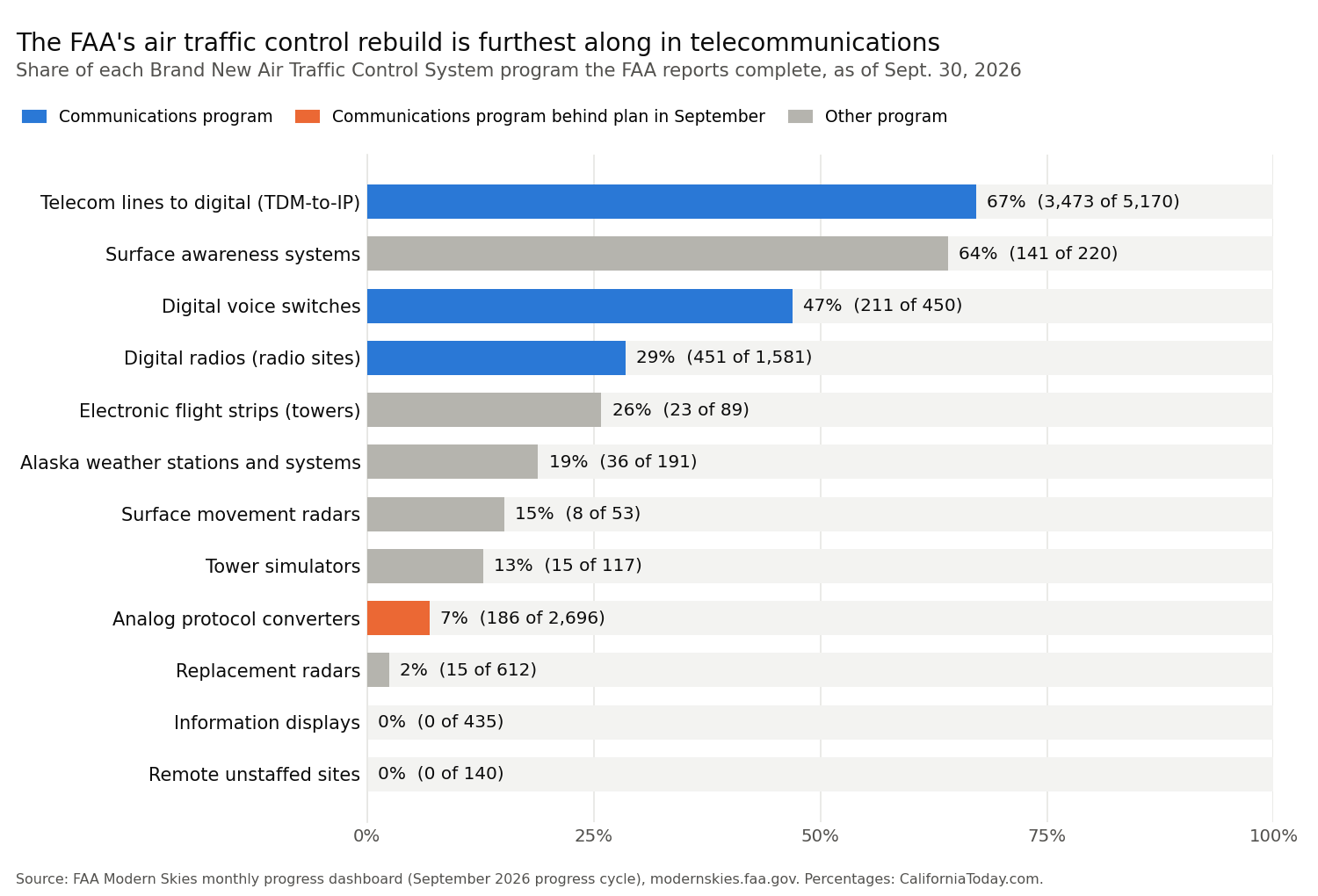
The FAA publishes progress on the project at Modern Skies, a site with a monthly dashboard of 12 programs. The program most directly tied to the kind of failure the FAA and Duffy have described is the conversion of the agency's old telecommunications lines to digital, internet-protocol connections. GAO describes that program as replacing 5,170 copper lines with fiber optic cable and moving nearly 30,000 services to internet protocol. Under the rebuild, the FAA moved its deadline from September 30, 2030, to December 31, 2028.
The September dashboard puts the telecom conversion at 3,473 of 5,170 sites, or 67%, as of September 30. That leaves 1,697 sites to convert. GAO reported that as of May the FAA had replaced 2,560 of the same 5,170 copper lines, so the count rose by 913 in about four months. In September the FAA completed 143 sites against a plan of 150.
The other communications programs are less advanced. The FAA reports 211 of 450 digital voice switches installed (47%) and 451 of 1,581 radio sites converted to digital radios (29%). The site's homepage gives slightly higher figures, dated October 15: 3,508 telecom sites, 220 voice switches and 457 radio sites.
Analog protocol converters are the one program the FAA lists as behind plan:
Of the 12 programs on the dashboard, the FAA rates 11 as at or ahead of plan. The exception is the analog protocol converter program, also in communications. The FAA reports 186 of 2,696 sites done (7%). In September the program completed 45 against a plan of 69, and the dashboard says "active recovery plans are in place."
Oakland Center and Los Angeles Center both have radio and voice-switch upgrades in progress:
The tracker also publishes local reports, which the FAA says are generated from its project database as of October 15. The reports for Oakland Center and Los Angeles Center list the same five items:
- Digital radios (NEXCOM): in progress at both centers.
- Internet-protocol voice switches (IPVCS): in progress at both centers.
- New controller consoles: planned.
- Enterprise information displays: planned.
- Flow Management Data and Services, a replacement for the FAA's traffic flow management system: planned, in the rebuild's second phase.
Neither report lists the telecom conversion as a separate item for the center.
California has 366 projects in the FAA's rebuild, and 86 of them are complete:
The tracker's California report counts 366 projects in the state. It lists 86 as complete, 128 in progress and 152 planned. That puts 23.5% of California's projects finished and 58.5% finished or under way. Communications projects make up 217 of the 366, and surveillance projects such as radars make up 69.
GAO found the FAA has no reliable cost estimate or integrated schedule for the rebuild:
GAO, Congress's auditor, examined the program in a report published in September. It set the rebuild against a history of failing equipment. An FAA risk assessment, which GAO reported on in 2024, found 51 of the agency's 138 air traffic control systems unsustainable and 54 more potentially unsustainable. In April and May 2025, failures of old telecommunications lines at the Philadelphia approach control facility that handles Newark's airspace left controllers without radar and radio contact. GAO wrote that the FAA attributed those failures to aging infrastructure, "specifically old copper wiring."
GAO's findings on the rebuild itself:
- The FAA projects phase 1 will cost $10.6 billion, but it has no comprehensive lifecycle cost estimate.
- The FAA has not built an integrated master schedule. It manages 11,389 separate project schedules, and GAO found separate projects scheduled at the same sites without being arranged to limit disruption for controllers.
- Phase 2, which includes new automation systems such as the flow management replacement planned for both California centers, needs about $10.2 billion more by FAA officials' estimate, excluding facilities. It has no start date.
The Department of Transportation partially agreed with GAO's two recommendations. The FAA's own fact sheet from December 2025 calls the $12.5 billion a "down payment" and puts the further need at $20 billion. GAO's $10.2 billion figure covers only phase 2's systems.
The FAA ground stop's cause is still under investigation as flights recover:
The FAA ground stop ended Friday evening, but its cause is not settled. The FAA's statement remains marked preliminary, and the agency has said it will provide updates. The FAA and Duffy have described a telecommunications failure. Telecommunications is the part of the rebuild the FAA's tracker shows furthest along, about two-thirds converted nationwide, and radio and voice-switch work is still in progress at Oakland Center and Los Angeles Center.
The next records to watch are the FAA's finding on what failed, the tracker's next monthly update and any congressional review. Travelers with canceled or disrupted flights can find their federal refund rights and the airlines' waiver terms in our refund rights explainer.
---
Sources & References
- FAA Air Traffic Control System Command Center. Advisory 111, National Ground Stop, November 13, 2026. https://www.fly.faa.gov/adv/adv_otherdis?adv_date=11132026&advn=111
- FAA Air Traffic Control System Command Center. Advisory 116, Nation Wide Airborne Holding, November 13, 2026. https://www.fly.faa.gov/adv/adv_otherdis?adv_date=11132026&advn=116
- FAA Air Traffic Control System Command Center. Advisory 120, Nationwide Ground Stop, November 13, 2026. https://www.fly.faa.gov/adv/adv_otherdis?adv_date=11132026&advn=120
- FAA Air Traffic Control System Command Center. Advisory 005, Cancellation of Nationwide Ground Stop, November 14, 2026 (UTC). https://www.fly.faa.gov/adv/adv_otherdis?adv_date=11142026&advn=5
- Federal Aviation Administration. FAA Statement on Nationwide Ground Stop, November 13, 2026. https://www.faa.gov/newsroom/faa-statement-nationwide-ground-stop
- Federal Aviation Administration (@FAANews). Post on X, November 13, 2026. https://x.com/FAANews/status/2121363171361575176
- Secretary Sean Duffy (@SecDuffy). Post on X announcing the ground stop, November 13, 2026. https://x.com/SecDuffy/status/2121351591106072679
- Secretary Sean Duffy (@SecDuffy). Post on X with the day's timeline, November 13, 2026. https://x.com/SecDuffy/status/2121426698172293310
- Secretary Sean Duffy (@SecDuffy). Post on X on reopening the airspace, November 13, 2026. https://x.com/SecDuffy/status/2121422750686310818
- San Francisco International Airport (@flySFO). Post on X, 3 p.m., November 13, 2026. https://x.com/flySFO/status/2121385265285788057
- San Francisco International Airport (@flySFO). Post on X, 5:30 p.m., November 13, 2026. https://x.com/flySFO/status/2121419276477460502
- Los Angeles International Airport (@flyLAXairport). Post on X, November 13, 2026. https://x.com/flyLAXairport/status/2121422414596989385
- ABC News / Good Morning America. "FAA ground stop live updates," November 13, 2026. https://www.goodmorningamerica.com/news/live-updates/faa-ground-stop-live-updates-hundreds-flights-canceled-138125140
- NBC News. "Live updates: FAA ground stop," November 13, 2026. https://www.nbcnews.com/news/us-news/live-blog/live-updates-flights-grounded-faa-communications-outage-rcna609268
- The Washington Post. "FAA grounds flights at all U.S. airports, citing 'telecommunications outage,'" November 13, 2026. https://www.washingtonpost.com/transportation/2026/11/13/faa-grounds-flights-all-us-airports-citing-communications-issue/
- U.S. Government Accountability Office. Air Traffic Control Systems: Ambitious New Modernization Effort Needs to Improve Cost and Schedule Planning (GAO-26-107992), September 2026. https://files.gao.gov/reports/GAO-26-107992/index.html
- Federal Aviation Administration. Air Route Traffic Control Center facility listing (Oakland ARTCC address). https://www.faa.gov/taxonomy/term/1371?page=16
- Federal Aviation Administration. Oakland Air Route Traffic Control Center (ZOA). https://www.faa.gov/about/office_org/headquarters_offices/ato/service_units/air_traffic_services/artcc/oakland
- Federal Aviation Administration. Los Angeles ARTCC (history). https://www.faa.gov/sites/faa.gov/files/about/history/milestones/Los_Angeles_ARTCC.pdf
- Federal Aviation Administration. Facility Orientation Guide, Los Angeles Air Route Traffic Control Center. https://www.faa.gov/sites/faa.gov/files/about/office_org/headquarters_offices/ato/ZLA-ARTCC.pdf
- Federal Aviation Administration. Modern Skies, monthly progress dashboard (September 2026 progress cycle). https://modernskies.faa.gov/#dashboard
- Federal Aviation Administration. Modern Skies (homepage figures as of October 15, 2026). https://modernskies.faa.gov/
- Federal Aviation Administration. Modern Skies local report, Oakland Center (ZOA). https://modernskies.faa.gov/?q=ZOA
- Federal Aviation Administration. Modern Skies local report, Los Angeles Air Route Traffic Control Center (ZLA). https://modernskies.faa.gov/?q=ZLA
- Federal Aviation Administration. Modern Skies local report, California. https://modernskies.faa.gov/?q=CA
- Federal Aviation Administration. Brand New Air Traffic Control System (BNATCS) Fact Sheet, December 4, 2025. https://www.faa.gov/newsroom/brand-new-air-traffic-control-system-bnatcs-fact-sheet


