California CEQA reform on the ballot: Understanding Prop 45's fast track for "essential projects"
Proposition 45 would let housing, water, clean-energy, hospital, school, broadband, wildfire and transportation projects opt into a new CEQA track with binding deadlines, fewer alternatives and narrower lawsuits. The changes, the 2025 baseline, the funders and the cost.


Proposition 45 would add a new chapter to the California Environmental Quality Act, the 1970 law that requires public agencies to study and disclose a project's environmental effects before approving it. The chapter, titled the "Building an Affordable California Act," applies to nine categories of projects the measure calls essential: housing, water systems, clean energy, medical facilities, fire and police stations, wildfire risk reduction, broadband, education facilities and transportation. For those projects, and only if the applicant chooses, it replaces CEQA's open-ended timelines with fixed ones, narrows what an environmental review must consider, caps public comment, and restricts what a court can do when a review is challenged. It is a statute, placed on the ballot by petition, and it is the closest contest among the 14 measures in this year's guide: 49% yes to 46% no in PPIC's September survey.
 Mac Douglass | Editor
The measure's own framing is affordability: "California's outdated system for approving essential projects is too slow, too bureaucratic, and too costly," its findings begin. Its opponents' framing is pollution: the measure "lets projects move forward with far less scrutiny of their harms to air, water and public health." Both sides agree on one thing the Legislative Analyst's Office also states: Prop 45 "does not exempt any essential project from environmental review." What it changes is the process. This explainer sets out that process as the text defines it, what the Legislature already changed in 2025, what the LAO says it would cost, and who is paying.
Proposition 45 creates an opt-in CEQA track for nine project categories
The text adds sections 21010 through 21034 to the Public Resources Code. Section 21015 makes the track voluntary: an applicant "may elect to utilize none, some, or all of the provisions of this chapter," in combination with or instead of other laws, and nothing "requires an applicant seeking approval of a project that meets the definition of an essential project to utilize this chapter." Section 21014 makes it binding on government: the chapter "shall apply to all public agencies," and "to the extent a conflict exists between this chapter and any other law, this chapter shall control." It also preserves existing exemptions and lets applicants with pending applications withdraw and resubmit under the new rules.
The nine categories are defined in section 21028, with exclusions written into each. Housing includes residential, mixed-use developments that are at least two-thirds residential, shelters, farmworker and student housing, and commercial-to-residential conversions. Water projects exclude "Delta conveyance facilities." Clean energy includes solar, wind, geothermal, small hydro, non-fossil hydrogen, microgrids, carbon capture and storage, and transmission, but "excludes producing or generating electricity from nuclear power." Public safety covers fire, police and sheriff's stations, "excluding any portion used as a jail or other detention facility," plus wildfire risk reduction such as undergrounding lines, fuel breaks and home hardening. Transportation covers roads, highways and transit under Article XIX of the Constitution and electric-vehicle charging, but "does not include a high-speed train." Medical facilities, broadband and education facilities, including those of UC, CSU, community colleges, school districts, charter schools and nonprofit private colleges, round out the list. An essential project "does not include a jail or other detention facility, or involve the development of a new oil or natural gas production facility," and each category carries "all related and ancillary public, private, and utility infrastructure."
CEQA today, and the changes the Legislature made in 2025
The LAO's analysis describes the current process: an agency decides whether CEQA applies, whether a project "could significantly affect the environment," and whether minor changes could avoid that; if not, it prepares an environmental impact report that "analyzes possible environmental impacts the project could cause and considers alternatives that could reduce those impacts," takes public comment, and then decides. "The majority of projects do not require an EIR," the LAO notes. Afterward, "people who think the agency did not follow the CEQA process correctly can sue the agency," and "if the court finds that the agency did not follow CEQA correctly, it can stop the whole project."
The Legislature has already carved large holes in that process. In June 2025, as part of the budget, Governor Newsom signed AB 130 and SB 131. AB 130 exempts from CEQA entirely infill housing on sites of up to 20 acres in cities or urban areas that are consistent with local zoning. SB 131 exempts day care centers, federally qualified health centers, food banks, advanced manufacturing facilities, wildfire risk-reduction projects, broadband in local rights of way, certain water projects and housing-element rezonings, and creates a "near-miss" rule under which a project that fails an exemption on a single condition is reviewed only for the effects of that condition. The Governor continued in September 2026, signing CEQA bills for fire stations (AB 2152), hospitals (AB 2231), day care zoning (SB 299), geothermal exploration (AB 2234) and an urban rail station (SB 1375), while vetoing SB 954, which would have narrowed the advanced-manufacturing exemption: the exemption "should be given a meaningful opportunity to work," he wrote.
Prop 45 is different in kind. The 2025 laws exempt specific project types from CEQA; Prop 45 exempts nothing but rewrites the procedure for everything in its nine categories, regardless of size, from a four-unit infill lot to a transmission line, and it does so by initiative, which the Legislature can amend only by a two-thirds vote "consistent with, and furthers the purposes of, this chapter," after the bill has been in print for 12 business days. Prop 45 also incorporates AB 130's labor rule, applying prevailing-wage requirements to housing "solely to buildings over 85 feet in height."
The clocks: 30 days to accept an application, 365 business days to decide an EIR
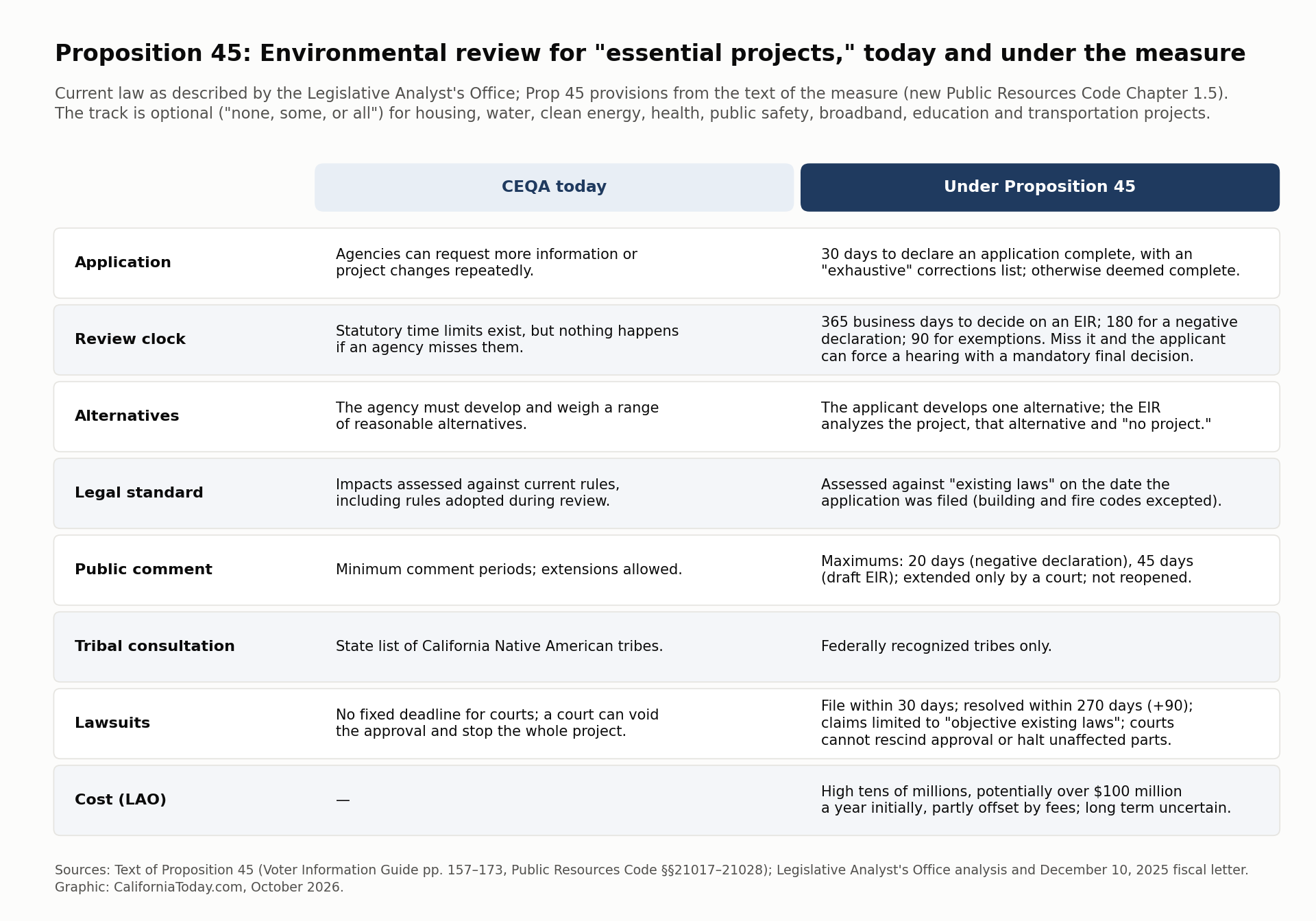
The measure's first mechanism is deadlines with consequences. Under section 21017, an agency has 30 days to tell an applicant whether an application is complete, with "an exhaustive written corrections list"; if it misses the deadline, "the initial application shall be deemed complete." An application cannot be rejected for lacking studies that were not on a published checklist, and the agency "shall not request or require an applicant to provide any new information unless that information was included on the exhaustive written corrections list."
Sections 21018 and 21019 then set the review clock: a final decision on an environmental impact report "no later than 365 days after" the application is complete, 180 days for a negative declaration, and 90 days to decide that a project is exempt or already covered by a prior review. Those three clocks run in business days, excluding weekends and state holidays; every other deadline in the chapter is in calendar days. The applicant can extend them. The LAO notes that current law also has time limits, but "nothing specific happens if an agency misses" them.
Under Prop 45 something does. Section 21020 lets an applicant, once a deadline passes, demand a meeting or hearing within 60 days at which the agency "shall" make "a final written determination on the available environmental review documentation that has been completed as of the date of the meeting or hearing" and "a final written determination to approve or disapprove the essential project." Compliance with the deadlines is "a nondiscretionary ministerial duty," and the applicant may sue within 90 days to enforce it. The agency keeps the power to say no: "No outcomes on any proposed essential project are preordained by this chapter."
The review: One alternative, standards frozen at filing, comment capped
The second mechanism narrows what the review contains. Section 21025 provides that "the applicant shall develop one proposed alternative to the essential project," which need not be at a different site, and that the EIR "shall only analyze" the project, that alternative and the no-project option; "all additional alternatives beyond those described… are unnecessary." The applicant's alternative "shall be presumed to lessen impacts that the alternative is intended to address" if substantial evidence supports it. Under current law, the LAO says, "the lead agency must develop and consider a range of reasonable alternatives to the project or its location."
Section 21022 fixes the yardstick: impacts are assessed "based on compliance with existing laws," defined as rules "in effect on the date an application for an essential project was submitted," with exceptions for later rules an agency finds necessary to avoid "a specific, adverse life-safety impact" and for building and fire code updates. Section 21021 caps public comment at 20 days for a negative declaration and 45 for a draft EIR, allows extensions only "by a court of competent jurisdiction," bars reopening the period at later hearings, and provides that comments outside those windows, other than oral testimony at a recorded hearing and late comments on issues that could not have been raised earlier, "shall be disregarded and excluded from the administrative record." Current law sets minimum comment periods, not maximums.
Tribal consultation changes too. For essential projects, "California Native American tribe" is redefined to mean a "consulting tribe," one "that appears on the most recent list published by the United States" of federally recognized tribes and is "traditionally and culturally affiliated with the geographic area." The LAO's letter to the Attorney General describes the effect: consultations would be based "on the list of federally recognized tribes, rather than on the longer contact list maintained by the state Native American Heritage Commission." The measure sets its own consultation procedure, with a records search within 20 days and a 30-day response window, and makes agreed mitigation "enforceable conditions of project approval."
The courts: 30 days to sue, 270 to decide, and no power to void the approval
The third mechanism is litigation. Section 21027 requires a CEQA challenge to an essential project to be filed "within 30 days" of the notice of determination and "completed within 270 days, inclusive of original and appellate court proceedings," extendable by up to 90 days at the court's discretion. Section 21026 limits the claims a petitioner can bring to "a public agency's noncompliance with objective existing laws," where objective means "involving no personal or subjective judgment and being uniformly verifiable by reference to an external and uniform benchmark," and limits the court to asking "whether the approval or authorization is supported by substantial evidence in light of the whole record." The LAO's summary of the contrast: "Under current law, the court can use its independent judgment to determine whether an agency appropriately applied CEQA."
The remedy is the sharpest change. If a court finds a violation, "the remedy shall be limited only to prohibiting commencement of the noncomplying part, phase, or activity until the noncompliance is corrected"; "a court may not order or direct… that a public agency rescind its approval," and parts of the project outside the deficiency "shall not be subject to the writ."
A full injunction is available only "upon a showing by clear and convincing evidence that an essential project would have a specific, adverse impact upon public safety" with no feasible mitigation. The administrative record is confined to documents the agency published and to timely comments. Once an approval survives challenge, or the agency files its return to the writ, "no further action or proceeding to challenge the implementation through completion of construction" may be filed. The provisions apply to cases "pending on, or commenced after" the effective date, which, as an initiative, is the fifth day after the Secretary of State certifies the result on December 11.
The measure contains no attorney-fee provision; its only reference to attorneys is a clause directing the Attorney General to appoint independent counsel, with a continuous appropriation, if the Governor and Attorney General decline to defend the act in court.
The cost: High tens of millions a year at first, uncertain after
The LAO's ballot analysis estimates that "during the first several years, Proposition 45 likely would increase costs for the state and local governments, including state courts," at "the high tens of millions of dollars annually, potentially exceeding $100 million annually," partly covered by fees on applicants and litigants. Its December 2025 letter had put the same costs at "tens of millions of dollars annually for the first several years" and added that "over the long term… state and local governments likely would experience net savings due to reduced administrative and legal workload," with court effects ranging "from annual savings of up to the tens of millions of dollars to annual costs of up to the low tens of millions."
The ballot analysis is more cautious about the long term, "uncertain, but potentially more significant," in either direction, depending on "how the new procedures change the number of eligible projects that get built and whether those projects have different environmental impacts." It also carries the sentence the No campaign quotes: some agencies "might incur costs to mitigate or respond to" projects approved with "unintended negative environmental impacts."
Proposition 45's author and funders: Nielsen Merksamer, CalChamber and a $226 million committee
The proponent of record is Kurt R. Oneto, a partner at the Sacramento election-law firm Nielsen Merksamer, whose firm bio says he "has served as counsel and legal strategist to over 60 ballot measure campaigns." The Attorney General's list shows Oneto as proponent of three measures on this ballot: Prop 45 and the two tax measures, Props 41 and 42, that could cancel the billionaire tax. The California Chamber of Commerce says it "not only strongly supports Proposition 45… but led the effort to qualify the measure"; the Secretary of State's top-funder disclosure for the petition drive names a CalChamber-sponsored committee with "major funding from" Building a Better California, Edison International and the California Building Industry Association.
Building a Better California is the committee behind the campaigns against Prop 40 and for Props 41 and 42, the three measures that decide the billionaire tax. Its Cal-Access filings show $226.7 million raised between January 1 and September 19, 2026; the FPPC identifies its top donors as Google co-founder Sergey Brin and venture capitalist L. John Doerr III; it has no public website, and its filer telephone number is that of Nielsen Merksamer's San Rafael office. It has given $10 million to the Yes on 45 committee, the largest single contribution on that side.
The FPPC's October 6 list puts the Yes side at $32.8 million from top contributors across three committees: after Building a Better California come the California Building Industry Association's issues committee ($5.65 million, with KB Home and Lennar as its top donors) and the association itself ($2.25 million), a separate CBIA committee funded by homebuilders ($4.1 million), a committee funded by PG&E ($2.4 million), CalChamber ($2 million), Edison International ($2 million), the California Association of Realtors ($1.5 million), a business PAC funded by California Resources Corporation and PG&E ($1.35 million), and $500,000 each from the hospital association, California Resources Corporation and a committee sponsored by Prologis, the logistics real-estate company. The No side reports $22.2 million: Clean and Healthy California, an environmental political committee, $7.08 million; philanthropist Wendy Schmidt, $5 million; the State Building and Construction Trades Council's committees, $2 million; the Laborers, $1.5 million; Operating Engineers Local 12 and the Iron Workers, $1 million and $1.5 million; and the Center for Biological Diversity, Earthjustice and the Natural Resources Defense Council's action fund in smaller amounts.
The lineup is unusual. The construction trades, which generally support building, are against; so are the Laborers, whose members build the projects the measure covers. The No argument's explanation is the measure's labor provisions and its backers: it "was written by the California Chamber of Commerce and financed by gas and electric utilities and corporate PACs." The Yes argument's coalition includes the California Children's Hospital Association, the California Water Association, American Clean Power, LULAC, the NAACP state conference and the California Taxpayers Association.
The arguments: Red tape versus review
The Yes argument is an affordability case: "Permitting delays add more than $75,000 to the cost of a new home," it says, and Prop 45 "will help lower rents and mortgages." The campaign's own site adds a commissioned estimate that the measure would raise housing permitting 18.1% and "add nearly 200,000 homes over ten years." It stresses that "Prop. 45 does not exempt a single project from environmental review" and that "cities and counties retain full authority to approve or deny projects."
The No argument is a public-health case: Prop 45 "lets projects move forward with far less scrutiny of their harms to air, water and public health," and "reduces public agency requirements to consider public comments." Its campaign site argues the measure "would fast-track polluting projects like data centers, pipelines, and industrial warehouses." Data centers, pipelines and warehouses are not among the nine categories; the measure's definition does include, for every essential project, "all related and ancillary public, private, and utility infrastructure," and whether that clause lets parts of such projects use the track is a reading the campaigns dispute and the text does not settle. The $75,000, 200,000-home and 639-day figures on the Yes side come from a report the campaign commissioned; all of these are claims, printed in the guide with the standard note that arguments "have not been checked for accuracy by any official agency."
Polling and endorsements on Proposition 45
PPIC's September survey of 1,103 likely voters, reading the ballot title, found 49% yes, 46% no and 5% undecided, inside the ±3.8-point margin. No other independent poll has published a Prop 45 result. McClatchy's California editorial board, writing for the Sacramento Bee and four other papers, endorsed the measure on October 5; the Bakersfield Californian has also endorsed it; the San Francisco Chronicle's editorial board lists its Prop 45 recommendation as "coming soon," and the Los Angeles Times had not published one as of October 12. The parties have split: the California Democratic Party opposes Prop 45 and the California Republican Party supports it. Governor Newsom, whose campaign released his positions on 12 of the 14 measures on October 9, has not taken one on Prop 45; he is "still reviewing" it and Prop 41, his spokesperson told the San Francisco Chronicle.
Proposition 45 after November 3: An immediate rewrite of pending reviews, amendable only by two-thirds
If Prop 45 passes, it takes effect on certification and applies "to all pending and future public agency and judicial review and processes for all essential projects," so applicants with reviews under way could withdraw and resubmit under the new chapter, and pending lawsuits would be subject to its litigation rules. The Legislature could adjust it only by a two-thirds vote that "furthers the purposes" of the chapter. If it fails, CEQA continues as the Legislature has been reshaping it since 2025, exemption by exemption. Either way, Proposition 45 is the first time California voters have been asked to decide the shape of environmental review directly, and the question on the ballot is not whether to review essential projects but how long, how deeply, and with what recourse.
This article reflects the Voter Information Guide as published, the FPPC contributor list as of October 6, 2026, endorsements as of October 12, 2026, and polling fielded through September 10, 2026.
Sources and References
- Voter Information Guide, Proposition 45—https://voterguide.sos.ca.gov/propositions/45/
- Voter Information Guide, Proposition 45, Legislative Analyst's analysis—https://voterguide.sos.ca.gov/propositions/45/analysis.htm
- Voter Information Guide, Proposition 45, arguments and rebuttals—https://voterguide.sos.ca.gov/propositions/45/arguments-rebuttals.htm
- Text of Proposed Laws, Proposition 45 (pp. 157–173)—https://vig.cdn.sos.ca.gov/2026/general/pdf/prop45-text-proposed-laws.pdf
- Legislative Analyst's Office and Department of Finance, fiscal review of initiative 25-0023A1, December 10, 2025—https://lao.ca.gov/ballot/2025/250480.pdf
- Governor of California, "Governor Newsom signs into law groundbreaking reforms to build more housing, affordability" (June 30, 2025)—https://www.gov.ca.gov/2025/06/30/governor-newsom-signs-into-law-groundbreaking-reforms-to-build-more-housing-affordability/
- AB 130 (Chapter 22, Statutes of 2025)—https://leginfo.legislature.ca.gov/faces/billTextClient.xhtml?bill_id=202520260AB130
- SB 131 (Chapter 24, Statutes of 2025)—https://leginfo.legislature.ca.gov/faces/billTextClient.xhtml?bill_id=202520260SB131
- Governor of California, veto message, SB 954 (September 18, 2026)—https://www.gov.ca.gov/wp-content/uploads/2026/09/Veto-Message-SB-954.pdf
- Governor of California, legislative updates of September 18, 20, 27, 29 and 30, 2026—https://www.gov.ca.gov/2026/09/30/governor-newsom-issues-legislative-update-9-30-2026/
- Office of the Attorney General, Active Measures (proponents)—https://oag.ca.gov/initiatives/active-measures
- Office of the Attorney General, initiative 25-0023A1 submission letter—https://oag.ca.gov/system/files/initiatives/pdfs/25-0023A1%20%28%26quot%3BEssential%20Projects%26quot%3B%29.pdf
- Nielsen Merksamer, Kurt Oneto—https://www.nmgovlaw.com/team/kurt-oneto/
- California Chamber of Commerce, board positions on November ballot measures (September 11, 2026)—https://advocacy.calchamber.com/2026/09/11/calchamber-board-of-directors-announces-positions-on-november-ballot-measures/
- California Secretary of State, Official Top Funders, measure 2000 (April 1, 2026)—https://elections.cdn.sos.ca.gov/ballot-measures/top-funders/2000-top-funders-04-01-26.pdf
- Cal-Access, Building a Better California (ID 1486767)—https://cal-access.sos.ca.gov/Campaign/Committees/Detail.aspx?id=1486767
- Fair Political Practices Commission, Top 10 Contributors List, November 2026 General Election (last modified October 6, 2026)—https://www.fppc.ca.gov/search-filings/top-10-contributors-list/november-2026-general-election/
- Yes on 45 campaign—https://yesonprop45.com/
- No on Prop 45 campaign—https://www.noprop45ca.com/
- Public Policy Institute of California, September 2026 likely-voter crosstabs—https://www.ppic.org/wp-content/uploads/crosstabs-likely-voters-0926.pdf
- Sacramento Bee / McClatchy California editorial board, Prop 45 endorsement (October 5, 2026)—https://www.sacbee.com/opinion/election-endorsements/article317475362.html
- California Democratic Party, 2026 General Election Endorsements and Ballot Measure Positions—https://cadem.org/wp-content/uploads/2026/08/FINAL-2026-General-Election-Endorsements.pdf
- California Republican Party, 2026 endorsements—https://cagop.org/endorsements/
- CalMatters, "Gavin Newsom backs measure to kill the billionaire tax and ban future wealth taxes" (October 9, 2026)—https://calmatters.org/politics/2026/10/newsom-tax-propositions-november-election/
- San Francisco Chronicle, "Here's how Gavin Newsom is voting on California's propositions" (October 9, 2026)—https://www.sfchronicle.com/politics/article/gavin-newsom-ballot-propositions-22470170.php
- California Today, guide to all 14 November 2026 propositions—https://californiatoday.com/guides/elections/2026-california-propositions-master-guide/
- California Today, "What, exactly, is California's 'billionaire tax'?"—https://californiatoday.com/news/elections/what-exactly-is-the-california-billionaire-tax/
What to Read Next:
 Mac Douglass | Editor
 Mac Douglass | Editor
 Mac Douglass | Editor