Did we see a wolf in Yosemite last summer? Here are the videos
It certainly looked like a wolf to us. Watch the clips so you can decide for yourself.


Last July (2025), my brothers and I spotted either a wolf or a coyote in Yosemite and recorded the videos below.
According to the the California Department of Fish & Wildlife, wolves are not currently active in Yosemite.
However, according to the U.S. Fish & Wildlife Service, Yosemite is included in the gray wolf species' range.
Did we see (and hear) a wolf? Did we see (and hear) a coyote?
We don't know.
But we know it looked (and sounded) an awful lot like a wolf to us.
The Original Footage
Here's everything we recorded so you make your own decision.
Video 1: The Clip Where You Can See the Animal
This is the original footage I recorded.
Video 2: The Clip Where You Can Hear the Animal
This is the original footage my brother Ross recorded.
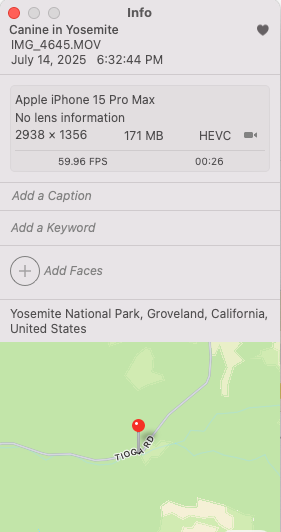
We recorded these videos on July 14th, 2025, on the Dana Fork of the Tuolumne River. We were on a fishing trip.
The exact location where we spotted the canine (more or less) is on the map below. The metadata and video details are screen-shotted at the bottom of this article.
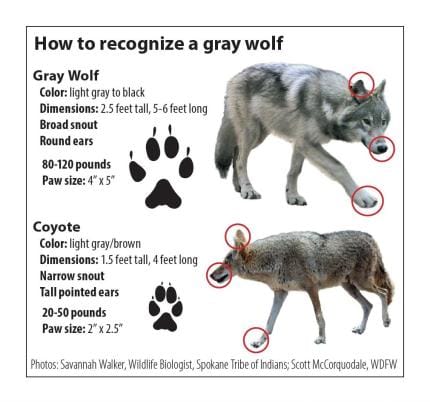
Wolf vs. Coyote: How Can We Tell?
First, we can review the quick reference below, or check this official California DFG guide for a more detailed breakdown of the physical differences between wolves and coyotes.
Can We Use Size to Figure it Out?
No.
If this is a full grown wolf, size should be the easiest way to tell. Full grown wolves are much bigger than full grown coyotes.
The canine looked huge while I was filming. But I won't pretend I can make an accurate estimate of how big it really was. It was far away.
There are probably internet sleuths who can make a reasonable estimate of the canine's size based on reference clues from the videos. I invite this sort of analysis.
Can We Use Head Shape to Figure it Out?
My video is already zoomed in significantly. It gets very grainy when I zoom in any further. This is problematic, because it's fine details like ear size and nose shape will be our best clues to figure this out.
Grainy or not, I zoomed in on a still from my video, and turned up the contrast to create the best possible perspective of our canine's head shape.
Below, you can compare it side by side with a wolf and coyote.
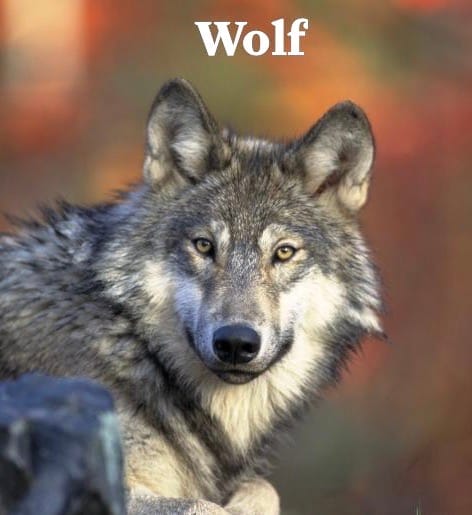
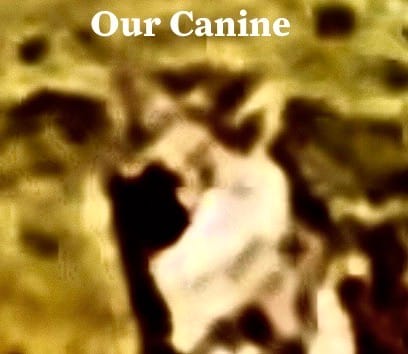
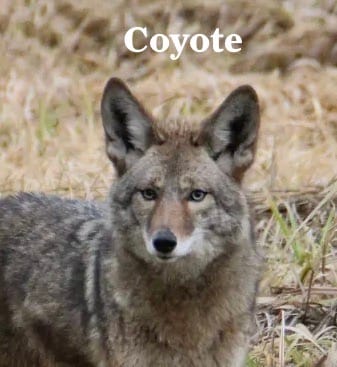
Photo credits: Wolf photo (left): Gary Kramer, USFWS. Coyote photo (right):
In my opinion, there are more indicators that point toward wolf than coyote. The coloring matches the wolf better. Also the ratio of ear size to head size seems more similar to the wolf photo than the coyote photo.
Can We Use the Way the Howl Sounded to Figure it Out?
Not in my opinion.
My gut feeling (and my brother's) was that the sound was made by a big animal. Too big to be a coyote.
But at this point I have listened to too many audio recordings of both wolves and coyotes howling to feel confident.
The howl we heard definitely sounded like a wolf. Coyotes usually sound high and yippy, The trouble is - they don't always sound that way. While most of the coyote-howl recordings I've heard don't sound like wolves, some of them do.
Here's one more brief recording of what our canine sounded like:
Metadata from My Video
Below is a screenshot of my video's metadata. If anyone is interested enough to request additional details to verify the clip's authenticity, I'll be happy to provide them.