


Yosemite has officially been added to the range of the gray wolf, per USFWS tracking data
Updated federal mapping confirms that the gray wolf range in California now extends continuously from the Oregon border into Tulare County. This expansion formally places Yosemite, Kings Canyon, and Sequoia National Parks within the active range of the gray wolf.

Yosemite National Park is now federally classified as part of the gray wolf’s active range, according to updated tracking data from the U.S. Fish & Wildlife Service (USFWS).
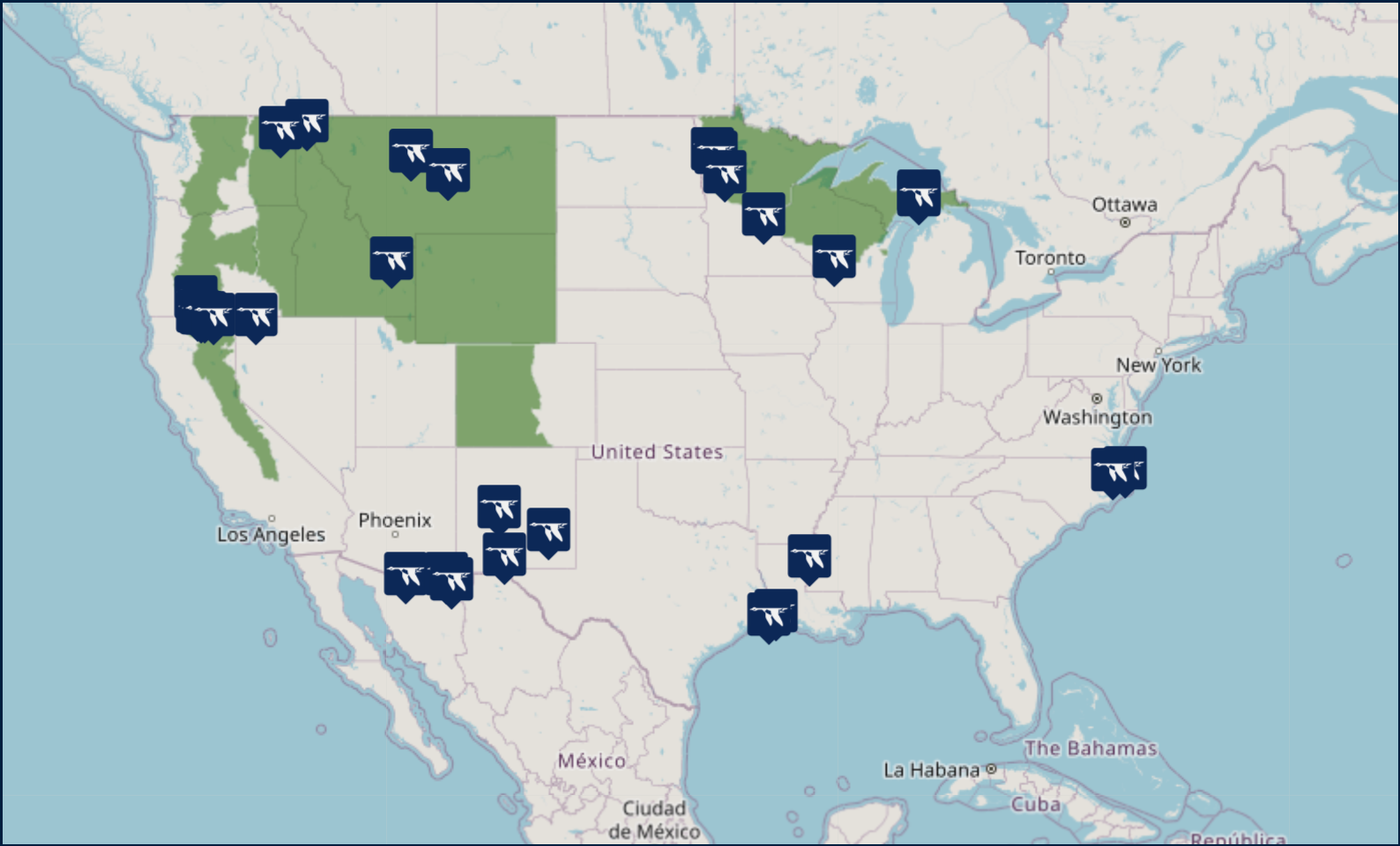
This is part of a massive expansion of the California gray wolves' range since May 2023, when the USFWS published its most recent previous range map. It marks the first time since the early 20th Century that Yosemite National Park, and many more iconic California landmarks, have been formally recognized as gray wolf territory.
Gray wolves were eliminated from California in the 1920s and remained absent for nearly 90 years. They were not documented again in the state until 2011. Since then, gray wolf activity in California has been largely concentrated in the north, and their confirmed presence in Yosemite marks a major milestone in the Central Sierra ecosystem.
 Brian Douglass | Specialist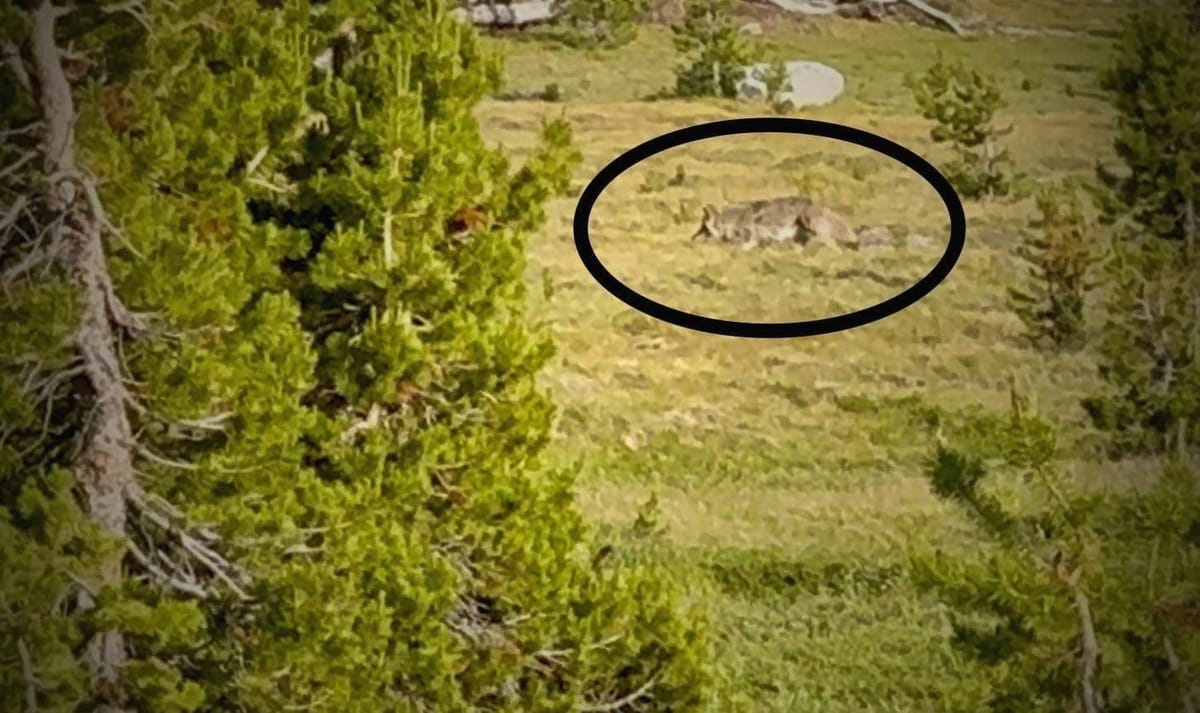
Mapping the Gray Wolfs' Range Expansion to Yosemite: Present Day vs. 2023
The U.S. Fish & Wildlife Service's official gray wolf range map updates automatically with new data. As of early February, 2026, the map reflects a significant southward expansion of gray wolves along the Sierra Nevada crest, extending their documented corridor from the Oregon border down into Tulare County.
Comparing the current USFWS range map to the 2023 iteration illustrates how rapidly and significantly the gray wolf range has expanded.
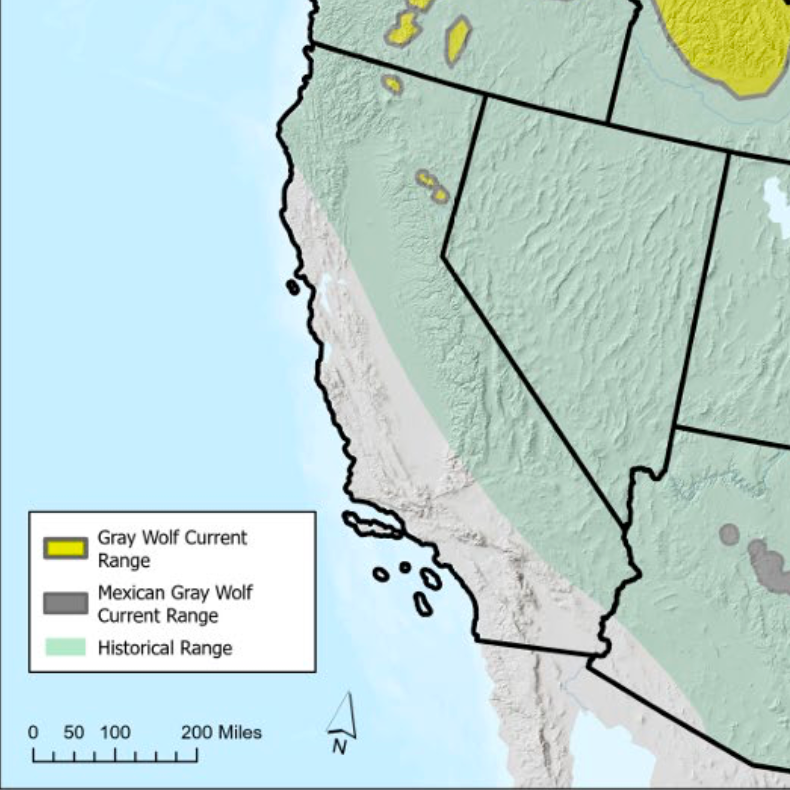
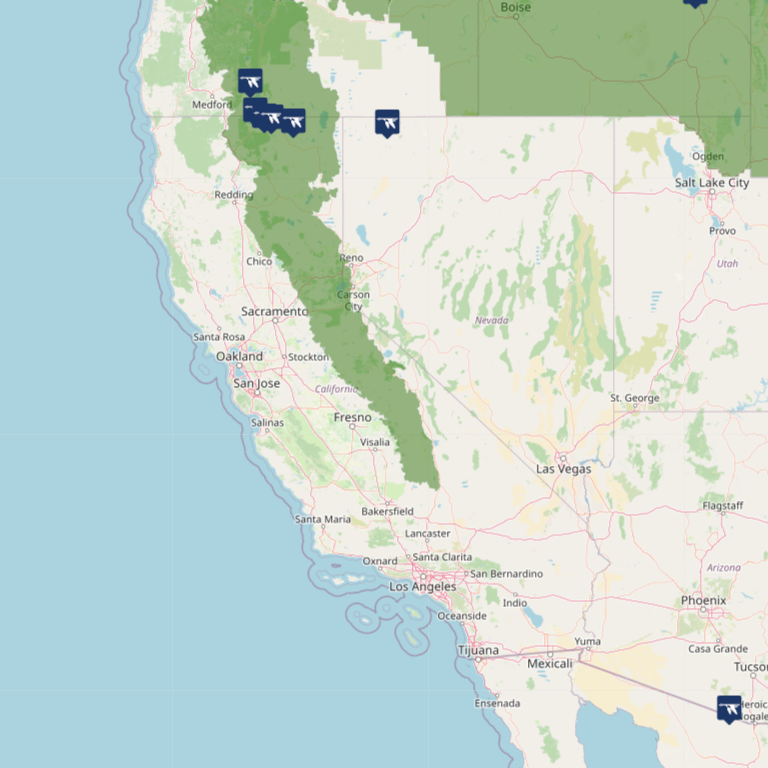
Figure 1 (left) depicts the known gray wolf range map as of May 2023. At that time, established wolf territory was limited to the northeastern corner of California.
Figure 2 (right) depicts the most up-to-date gray wolf range data as of February 1st, 2026. It depicts a continuous gray wolf corridor that now encompasses the Stanislaus and Sierra National Forests, Kings Canyon and Sequoia National Parks, and Yosemite.
Contextualizing the Data: Gray Wolf Range vs. Active Residency
While the federal map (Figure 2) now includes Yosemite within the species' range, this does not necessarily mean a wolf pack has permanently settled inside the park.
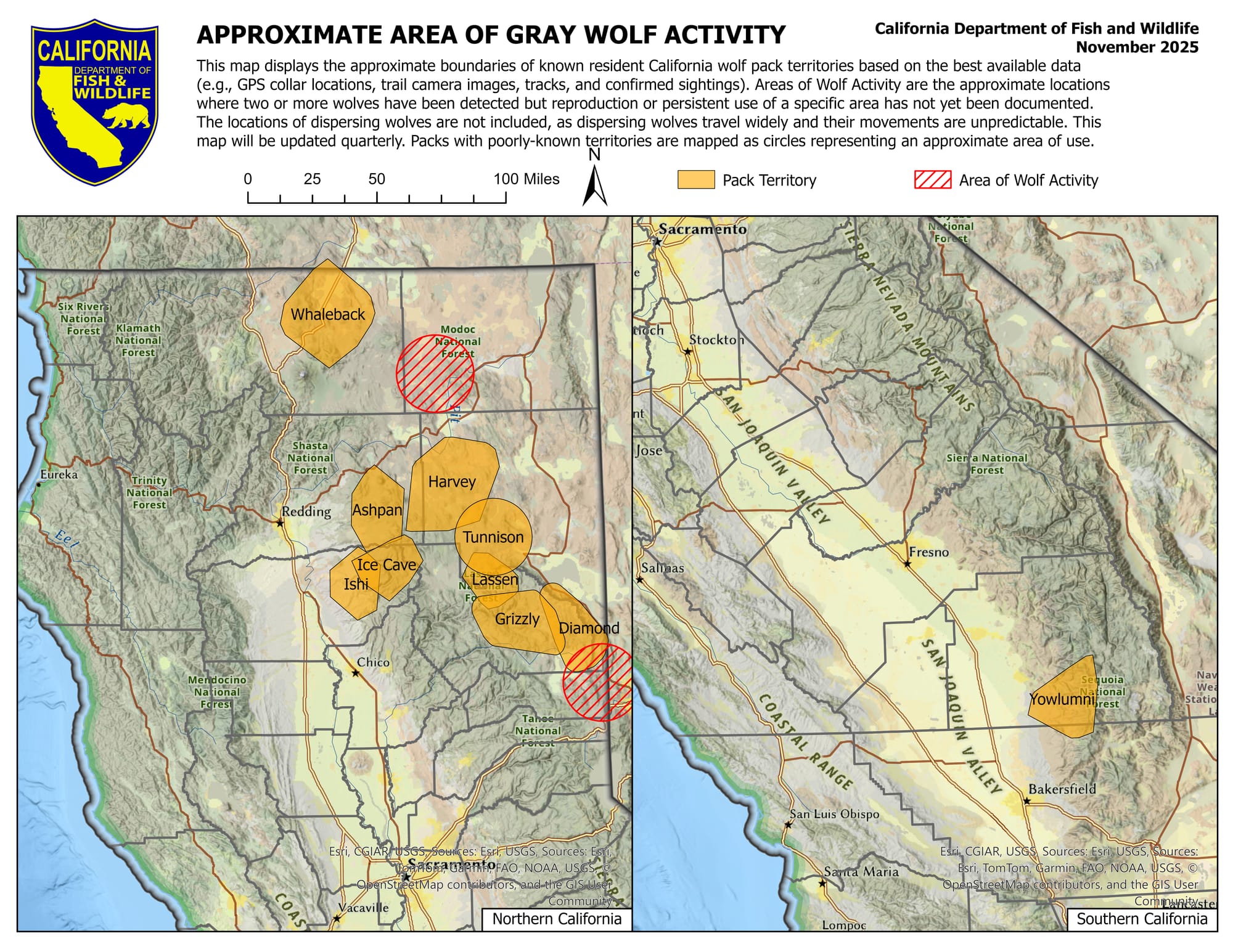
The "Area of Gray Wolf Activity" map above, released by the California Department of Fish and Wildlife (CDFW) in November 2025, provides a different perspective. It tracks "known resident wolf pack territories," which are currently clustered in the north and the far ssouth.
The federal map classifies the gap between them—including Yosemite—as "Range" because it serves as the vital dispersal corridor connecting these isolated populations. The state map focuses strictly on where packs have established dens.
Yowlumni Pack Confirms Wolf Presence in Southern Sierra
The primary driver for this range extension is the Yowlumni pack. Confirmed in July 2023—two months after the data cutoff for the previous federal assessment—the Yowlumni pack established a territory in the Sequoia National Forest area of eastern Tulare County.
Located roughly 200 miles south of the nearest northern packs, the Yowlumni pack’s presence provided the biological evidence necessary to reclassify the Central and Southern Sierra as active gray wolf habitat.
California Gray Wolf Population: 10 Active Packs as of 2026
The gray wolf population in California has grown steadily since wolves first re-entered California in 2011. As of February 1st, 2026, the California Department of Fish and Wildlife (CDFW) recognizes 10 active wolf packs.
Three of these packs—the Ashpan, Ishi, and Tunnison—were formally confirmed in 2025. The current distribution now spans the length of California's mountain ranges, contrasting with the gray wolf's total absence from California 15 years ago.
Endangered Species Protections and Wolf Management in California
Gray wolves remain listed as endangered under both the federal Endangered Species Act and the California Endangered Species Act (CESA). Killing gray wolves is prohibited under California law, except in defense of human life.
State wildlife officials continue to manage conflicts where range expansion overlaps with agriculture. Following high levels of livestock depredation in Northern California by the Beyem Seyo pack in 2024, CDFW deployed a "Strike Team" that resulted in the lethal removal of adult pack members. Operations have since shifted to monitoring the remaining juveniles and tracking the broader gray wolf expansion across the Sierra.


