ADHD meds are legal in Italy—but don't bring your Adderall without a doctor's certificate
Italy allows Adderall, Vyvanse and Ritalin for personal use, with a doctor's certificate in the Ministry of Health's format once you carry more than one pack. This guide covers the certificate, the one-package exception, Italian customs' quantity rule and the limits on codeine, Xanax and Ambien.


Italy is known for its food, its art and a bureaucracy that runs on paper.
For most visitors, the paperwork ends at a passport stamp. For travelers managing ADHD, chronic pain, anxiety or insomnia, there is one more document to think about. Italy's Ministry of Health (Ministero della Salute) lets travelers bring medicines containing controlled drugs, including Adderall, Vyvanse, Ritalin, oxycodone, Xanax and Ambien, as long as they carry a certificate or prescription in a set format from their home country. Italy does not ask Americans to apply for approval in advance. It asks them to arrive with the right document, because carrying a controlled drug without one falls under the Testo unico sugli stupefacenti (DPR 309/90), Italy's narcotics law.
Most everyday prescriptions are simpler. Italian customs allows travelers to bring ordinary medicines, such as those for blood pressure, cholesterol and diabetes, in a quantity compatible with the planned stay, with a prescription written at least in English. That allowance does not cover controlled medicines once you carry more than a single pack of each, and it does not cover cannabis, CBD oils or hemp products, which Italy treats as narcotics or has banned outright.
Below, we break down Italy's certificate rule for controlled drugs like Adderall, explain the one-package exception, cover the customs quantity rule for standard prescriptions, list the codeine limits, and cover medical devices, cannabis and transit through Rome and Milan.
Sources & References
Everything in this guide comes from Italian government sources, plus one US State Department page. To verify a detail or print a form, use these:
- Ministero della Salute (Ministry of Health): Travelling Internationally with Medicines Containing Controlled Substances—The English page for travelers entering Italy with controlled medicines, including the certificate contents.
- Ministero della Salute: Medicinali stupefacenti al seguito dei viaggiatori—The Italian page, with the Ministry's examples of covered opioids, benzodiazepines and barbiturates.
- Ministero della Salute: Info for travellers (PDF)—The Ministry's one-page letter listing what the certificate must contain.
- Ministero della Salute: Allegato 1 certificate form (PDF)—The bilingual certificate template attached to the 2007 decree.
- Ministero della Salute: Decreto 16 novembre 2007—The decree on carrying narcotic and psychotropic medicines in and out of Italy, including the one-package exception and Annex 2.
- Ministero della Salute: Tabelle delle sostanze stupefacenti e psicotrope—The narcotics tables (Tabella I to IV and the medicines table) as downloadable files.
- Gazzetta Ufficiale: Decreto 18 aprile 2025 (lisdexamfetamina)—The 2025 decree that added Vyvanse's ingredient to Tabella I.
- Gazzetta Ufficiale: Decreto 2024 (destroamfetamina)—The decree that added dextroamphetamine to Italy's medicines table.
- Gazzetta Ufficiale: Decreto 27 giugno 2024 (cannabidiolo)—The decree classing oral CBD extracts as controlled medicines.
- Gazzetta Ufficiale: Decreto-legge 11 aprile 2025, n. 48—The 2025 security decree whose Article 18 bans hemp flowers, extracts and oils.
- Gazzetta Ufficiale: Corte Costituzionale referral n. 26/2026—A court referral that quotes the hemp ban in full and confirms the conversion law.
- Normattiva: DPR 9 ottobre 1990, n. 309 (Testo unico stupefacenti)—The narcotics law, including the penalties in Articles 73 and 75.
- Agenzia delle Dogane e dei Monopoli (ADM): Traveller's Customs Charter, August 2026 (PDF)—Customs' English guide, with the medicines rule in section 3.7 and transit baggage checks in 3.9.
- Agenzia delle Dogane e dei Monopoli: Carta doganale per chi viaggia, Agosto 2026 (PDF)—The Italian original of the same charter.
- US Department of State: American Citizens Services information for Italy—The State Department's note on what to carry when no US health authority issues the certificate.
- AIFA (Italian Medicines Agency): Metilfenidato (ADHD) therapeutic plan—The prescription pathway for methylphenidate in Italy.
- Istituto Superiore di Sanità: Registro nazionale ADHD—The national ADHD registry that governs stimulant prescriptions in Italy.
Rules for bringing ADHD medications like Adderall into Italy:
Adderall contains amphetamine, which sits in Tabella I of Italy's narcotics tables, the table with the heaviest penalties. Italy does not sell Adderall, so there is no Italian prescription to fall back on, and the Ministry of Health's rules for travelers decide whether it can come in.
The rule comes from the Ministry's Decree of November 16, 2007. Article 3 says a resident of another country who is on treatment with narcotic or psychotropic medicines must carry, to keep taking them in Italy, a certification or medical prescription showing the patient's details, the prescription with the trade name of the medicine, the name and total quantity of the active substance, and the number of dosage units. That document has to be prepared by the competent health authority of the home country, and it is what gives you the right to hold the medicine on Italian soil. Customs lets the medicines through after checking it.
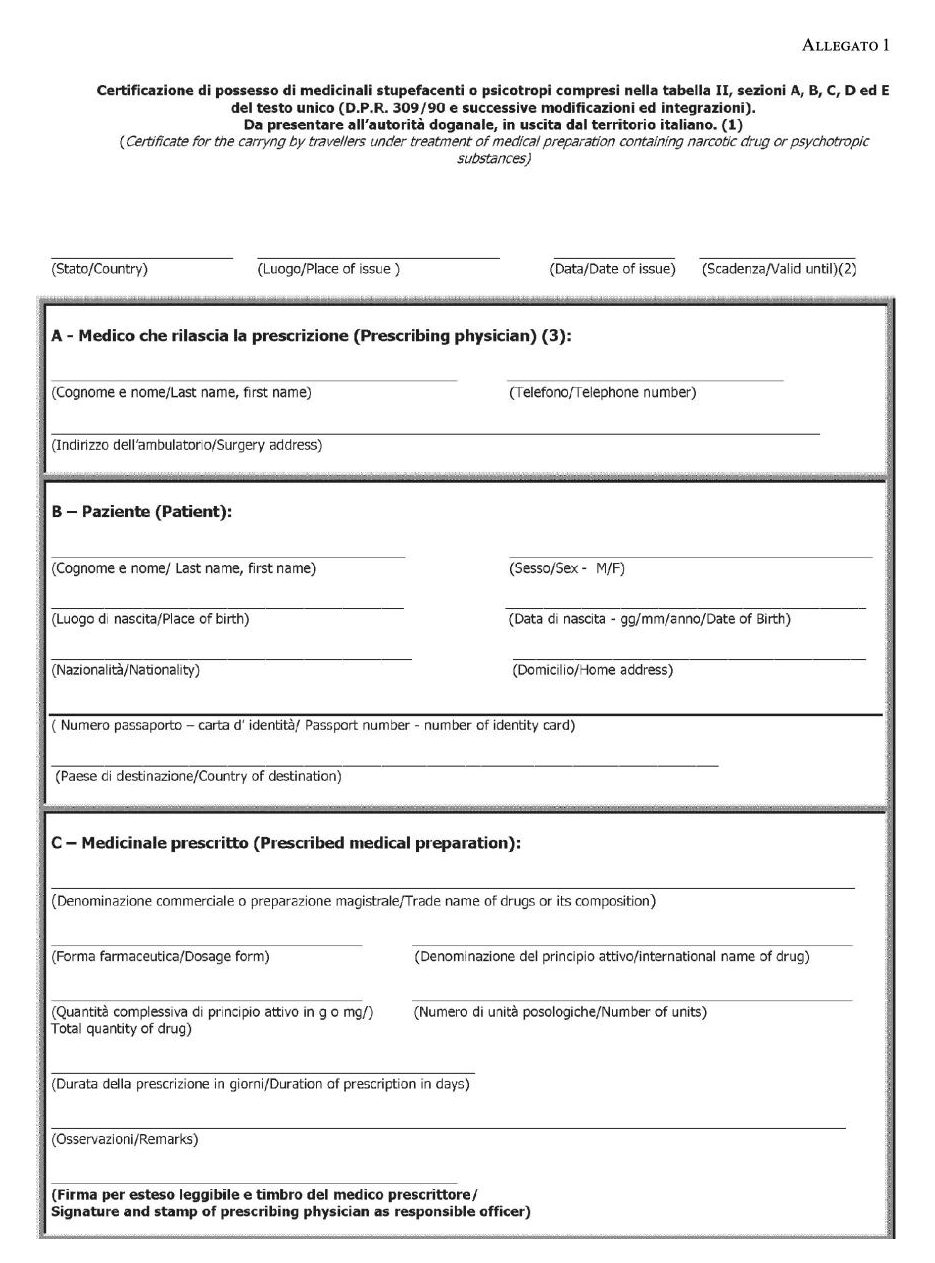
The Ministry's English page spells out what the certificate must contain, and it must be issued by a general practitioner or pediatrician who is authorized to prescribe internationally controlled drugs:
- Country and place of issue: Country, place, date and period of validity, which is a maximum of 30 days.
- Prescribing physician: Last name, first name, address and license number.
- Patient: Last name, first name, sex, place and date of birth, home address, passport number and the country of destination.
- Prescribed preparation: Trade name or composition, dosage form, number of units, the international name of the active substance, its concentration, the total quantity of active substance, the duration of the prescription in days, and the doctor's signature and stamp.
- Issuing authority: Name, address, official seal and signature of the responsible officer.
The United States has no national health authority that issues this document, and the Ministry's decree assumes one exists. The US State Department's citizen services page for Italy answers that gap: if no competent state health authority exists, bring the doctor's prescription for the medicine and a doctor's medical certificate on your condition and therapy. The Ministry's own "Info for travellers" letter ends the preparation section with the prescribing physician's signature and stamp, so a certificate your doctor completes on letterhead, covering every item above, is the practical equivalent.
Steps to legally bring Adderall or Vyvanse into Italy:
- Count your packs. If you carry a single package of each controlled medicine, the decree does not apply and a valid prescription is all Italy asks for. More than one pack of any one medicine brings the certificate rule into play.
- Ask your doctor for the certificate. Print the Ministry's Allegato 1 form, which is bilingual, or have your doctor write a letter covering every item in sections A to E. It needs the doctor's license number, your passport number, the total quantity of active substance and the duration in days.
- Date it close to departure. The Ministry gives the certificate a maximum validity of 30 days, so a letter written months ahead may be out of date by the time you land.
- Keep the quantity reasonable. The decree sets no number of days, but its recitals adopt the UN guideline that a 30-day prescription is adequate, with longer periods where the doctor considers them necessary. Carry what the trip needs and have the certificate match it.
- Travel with the paperwork. Keep the certificate, the prescription and the medicine in its original labeled packaging together in your carry-on, and have them ready for customs or police on request. The Ministry says the documents must stay in your possession for the whole stay.
Italy's Ministry of Health does not need to approve anything before you fly. Article 3 of the decree says the Ministry issues a prior authorization only where the home country expressly requires one, which the United States does not.
Vyvanse joined Italy's narcotics tables in May 2025:
Vyvanse's ingredient, lisdexamfetamine, was not on Italy's tables until the Ministry's Decree of April 18, 2025, published on May 7, 2025, and in force 15 days later. The decree's recitals explain why: during 2024 the Ministry received a stream of questions about lisdexamfetamine from travelers carrying it and from importers, AIFA confirmed that no medicine containing it is authorized in Italy, and the Ministry decided the drug was circulating without the controls that apply to other amphetamines. Vyvanse now follows exactly the same certificate rule as Adderall.
Dextroamphetamine, sold in the United States as Dexedrine and Zenzedi, was already in Tabella I and was added to Italy's medicines table in December 2024, under the names destroamfetamina, desamfetamina and dexamfetamina.
Ritalin and Concerta follow the same certificate rule:
Methylphenidate sits in Tabella IV, the lighter of Italy's tables, and it is the one stimulant Italy does sell, as Ritalin, Medikinet and Equasym. For travelers the classification makes no difference: methylphenidate is a psychotropic medicine under the 1971 UN Convention, so Article 3 of the decree applies, and more than one pack means the certificate. A single pack of Concerta with its pharmacy label and a prescription is enough on its own.
Opioid painkillers like oxycodone and morphine need the same certificate:
The same rule covers strong prescription painkillers. The Ministry's own examples of medicines covered by the decree are morphine, fentanyl, codeine, buprenorphine, oxycodone and methadone. Oxycodone, hydrocodone, tramadol and methadone are all in Tabella I, and buprenorphine is in Tabella IV. If you manage chronic pain, apply the same two-step check: one pack of each medicine needs only a prescription, and anything more needs the certificate.
Codeine works differently. Most codeine products Americans carry are combination tablets, and those fall under an exemption in the decree, covered in the codeine section below.
The "length of stay" rule for standard prescriptions in Italy:
For most travelers, bringing everyday medication into Italy is straightforward. The Agenzia delle Dogane e dei Monopoli, Italy's customs agency, says in its Traveller's Customs Charter that medicines can be imported for personal use if the quantity is compatible with the planned stay in Italy and, where the law requires a prescription for the medicine, you carry a regular prescription written at least in English, preferably showing the dosage. Health and customs officers can ask to see it.
That is the whole rule for medicines that contain no controlled drug, such as those for diabetes, high cholesterol, high blood pressure, asthma, thyroid conditions or contraception. There is no fixed day count, so a three-month supply for a three-month stay is fine and a six-month supply for a week in Rome is not. Keep every medicine in its original packaging with the pharmacy label visible, and carry the prescription or a printout from your pharmacy, because a bottle of loose pills with no label is what gets questions at the border.
The US State Department puts the same rule in plainer words: foreigners may bring personal medication for the whole period of their stay as long as they hold a doctor's prescription specifying the therapy and the dosage.
Rules for codeine, pseudoephedrine and dextromethorphan in Italy:
Italy's cough and cold rules are more forgiving than Singapore's or Japan's, because most of the ingredients Americans worry about are either exempt or not controlled at all.
Codeine and dihydrocodeine:
Codeine is a Tabella I substance, but Annex 2 of the 2007 decree takes most codeine products out of the certificate rule. Preparations containing codeine, dihydrocodeine, ethylmorphine, nicocodine, nicodicodine, norcodeine, pholcodine or acetyldihydrocodeine are exempt when they are combined with one or more non-narcotic ingredients and contain no more than 100 mg of the codeine-type substance per dosage unit and no more than 2.5% total concentration in the package. Tylenol with Codeine, which pairs 30 mg or 60 mg of codeine with acetaminophen, sits well inside the per-tablet limit, and a codeine cough syrup at the usual 10 mg per 5 ml strength is a fraction of the 2.5% figure, which is the limit that matters for liquids. For those products you need only a prescription, whatever the number of packs.
Plain codeine tablets with no second ingredient, and anything above 100 mg per unit, fall back under the certificate rule.
Pseudoephedrine and dextromethorphan:
Neither is a controlled substance in Italy. Pseudoephedrine, the decongestant in Sudafed, does not appear in Italy's narcotics tables, and the current Tabella I carries a note expressly excluding dextromethorphan and dextrorphan. Cold and flu products containing them follow the ordinary customs rule: a quantity that matches your stay, and a prescription where one is needed.
Psychotropic substances like Xanax, Valium and Ambien:
Benzodiazepines and sleeping pills are Tabella IV substances, and the Ministry lists diazepam (Valium), lorazepam (Ativan), oxazepam, bromazepam and flunitrazepam among the medicines its decree covers. Alprazolam (Xanax), clonazepam (Klonopin) and midazolam are in the same table, and so are the "Z-drugs" zolpidem (Ambien, sold in Italy as Stilnox), zopiclone and zaleplon. Phenobarbital and other barbiturates are in Tabella III. Every one of them follows the certificate rule: a single pack with a prescription is fine, and a second pack means the certificate.
| Medication or item | Examples | What Italy asks for |
|---|---|---|
| Common maintenance medications | Blood pressure, cholesterol, diabetes, asthma, thyroid, contraception | A quantity that fits your stay, plus a prescription at least in English where one is required |
| ADHD stimulants | Adderall, Vyvanse, dextroamphetamine, Ritalin, Concerta | One pack: prescription only. More than one pack: doctor's certificate in the Ministry of Health format, valid 30 days |
| Opioid painkillers | Oxycodone, morphine, fentanyl, hydrocodone, tramadol, buprenorphine, methadone | One pack: prescription only. More than one pack: doctor's certificate |
| Benzodiazepines and sleeping pills | Xanax, Valium, Ativan, Klonopin, Ambien (Stilnox), zopiclone, phenobarbital | One pack: prescription only. More than one pack: doctor's certificate |
| Codeine combination products | Tylenol with Codeine, codeine cough syrups | Prescription only, when codeine is combined with a non-narcotic ingredient at up to 100 mg per unit and 2.5% per package |
| Pseudoephedrine and dextromethorphan | Sudafed, DayQuil, Robitussin DM | Not controlled. Ordinary customs rule applies |
| Medical devices | Syringes, insulin pens, glucose sensors, CPAP, blood pressure monitors | No separate rule. Carry the prescription or a doctor's letter for injectables |
| Medical cannabis | THC products prescribed abroad | Controlled medicine. Doctor's certificate as for other narcotics; a state medical marijuana card is not enough |
| CBD and hemp products | CBD oils, tinctures, hemp flower, hemp extracts and resins | Banned or treated as controlled medicines, with court challenges pending. Leave at home |
Medical devices like syringes and insulin pens have no separate rule in Italy:
Italy sets no approval requirement for personal medical devices. Neither the customs charter nor the Ministry's traveler pages mention syringes, needles, insulin pens, glucose sensors, CPAP machines or blood pressure monitors, so they travel under the ordinary rule for the medicine they go with: a quantity that matches your stay and a prescription or doctor's letter that explains the injectables. Insulin itself is not a controlled substance.
Cannabis, CBD and hemp products are the riskiest things to pack for Italy:
A few things are either banned outright or sit in a legal gray zone that no traveler should test:
- Cannabis is Tabella II of the narcotics tables, and THC is Tabella I. Medical cannabis prescribed abroad is a controlled medicine like any other, so the certificate rule applies and a state medical marijuana card is not the document Italy asks for.
- Hemp flowers and anything made from them. Article 18 of Decree-Law 48/2025, converted into law in June 2025, prohibits the import, transport, shipping and delivery of hemp inflorescences, including dried or ground flower, and of products containing or made from them, including extracts, resins and oils, whatever the THC content. The text is quoted in full in a Constitutional Court referral published in February 2026, because Italian courts are questioning it.
- CBD oils and oral CBD products. A Ministry of Health decree of June 27, 2024 placed oral compositions of cannabidiol obtained from cannabis extracts in section B of Italy's medicines table, which makes them prescription-only controlled medicines. Both that decree and the hemp ban are being challenged in court, and the Council of State has asked the EU Court of Justice to rule on whether they comply with EU law. Until the courts settle it, a CBD tincture bought at an American pharmacy is an item Italian customs can treat as a narcotic or a banned hemp extract.
Transit passengers through Rome or Milan still face hand-luggage checks:
Italy's customs rules apply to anyone who passes through an Italian customs point, and the customs charter explains where that happens. If you land in Italy from the United States and connect to another EU flight, your hand luggage is checked at the first EU airport you arrive in, which is Rome Fiumicino or Milan Malpensa, while checked bags are examined at your final airport. On the way home, checks take place in the country of departure even if the aircraft stops in another EU country first.
So a traveler changing planes in Rome for Athens or Lisbon should carry the same certificate and prescription as someone staying in Italy, because the medicine in their carry-on can be inspected in Rome. Italy's hemp and CBD rules apply at that inspection too.
Italy's narcotics laws apply to long stays on controlled medication:
The Testo unico sugli stupefacenti sorts controlled substances into Tabella I to IV plus a medicines table, and its penalties explain why the certificate matters. Article 73 treats unauthorized import of a Tabella I substance as a crime carrying 6 to 20 years in prison and a fine of €26,000 to €260,000, or 6 months to 5 years and €1,032 to €10,329 for minor cases. Article 75 covers import or possession for personal use, which brings administrative sanctions lasting 2 months to 1 year for Tabella I substances, such as amphetamine and oxycodone, and 1 to 3 months for Tabella IV substances, such as methylphenidate and benzodiazepines, including suspension of a driver's license, a passport or a tourist residence permit. The certificate is what takes a traveler with Adderall out of both articles.
If you are moving to Italy or staying beyond what one certificate covers, plan to see an Italian doctor. Adderall and Vyvanse are not sold in Italy. Methylphenidate is, as Ritalin, Medikinet and Equasym, but AIFA ties its prescription to a therapeutic plan from an authorized specialist center, and prescriptions feed the national ADHD registry run by the Istituto Superiore di Sanità. A US prescription cannot be filled at an Italian pharmacy.
Italy's traveler resource directory:
Before you finalize your plans, use these official pages to check your medications:
- Ministry of Health traveler page: Read Travelling Internationally with Medicines Containing Controlled Substances for the certificate requirements in English.
- Certificate form: Print the Ministry's bilingual Allegato 1 and the one-page "Info for travellers" letter for your doctor.
- Is my medicine controlled? Download Tabella I, II, III and IV from the Ministry's narcotics tables page and search for the active ingredient's Italian name (amfetamina, metilfenidato, ossicodone, alprazolam, zolpidem).
- Customs rules: The Traveller's Customs Charter covers medicines, baggage checks and everything else you can and cannot bring in.
- US travelers: The State Department's Italy page explains what to carry when no US health authority issues the certificate.
Frequently asked questions about bringing medication into Italy:
Can I bring Adderall to Italy?
Yes. Adderall is allowed for personal use. One pack with its pharmacy label and your prescription needs no other paperwork. More than one pack needs a doctor's certificate in the Ministry of Health's format, dated within 30 days of travel.
Can I bring Vyvanse, Ritalin or Concerta to Italy?
Yes, under the same rule as Adderall. Vyvanse was added to Italy's narcotics tables in May 2025, so it now needs the certificate once you carry more than one pack. Ritalin and Concerta (methylphenidate) are sold in Italy but follow the same traveler rule.
Do I need to apply to Italy for approval before I travel?
No. Italy's Ministry of Health issues a prior authorization only when the traveler's home country requires it, which the United States does not. The certificate from your doctor is the whole process.
Can I bring Xanax, Valium or Ambien to Italy?
Yes. Alprazolam, diazepam and zolpidem are Tabella IV substances. One pack needs only a prescription, and more than one pack needs the certificate.
Can I bring medication into Italy without a prescription?
Only medicines that are sold without a prescription. Customs expects a prescription, at least in English, for any medicine the law requires one for, and a quantity that fits your stay.
Is CBD oil legal in Italy?
Oral CBD products from cannabis extracts were classed as controlled medicines in 2024, and hemp flower extracts and oils were banned in 2025. Both rules are being fought in court, so leave CBD at home.
Is codeine allowed in Italy?
Yes. Combination products with up to 100 mg of codeine per tablet, such as Tylenol with Codeine, are exempt from the certificate rule and need only a prescription.
Do I need the certificate if I am only connecting through Rome?
Carry it anyway. Hand luggage on an EU connection is checked at the first EU airport you land in, so Italian customs can inspect your medicine in Rome or Milan.
Planning ahead for a safe trip to Italy:
Traveling with medication to Italy takes one visit to your doctor rather than an application to a government office. Check each medicine against the Ministry of Health's narcotics tables, and if any of them is controlled and you are carrying more than one pack, ask your doctor for a certificate that covers every item on the Ministry's list, dated within 30 days of travel.
Whether you are carrying a season's worth of blood pressure medication or a prescription for Adderall, keep it in its original packaging with the prescription and any certificate together in your carry-on. That is the quickest way through the Agenzia delle Dogane at Fiumicino or Malpensa. If you are still unsure about a medicine, the Ministero della Salute has the final word.
What to read next:
 Dr. Jennifer Trimpey | Specialist

 Dr. Jennifer Trimpey | Specialist