

What, exactly, is California's "billionaire tax"? (Spoiler: It's not an annual tax on billionaires)
California voters are deciding Proposition 40, the "billionaire tax," a one-time 5% tax on the net worth of the state's billionaires to fund health care. Here is what the measure proposes, how two other propositions could cancel it, and where the money would go.


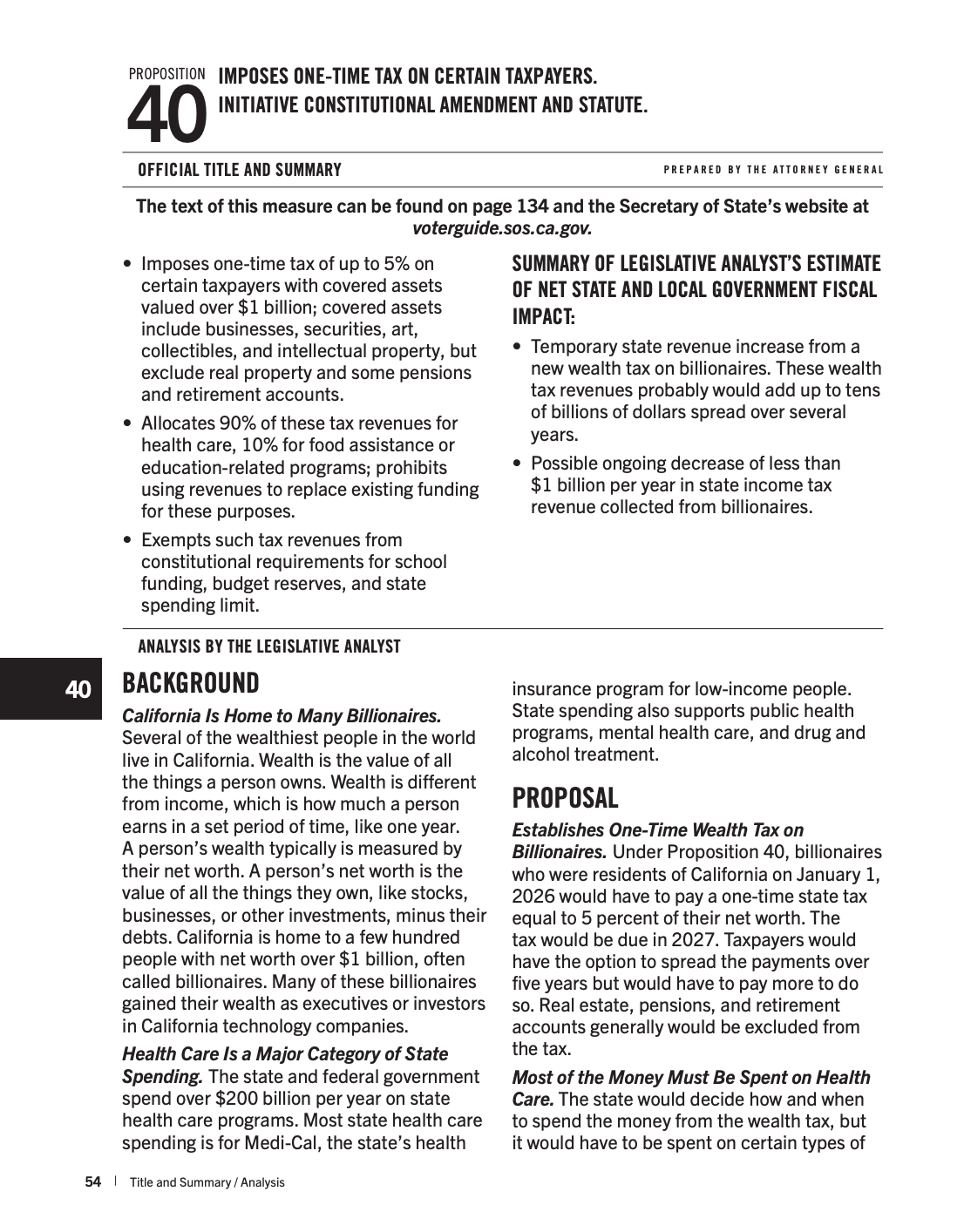
Proposition 40 is on California's November 3, 2026 ballot, seeking to impose a one-time 5% tax on the net worth of the state's billionaires and direct most of the money to health care.
If you are just tuning in, here is a full rundown of what Prop 40 is, the wealth-tax concept behind it (which is almost universally referred to as the "California billionaire tax"), the two other propositions on the same ballot that could cancel it, and the financial reality driving the proposal.
 Pat Sharyon | Editor
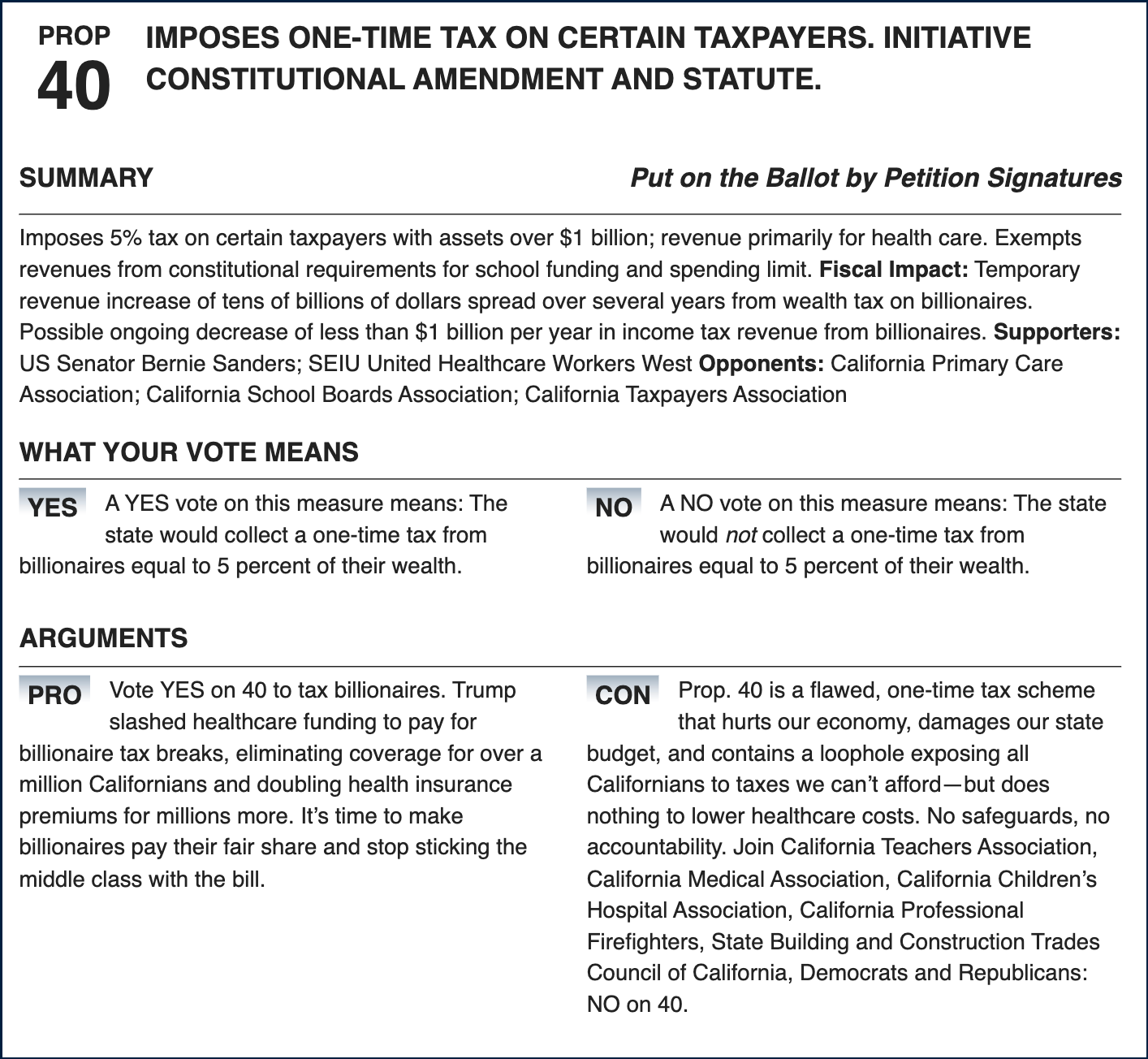
What Prop 40 does
Proposition 40—the 2026 Billionaire Tax Act, put on the ballot by petition—imposes a one-time state tax of 5% on the net worth of any individual who was a California resident on January 1, 2026 and whose net worth is $1 billion or more. Net worth is measured as of December 31, 2026, and a married couple counts as one taxpayer. The tax phases in between $1 billion and $1.1 billion, so someone worth exactly $1 billion owes nothing and someone worth $1.1 billion owes the full 5%.
A "Yes" vote does not create an annual wealth tax. The tax applies to the 2026 tax year only and is reported and paid with 2026 income taxes in 2027. Taxpayers can instead pay in five equal annual installments, but each deferred installment carries a 7.5% annual charge on the unpaid balance.
The official title and summary prepared by the Attorney General spells out what counts and what does not:
- Covered assets: businesses, securities, art, collectibles and intellectual property, wherever in the world they are held.
- Excluded: real property, and some pensions and retirement accounts.
- Where the money goes: 90% to a new Billionaire Tax Health Account and 10% to an Education and Food Assistance Account. The Legislature may spend up to $22.5 billion a year from the health account and $2.5 billion a year from the second, and may not use the money to replace existing funding.
- What it bypasses: the revenue is exempt from the Constitution's school-funding guarantee (Proposition 98), its budget-reserve rules and the state spending limit.
That last provision is the one that matters most for what follows.
Why the billionaire tax was proposed
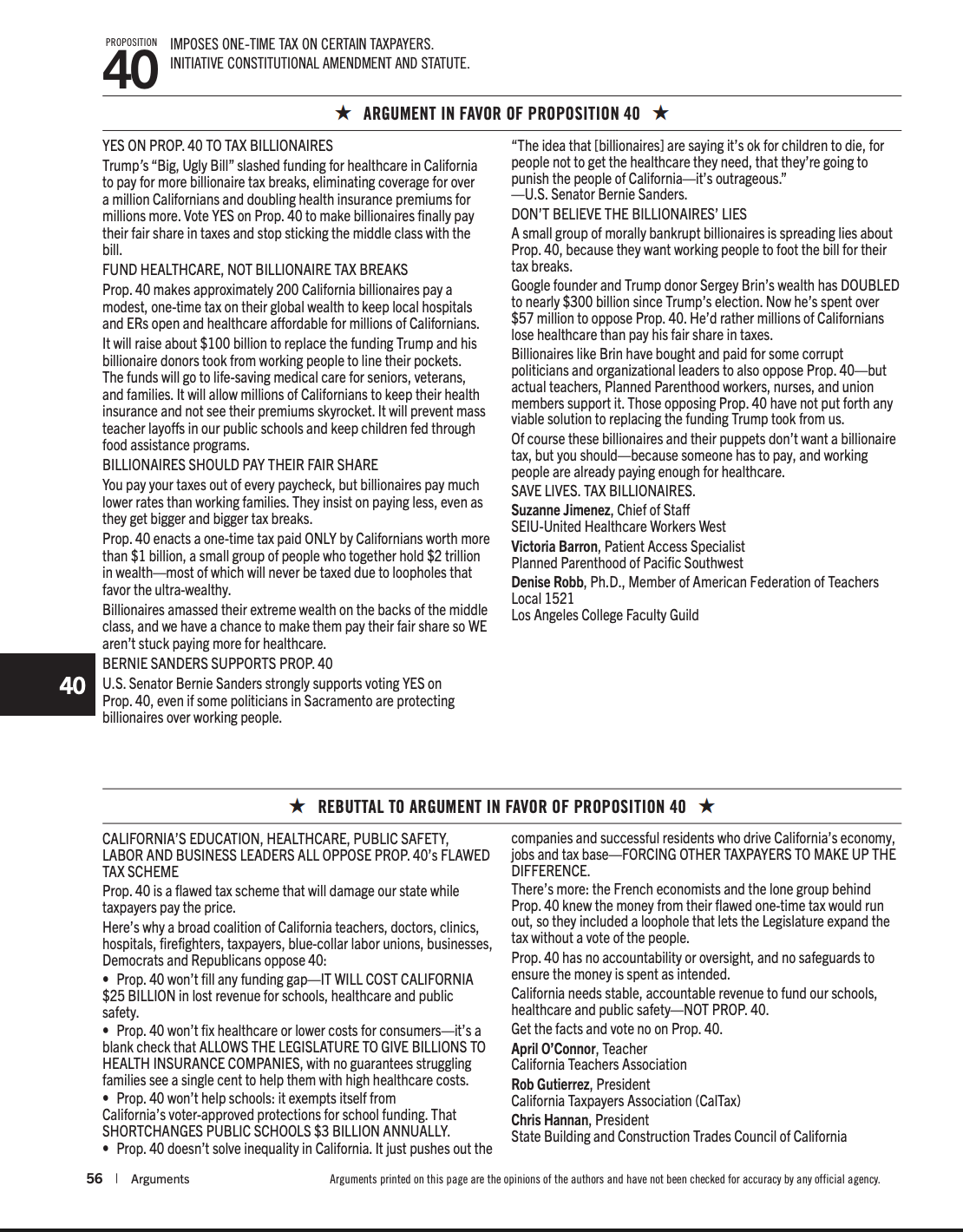
The measure's proponent is Suzanne Jimenez, chief of staff of SEIU-United Healthcare Workers West, which filed it with the Attorney General in November 2025 as initiative 25-0024. The union's ballot argument frames it as a response to the 2025 federal budget law, H.R. 1, which cuts federal health funding to the state: "Prop. 40 makes approximately 200 California billionaires pay a modest, one-time tax on their global wealth to keep local hospitals and ERs open and healthcare affordable for millions of Californians," the argument reads, claiming it "will raise about $100 billion."
Those are campaign figures. The Voter Information Guide notes that ballot arguments "have not been checked for accuracy by any official agency." The official estimates come from the Legislative Analyst's Office.
The revenue estimate: Tens of billions, once
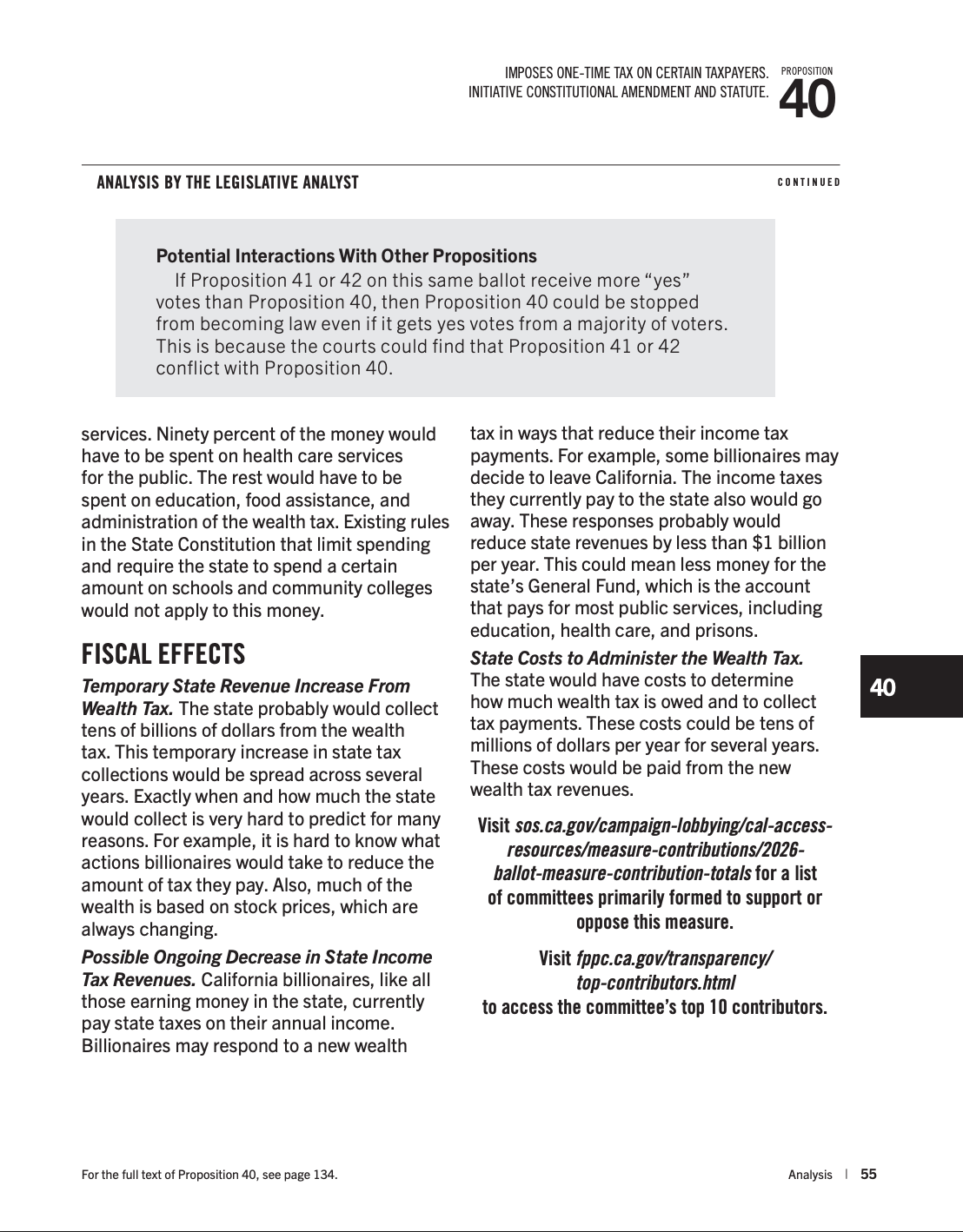
The LAO's analysis says California is "home to a few hundred people with net worth over $1 billion," and that the state "probably would collect tens of billions of dollars from the wealth tax," spread across several years beginning in 2027. It also says exactly how much "is very hard to predict," because it depends on "what actions billionaires would take to reduce the amount of tax they pay" and because "much of the wealth is based on stock prices, which are always changing." Administering the tax would cost "tens of millions of dollars per year for several years," paid from the tax itself.
The offsetting loss: Income tax that leaves with the taxpayer
The LAO also projects a "possible ongoing decrease" in state income tax revenue "of less than $1 billion per year," because "some billionaires may decide to leave California" and the income taxes they pay now would go with them. The LAO's earlier letter to the Attorney General, dated December 11, 2025, put the same point more firmly: "it is likely that some billionaires decide to leave California," with a loss of "hundreds of millions of dollars or more per year." For scale, the LAO notes that the state and federal governments together spend over $200 billion a year on California's state health programs.
The ballot context behind Prop 40: Props 41 and 42
Prop 40 is one of 14 statewide measures on the November ballot, and two of them were written after it. Proposition 41 and Proposition 42 were filed with the Attorney General on January 12, 2026 by the same proponent, attorney Kurt R. Oneto, as initiatives 25-0040 and 25-0041. Neither text mentions Prop 40, billionaires or a wealth tax. But each is written to reach any measure "that appear[s] on the ballot at the same election," and each contains a provision that Prop 40, as drafted, cannot satisfy.
Prop 41: The spending-limit measure
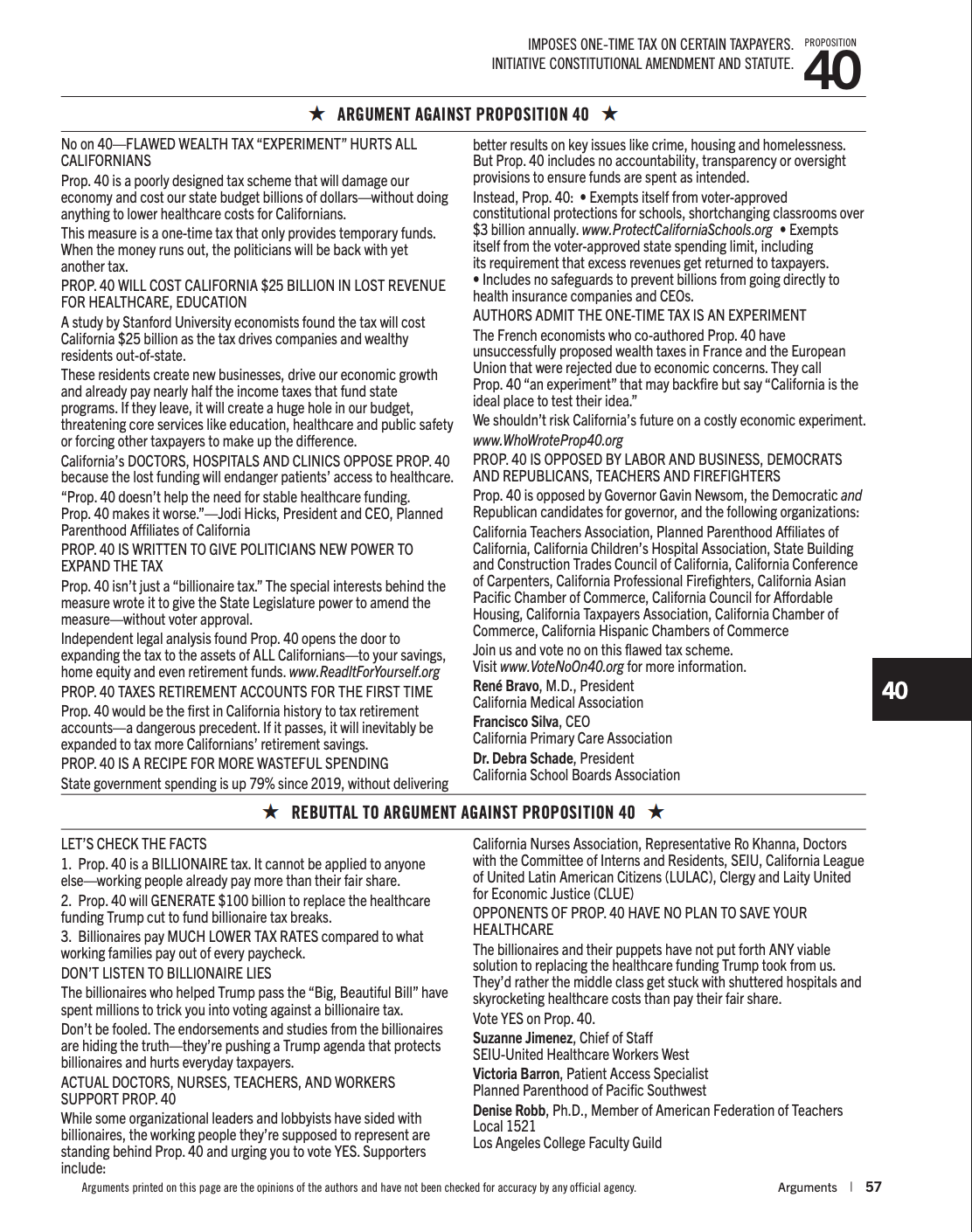
Prop 41 amends the Constitution to say that no state tax enacted or taking effect on or after January 1, 2026 "shall be exempted or excluded from the Government Spending Limitation," meaning the appropriations limit voters adopted in 1979 (Article XIII B). It also requires the State Auditor to audit programs funded by new special taxes, before an initiative reaches the ballot and every four years afterward. Prop 40's summary states that its revenue is exempt from the "state spending limit." The LAO's analysis of Prop 41 concludes that under it "the state might not be able to exclude new special tax spending from the limit."
Prop 42: The personal-property measure
Prop 42 amends the Constitution to bar any new state tax "on the ownership or control of retirement holdings, individually owned assets, and other forms of personal savings," a phrase its text defines to include "financial assets, investment accounts, business interests, digital assets, intellectual property" and "all personal property, whether tangible or intangible." It separately bars retroactive taxes, including, in its own words, "a tax that is imposed on a taxpayer based upon their residency status on a date prior to the effective date of the tax." Prop 40 taxes securities, business interests and intellectual property, and it fixes liability on residency as of January 1, 2026.
How the "most votes wins" rule works
Article II, Section 10(b) of the California Constitution provides: "If provisions of two or more measures approved at the same election conflict, the provisions of the measure receiving the highest number of affirmative votes shall prevail." Props 41 and 42 each declare that any same-ballot measure exempting a tax from the spending limit, or taxing personal property, "shall be deemed to be in conflict," and that if they win more yes votes, "all the provisions of the other measure shall be null and void." Prop 40's own conflict clause is narrower: it claims precedence only over other measures that tax billionaire net worth.
The Voter Information Guide puts the consequence in a box on each of the three measures' pages. On Prop 40's: "If Proposition 41 or 42 on this same ballot receive more 'yes' votes than Proposition 40, then Proposition 40 could be stopped from becoming law even if it gets yes votes from a majority of voters. This is because the courts could find that Proposition 41 or 42 conflict with Proposition 40." The word "could" is doing real work: whether the measures actually conflict would be decided in court, and Prop 40's text requires any validation lawsuit to be filed within 60 days of voter approval.
What the billionaire tax would look like if it passes
If Prop 40 wins and outpolls both 41 and 42, the sequence in the text is:
- The Franchise Tax Board receives a start-up loan of up to $50 million to build the assessment and collection machinery.
- Billionaires who were residents on January 1, 2026 value their worldwide covered assets as of December 31, 2026 and file with their 2026 income tax return in 2027, paying in full or electing the five-year installment plan with its 7.5% charge.
- Receipts go to a Billionaire Tax Reserve Fund; after administrative costs, the Controller moves 90% to the health account and 10% to the education and food-assistance account.
- The Legislature appropriates from those accounts, capped at $22.5 billion and $2.5 billion per year, for purposes the text lists: restoring reductions in federal funding, protecting Medi-Cal and other coverage programs, supporting safety-net providers and preventing facility closures.
- The Legislature can amend the act by a two-thirds vote in each house, but only in ways "consistent with and further[ing] the purposes" of the act.
The text also anticipates litigation over its dates. If a court finds the January 1, 2026 residency date or the December 31, 2026 valuation date unlawful, the act directs the court to substitute "the earliest date or dates" on which liability can lawfully attach, preserving the tax "for the 2026 tax year, or if that is not permissible then for 2027."
Financial stakes
The stakes are asymmetric in time. On the revenue side, the LAO's "tens of billions of dollars" arrives once, over several years. On the cost side, any billionaires who relocate take their annual income-tax payments with them permanently; the LAO's ballot estimate is under $1 billion a year, and its December letter said "hundreds of millions of dollars or more." The No campaign's argument goes further, claiming "a study by Stanford University economists found the tax will cost California $25 billion"; that figure is a campaign claim, not an official estimate.
Health care is where the money would land, and the timing is not accidental. Federal changes under H.R. 1 begin narrowing Medi-Cal eligibility on October 1, 2026, with work requirements following on January 1, 2027, and Covered California premiums rise an average of 9.9% for 2027. Prop 40's health account is written to "restore or address any reductions in federal funding."
Who supports and opposes the billionaire tax, and who is paying
The money behind the three measures is documented in the Fair Political Practices Commission's top-contributor list, last updated September 25, 2026. The table shows each committee's total from its top ten contributors, which is the figure the FPPC publishes; it is not total receipts.
| Measure | Side | Committee | Total from top contributors | Largest contributor |
|---|---|---|---|---|
| Prop 40 | Yes | Yes on 40 – Billionaire Tax Now – No on 41 & 42 (SEIU-UHW) | $31.8 million | SEIU-UHW and its committees, $31.5 million |
| Prop 40 | No | No on Prop 40 – Doctors, Teachers, Small Businesses, Working Families and Public Safety | $56.7 million | Building a Better California, $56.5 million (top donors: Sergey Brin, L. John Doerr III) |
| Prop 40 | No | Golden State Promise | $10.5 million | Ripple Labs $5 million; Chris Larsen $5 million |
| Prop 41 | Yes | Yes on 41 – Californians for Transparency and Accountability | $58.4 million | Building a Better California, $58.35 million |
| Prop 42 | Yes | Yes on 42 – Protect Retirement & Life Savings | $73.8 million | Building a Better California, $73.8 million |
| Props 41, 42 | No | The Yes on 40 committee above (same money, listed against both) | $31.8 million | SEIU-UHW |
Adding the three Building a Better California lines together, the committee funded by Sergey Brin and John Doerr has put $188.65 million behind defeating Prop 40 and passing Props 41 and 42. On the other side, SEIU-UHW's $31.8 million is one pot of money: the FPPC lists the same committee under all three measures because it was formed to support 40 and oppose 41 and 42 at once. No separate committee opposes 41 or 42.
The official ballot argument against Prop 40 lists the California Teachers Association, the California Medical Association, the California Primary Care Association, the California School Boards Association, the California Taxpayers Association, the California Chamber of Commerce, the State Building and Construction Trades Council and Planned Parenthood Affiliates of California among its opponents, and states that "Governor Gavin Newsom, the Democratic and Republican candidates for governor" oppose it. Newsom's and Xavier Becerra's opposition was reported by CalMatters in August, when the California Democratic Party endorsed the measure over the governor's objection. The Secretary of State's guide lists US Senator Bernie Sanders and SEIU-UHW as the measure's headline supporters.
Propositions 41 and 42 are being funded by the same billionaire-backed committee that opposes Prop 40, according to Fair Political Practices Commission filings updated in September 2026.
Polling before election night
The Public Policy Institute of California's September statewide survey, fielded September 4–10 among 1,103 likely voters with a margin of error of ±3.8 points, found 52% would vote yes on Prop 40 and 46% no. The same survey found 51% yes on Prop 41 (44% no) and 54% yes on Prop 42 (43% no). Read against the Constitution's most-votes rule, those numbers mean Prop 42 currently outpolls the billionaire tax, and Prop 41 is within the margin.
PPIC read respondents each measure's ballot title and nothing else; it did not ask whether voters know that 41 and 42 could cancel 40. Prop 40 is the measure likely voters most often name as the one they are most interested in, at 16%, against 12% for Prop 42 and 6% for Prop 41. PPIC's polling director, Mark Baldassare, told CalMatters:
"I don't think that people at this point realize they're direct countermeasures because there hasn't been much said about 41 and 42."
What happens next with the California billionaire tax:
County elections offices begin mailing ballots by October 5; the registration deadline is October 19, and polls close at 8 p.m. on November 3. Three outcomes are possible for the California billionaire tax. If Prop 40 fails, there is no tax. If Prop 40 passes and receives more yes votes than both Prop 41 and Prop 42, the 2026 Billionaire Tax Act takes effect and, by its own terms, voids the conflicting provisions of the other two. If Prop 40 passes but either Prop 41 or Prop 42 receives more yes votes, the Voter Information Guide's warning applies: the billionaire tax "could be stopped from becoming law even if it gets yes votes from a majority of voters," with the courts deciding whether the measures conflict. The vote counts on all three lines, not just the first, will decide whether California collects a billionaire tax at all.
This article describes measures on the November 3, 2026 ballot as of September 27, 2026. Campaign finance figures are as of the FPPC's September 25, 2026 update and will change; the official Voter Information Guide is at voterguide.sos.ca.gov.
Sources and References
- California Secretary of State, Voter Information Guide, Proposition 40—https://voterguide.sos.ca.gov/propositions/40/
- Voter Information Guide, Proposition 40, official title and summary—https://voterguide.sos.ca.gov/propositions/40/title-summary.htm
- Voter Information Guide, Proposition 40, arguments and rebuttals—https://voterguide.sos.ca.gov/propositions/40/arguments-rebuttals.htm
- Voter Information Guide, Proposition 40, print pages including "Potential Interactions With Other Propositions"—https://vig.cdn.sos.ca.gov/2026/general/pdf/prop40.pdf
- Text of Proposed Laws, Proposition 40 (2026 Billionaire Tax Act)—https://vig.cdn.sos.ca.gov/2026/general/pdf/prop40-text-proposed-laws.pdf
- Legislative Analyst's Office, Proposition 40 analysis—https://lao.ca.gov/BallotAnalysis/Proposition?number=40&year=2026
- Legislative Analyst's Office and Department of Finance, fiscal review letter on initiative 25-0024A1, December 11, 2025—https://www.lao.ca.gov/ballot/2025/250481.pdf
- Office of the Attorney General, active measures list (initiative 25-0024A1, proponent Suzanne Jimenez)—https://oag.ca.gov/initiatives/active-measures ; text as filed—https://oag.ca.gov/system/files/initiatives/pdfs/25-0024A1%20(Billionaire%20Tax%20).pdf
- Voter Information Guide, Proposition 41—https://voterguide.sos.ca.gov/propositions/41/
- Voter Information Guide, Proposition 41, print pages and LAO analysis—https://vig.cdn.sos.ca.gov/2026/general/pdf/prop41.pdf
- Text of Proposed Laws, Proposition 41—https://vig.cdn.sos.ca.gov/2026/general/pdf/prop41-text-proposed-laws.pdf
- Office of the Attorney General, initiative 25-0040A1 text as filed—https://oag.ca.gov/system/files/initiatives/pdfs/25-0040A1%20%28Gov.%20Efficiency%29.pdf
- Voter Information Guide, Proposition 42—https://voterguide.sos.ca.gov/propositions/42/
- Text of Proposed Laws, Proposition 42—https://vig.cdn.sos.ca.gov/2026/general/pdf/prop42-text-proposed-laws.pdf
- Office of the Attorney General, initiative 25-0041A1 text as filed—https://oag.ca.gov/system/files/initiatives/pdfs/25-0041A1%20%28Retirement%20Protection%20%29.pdf
- California Constitution, Article II, Section 10—https://leginfo.legislature.ca.gov/faces/codes_displaySection.xhtml?lawCode=CONS§ionNum=SEC.%2010.&article=II
- Fair Political Practices Commission, Top 10 Contributors, November 2026 General Election (last modified September 25, 2026)—https://www.fppc.ca.gov/search-filings/top-10-contributors-list/november-2026-general-election/
- Public Policy Institute of California, Statewide Survey: Californians and Their Government, September 2026—https://www.ppic.org/publication/ppic-statewide-survey-californians-and-their-government-september-2026/
- PPIC, September 2026 likely-voter crosstabs—https://www.ppic.org/wp-content/uploads/crosstabs-likely-voters-0926.pdf
- California Department of Health Care Services, tracking federal impacts on Medi-Cal eligibility—https://www.dhcs.ca.gov/tracking-federal-impact-medi-cal-eligibility/
- California Secretary of State, General Election November 3, 2026, key dates and deadlines—https://www.sos.ca.gov/elections/upcoming-elections/general-election-november-3-2026/key-dates-deadlines
- CalMatters, "The billionaire tax could be defeated by two other tax measures. Here's how," September 24, 2026—https://calmatters.org/health/2026/09/california-wealth-tax-prop-40-41-42/
- CalMatters, "California Democrats buck Newsom and union allies by endorsing populist billionaire tax," August 4, 2026—https://calmatters.org/politics/2026/08/billionaire-tax-california-democrats-split/
- California Today, 2026-27 California health budget guide—https://californiatoday.com/guides/state-budget/2026-27-california-health-budget-guide-medi-cal-updates-cuts-coverages-and-timelines/
- California Today, Covered California premiums rise 9.9% for 2027—https://californiatoday.com/guides/health-insurance/covered-california-premiums-rise-9-9-for-2027-every-regions-rate-change-and-tips-to-lower-yours/

