


Alphabet cites AI Mode’s lower monetization as Google’s paid-click growth slows to 8%
Alphabet’s 10-Q shows paid clicks on Google Search & other properties grew 8% in the third quarter of 2026, after 13% in each of the first two quarters. On the earnings call, Google cited AI Mode’s lower monetization, and it began scaling AI Mode ads to 10 more countries.

Alphabet told investors on October 28 that searches on Google are growing faster than at any time in the past five years. Its own filings show growth in the paid clicks behind Google's search revenue slowing.
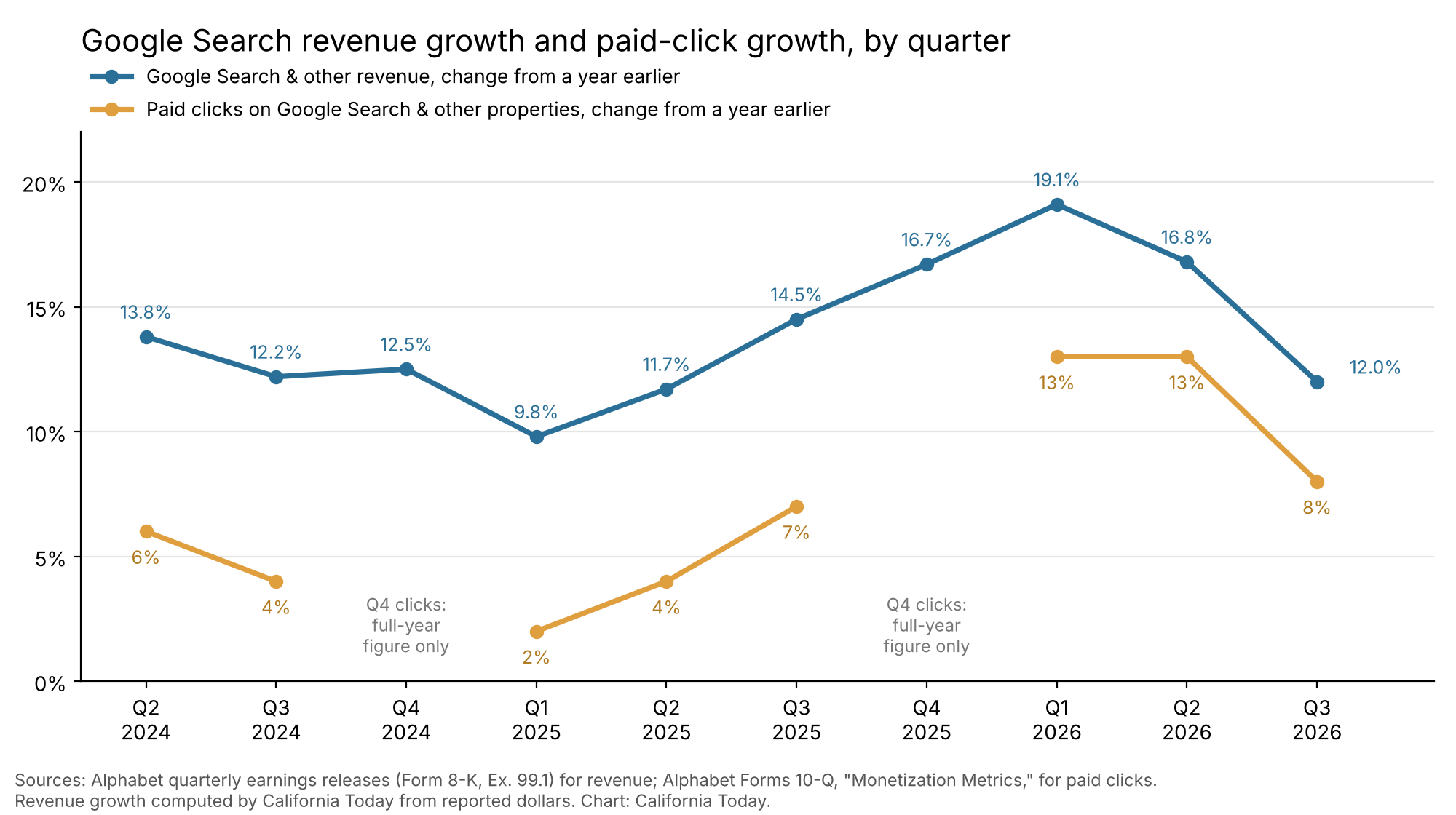
Paid clicks on Google Search and Google's other properties, such as Gmail and Maps, grew 8% in the third quarter of 2026, compared with a year earlier. That was down from 13% in each of the first two quarters. Revenue from Google Search & other grew 12%, its slowest pace since the second quarter of 2025.
On the earnings call that afternoon, an analyst asked Google's chief business officer, Philipp Schindler, about the gap between query growth and Search revenue. Schindler put currency movements first. He then turned to AI Mode, Google's conversational search mode, and said that "the strong growth in AI Mode queries had an impact because of the lower monetization we were seeing in AI Mode." The same day, Google began scaling ads in AI Mode to 10 more countries, including Australia and Canada.
The next day, Alphabet's Class A shares fell 12.6%. It was their largest one-day percentage fall in the daily price history on Nasdaq's website, which goes back to November 2016, and the shares closed on November 10 still 11.5% below their level before the report.
This article sets out what Alphabet's filings and its last five earnings calls show about AI Mode and Google's search ad business, what changes for advertisers as AI Mode ads spread, and what Alphabet still does not disclose.
Google AI Mode queries grew strongly while Google Search revenue growth slowed to 12%:
Alphabet reported third-quarter revenue of $127.6 billion, up 25% from a year earlier. Google Cloud supplied much of that growth, with revenue up 103% to $30.7 billion.
Google Search & other, the advertising revenue line for Google's search properties and its other properties such as Gmail, Google Maps and Google Play, grew 12% to $63.35 billion.
That growth rate had risen through 2025 and peaked early in 2026. By our calculation from Alphabet's quarterly earnings releases, Search & other grew 14.5% in the third quarter of 2025, 16.7% in the fourth, 19.1% in the first quarter of 2026 and 16.8% in the second. The third quarter's 12.0% was the lowest since the second quarter of 2025, when growth was 11.7%.
In dollars, Search & other brought in $79 million more in the third quarter than in the second. A year earlier, the same step from the second quarter to the third was $2.38 billion. In her remarks on advertising revenue, Anat Ashkenazi, Alphabet's chief financial officer, said currency "was a slight headwind on year-over-year growth rates and had a more significant impact on sequential basis," meaning on the comparison with the previous quarter.
Sundar Pichai, chief executive of Alphabet and Google, presented the quarter as strong. He said Google's AI investments "are driving increased usage and overall query growth, including commercial queries," and that "our year-over-year query growth rate is the highest it's been in the last five years." Alphabet does not publish query counts, so that comparison cannot be checked against a figure.
Google's paid clicks grew 8%, down from 13% in each of the two previous quarters:
Alphabet's quarterly 10-Q reports carry two figures that its earnings releases omit. One is the change in paid clicks, which the filing defines as "clicks on advertisements by end-users on Google search properties and other Google owned and operated properties including Gmail, Google Maps, and Google Play." The other is the change in cost-per-click, the average amount Google charges an advertiser for each of those clicks.
In the third quarter, paid clicks grew 8% and cost-per-click grew 4%. In the second quarter the figures were 13% and 3%. In the first quarter they were 13% and 5%.
So in Alphabet's own metrics, the third-quarter slowdown shows up in the number of paid clicks rather than in their price. Click growth fell by five percentage points, while the average price rose a little faster than it had in the second quarter.
The 10-Q ties paid clicks to search activity. Changes in paid clicks are driven by factors "including changes in advertiser spending; ongoing product and policy changes; and, as it relates to paid clicks, fluctuations in search queries resulting from changes in user adoption and usage, primarily on mobile devices," the filing says.
The 2026 click figures stand out against the two years before them. Paid clicks grew 6% and 4% in the second and third quarters of 2024, then 2%, 4% and 7% across the first three quarters of 2025, before jumping to 13% at the start of 2026. Alphabet reports fourth-quarter paid clicks only as part of a full-year figure, which was 6% for 2025.
Alphabet put currency first and AI Mode's lower monetization after it:
The first analyst on the October 28 call asked about the gap between queries and revenue. "Philipp, just on query growth, the fastest in five years, but obviously some deceleration in Search growth. Can you just help us understand the disconnect there?" Doug Anmuth of JPMorgan asked. He wanted to know whether Google simply hadn't "been showing as many ads basically in AI Overviews, in AI Mode."
Schindler first listed drivers of the slowdown from the second quarter:
- Currency: "It was the single largest driver of Search deceleration relative to Q2."
- Retail: "some of our APAC advertisers were impacted by the EU eliminating its de minimis exemption," a customs exemption for low-value imports.
- Media and entertainment: spending "normalized after an unseasonably strong Q2 driven by the FIFA World Cup."
He then turned to the second half of Anmuth's question, about ads in AI Overviews and AI Mode.
"To the next part of your question, it's worth noting that the strong growth in AI Mode queries had an impact because of the lower monetization we were seeing in AI Mode."
Philipp Schindler, Google's chief business officer, October 28, 2026
Ashkenazi added another factor in reply to Brian Nowak of Morgan Stanley. Search growth had accelerated late in 2025, so the third quarter of 2026 was being measured against a strong period. She put that effect at "about three points of growth."
Google's executives also made the case for AI Mode. In his prepared remarks, Schindler said "the majority of AI Mode queries are incremental, creating more monetization opportunities over time," and that many are "upper-funnel queries, allowing us to capture new high-value commercial intent." Right after the AI Mode remark in his answer, he said: "To be clear, we feel very good about our trajectory here. Our ad experiments have shown promising results and we're now scaling ads within both AI Overviews and AI Mode to more users and more queries."
Neither Schindler nor Ashkenazi put a number on how much of the slowdown came from AI Mode.
Alphabet's Class A shares fell 12.6% on October 29, their worst day since at least 2016:
Alphabet filed its results with the Securities and Exchange Commission at 4:01 p.m. Eastern on October 28, just after the stock market closed. The next day its Class A shares (GOOGL) fell from $324.89 to $283.82, a drop of 12.6%, on 139.7 million shares traded, more than twice the previous day's volume. The Class C shares (GOOG) fell 12.3%.
That was the largest one-day percentage fall for GOOGL in the daily price history on Nasdaq's website, which goes back to November 2016. The previous largest was 11.6%, on March 16, 2020. Using the share counts in Alphabet's 10-Q, the fall reduced Alphabet's market value by about $497 billion, by our calculation.
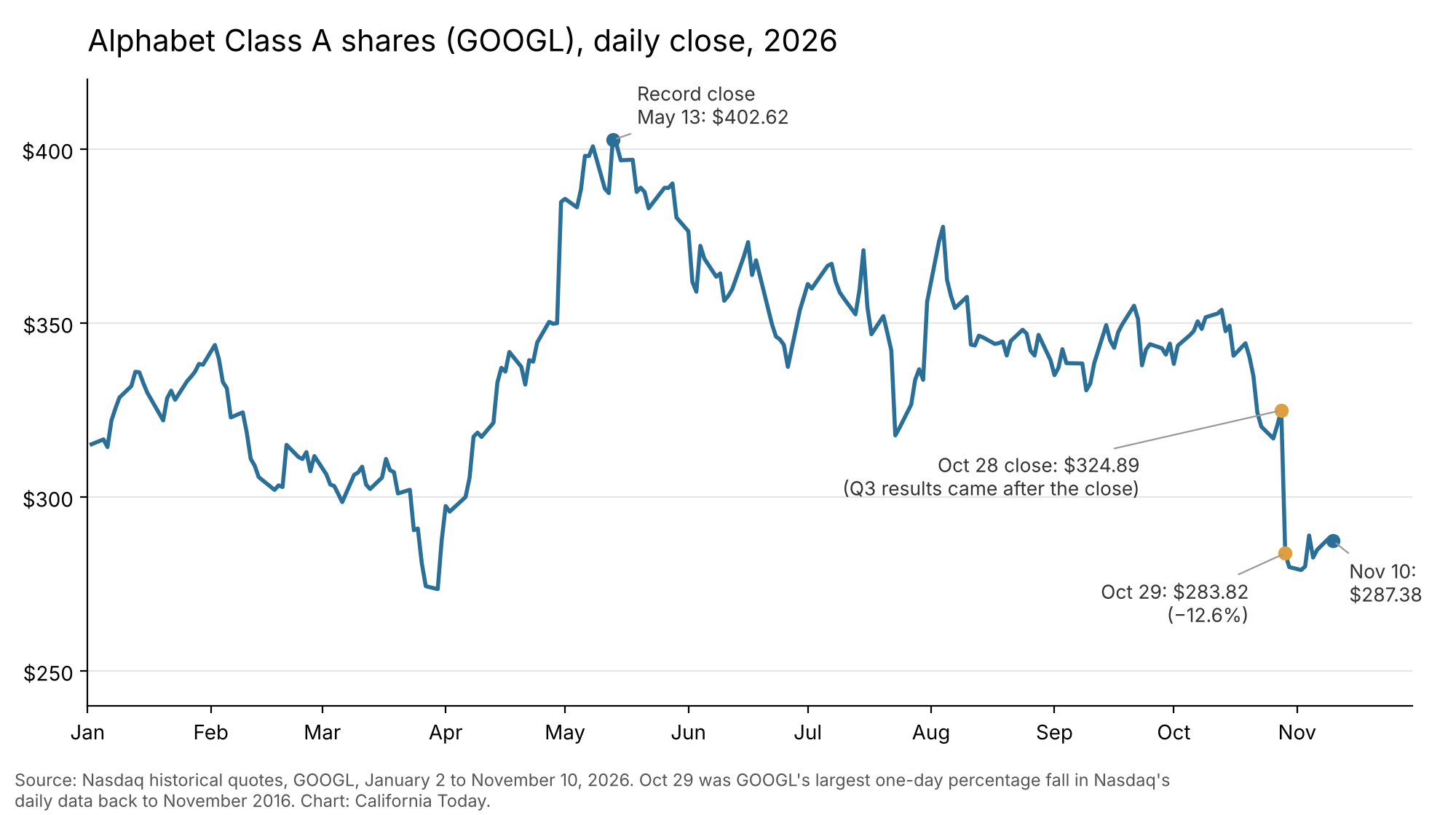
The shares had already slipped before the report, from $353.78 on October 13 to $324.89 on October 28. They closed on November 10 at $287.38. That was 11.5% below the October 28 close and 28.6% below the record close of $402.62 on May 13.
The report's other AI figure was spending. Capital expenditures were $51.4 billion in the quarter, "with the vast majority of the spend in technical infrastructure to support our investments in AI," Ashkenazi said. Free cash flow was negative $9.1 billion. She said it was also affected by inventory built for sales of Google's TPU systems, its AI computing hardware, and by a $5.2 billion payment for a 2018 European Commission fine. Alphabet kept its 2026 capital spending forecast at $195 billion to $205 billion and said it expects that spending "to increase significantly in 2027."
Neither the filings nor the executives say why the stock fell. The record shows the order of events: results after the close, an opening analyst question about the gap between queries and Search revenue, and a 12.6% fall the next day.
Philipp Schindler's account of ads in AI Mode changed across five earnings calls:
Schindler has discussed ads in AI Mode on each of Alphabet's last five earnings calls. Until October 28, he described tests, pilots and encouraging early results. In October 2025 he said that for AI Overviews, the AI snapshots on Google's regular results page, "even at our current baseline of ads," Google saw "the monetization at approximately the same rate," and that Google was still testing ads in AI Mode. October 2026 was the first of the five calls on which he described AI Mode's monetization as lower.
Philipp Schindler on ads in AI Mode and AI Overviews, October 2025 to October 2026:
| Earnings call | What Philipp Schindler said (verbatim) | Transcript |
|---|---|---|
| Oct 29, 2025 (Q3 2025) | On AI Overviews: “we see the monetization at approximately the same rate.” On AI Mode: “we’re testing ads in AI Mode, and we’ll continue to test and learn before we expand this any further.” | |
| Feb 4, 2026 (Q4 2025) | “We have significantly increased our focus on AI Mode and are in the early stages of experimenting with AI Mode monetization, like testing ads below the AI response, with more underway.” | |
| Apr 29, 2026 (Q1 2026) | “Direct Offers in AI Mode are resonating with users and continue to receive positive customer feedback.” | |
| Jul 22, 2026 (Q2 2026) | “We continue to be encouraged with monetization performance on queries that show AI Overviews, even as we’ve expanded AI Overviews to more commercial queries.” And: “Within AI Mode, we continue to test and deploy a range of new ad formats.” | |
| Oct 28, 2026 (Q3 2026) | “it’s worth noting that the strong growth in AI Mode queries had an impact because of the lower monetization we were seeing in AI Mode.” And: “we’re now scaling ads within both AI Overviews and AI Mode to more users and more queries.” |
The comparison Google gave in 2025 was for AI Overviews, not AI Mode.
In April, Anmuth asked how much room Google had to show ads on more queries than "the 20% you've been at historically," his figure for ad coverage. Schindler replied, "I think there is upside in that coverage number," but gave no current figure.
Google began scaling ads in AI Mode to 10 more countries on October 28:
Shashi Thakur, Google's vice president and general manager of Google Search Ads and Ads on Google Experiences, announced the expansion on the Google Ads & Commerce blog on the day of the earnings report. Google is "scaling ads in AI Mode in Australia, Canada, India, Kenya, Malaysia, New Zealand, Nigeria, Pakistan, the Philippines, and Singapore," the post says. Google plans to expand to "additional locales, including Brazil, Mexico, and the United Kingdom" in the fourth quarter of 2026.
In the United States, Google is launching what it calls multiturn ads, which can appear in the follow-up questions of an AI Mode conversation. Ads "will be clearly labeled as 'Sponsored,'" the post says.
Two claims in the post rest on US data. AI Mode queries are "on average, three times longer than traditional searches," according to a Google AI Mode report from May 2026. Click-through rates "are already similar between sponsored and organic product list items within AI Mode," according to Google internal data from August 20 to September 3, 2026. Google did not publish the rates.
The screenshot at the top of this article, captured on the evening of November 10, Pacific time, shows one of the formats: a block labeled "Sponsored," headed "You might consider these related products," placed beneath an AI Mode answer about running shoes.
Advertisers cannot opt out of Google AI Mode ads separately from Search:
Google's help page for advertisers sets out how the ads work:
- Eligibility is automatic. "Existing Search, Shopping, and Performance Max campaigns are automatically eligible to serve ads within AI Overviews and AI Mode." No new campaign or budget is needed.
- There is no separate switch. Advertisers "can't target ads exclusively to AI Overviews or AI Mode, or opt out of showing ads in them separately from Search," the page says. Negative keywords and brand exclusions still apply.
- Keyword type matters. Exact and phrase match keywords are eligible only when a query "expresses direct commercial intent." AI Max for Search, broad match, Shopping campaigns and Performance Max can also be matched to the AI response itself.
- Results are not reported separately. Performance in AI Overviews and AI Mode is "included in aggregate in your standard Google Ads campaign reports."
- Some ads come with AI-written text. Google's Gemini models can add "AI explainers" that draw on "publicly available sources including your website." Advertisers "can't manually write, edit, approve, or opt out of them."
- Billing is unchanged. The ads use "the same auction mechanism and cost-per-click (CPC) or conversion-based bidding models as standard Google Search ads."
The same page says "Paid advertising does not influence the organic responses generated by Google AI."
Sponsored listings now sit inside Google AI Mode answers alongside organic results:
For publishers and brands that rely on organic search, the change is where the ads sit. Google's help page says ads in AI Mode can appear "directly within or alongside these AI-generated responses," the same answers that carry unpaid links and product listings. Google says sponsored and organic product listings in AI Mode draw similar click-through rates.
In July, Pichai said Google was "now sending billions of clicks to websites every week through AI features in Search." The October call gave no comparable number.
What AI Mode says about a business also depends on the pages it reads. In October, three days after Meta launched Muse in Japan, Google's AI Overview and AI Mode were still describing Muse as available only in the US and Canada.
Alphabet does not report revenue, query volume or ad coverage for AI Mode:
Several figures that would show AI Mode's effect on Google's business are not public:
- AI Mode revenue. Alphabet reports one Search & other line. Google's help page says advertisers see AI Mode results only "in aggregate" with their other Search results.
- Query counts. Alphabet gives growth comparisons ("the highest it's been in the last five years") but no volumes, for AI Mode or for Search as a whole.
- Ad coverage. The share of queries that show ads is not reported. The 20% figure discussed in April was an analyst's.
- Click-through rates. Google says sponsored and organic product listings in AI Mode perform similarly but has not published the rates.
- The size of the AI Mode effect. Google named AI Mode's lower monetization as a factor in the third quarter and did not quantify it.
Alphabet's fourth-quarter report is the next update on Google AI Mode and Search revenue:
Alphabet has told investors to expect more pressure on Search growth. Ashkenazi said that "at current spot rates, we would expect a slightly larger FX headwind to our consolidated revenues in Q4," primarily in Search and YouTube ads. She said Google "will continue to lap the Search performance acceleration that began in the third quarter last year, which will pressure revenue growth in Q4."
The fourth quarter is also when ads in AI Mode spread to the 10 new countries and, under Google's plan, to more markets, including Brazil, Mexico and the United Kingdom. Alphabet's fourth-quarter report will show how Search & other revenue fared. Last year's arrived on February 4. The annual report that follows gives paid clicks only for the full year, so the next quarterly paid-click figure will come with the first-quarter 2027 10-Q, which past filing dates put in late April.
Until then, the record on Google AI Mode is Alphabet's own description: strong query growth, lower monetization and, since October 28, ads in more countries.
Sources & References
- Alphabet Inc., "Alphabet Announces Third Quarter 2026 Results," Form 8-K Exhibit 99.1, October 28, 2026.
- Alphabet Inc., Form 8-K filing index (acceptance time 4:01 p.m. ET), October 28, 2026.
- Alphabet Inc., Quarterly Report on Form 10-Q for the quarter ended September 30, 2026, filed October 29, 2026.
- Alphabet Inc., Form 10-Q for the quarter ended June 30, 2026.
- Alphabet Inc., Form 10-Q for the quarter ended March 31, 2026.
- Alphabet Inc., Annual Report on Form 10-K for 2025, filed February 5, 2026.
- Alphabet Inc., Form 10-Q for the quarter ended September 30, 2025.
- Alphabet Inc., Form 10-Q for the quarter ended June 30, 2025.
- Alphabet Inc., Form 10-Q for the quarter ended March 31, 2025.
- Alphabet Inc., Form 10-Q for the quarter ended September 30, 2024.
- Alphabet Inc., Form 10-Q for the quarter ended June 30, 2024.
- Alphabet Inc., quarterly earnings releases, Form 8-K Exhibit 99.1, second quarter 2024 through second quarter 2026 (nine releases), including Q2 2026, Q4 2025, released February 4, 2026, Q1 2026 and Q2 2025. Full list on EDGAR
- Alphabet Investor Relations, Q3 2026 earnings call transcript, October 28, 2026.
- Alphabet Investor Relations, "Alphabet 2026 Q3 Earnings Call" webcast, YouTube.
- Alphabet Investor Relations, Q2 2026 earnings call transcript, July 22, 2026.
- Alphabet Investor Relations, Q1 2026 earnings call transcript, April 29, 2026.
- Alphabet Investor Relations, Q4 2025 earnings call transcript, February 4, 2026.
- Alphabet Investor Relations, Q3 2025 earnings call transcript, October 29, 2025.
- Shashi Thakur, "Ads in AI Mode expand to new markets," Google Ads & Commerce blog, October 28, 2026.
- Google Ads Help, "About ads in AI-powered experiences in Google Search," read November 11, 2026.
- Nasdaq, Alphabet Inc. Class A (GOOGL) historical quotes, read November 11, 2026.
- Nasdaq, Alphabet Inc. Class C (GOOG) historical quotes, read November 11, 2026.


