

2026 California voting master guide: Deadlines, vote centers and drop-off sites in all 58 counties
California's November 3 election is in its final days. This guide covers every way to vote: mail and postmark rules, drop-off sites, vote centers and polling places, same-day registration, ID rules, fixing a signature problem and when results arrive, with all 58 county elections offices.


California's November 3, 2026 general election is in its final days, and voting is well underway. Counties began mailing a ballot to every active registered voter by October 5. Through October 29, Californians had cast 5,094,898 ballots, according to the Secretary of State's ballot return statistics. That is about 22% of the 23,273,590 Californians registered to vote as of October 19, the state's latest report of registration shows.
 Mac Douglass | Editor
The ballot is long. Voters are electing a governor and the other statewide officers, all 52 of California's members of the U.S. House, 20 state senators and all 80 Assembly members, according to the Secretary of State's certified list of candidates. They are also deciding 14 propositions. Our propositions master guide covers every measure; our candidates master guide covers every statewide race, and our Becerra vs. Hilton breakdown compares the two candidates for governor issue by issue.
This guide covers how to vote: the deadlines that remain, the three ways to return a mail ballot, how vote centers differ from polling places, same-day registration, ID rules, fixing a signature problem and when results will arrive. A table lists the voting system, location counts and elections office for all 58 counties. The rules come from the Secretary of State's election guidance and the state Elections Code, linked where each one appears.
Polls are open from 7 a.m. to 8 p.m. on Tuesday, November 3. Anyone in line at 8 p.m. can still vote.
California's voting deadlines for the November 3, 2026 election:
The calendar below comes from the Secretary of State's key dates and deadlines and the Elections Code. Dates that have passed stay in for reference.
- October 5: Last day for counties to begin mailing ballots. Ballot drop-off locations opened by the same day.
- October 19: Regular registration deadline. Same-day registration runs from October 20 through November 3.
- October 24: The first vote centers opened in counties that use them.
- Saturday, October 31: In-person early voting is open throughout the state. Vote-center counties must have one vote center open for every 10,000 registered voters from October 31 through Election Day.
- Tuesday, November 3: Election Day. Polls are open 7 a.m. to 8 p.m. Mailed ballots must be postmarked by this date, and ballots handed in must arrive by 8 p.m.
- November 10: Last day for a mailed ballot postmarked by November 3 to reach the county.
- November 17: Last day for counties to send notice to voters whose ballot signature is missing or does not match.
- November 25: Voters have until 5 p.m. to fix a missing or mismatched signature.
- December 3: Last day for counties to certify their results.
- December 11: The Secretary of State certifies the statewide results.
California mails every active voter a ballot, and there are three ways to return it:
All active registered voters receive a ballot and a first-class, postage-paid return envelope, according to the Secretary of State's vote-by-mail FAQ. The prepaid postage is required by Elections Code section 3010. Voters mark the ballot, seal it in the envelope and sign and date the outside. The county compares that signature with the one in the voter's registration record before the ballot is counted.
Through October 29, voters had returned 4,974,998 mail ballots, or 21.2% of the 23,450,869 issued. Of those, 2,638,002 came back by mail and 2,066,328 through drop boxes, the ballot return statistics show.
A ballot mailed in the final days needs a November 3 postmark:
A mailed ballot counts if it is postmarked on or before Election Day and reaches the county elections office within seven days, under Elections Code section 3020. For this election that means by November 10. A ballot with no postmark or an unreadable one still counts if it arrives by then and the voter signed and dated the envelope on or before Election Day.
The Secretary of State recommends mailing at least seven days before Election Day. Voters who mail closer to the deadline should take the ballot inside a Post Office and ask a postal employee for a manual postmark. The reason is how postmarks work. A U.S. Postal Service rule that took effect in late December 2025 spells it out: postmarks applied at processing facilities can carry a later date than the day the mail was dropped off.
"[T]he postmark date does not necessarily indicate the first day that the Postal Service had possession of the mailpiece."
U.S. Postal Service, final rule on postmarks and postal possession, November 2025
The same rule says customers can request a manual postmark at no extra charge "at any Post Office, station, or branch." A ballot dropped in a collection box on November 3 could be postmarked after Election Day.
Drop boxes and drop-off sites take ballots until 8 p.m. on November 3:
Voters can put their ballot in any official drop box or ballot drop-off location in California until 8 p.m. on Election Day, the Secretary of State's quick facts for this election say. A ballot dropped off in another county is sent on to the voter's home county within eight days, under Elections Code section 3017.
Counties estimated 2,564 drop-off locations statewide for this election in the Secretary of State's county location tally. Drop boxes are locked, marked "Official Ballot Drop Box," and emptied by two authorized county employees, according to the vote-by-mail FAQ. The state's early voting and drop-off finder lists every location by address.
Any vote center or polling place in the state also accepts mail ballots:
Voters can hand a completed mail ballot to the poll workers at any vote center or polling place in California, under section 3017. The Secretary of State's Voter Bill of Rights lists it as a right.
Voters who cannot return their own ballot can ask someone else to do it. That person must return it within three days or before the polls close, whichever comes first, and the voter fills in the authorization section on the envelope. Anyone can do this, the vote-by-mail FAQ says, "as long as they do not get paid on a per ballot basis."
Thirty California counties vote at vote centers, and 24 still use neighborhood polling places:
Where a Californian votes in person depends on the county. The Secretary of State's county location tally for this election lists 30 counties that run vote centers under the Voter's Choice Act, 24 that use traditional polling places and four that run all-mail elections. The vote-center counties hold 18,152,594 of the state's 23,164,977 registered voters as of early September, or 78.4%, by our count from the same table.
In a vote-center county, voters are not tied to one precinct. They can vote at any vote center in their county. At a vote center, the Secretary of State's Voter's Choice Act page says, voters can:
- Vote in person
- Drop off their ballot
- Get a replacement ballot
- Vote using an accessible voting machine
- Get help and voting material in multiple languages
- Register to vote or update their registration
The law sets a schedule for how many vote centers must be open. Counties need one for every 50,000 registered voters from 10 days before the election and one for every 10,000 voters from the Saturday before through Election Day. Those must be open at least eight hours a day, and 7 a.m. to 8 p.m. on Election Day. Los Angeles County planned 122 vote centers for the stretch that began October 24 and 645 on Election Day, the state tally shows.
The 24 polling-place counties include San Francisco, San Bernardino, Kern, Contra Costa, San Joaquin, Tulare, Santa Barbara, Solano, Monterey and San Luis Obispo. Their 4,985,563 registered voters, 21.5% of the state, are assigned a precinct polling place for Election Day. The Secretary of State's polling place lookup and each county's sample ballot show where. For early voting, Elections Code section 3016.3 requires each of these counties to open at least one location on the Saturday before the election for at least six hours. The county elections office itself has been open for in-person voting since early October, the Secretary of State's displaced voters fact sheet notes.
Four small counties, Alpine, Colusa, Plumas and Sierra, run all-mail elections. Their voters return ballots by mail or drop-off, and each county still runs one or two in-person voting sites on Election Day.
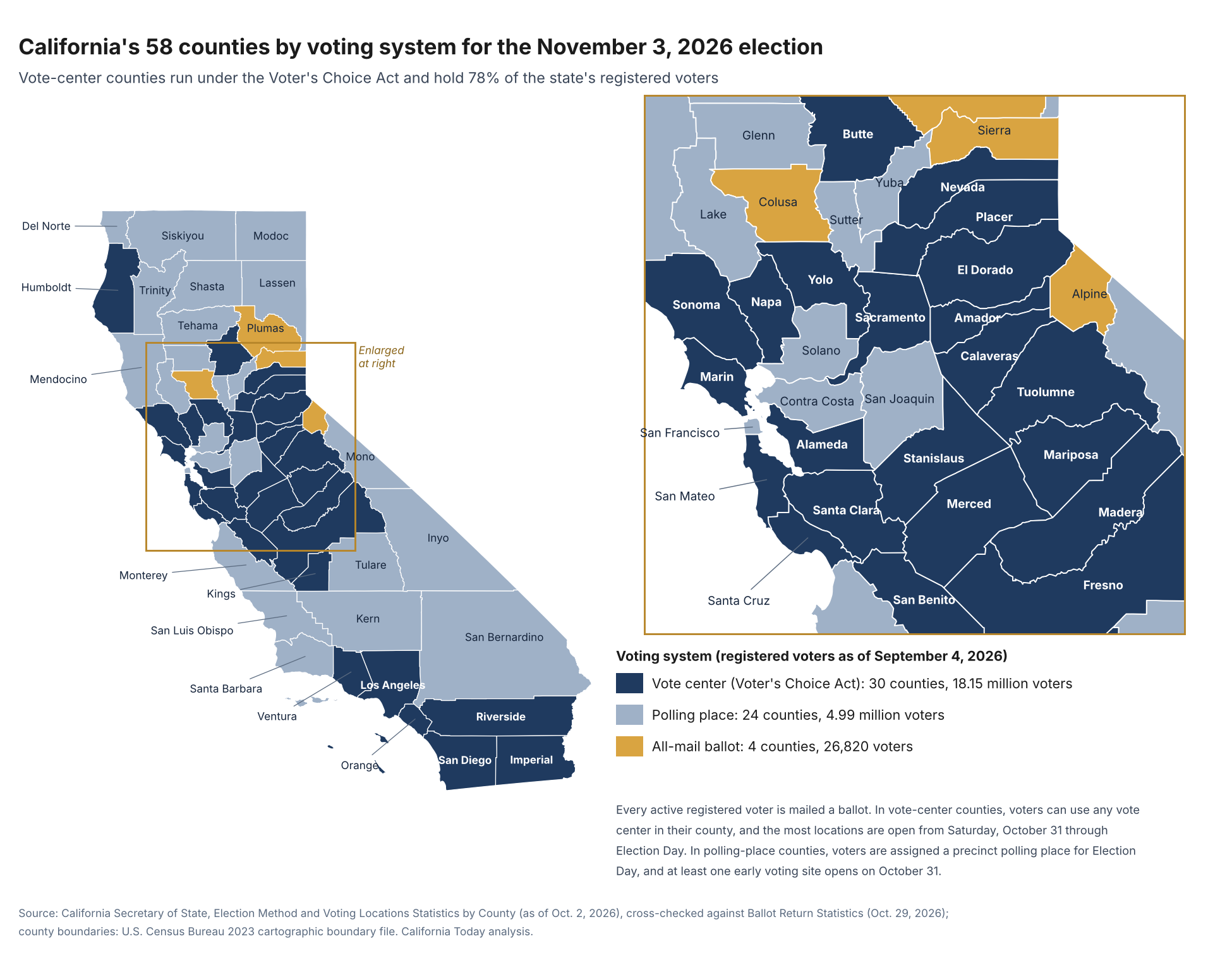
Every California county's voting system, voting locations and elections office:
The table lists each county's voting system, the number of Election Day voting locations and ballot drop-off locations it planned, and its elections office website and phone number. Location counts are the counties' estimates as reported to the Secretary of State on October 2 and can change. For exact addresses and hours, use the state's early voting and drop-off finder or the county's own site. Office details come from the Secretary of State's county elections office directory.
| County | Voting system | Election Day voting locations | Ballot drop-off locations | County elections office | Phone |
|---|---|---|---|---|---|
| Alameda | Vote center | 100 | 66 | acvote.alamedacountyca.gov | (510) 272-6933 |
| Alpine | All-mail ballot | 1 | 1 | alpinecountyca.gov | (530) 694-2281 |
| Amador | Vote center | 3 | 5 | amadorcounty.gov | (209) 223-6465 |
| Butte | Vote center | 13 | 26 | buttevotes.ca.gov | (530) 552-3400 (option 1) |
| Calaveras | Vote center | 6 | 14 | elections.calaverasgov.us | (209) 754-6376 |
| Colusa | All-mail ballot | 2 | 8 | countyofcolusaca.gov | (530) 458-0500 |
| Contra Costa | Polling place | 151 | 43 | contracostavote.gov | (925) 335-7800 |
| Del Norte | Polling place | 15 | 2 | co.del-norte.ca.us | (707) 464-7216 |
| El Dorado | Vote center | 14 | 30 | eldoradocounty.ca.gov | (530) 621-7480 |
| Fresno | Vote center | 55 | 124 | fresnocountyca.gov | (559) 600-8683 |
| Glenn | Polling place | 3 | 7 | countyofglenn.net | (530) 934-6414 |
| Humboldt | Vote center | 13 | 24 | humboldtgov.org | (707) 445-7481 |
| Imperial | Vote center | 15 | 24 | elections.imperialcounty.org | (442) 265-1060 |
| Inyo | Polling place | 5 | 7 | elections.inyocounty.us | (760) 878-0224 |
| Kern | Polling place | 92 | 20 | kernvote.com | (661) 868-3590 |
| Kings | Vote center | 7 | 19 | countyofkingsca.gov | (559) 852-4401 |
| Lake | Polling place | 21 | 7 | lakecountyca.gov | (707) 263-2372 |
| Lassen | Polling place | 5 | 10 | lassencounty.gov | (530) 251-8217 |
| Los Angeles | Vote center | 645 | 429 | lavote.gov | (800) 815-2666 |
| Madera | Vote center | 9 | 15 | votemadera.com | (559) 675-7720 |
| Marin | Vote center | 21 | 17 | marincounty.gov | (415) 473-6456 |
| Mariposa | Vote center | 4 | 9 | mariposacounty.gov | (209) 966-2007 |
| Mendocino | Polling place | 21 | 7 | mendocinocounty.gov | (707) 234-6819 |
| Merced | Vote center | 16 | 35 | countyofmerced.com | (209) 385-7541 |
| Modoc | Polling place | 6 | 2 | countyofmodoc.gov | (530) 233-6200 |
| Mono | Polling place | 6 | 8 | monocounty.ca.gov | (760) 932-5537 |
| Monterey | Polling place | 62 | 82 | countyofmonterey.gov | (831) 796-1499 |
| Napa | Vote center | 9 | 12 | napacounty.gov | (707) 253-4321 |
| Nevada | Vote center | 9 | 27 | nevadacountyca.gov | (530) 265-1298 |
| Orange | Vote center | 192 | 128 | ocvote.gov | (714) 567-7600 |
| Placer | Vote center | 30 | 59 | placercountyelections.gov | (530) 886-5650 |
| Plumas | All-mail ballot | 1 | 1 | plumascounty.us | (530) 283-6256 |
| Riverside | Vote center | 152 | 107 | voteinfo.net | (951) 486-7200 |
| Sacramento | Vote center | 92 | 63 | elections.saccounty.gov | (916) 875-6451 |
| San Benito | Vote center | 5 | 13 | sanbenitocounty-ca-cre.gov | (831) 636-4016 |
| San Bernardino | Polling place | 222 | 78 | elections.sbcounty.gov | (909) 387-8300 |
| San Diego | Vote center | 220 | 154 | sdvote.com | (858) 565-5800 |
| San Francisco | Polling place | 502 | 37 | sf.gov | (415) 558-6100 |
| San Joaquin | Polling place | 159 | 186 | sjgov.org | (209) 468-8683 |
| San Luis Obispo | Polling place | 61 | 25 | slocounty.ca.gov | (805) 781-5228 |
| San Mateo | Vote center | 50 | 57 | smcacre.gov | (650) 312-5222 |
| Santa Barbara | Polling place | 69 | 87 | countyofsb.org | (805) 568-2200 |
| Santa Clara | Vote center | 110 | 111 | vote.santaclaracounty.gov | (408) 299-8683 |
| Santa Cruz | Vote center | 24 | 24 | votescount.santacruzcountyca.gov | (831) 454-2060 |
| Shasta | Polling place | 54 | 4 | elections.shastacounty.gov | (530) 225-5730 |
| Sierra | All-mail ballot | 1 | 2 | sierracounty.ca.gov | (530) 289-3295 |
| Siskiyou | Polling place | 16 | 1 | siskiyoucounty.gov | (530) 842-8084 |
| Solano | Polling place | 68 | 27 | solanocounty.gov | (707) 784-6675 |
| Sonoma | Vote center | 32 | 55 | sonomacounty.gov | (707) 565-6800 |
| Stanislaus | Vote center | 32 | 65 | stanvote.gov | (209) 525-5200 |
| Sutter | Polling place | 14 | 20 | sutter.gov | (530) 822-7122 |
| Tehama | Polling place | 24 | 6 | tehama.gov | (530) 527-8190 |
| Trinity | Polling place | 5 | 5 | trinitycounty.org | (530) 623-1220 |
| Tulare | Polling place | 43 | 58 | tularecounty.ca.gov | (559) 839-2100 |
| Tuolumne | Vote center | 5 | 15 | tuolumnecounty.ca.gov | (209) 533-5570 |
| Ventura | Vote center | 53 | 40 | clerkrecorder.venturacounty.gov | (805) 654-2664 |
| Yolo | Vote center | 14 | 30 | elections.yolocounty.gov | (530) 666-8133 |
| Yuba | Polling place | 22 | 26 | yuba.gov | (530) 749-7855 |
| Voting systems and location counts are the Secretary of State's Election Method and Voting Locations Statistics by County, as of October 2, 2026 (estimates, subject to change). "Election Day voting locations" counts vote centers in vote-center counties and precinct polling places in polling-place counties. Office websites and phone numbers are from the Secretary of State's County Elections Offices directory. For exact addresses and hours, use the state's early voting and drop-off finder or the county's site. | |||||
Statewide, counties planned 3,601 Election Day voting locations and 2,564 drop-off locations, the tally's state totals show.
Californians who missed the October 19 deadline can still register and vote through November 3:
California calls it conditional voter registration, and the Secretary of State calls it Same Day Voter Registration. It is open during the 14 days before an election and on Election Day, under Elections Code section 2170. Counties must offer it at their elections offices and at every polling place in the county. In vote-center counties, every vote center offers it.
A voter who registers this way casts a ballot that is held until the county confirms the registration. The registration takes effect once the county verifies the voter's eligibility and matches their information to Department of Motor Vehicles or Social Security records. If the records cannot be matched but the voter is otherwise eligible, the county assigns a unique identification number and the registration still counts. Where poll workers can confirm eligibility on the spot, some locations process an "instant" registration and issue a regular ballot, the ballot return statistics' field definitions explain.
Through October 29, 2,278 Californians had voted this way: 1,720 with a conditional ballot and 558 with an instant registration, by our count from the state totals.
The same process covers voters who have moved. A voter displaced by a fire or other emergency can register at a new or temporary address, even outside their home county, the displaced voters fact sheet says. Ballots cannot be forwarded by the post office.
To register, a voter must be, according to the Secretary of State's registration fact sheet:
- A U.S. citizen and a California resident
- 18 or older on Election Day (16- and 17-year-olds can pre-register)
- Not currently serving a state or federal prison term for a felony
- Not currently found mentally incompetent to vote by a court
Voters who are unsure whether they are registered can check My Voter Status.
Most California voters do not need to show ID at the polls:
"In most cases, NO," the Secretary of State's voter ID fact sheet answers. A voter may be asked for identification only if all three of these apply: they are voting for the first time in a federal election, they registered by mail or online, and they did not give a California driver's license or ID number or the last four digits of a Social Security number when registering. Those voters are told in advance, and poll workers can ask for ID only when the voter list shows it is required.
A voter in that group can show a photo or non-photo document, including:
- A California driver's license or state ID card
- A U.S. passport
- A student or military ID
- Official mail from a government agency
- A paycheck or government check
- A utility bill or bank statement
The ID does not have to show an address or be issued by a government, the fact sheet adds. The full list is on the Secretary of State's identification standards page. A voter who does not have one can still cast a provisional ballot, which is counted once eligibility is confirmed.
Voter ID is on this ballot as Proposition 39, a constitutional amendment that would require identification to vote. It does not change the rules for this election. Under Article XVIII, Section 4 of the California Constitution, an approved amendment takes effect on the fifth day after the Secretary of State files the statement of the vote. That filing is scheduled for December 11.
Voters holding a mail ballot can still vote in person:
A voter who received a mail ballot can vote at a vote center, a polling place or the county elections office instead. Under Elections Code section 3015, they get a regular ballot if they hand over the unused mail ballot. If they don't have it, they still get a regular ballot when the poll worker or elections official confirms the mail ballot was not returned and marks the voter's record so it cannot be counted later. Otherwise, the voter casts a provisional ballot.
Voters whose ballot never arrived, or was lost or damaged, can ask the county for a replacement by phone, email, fax or other electronic means, the quick facts say. The state's replacement ballot application is a one-page form. In vote-center counties, any vote center can issue a replacement ballot.
A voter who makes a mistake on a ballot can get a new one, as long as the first has not been cast. They can ask a poll worker or exchange the mail ballot at a polling place or elections office, the Voter Bill of Rights says.
California's Voter Bill of Rights covers lines at 8 p.m., provisional ballots and help in the booth:
"The right to vote if you are still in line when the polls close."
California Secretary of State, Voter Bill of Rights
The polls close at 8 p.m. under Elections Code section 14212. If voters are inside or in line at the door at that hour, section 14401 requires the polls to stay open until they have voted.
The Voter Bill of Rights also guarantees:
- A provisional ballot for a registered voter whose name is not on the list, counted if officials confirm eligibility
- A secret ballot, cast without anyone bothering the voter or telling them how to vote
- Election materials in other languages where enough voters in the precinct speak them
- Answers from elections officials about procedures, and the chance to watch the process
A voter who needs help marking a ballot can bring up to two people of their choice. Under Elections Code section 14282, neither can be the voter's employer, an agent of the employer or an officer or agent of the voter's union.
Campaign gear stays outside a 100-foot zone around polling places, vote centers, elections offices and outdoor ballot drop-off sites. Elections Code section 18370 bars electioneering within that distance. Section 319.5 defines it to include a candidate's name or logo, a measure's number or title, and buttons, hats, shirts, signs or stickers carrying them.
 Mac Douglass | Editor

Workers who cannot vote outside their working hours can take up to two hours off with pay, under Elections Code section 14000. The time comes at the start or end of the shift, and a worker who knows they will need it should give the employer at least two working days' notice.
Voters who think their rights were denied, or who see election fraud or misconduct, can call the Secretary of State's confidential Voter Hotline at (800) 345-VOTE (8683).
California checks every mail ballot signature, and voters have until November 25 to fix a problem:
The county compares the signature on each return envelope with the voter's registration record. If the envelope is unsigned or the signature does not match, Elections Code section 3019 requires the county to tell the voter. It must mail a notice by first-class mail with a postage-paid return envelope. If it has a phone number or email address on file, it must also call, text or email.
For a statewide election, the notice must go out within 14 days after the election, which this year is November 17. Voters then have until 5 p.m. on the 22nd day after the election, November 25, to return a signed statement. The Secretary of State's missing-signature fact sheet gives the same date. The state's vote-by-mail FAQ still describes an older deadline, two days before the county certifies its results, but the statute as now written and the signature fact sheet both set November 25.
Counties post the form on their websites, and return options vary by county, the fact sheet says. Voters who left an envelope unsigned can also sign it in person at the county elections office by the same deadline.
Voters can watch for a problem with Where's My Ballot, the state's free tracking service. It sends a text, email or voice message when the ballot is mailed, when the county receives it, when it is counted and if there is a problem to fix, according to the Secretary of State's Where's My Ballot page and the FAQ. The status of each ballot also appears on My Voter Status within 60 days of the election.
California voters with disabilities and voters overseas have more ways to vote:
Any voter can use the state's remote accessible vote-by-mail system to read and mark a ballot on their own device with their own assistive technology. It is "NOT a form of internet voting," the Secretary of State's RAVBM FAQ says. The voter prints the marked selections, signs the envelope and returns it by mail or in person by 8 p.m. on Election Day. It cannot be returned by email. Voters request access through their county or My Voter Status. Every vote center also offers an accessible voting machine, according to the state's Voter's Choice Act page.
Military and overseas voters return ballots under the same postmark and seven-day rules as everyone else, the Secretary of State's military and overseas voter page says. Voters outside the United States, or called to military service within seven days of the election, may fax a ballot instead. The fax must reach the county by 8 p.m. on Election Day, and it must include an "Oath of Voter" form that waives the right to a confidential vote. The federal voting program no longer forwards faxes, so the fax goes straight to the county. California law does not allow a voted ballot to be returned by email.
California's results start at 8 p.m. on November 3, and the count runs into December:
Counties begin reporting at 8 p.m. on election night and must send updated totals to the Secretary of State at least every two hours until the election-night count is complete, the key dates page says. The first results cover mail ballots received before Election Day and ballots cast at voting locations, according to the state's life cycle of a ballot guide. Mail ballots that arrive through November 10, and those whose signatures are fixed by November 25, are added after that.
The first night's totals leave millions of ballots uncounted. Two days after the November 2024 general election, counties had counted 10,728,985 ballots and estimated 5,472,423 still outstanding, the Secretary of State reported on November 7, 2024. Two days after this June's primary, the June 4, 2026 report put the figures at 5,617,892 counted and 3,606,128 outstanding. By our math, that left 33.8% of ballots uncounted after the 2024 general and 39.1% after the primary.
Counties have 30 days to finish and certify, under Elections Code section 15372. Their deadline is December 3, and the Secretary of State certifies the statewide results on December 11. The propositions master guide explains what each measure does if it passes.
California's November 3 election checklist for voters:
- Sign and date the return envelope before sending it.
- Mailing on Monday or Tuesday means handing the ballot to a postal clerk and asking for a manual postmark.
- Drop boxes, drop-off sites, vote centers and polling places take ballots until 8 p.m. on November 3, and any of them in the state will do.
- A voter casting a ballot in person should bring the mail ballot to hand over.
- A voter who missed the registration deadline or has moved can register and vote the same day at the county elections office, a vote center or a polling place in their county.
- A voter in line at 8 p.m. should stay in line.
- Signing up for Where's My Ballot flags a signature problem, and the fix is due by 5 p.m. on November 25.
- Problems at the polls go to the Voter Hotline at (800) 345-VOTE (8683).
What to read next: All 14 propositions on the November 3 ballot · All 24 statewide candidates · Becerra vs. Hilton on the issues · Proposition 39 and voter ID
Status: This guide reflects Secretary of State and county information as of October 30, 2026 (Pacific time). Ballot return figures run through October 29. Voting-location counts are the counties' October 2 estimates and can change, so check your county elections office for current addresses and hours.
Sources & References
The information in this guide was sourced from:
- California Secretary of State, "General Election - November 3, 2026"—https://www.sos.ca.gov/elections/upcoming-elections/general-election-november-3-2026
- California Secretary of State, "Key Dates and Deadlines, General Election - November 3, 2026"—https://www.sos.ca.gov/elections/upcoming-elections/general-election-november-3-2026/key-dates-deadlines
- California Secretary of State, "VoteCal Ballot Return Statistics as of Thursday, October 29, 2026" (PDF and XLSX)—https://elections.cdn.sos.ca.gov/statewide-elections/2026-general/bsr-statistics-10-29-26.pdf
- California Secretary of State, "Report of Registration - October 19, 2026"—https://www.sos.ca.gov/elections/report-registration/15day-general-2026
- California Secretary of State, "Certified List of Candidates, November 3, 2026, General Election" (PDF)—https://elections.cdn.sos.ca.gov/statewide-elections/2026-general/cert-list-candidates.pdf
- California Secretary of State, "Vote-by-Mail Ballot Return Frequently Asked Questions" (PDF, updated 07/2026)—https://elections.cdn.sos.ca.gov/pdfs/trusted-info/vbm-faq.pdf
- California Elections Code section 3010—https://leginfo.legislature.ca.gov/faces/codes_displaySection.xhtml?lawCode=ELEC§ionNum=3010
- California Elections Code section 3020—https://leginfo.legislature.ca.gov/faces/codes_displaySection.xhtml?lawCode=ELEC§ionNum=3020
- California Secretary of State, "Quick Facts for the November 3, 2026, General Election" (PDF)—https://elections.cdn.sos.ca.gov/pdfs/quick-facts-2026-general.pdf
- U.S. Postal Service, "Postmarks and Postal Possession," final rule, FR Doc. 2025-20740 (scheduled for publication November 24, 2025)—https://public-inspection.federalregister.gov/2025-20740.pdf
- California Elections Code section 3017—https://leginfo.legislature.ca.gov/faces/codes_displaySection.xhtml?lawCode=ELEC§ionNum=3017
- California Secretary of State, "November 3, 2026, General Election: Election Method and Voting Locations Statistics by County, as of 10/2/26" (PDF)—https://elections.cdn.sos.ca.gov/statewide-elections/2026-general/voting-location-number-method.pdf
- California Secretary of State, Early Voting and Vote-by-Mail Drop-Off Locations—https://caearlyvoting.sos.ca.gov/
- California Secretary of State, "Voter Bill of Rights"—https://www.sos.ca.gov/elections/voter-bill-rights
- California Secretary of State, "About California Voter's Choice Act"—https://www.sos.ca.gov/california-voters-choice-act/about-vca
- California Secretary of State, "Find Your Polling Place"—https://www.sos.ca.gov/elections/polling-place
- California Elections Code section 3016.3—https://leginfo.legislature.ca.gov/faces/codes_displaySection.xhtml?lawCode=ELEC§ionNum=3016.3
- California Secretary of State, "County Elections Offices"—https://www.sos.ca.gov/elections/voting-resources/county-elections-offices
- California Secretary of State, "Same Day Voter Registration (Conditional Voter Registration)"—https://www.sos.ca.gov/elections/voter-registration/same-day-reg
- California Elections Code section 2170—https://leginfo.legislature.ca.gov/faces/codes_displaySection.xhtml?lawCode=ELEC§ionNum=2170
- California Secretary of State, "Displaced Voters Fact Sheet" (PDF)—https://elections.cdn.sos.ca.gov/pdfs/trusted-info/trusted-info-displaced-voters.pdf
- California Secretary of State, My Voter Status—https://voterstatus.sos.ca.gov/
- California Secretary of State, "California Voter ID & Registration Requirements" (PDF, updated 07/2026)—https://elections.cdn.sos.ca.gov/pdfs/trusted-info/trusted-info-voter-id-reg-requirements.pdf
- California Secretary of State, "HAVA Identification Standards"—https://www.sos.ca.gov/elections/hava-id-standards
- California Constitution, Article XVIII, Section 4—https://leginfo.legislature.ca.gov/faces/codes_displaySection.xhtml?lawCode=CONS§ionNum=SEC.%204.&article=XVIII
- California Elections Code section 3015—https://leginfo.legislature.ca.gov/faces/codes_displaySection.xhtml?lawCode=ELEC§ionNum=3015
- California Secretary of State, "Application for Replacement Vote-by-Mail Ballot" (PDF)—https://elections.cdn.sos.ca.gov/vote-by-mail/pdf/replacement-application.pdf
- California Elections Code section 14212—https://leginfo.legislature.ca.gov/faces/codes_displaySection.xhtml?lawCode=ELEC§ionNum=14212
- California Elections Code section 14401—https://leginfo.legislature.ca.gov/faces/codes_displaySection.xhtml?lawCode=ELEC§ionNum=14401
- California Elections Code section 14282—https://leginfo.legislature.ca.gov/faces/codes_displaySection.xhtml?lawCode=ELEC§ionNum=14282
- California Elections Code section 18370—https://leginfo.legislature.ca.gov/faces/codes_displaySection.xhtml?lawCode=ELEC§ionNum=18370
- California Elections Code section 319.5—https://leginfo.legislature.ca.gov/faces/codes_displaySection.xhtml?lawCode=ELEC§ionNum=319.5
- California Elections Code section 14000—https://leginfo.legislature.ca.gov/faces/codes_displaySection.xhtml?lawCode=ELEC§ionNum=14000
- California Elections Code section 3019—https://leginfo.legislature.ca.gov/faces/codes_displaySection.xhtml?lawCode=ELEC§ionNum=3019
- California Secretary of State, "How to Fix a Missing or Noncomparable Signature on Your Vote-by-Mail Ballot Return Envelope" (PDF, updated 07/2026)—https://elections.cdn.sos.ca.gov/pdfs/trusted-info/trusted-info-missing-signature.pdf
- California Secretary of State, Where's My Ballot? sign-up—https://wheresmyballot.sos.ca.gov/
- California Secretary of State, "Where's My Ballot?"—https://www.sos.ca.gov/elections/ballot-status/wheres-my-ballot
- California Secretary of State, "Remote Accessible Vote-By-Mail (RAVBM)"—https://www.sos.ca.gov/elections/voting-resources/remote-accessible-vote-mail
- California Secretary of State, "Remote Accessible Vote-by-Mail System FAQs" (PDF)—https://elections.cdn.sos.ca.gov/vote-by-mail/pdf/ravbm-faq.pdf
- California Secretary of State, "Military & Overseas Voters"—https://www.sos.ca.gov/elections/voter-registration/military-overseas-voters
- California Secretary of State, "Life Cycle of a Ballot" (PDF)—https://elections.cdn.sos.ca.gov/pdfs/life-cycle-of-a-ballot.pdf
- California Secretary of State, "California Secretary of State Shirley N. Weber, Ph.D., Issues Unprocessed Ballots Report," November 7, 2024—https://www.sos.ca.gov/administration/news-releases-and-advisories/2024-news-releases-and-advisories/california-secretary-state-shirley-n-weber-phd-issues-unprocessed-ballots-report
- California Secretary of State, "California Secretary of State Shirley N. Weber, Ph.D., Issues Unprocessed Ballots Report," PR26-77, June 4, 2026—https://www.sos.ca.gov/administration/news-releases-and-advisories/2026-news-releases-and-advisories/california-secretary-state-shirley-n-weber-phd-issues-unprocessed-ballots-report
- California Elections Code section 15372—https://leginfo.legislature.ca.gov/faces/codes_displaySection.xhtml?lawCode=ELEC§ionNum=15372
- U.S. Census Bureau, 2023 cartographic boundary file, counties, 1:5,000,000 (map boundaries)—https://www2.census.gov/geo/tiger/GENZ2023/shp/cb_2023_us_county_5m.zip


