2026 California Prop 42 guide: "Retirement savings" measure would ban new state taxes on what Californians own
Proposition 42 bars new state taxes on owning pensions, 401(k)s, stocks, business stakes and other personal property, and most retroactive taxes. It could cancel Prop 40's billionaire tax, and its $112.8 million campaign is the ballot's largest.


Proposition 42 would amend the California Constitution to bar any new state tax on owning personal property, a category its text defines to include pensions, 401(k)s, IRAs, mutual funds, stocks, business interests, digital assets and intellectual property. It would also bar new state taxes that reach back in time, including any tax "imposed on a taxpayer based upon their residency status on a date prior to the effective date of the tax." Both rules cover taxes enacted on or after January 1, 2026. That reaches Proposition 40, the one-time "billionaire tax" on the same ballot, and the Voter Information Guide warns that if Prop 42 receives more yes votes, Prop 40 "could be stopped from becoming law even if it gets yes votes from a majority of voters."
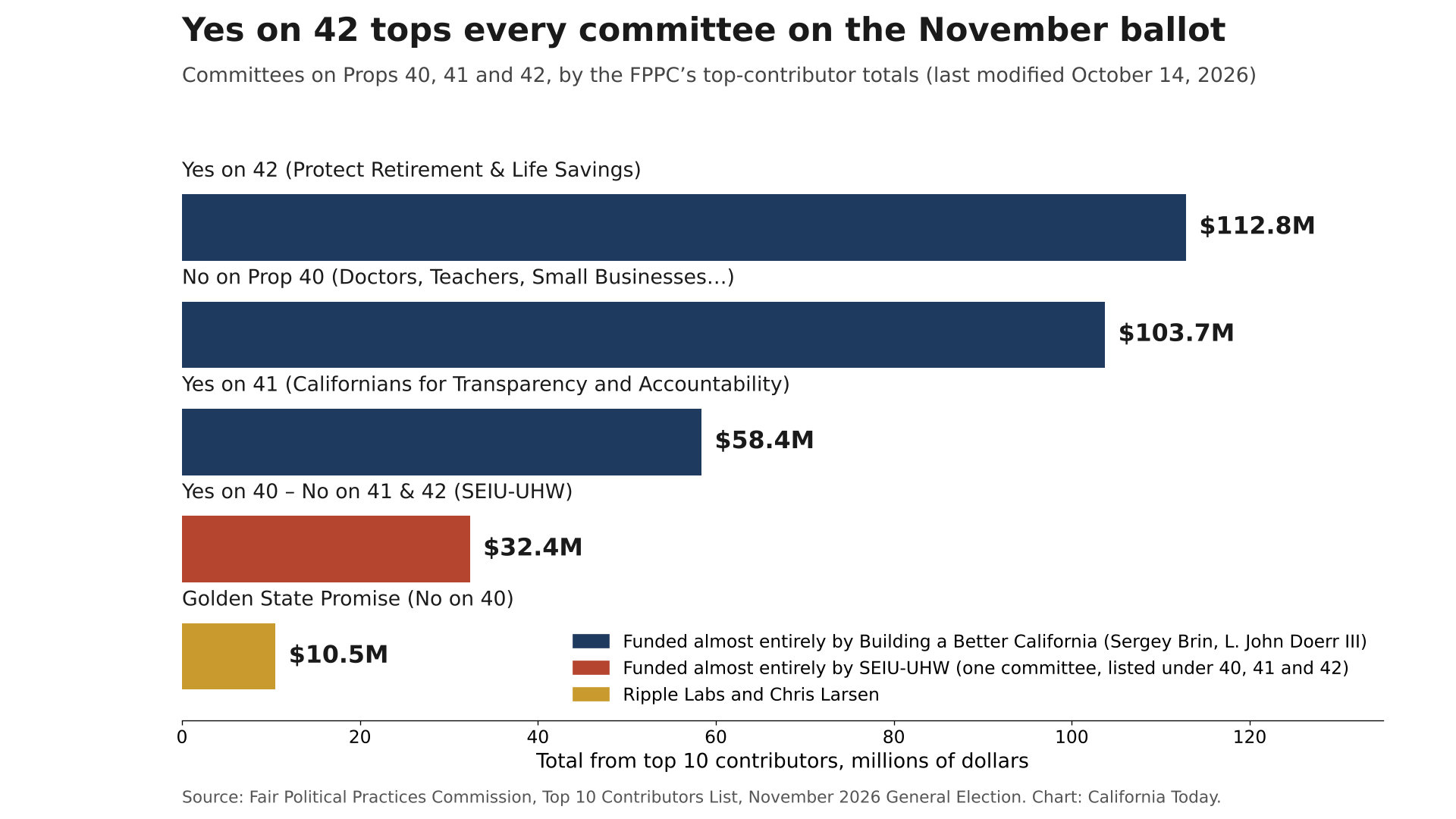
Prop 42 is an initiative constitutional amendment titled the Retirement and Personal Savings Protection Act of 2026. Its campaign has $112.8 million from its top contributors, more than any other committee on the ballot, almost all of it from Building a Better California, whose top donors are Google co-founder Sergey Brin and L. John Doerr III. Governor Gavin Newsom endorsed it on October 9. PPIC's September survey found 54% of likely voters in favor and 43% opposed. It is one of 14 measures in our guide to every November proposition, and our billionaire tax explainer covers how Props 40, 41 and 42 interact. This guide covers what Prop 42 would ban, what it would leave alone and who is behind it.
 Mac Douglass | Editor
Proposition 42 bans new state taxes on owning retirement accounts, stocks and other personal property:
The core of the measure's text is one sentence. No state law or constitutional provision enacted on or after January 1, 2026 "may enact, create, impose, or authorize collection of a tax on the ownership or control of retirement holdings, individually owned assets, and other forms of personal savings, whether held directly or indirectly." The definition of that phrase is broad. It covers pensions, retirement accounts and mutual funds, and "all personal property, whether tangible or intangible," including financial assets, investment accounts, business interests, digital assets, intellectual property and personal belongings.
It does not repeal anything. Any tax "in effect, imposed, and first collected on or before December 31, 2025" is untouched, and the measure says it does not "alter or affect the taxation of real property." The Legislative Analyst's Office notes that California already taxes some personal property, such as the vehicle license fee drivers pay each year and the property tax on business equipment. It also notes that while the state taxes the income people earn from financial assets, "there is no tax for simply owning those assets." Prop 42 would keep it that way.
Taxes Proposition 42 would leave alone and taxes it would bar:
| Tax | Under Proposition 42 |
|---|---|
| Vehicle license fee and property tax on business equipment | Unchanged. Both were “in effect, imposed, and first collected” before December 31, 2025, which the measure protects |
| Property tax on homes and land | Unchanged. The measure says it does not “alter or affect the taxation of real property” |
| Income tax on wages, interest, dividends and capital gains | Unchanged. Proposition 42 bars taxes on the “ownership or control” of assets, not on income they produce or gains when they are sold |
| A new state tax on the value of stocks, funds, business stakes, crypto or intellectual property | Barred if enacted on or after January 1, 2026 |
| A new state tax on the value of pensions, 401(k)s, 403(b)s or IRAs | Barred if enacted on or after January 1, 2026 |
| A tax keyed to where someone lived on a date before the tax took effect | Barred |
| A retroactive tax passed by the Legislature | Barred, except for a look-back of 365 days or less during a declared disaster or fiscal emergency, with the money limited to that emergency |
| A retroactive tax passed by initiative | Barred, with no emergency exception |
| Compiled by California Today from the text of Proposition 42 (Article VIII, §§1–4) and the Legislative Analyst’s analysis in the Voter Information Guide, which names the vehicle license fee and business equipment taxes as existing personal property taxes. “Barred” applies to state law and the state Constitution; the text does not mention local ordinances. | |
Proposition 42 also bans retroactive state taxes, with a 365-day emergency exception for the Legislature:
The second rule bars any new state tax "that operates retroactively to result in tax liability based on conduct, activities, or a status that occurred or was present prior to the effective date." The LAO's example of a retroactive tax is "a tax on money someone earned two years ago." The text adds a line aimed at residency: the ban "also applies to a tax that is imposed on a taxpayer based upon their residency status on a date prior to the effective date of the tax."
There is one exception, and it is open only to the Legislature. A statute may reach back up to 365 days if the Governor has declared an emergency, such as a fire, flood, earthquake or attack, or a fiscal emergency, and the statute limits the money to responding to it. A retroactive tax proposed by initiative gets no exception.
Proposition 42 and the billionaire tax meet at two points:
The first is residency. Prop 40 taxes billionaires who were California residents on January 1, 2026, a date that falls before the November 3 vote and before any tax could take effect. Prop 42's residency clause describes exactly that structure. The second is the assets. Prop 40 taxes net worth, including business interests, securities and intellectual property, all of which Prop 42's definition covers.
Prop 42 says any initiative on the same ballot that would tax those assets, or impose liability based on past "conduct, activities, or a status," is "deemed to be in conflict," and that if Prop 42 gets more yes votes, "all the provisions of the other measure shall be null and void." Prop 40's text describes itself differently, as "an excise tax … on the activity of sustaining excessive accumulations of wealth," and its own conflict clause reaches only other measures that tax billionaires' net worth. Whether the two measures conflict would be for the courts, which is why the guide says Prop 40 "could," not "would," be stopped.
Retirement accounts are the campaign's headline, and Prop 40 mostly leaves them out. It exempts qualified pensions and individual retirement arrangements, but it counts Roth IRAs and similar accounts to the extent their combined value exceeds $10 million. The No on 40 campaign's ballot argument says Prop 40 "would be the first in California history to tax retirement accounts."
Proposition 42's fiscal effect is a "possibility" of lower future revenue:
Because Prop 42 leaves current taxes in place, the LAO's estimate is about the future. The measure "restricts the options the state has to raise taxes in the future," the analysis says, which "could make it somewhat harder for the state to raise taxes" and "could reduce future tax revenues. When and by how much future revenues would be reduced is unclear."
Proposition 42's $112.8 million campaign is the largest on the November ballot:
The Fair Political Practices Commission's top-contributor list, last updated October 14, shows the Yes on 42 committee with $112.82 million from its top contributors. Of that, $112.8 million came from Building a Better California and $22,537 from Republican Assemblymember Carl DeMaio's Reform California ballot measure committee. No other committee on the list comes close except the No on Prop 40 campaign at $103.7 million, also funded by Building a Better California. The Yes on 42 total has grown from $73.8 million on the FPPC's September 25 list.
The opposition is far smaller. The Secretary of State's tally through October 6 lists one committee formed to oppose Prop 42, Tax the Ultra-Rich Now, Yes on 3 & 40, No on 41 & 42, with $703,494. The FPPC also lists SEIU-United Healthcare Workers West's Yes on 40 committee as opposing it. That committee's $32.3 million is one pot of money counted under Props 40, 41 and 42. Building a Better California has given $274.65 million across the three measures, by our count.
The Proposition 42 arguments center on "double taxation" and a "billionaire-funded trick":
The argument in favor, signed by Michael Hedges of the California Small Business Association, Shelley Huff of AMVETS' California department and Jennifer Yoder of the California Senior Alliance, says the Constitution "allows the Legislature to tax the value of our personal property like retirement funds and savings accounts," calls that "double taxation," and says "the Legislature and special interests have introduced six separate proposals that would tax retirement and savings accounts." It quotes Chris Hannan of the State Building and Construction Trades Council: "new taxes on retirement shouldn't stand between people and the security they've planned for." Its rebuttal is signed by the California Professional Firefighters, the building trades council and the Peace Officers Research Association of California.
The argument against, signed by Suzanne Jimenez of SEIU-UHW, says Prop 42 "isn't about preventing new taxes on personal property. It's about preventing one specific tax that billionaires want to avoid." Its rebuttal says Prop 40 "would only tax billionaires' $2 trillion in wealth." The guide notes that ballot arguments "have not been checked for accuracy by any official agency."
Proposition 42 leads 54% to 43% in PPIC polling, and Newsom endorsed it on October 9:
PPIC's September survey, fielded September 4–10, found 54% yes, 43% no and 4% undecided. Republicans back it 74% to 24% and independents 61% to 36%, while Democrats oppose it 56% to 39%. Voters 55 and older support it 61% to 34% and those under 35 oppose it 60% to 36%. Homeowners favor it 58% to 38% and renters oppose it 54% to 41%. Twelve percent of likely voters named it the measure they are most interested in, second only to Prop 40 among the three. UC Berkeley's Institute of Governmental Studies, polling September 15–20, found 43% yes and 34% no.
Against Prop 40, the polls again differ. PPIC had Prop 42's yes share two points above Prop 40's 52%. IGS had it two points below Prop 40's 45%. Both are polling again before the election.
Newsom, who opposes Prop 40, endorsed Prop 42 on October 9 in a statement released by its campaign. "We all agree that Californians deserve to have their retirement and life savings protected from new state taxes," he said, "so those savings are there when they need them," CalMatters reported. Debru Carthan, a vice president of SEIU-UHW, responded that "by voting yes on Prop 42, he's showing California his true colors." The California Democratic Party opposes Prop 42 and the California Republican Party supports it.
Proposition 42 after November 3 decides whether California can tax what people own:
If Prop 42 fails, the state keeps its current power to propose taxes on personal property and retroactive taxes, subject to the usual votes. If it passes, the ban is written into the Constitution, and only another constitutional amendment approved by voters could lift it. Existing taxes, including the vehicle license fee, business equipment taxes and income taxes on investment earnings, would continue. If Prop 42 and Prop 40 both pass, the yes-vote totals decide which prevails, and a court would likely be asked to settle whether they conflict. The regular registration deadline is October 19. After that, voters can still register and cast a ballot the same day at a county elections office or vote center through November 3.
This article reflects the Voter Information Guide as published, campaign-finance data as of October 6, 2026 (Secretary of State) and October 14, 2026 (FPPC), positions as of October 19, 2026, and polling fielded September 4–20, 2026.
Sources and References
- Voter Information Guide, Proposition 42—https://voterguide.sos.ca.gov/propositions/42/
- Voter Information Guide, Proposition 42, title and summary, Legislative Analyst's analysis and arguments (print pages 62–65)—https://vig.cdn.sos.ca.gov/2026/general/pdf/prop42.pdf
- Voter Information Guide, Proposition 42, arguments and rebuttals—https://voterguide.sos.ca.gov/propositions/42/arguments-rebuttals.htm
- Text of Proposed Laws, Proposition 42 (pp. 150–153)—https://vig.cdn.sos.ca.gov/2026/general/pdf/prop42-text-proposed-laws.pdf
- Text of Proposed Laws, Proposition 40 (2026 Billionaire Tax Act)—https://vig.cdn.sos.ca.gov/2026/general/pdf/prop40-text-proposed-laws.pdf
- Voter Information Guide, Proposition 40, arguments and rebuttals—https://voterguide.sos.ca.gov/propositions/40/arguments-rebuttals.htm
- California Constitution, Article II, Section 10—https://leginfo.legislature.ca.gov/faces/codes_displaySection.xhtml?lawCode=CONS§ionNum=SEC.%2010.&article=II
- Office of the Attorney General, active measures (initiative 25-0041A1)—https://oag.ca.gov/initiatives/active-measures
- Fair Political Practices Commission, Top 10 Contributors List, November 2026 General Election (last modified October 14, 2026)—https://www.fppc.ca.gov/search-filings/top-10-contributors-list/november-2026-general-election/
- California Secretary of State, 2026 Ballot Measure Contribution Totals, Proposition 42 (through October 6, 2026)—https://www.sos.ca.gov/campaign-lobbying/helpful-resources/measure-contributions/2026-ballot-measure-contribution-totals/proposition-42-prohibits-new-state-personal-property-taxes-and-certain-retroactive-state-taxes-initiative-constitutional-amendme
- Public Policy Institute of California, September 2026 likely-voter crosstabs—https://www.ppic.org/wp-content/uploads/crosstabs-likely-voters-0926.pdf
- UC Berkeley Institute of Governmental Studies, Berkeley IGS Poll, Release #2026-20 (September 2026)—https://escholarship.org/content/qt3w14s99c/qt3w14s99c.pdf
- CalMatters, "Gavin Newsom backs measure to kill the billionaire tax and ban future wealth taxes" (October 9, 2026, updated October 13)—https://calmatters.org/politics/2026/10/newsom-tax-propositions-november-election/
- California Democratic Party, 2026 General Election Endorsements—https://cadem.org/wp-content/uploads/2026/08/FINAL-2026-General-Election-Endorsements.pdf
- California Republican Party, 2026 endorsements—https://cagop.org/endorsements/
- California Secretary of State, General Election November 3, 2026, key dates and deadlines—https://www.sos.ca.gov/elections/upcoming-elections/general-election-november-3-2026/key-dates-deadlines
More November 2026 California Election Guides:
 Mac Douglass | Editor

 Mac Douglass | Editor

 Mac Douglass | Editor

 Pat Sharyon | Editor

 Dr. Jennifer Trimpey | Specialist

 Mac Douglass | Editor

 Dr. Jennifer Trimpey | Specialist

 Mac Douglass | Editor

 Mac Douglass | Editor

 Mac Douglass | Editor

 Mac Douglass | Editor