2026 California Prop 41 guide: "Tax audits" measure could cancel the billionaire tax if it outpolls Prop 40
Proposition 41 requires State Auditor reviews of new special taxes and bars any new state tax from the 1979 spending limit. Because Prop 40 exempts its revenue from that limit, Prop 41 could void the billionaire tax if it gets more yes votes.


Proposition 41 would amend the California Constitution to do two things. It would require the State Auditor to audit the programs a new special tax would pay for, once before voters see an initiative proposing the tax and every four years after any such tax passes. And it would bar any new state tax from being exempted from the spending limit voters adopted in 1979, known as the Gann limit. The second rule is the one that matters most on this ballot. Proposition 40, the "billionaire tax," exempts its revenue from that limit, and the Voter Information Guide warns that if Prop 41 receives more yes votes, Prop 40 "could be stopped from becoming law even if it gets yes votes from a majority of voters."
Prop 41 is an initiative constitutional amendment titled the Improving Transparency, Effectiveness, and Efficiency in California Government Act of 2026. Attorney Kurt R. Oneto filed it with the Attorney General in January, and nearly all of its campaign money comes from Building a Better California, the committee whose top donors are Google co-founder Sergey Brin and L. John Doerr III. It is one of 14 measures in our guide to every November proposition. PPIC's September survey found 51% of likely voters in favor and 44% opposed. Our billionaire tax explainer covers how Props 40, 41 and 42 interact. This guide covers what Prop 41 would do on its own, what it would cost and who is paying for it.
 Mac Douglass | Editor
Proposition 41 requires State Auditor reviews of new special taxes before and after voters approve them:
A special tax, in the measure's words, is "a tax that can only be used to fund specific, as opposed to unlimited, purposes." Prop 41's text sets up two kinds of audits for them.
The first comes before an election. When supporters of a special-tax initiative tell the Secretary of State they have gathered 25% of the signatures they need, the State Auditor must begin a "preelection financial and performance audit" of every program that would receive the money. The audit has to cover ten matters, including whether the program buys what it needs "at the lowest cost for the required quality," whether it is achieving its goals, how much "fraud, waste, and abuse" it has, how its costs compare with "analogous programs in the nongovernment sector," and how it "could achieve a budgetary savings of at least 10 percent annually." If the initiative qualifies, the auditor's executive summary is printed in the Voter Information Guide "immediately following the impartial analysis prepared by the Legislative Analyst." The Legislative Analyst's Office notes that the audit starts "before it is known whether the initiative will qualify for the ballot."
The second kind is ongoing. Every program funded by a special tax that the Legislature or voters enact on or after January 1, 2026 would be audited every four years, with recommendations on how it "could improve effectiveness and cut costs." The auditor must invite input from the LAO and the public, and the cost of both kinds of audits comes out of the new tax's revenue once it passes.
 Mac Douglass | Editor
Proposition 41 bars new state taxes from escaping the 1979 Gann spending limit:
The audits apply only to special taxes. Prop 41's other rule covers every new state tax. "No state tax that is enacted or takes effect on or after January 1, 2026, shall be exempted or excluded from the Government Spending Limitation," the text says, and the state "shall not impose, collect, or enforce" a tax that is. A tax counts as exempted if its revenue goes into a fund whose spending is not counted against the limit, or if the limit is raised by statute to make room for it.
The limit is Proposition 4 of 1979, named for one of its coauthors, Paul Gann. Its purpose, the LAO explains, was "to keep inflation‑ and population‑adjusted appropriations under the 1978‑79 level." When revenue exceeds the limit over two consecutive years, the excess is split between extra school funding and rebates to taxpayers, a formula voters set in 1990's Proposition 111. The state had to rebate $1.1 billion to taxpayers after exceeding the limit in 1986-87, and the LAO's 2017 review found rebates had not been triggered since. Some spending does not count against the limit, including debt service, certain capital projects and money passed to local governments.
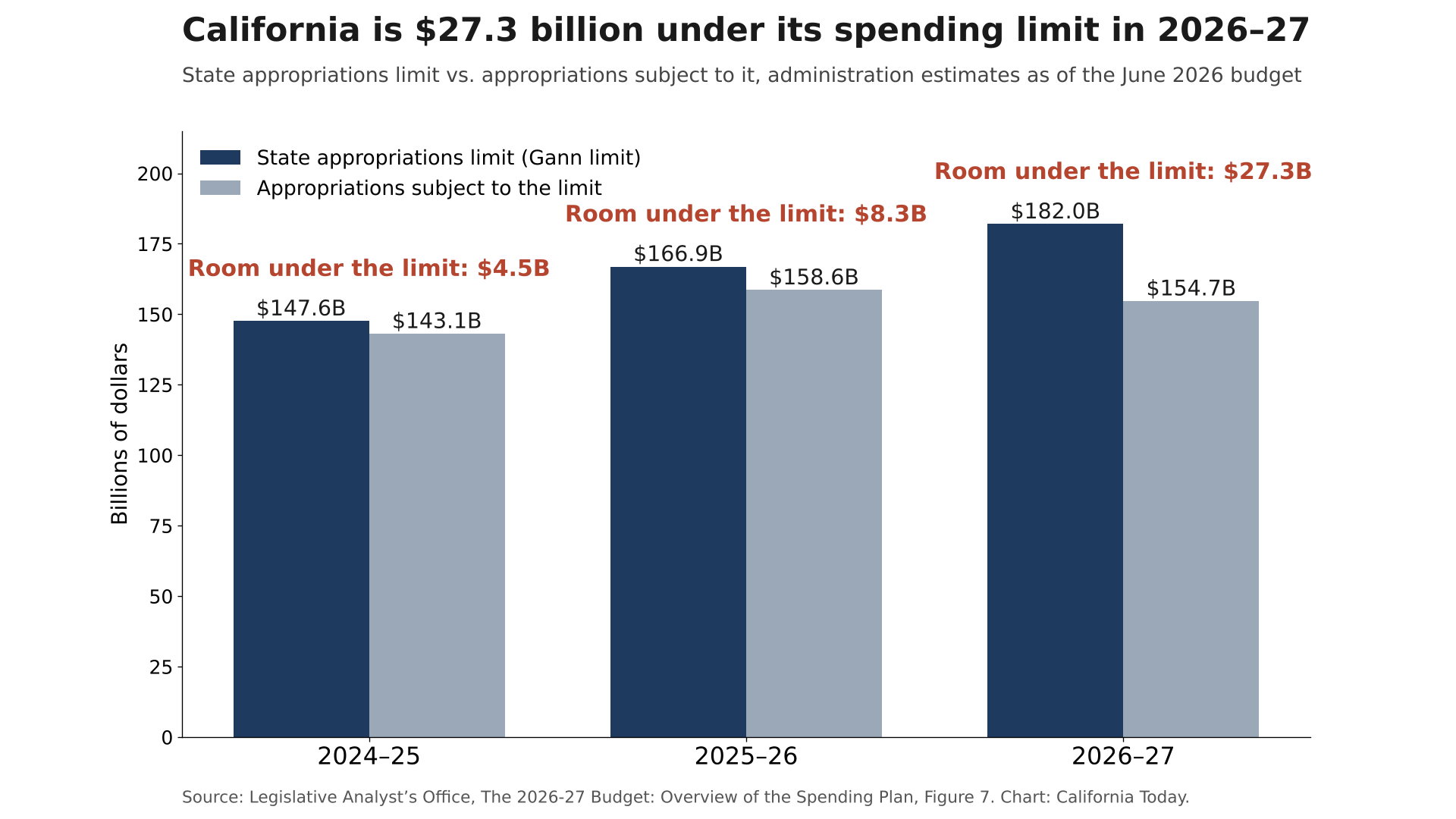
The limit is not tight right now. Under the June 2026 budget, the state has $27.3 billion of room under it in 2026-27, up from $8.3 billion the year before, according to the LAO's overview of the spending plan. The LAO notes that the limit "was an important constraint in the budget process" during the revenue surges of the early 2020s. Prop 41's findings say "special interests have repeatedly passed new taxes that exempted themselves from the state spending limit." The LAO's analysis of Prop 41 concludes that under it, "the state might not be able to exclude new special tax spending from the limit."
Special taxes and the spending limit today and under Proposition 41 compared:
| Rule | Today | Under Proposition 41 |
|---|---|---|
| Audit before a special-tax initiative reaches the ballot | None required | The State Auditor starts a financial and performance audit of every program that would get the money once proponents file their 25% signature certification |
| What voters see in the Voter Information Guide | Title and summary, Legislative Analyst’s analysis, arguments | The same, plus the State Auditor’s executive summary, printed right after the Legislative Analyst’s analysis |
| Savings target in each audit | None | Recommendations to save at least 10% a year |
| Audits after a special tax passes | No audit rule specific to special taxes | Every four years for each program funded by a special tax enacted on or after January 1, 2026, by the Legislature or by initiative |
| Who pays for the audits | No special-tax audits to pay for | The new tax’s revenue; the General Fund pays for pre-election audits of measures that fail or never qualify |
| New state taxes kept outside the 1979 spending limit | Voters can exempt a tax’s revenue from the limit, as Prop 40 would | Barred for any state tax enacted or taking effect on or after January 1, 2026; the state may not “impose, collect, or enforce” one |
| Measures on the same ballot | Conflicts go to the measure with the most yes votes (Cal. Const. art. II, §10(b)) | Any initiative with a tax outside the limit, or different audit rules, is “deemed to be in conflict”; if Prop 41 gets more yes votes, “all the provisions of the other measure shall be null and void” |
| Compiled by California Today from the text of Proposition 41 (Article XXIV, §§1–5, and Sec. 5 of the act), the Legislative Analyst’s analysis in the Voter Information Guide and Article II, Section 10 of the California Constitution. | ||
Proposition 41 and the billionaire tax collide over the spending limit:
Prop 40's official summary says its revenue is exempt from the "state spending limit." Prop 41 would bar the state from collecting any new tax that is. Prop 41 also says any initiative on the same ballot that contains a tax outside the limit "shall be deemed to be in conflict," and that if Prop 41 gets more yes votes, "all the provisions of the other measure shall be null and void." The state Constitution already gives the win to the measure with the most yes votes when two approved measures conflict. Whether these two do is a question the courts would answer, which is why the guide says Prop 40 "could" be stopped rather than "would."
Prop 41 has a fallback as well. If it passes but is overridden by a conflicting measure that a court later strikes down, Prop 41 "shall be self-executing and given full force and effect." Prop 40's own conflict clause is narrower and reaches only other measures that tax billionaires' net worth. Proposition 42, also on the ballot and funded by the same committee, carries the same warning for Prop 40 on different grounds. The billionaire tax explainer walks through all three outcomes.
Proposition 41's net cost is unknown, according to the Legislative Analyst:
The LAO expects the State Auditor's new work to cost "in the range of the low millions of dollars per year but would grow over time," depending on how many special taxes are proposed and passed and how complex the programs are. Taxes that pass would pay for their own audits. The state's General Fund would cover pre-election audits of initiatives that never make the ballot or that voters reject. Printing the audit summaries could add several pages to the Voter Information Guide, which the LAO puts at "a few hundred thousand dollars per qualified initiative." Savings are possible if lawmakers act on the auditor's recommendations, but the LAO says they "would depend on future decisions and are not known," and it calls the measure's net fiscal effect unknown.
Building a Better California has put $58.4 million behind Proposition 41:
The Fair Political Practices Commission's top-contributor list, last updated October 14, shows the Yes on 41 committee with $58.37 million from its top contributors. Of that, $58.35 million came from Building a Better California and $21,808 from Republican Assemblymember Carl DeMaio's Reform California ballot measure committee. The Secretary of State's tally, which runs through October 6, lists one opposition committee, Tax the Ultra-Rich Now, Yes on 3 & 40, No on 41 & 42, with $703,494. The FPPC also lists SEIU-United Healthcare Workers West's Yes on 40 committee as opposing Prop 41. Its $32.3 million is a single pot of money that the FPPC counts under Props 40, 41 and 42 alike.
Building a Better California has now given $274.65 million across the three measures, by our count of the FPPC lines: $103.5 million to defeat Prop 40, $58.35 million for Prop 41 and $112.8 million for Prop 42.
The Proposition 41 arguments pit "better results" against a "billionaire-funded smoke screen":
The argument in favor is signed by Denise LeDuc Froemming of the California Society of Certified Public Accountants, former State Auditor Tom Hayes and Robert Gutierrez of the California Taxpayers Association. It says state government "will spend more than $350 billion—a 79% increase in spending since 2019," that "billions of our tax dollars have flowed into state programs like homelessness efforts, with too little to show for it," and that Prop 41 "doesn't raise taxes." Its rebuttal adds former Controller Steve Westly and Pat Fong Kushida of the CalAsian Chamber of Commerce.
The argument against, signed by Suzanne Jimenez of SEIU-UHW, calls Prop 41 "a billionaire-funded initiative designed specifically to undo the California Billionaire Tax, Prop. 40," and says Brin "spent over $57 million to fund sham measures like Prop. 41." The FPPC now shows more than that on Prop 41 alone. The guide notes that ballot arguments "have not been checked for accuracy by any official agency."
Proposition 41 leads 51% to 44% in PPIC polling, and Newsom has taken no position:
PPIC's September survey, fielded September 4–10, found 51% yes, 44% no and 5% undecided. Republicans back it 74% to 22% and Democrats oppose it 56% to 38%, while independents split 51% to 44%. Voters under 35 oppose it 58% to 39%, and homeowners support it 54% to 40% while renters oppose it 54% to 42%. Six percent of likely voters named it the measure they are most interested in. UC Berkeley's Institute of Governmental Studies, polling September 15–20, found 37% yes and 33% no, with the rest undecided.
Measured against Prop 40, the two polls point in different directions. PPIC had Prop 41 one point behind Prop 40's 52% yes, inside the margin of error. IGS had it eight points behind Prop 40's 45%. Both organizations are polling again before the election.
Governor Gavin Newsom, who opposes Prop 40 and has endorsed Prop 42, "has not yet taken a position on Prop. 41," his spokesperson Izzy Gardon told CalMatters. The California Democratic Party opposes Prop 41 and the California Republican Party supports it. The San Diego Union-Tribune and the Orange County Register recommend yes and the Sacramento Bee and the San Francisco Chronicle recommend no, according to CalMatters' voter guide.
Proposition 41 after November 3 turns on two vote counts:
If Prop 41 fails, nothing changes: no new audits, and new taxes can still be kept outside the spending limit. If it passes, future special-tax initiatives would get a State Auditor review before reaching voters, special taxes passed since January 1, 2026 would be audited every four years, and no new state tax could be collected unless it counts against the Gann limit. If Prop 41 and Prop 40 both pass, the yes-vote totals decide which prevails, and a court would likely be asked to settle whether they conflict. The regular registration deadline is October 19. After that, voters can still register and cast a ballot the same day at a county elections office or vote center through November 3.
This article reflects the Voter Information Guide as published, campaign-finance data as of October 6, 2026 (Secretary of State) and October 14, 2026 (FPPC), positions as of October 19, 2026, and polling fielded September 4–20, 2026.
Sources and References
- Voter Information Guide, Proposition 41—https://voterguide.sos.ca.gov/propositions/41/
- Voter Information Guide, Proposition 41, title and summary, Legislative Analyst's analysis and arguments (print pages 58–61)—https://vig.cdn.sos.ca.gov/2026/general/pdf/prop41.pdf
- Voter Information Guide, Proposition 41, arguments and rebuttals—https://voterguide.sos.ca.gov/propositions/41/arguments-rebuttals.htm
- Text of Proposed Laws, Proposition 41 (pp. 147–150)—https://vig.cdn.sos.ca.gov/2026/general/pdf/prop41-text-proposed-laws.pdf
- Text of Proposed Laws, Proposition 40, Sec. 8 (p. 147)—https://vig.cdn.sos.ca.gov/2026/general/pdf/prop40-text-proposed-laws.pdf
- Voter Information Guide, Proposition 40, official title and summary—https://voterguide.sos.ca.gov/propositions/40/title-summary.htm
- Legislative Analyst's Office, The 2017-18 Budget: Governor's Gann Limit Proposal—https://lao.ca.gov/Publications/Report/3596
- Legislative Analyst's Office, The 2026-27 Budget: Overview of the Spending Plan—https://lao.ca.gov/Publications/Report/5197
- California Constitution, Article II, Section 10—https://leginfo.legislature.ca.gov/faces/codes_displaySection.xhtml?lawCode=CONS§ionNum=SEC.%2010.&article=II
- Office of the Attorney General, active measures (initiative 25-0040A1)—https://oag.ca.gov/initiatives/active-measures
- Fair Political Practices Commission, Top 10 Contributors List, November 2026 General Election (last modified October 14, 2026)—https://www.fppc.ca.gov/search-filings/top-10-contributors-list/november-2026-general-election/
- California Secretary of State, 2026 Ballot Measure Contribution Totals, Proposition 41 (through October 6, 2026)—https://www.sos.ca.gov/campaign-lobbying/helpful-resources/measure-contributions/2026-ballot-measure-contribution-totals/proposition-41-requires-audits-programs-funded-new-state-special-taxes-prohibits-new-state-taxes-are-excluded-existing-voter-app
- Public Policy Institute of California, September 2026 likely-voter crosstabs—https://www.ppic.org/wp-content/uploads/crosstabs-likely-voters-0926.pdf
- UC Berkeley Institute of Governmental Studies, Berkeley IGS Poll, Release #2026-20 (September 2026)—https://escholarship.org/content/qt3w14s99c/qt3w14s99c.pdf
- CalMatters, "Gavin Newsom backs measure to kill the billionaire tax and ban future wealth taxes" (October 9, 2026, updated October 13)—https://calmatters.org/politics/2026/10/newsom-tax-propositions-november-election/
- CalMatters, CA voter guide to Proposition 41: Tax audits—https://calmatters.org/california-voter-guide-2026/proposition-41-tax-audits/
- California Democratic Party, 2026 General Election Endorsements—https://cadem.org/wp-content/uploads/2026/08/FINAL-2026-General-Election-Endorsements.pdf
- California Republican Party, 2026 endorsements—https://cagop.org/endorsements/
- California Secretary of State, General Election November 3, 2026, key dates and deadlines—https://www.sos.ca.gov/elections/upcoming-elections/general-election-november-3-2026/key-dates-deadlines
More November 2026 California Election Guides:
 Mac Douglass | Editor
 Mac Douglass | Editor
 Pat Sharyon | Editor

 Dr. Jennifer Trimpey | Specialist

 Mac Douglass | Editor

 Dr. Jennifer Trimpey | Specialist

 Mac Douglass | Editor

 Mac Douglass | Editor
 Mac Douglass | Editor

 Mac Douglass | Editor