California's Proposition 5 would remove the "replacement vote" after a governor is recalled; here's who would take charge
Prop 5, a constitutional amendment from former state Sen. Josh Newman, removes question two from state recall ballots. Governors would be succeeded by the lieutenant governor; other vacancies filled by appointment or special election. PPIC has it losing 35% to 59%.


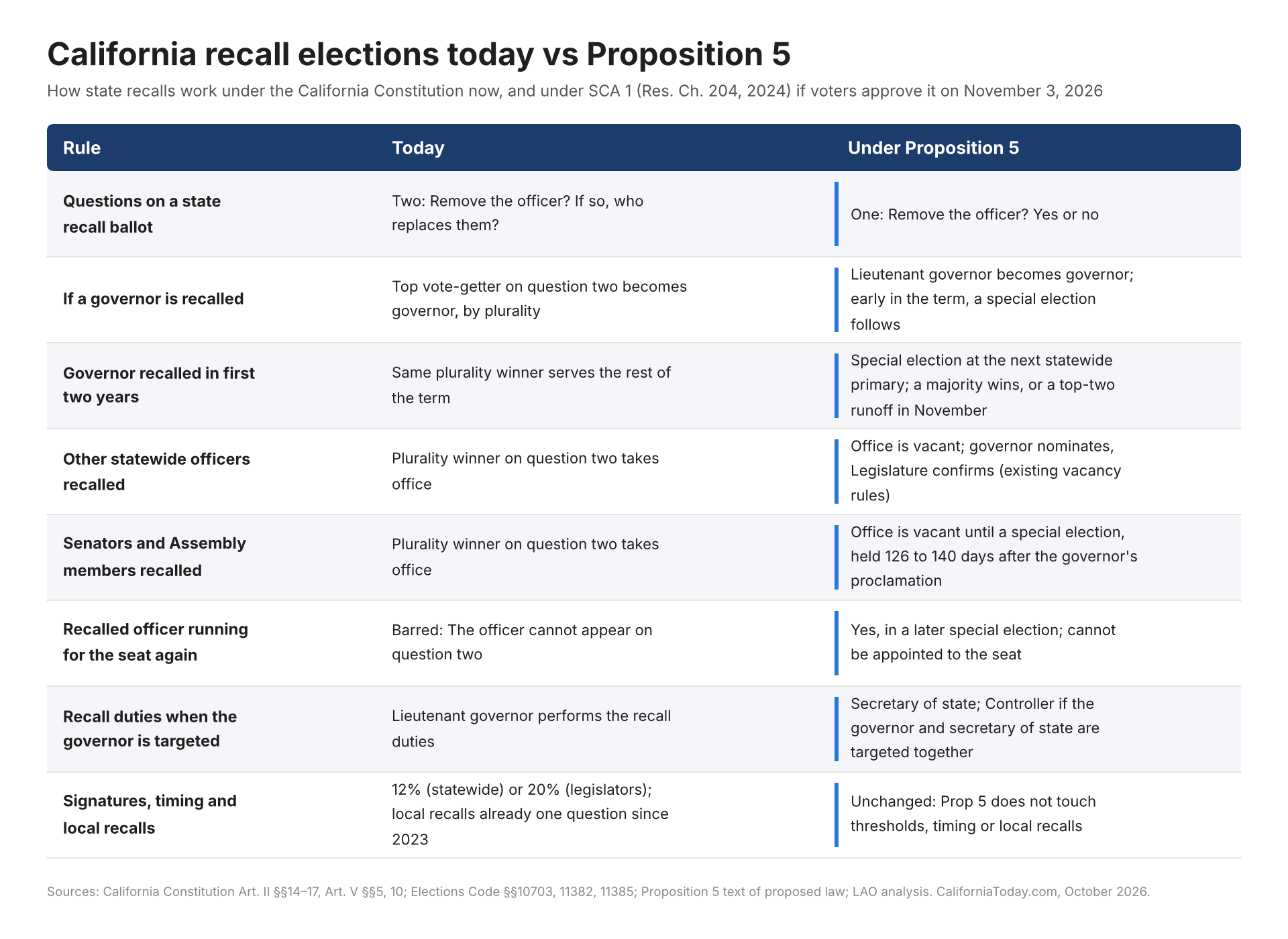
Proposition 5 would rewrite how California recalls state officials. Today a recall ballot asks two questions: whether to remove the officer and, if so, who should replace them, with the replacement chosen by plurality from a list that ran to 135 names in 2003 and 46 in 2021. Prop 5 removes the second question. A recalled governor would be succeeded by the lieutenant governor; other recalled statewide officers would be replaced by the governor's appointment; recalled legislators would be replaced through a later special election. It is a legislative constitutional amendment, SCA 1 by former state Sen. Josh Newman, who was himself recalled in 2018, and it is one of 14 measures in this year's guide. It also has the weakest polling on the ballot: 35% yes to 59% no in PPIC's September survey.
 Mac Douglass | Editor
The case for the measure is majority rule. Under the current system a replacement can take office with far less than half the vote, and in 2018 Newman's replacement won the seat with 31.8% of the votes cast on the recall question, fewer than voted to keep him. The case against is voter choice: opponents say Prop 5 "takes away half" of the recall right by giving the replacement decision to "Sacramento political insiders." This explainer sets out what the amendment's text changes, the recall law it amends, what the state's 11 qualified recalls since 1913 show, what the Legislative Analyst's Office says it would cost, and where the campaigns, parties and polls stand with three weeks to go.
Sources and References
- Voter Information Guide, Proposition 5—https://voterguide.sos.ca.gov/propositions/5/
- Voter Information Guide, Proposition 5, Official Title and Summary—https://voterguide.sos.ca.gov/propositions/5/title-summary.htm
- Voter Information Guide, Proposition 5, Legislative Analyst's analysis—https://voterguide.sos.ca.gov/propositions/5/analysis.htm
- Voter Information Guide, Proposition 5, arguments and rebuttals—https://voterguide.sos.ca.gov/propositions/5/arguments-rebuttals.htm
- Text of Proposed Laws, Proposition 5 (p. 118)—https://vig.cdn.sos.ca.gov/2026/general/pdf/prop5-text-proposed-laws.pdf
- SCA 1 (Newman), Res. Ch. 204, Stats. 2024, bill history—https://leginfo.legislature.ca.gov/faces/billHistoryClient.xhtml?bill_id=202320240SCA1
- California Constitution, Article II, Sections 13–18—https://leginfo.legislature.ca.gov/faces/codes_displaySection.xhtml?lawCode=CONS§ionNum=SEC.%2014.&article=II
- California Constitution, Article V, Section 5—https://leginfo.legislature.ca.gov/faces/codes_displaySection.xhtml?lawCode=CONS§ionNum=SEC.%205.&article=V
- California Constitution, Article V, Section 10—https://leginfo.legislature.ca.gov/faces/codes_displaySection.xhtml?lawCode=CONS§ionNum=SEC.%2010.&article=V
- California Constitution, Article XVIII, Section 4—https://leginfo.legislature.ca.gov/faces/codes_displaySection.xhtml?lawCode=CONS§ionNum=SEC.%204.&article=XVIII
- Elections Code Section 10703—https://leginfo.legislature.ca.gov/faces/codes_displaySection.xhtml?lawCode=ELEC§ionNum=10703
- Elections Code Section 11382—https://leginfo.legislature.ca.gov/faces/codes_displaySection.xhtml?lawCode=ELEC§ionNum=11382
- Elections Code Section 11385—https://leginfo.legislature.ca.gov/faces/codes_displaySection.xhtml?lawCode=ELEC§ionNum=11385
- AB 2582 (Bennett), Chapter 790, Statutes of 2022—https://leginfo.legislature.ca.gov/faces/billTextClient.xhtml?bill_id=202120220AB2582
- California Secretary of State, Recall History in California (1913 to Present)—https://www.sos.ca.gov/elections/recalls/recall-history-california-1913-present
- California Secretary of State, Current Recall Efforts—https://www.sos.ca.gov/elections/recalls/current-recall-efforts
- California Secretary of State, Statement of Vote summary, October 7, 2003 statewide special election—https://elections.cdn.sos.ca.gov/sov/2003-special/sum.pdf
- California Secretary of State, Statement of Vote, June 5, 2018, State Senator 29th District recall—https://elections.cdn.sos.ca.gov/sov/2018-primary/sov/15-state-senator-29th-district.pdf
- California Secretary of State, Statement of Vote summary, September 14, 2021 gubernatorial recall—https://elections.cdn.sos.ca.gov/sov/2021-recall/sov/11-sov-summary.pdf
- California Department of Finance, gubernatorial recall election cost letters (July 1 and July 20, 2021)—https://elections.cdn.sos.ca.gov/statewide-elections/2021-recall/dof-allocation-costs-letter.pdf
- National Conference of State Legislatures, Recall of State Officials (updated August 27, 2025)—https://www.ncsl.org/elections-and-campaigns/recall-of-state-officials
- Little Hoover Commission, "Reforming the Recall" press release (February 8, 2022)—https://lhc.ca.gov/press-release-43/
- California Secretary of State, 2026 Ballot Measure Contribution Totals, Proposition 5 (as of October 6, 2026)—https://www.sos.ca.gov/campaign-lobbying/helpful-resources/measure-contributions/2026-ballot-measure-contribution-totals/proposition-5-sca-1-newman-elections-recall-state-officers-res-ch-204-2024
- Fair Political Practices Commission, Top 10 Contributors List, November 2026 General Election (last modified October 6, 2026)—https://www.fppc.ca.gov/search-filings/top-10-contributors-list/november-2026-general-election/
- Yes on Proposition 5 campaign—https://fixtherecall.com/
- Public Policy Institute of California, September 2026 likely-voter crosstabs—https://www.ppic.org/wp-content/uploads/crosstabs-likely-voters-0926.pdf
- California Democratic Party, 2026 General Election Endorsements and Ballot Measure Positions—https://cadem.org/wp-content/uploads/2026/08/FINAL-2026-General-Election-Endorsements.pdf
- California Republican Party, 2026 endorsements—https://cagop.org/endorsements/
- San Francisco Chronicle, "Here's how Gavin Newsom is voting on California's propositions" (October 9, 2026)—https://www.sfchronicle.com/politics/article/gavin-newsom-ballot-propositions-22470170.php
- San Francisco Chronicle editorial board, "Endorsement: Prop 5 has a flaw so bizarre even its author doesn't like it" (October 8, 2026)—https://www.sfchronicle.com/opinion/editorials/article/prop-5-recall-california-22458510.php
- McClatchy Media California editorial board, "Proposition 5 could change California's recall elections. Here is our endorsement" (September 18, 2026)—https://www.yahoo.com/news/politics/articles/proposition-5-could-change-california-173000601.html
- CalMatters, Proposition 5 explainer (October 5, 2026)—https://calmatters.org/politics/2026/10/california-election-proposition-5-explainer/
- California Today, guide to all 14 November 2026 propositions—https://californiatoday.com/guides/elections/2026-california-propositions-master-guide/
- California Today, Proposition 39 voter ID explainer—https://californiatoday.com/guides/elections/yes-voter-id-laws-are-on-the-california-ballot-proposition-39s-rules-costs-and-court-fights/
Proposition 5 rewrites three sections of the California Constitution
The text of proposed law amends Article II, sections 15 and 17, and Article V, section 10. It changes no statute directly. Its edits are short:
- Section 15(a) strikes the words "and, if appropriate, to elect a successor" from the description of a recall election, leaving an election "to determine whether to recall an officer."
- Section 15(c) strikes the sentence that makes "the candidate who receives a plurality" the successor, and strikes the ban on the targeted officer being a candidate. In their place it provides that if the majority votes to recall, "the officer is removed and the office shall be vacant. The vacancy shall be filled in accordance with this Constitution and statute, provided that the officer who was the subject of the recall election shall not be appointed to fill the vacancy in that office."
- Article V, section 10(b) is new. If the Governor is removed by recall, "the Lieutenant Governor shall become Governor for the remainder of the unexpired term," unless the recall comes "before the close of the nomination period for the next statewide election during the first two years of the Governor's term." In that case "a special election shall be called to replace the Governor," consolidated with the statewide primary; a candidate with a majority at the primary takes office, and otherwise "the top two vote-getters shall compete in a special election consolidated with the subsequent statewide general election."
- Section 17 moves the job of running a governor's recall from the lieutenant governor, who would now be the successor, to the secretary of state, with the controller taking over if the governor and secretary of state are targeted at the same time.
The Attorney General's ballot label calls it a change for "statewide officers," but the text applies to every state officer subject to recall, and the LAO's analysis describes its effect on Senate and Assembly seats as well. Prop 5 does not change how a recall qualifies, how quickly the election is held, or how local recalls work.
California recall law today: 12% of the last vote, two questions, a plurality winner
The power to recall is in Article II of the Constitution: "Recall is the power of the electors to remove an elective officer." A recall of a statewide officer needs signatures equal to 12% of the last vote for the office, including 1% of the last vote in each of five counties; senators, Assembly members, Board of Equalization members and appellate and trial judges need 20%. Proponents have 160 days to gather them, and the "sufficiency of reason is not reviewable." Once signatures are certified, the election is held 60 to 80 days later, or within 180 days to coincide with a regular election. An officer who survives is reimbursed for recall expenses, and no new recall can begin for six months.
The successor rule sits in section 15(c), last amended by Proposition 183 in 1994: if the majority votes to recall, "the officer is removed and, if there is a candidate, the candidate who receives a plurality is the successor. The officer may not be a candidate." Elections Code section 11385 repeats it: the candidate "receiving the highest number of votes for the office shall be declared elected for the unexpired term."
Prop 5 would replace that with the rules California already uses when an office falls vacant for any other reason. The lieutenant governor becomes governor under Article V, section 10. For the lieutenant governor, secretary of state, controller, treasurer, attorney general, superintendent of public instruction and Board of Equalization, Article V, section 5 has the governor nominate a replacement who takes office on confirmation by a majority of each house, or automatically if neither house acts within 90 days. For a legislative seat, Elections Code section 10703 requires a special election "at least 126 days, but not more than 140 days" after the governor's proclamation, which must be issued within 14 days of the vacancy.
California has already made this change for local officials. Since January 1, 2023, under AB 2582, recalls of local officers have asked only whether to remove the officer; under Elections Code section 11382 the office "shall be vacant until it is filled according to law," and the recalled officer may not be appointed to the vacancy. Prop 5 uses the same structure and much of the same wording for state offices, which only a constitutional amendment can reach.
The governor's seat under Prop 5: The lieutenant governor, then possibly a special election
For a recalled governor, Prop 5 creates a two-track rule keyed to timing. Late in a term, the lieutenant governor serves out the remainder, and no election is held for the seat until the next regular gubernatorial election. Early in a term, before the nomination period closes for the next statewide election during the governor's first two years, the lieutenant governor takes over and a special election is held alongside the next statewide primary. A majority winner there serves the rest of the term; without one, the top two meet again on the November ballot. The LAO's summary: the lieutenant governor "serves as Governor until voters elect a new Governor at a future statewide election" in the first case and "for the rest of the term" in the second.
Because Prop 5 removes the constitutional bar on the recalled officer's candidacy, a governor recalled early in a term could appear in that special election. The same applies to a recalled legislator in the special election that would fill the seat. The only limit the text adds is on appointment: a recalled officer "shall not be appointed to fill the vacancy in that office."
That provision is the one even the measure's author has not defended. Newman told the San Francisco Chronicle's editorial board he could not explain why it is there: "I'm honestly not sure," he said. "It wouldn't pain me if it wasn't there." The Yes campaign's website presents it as a feature, saying that today's process "locks the recalled official out of the race entirely" and that under Prop 5 "the seat goes to a special election where every candidate can run." That description fits legislative seats and an early-term governor recall; for a governor recalled late in a term and for other statewide offices, the text provides succession or appointment, not an election.
California recall history: 182 attempts, 11 elections, six removals since 1913
The Secretary of State counts 182 attempts to recall state officials since 1913, 57 of them against governors. Eleven qualified for the ballot: nine against legislators and two against governors. Six succeeded: Senators Marshall Black (1913) and Edwin Grant (1914), Assembly members Paul Horcher (1994) and Doris Allen (1995), Governor Gray Davis (2003) and Senator Josh Newman (2018). No state recall effort is in circulation now, according to the Secretary of State's current-efforts page.
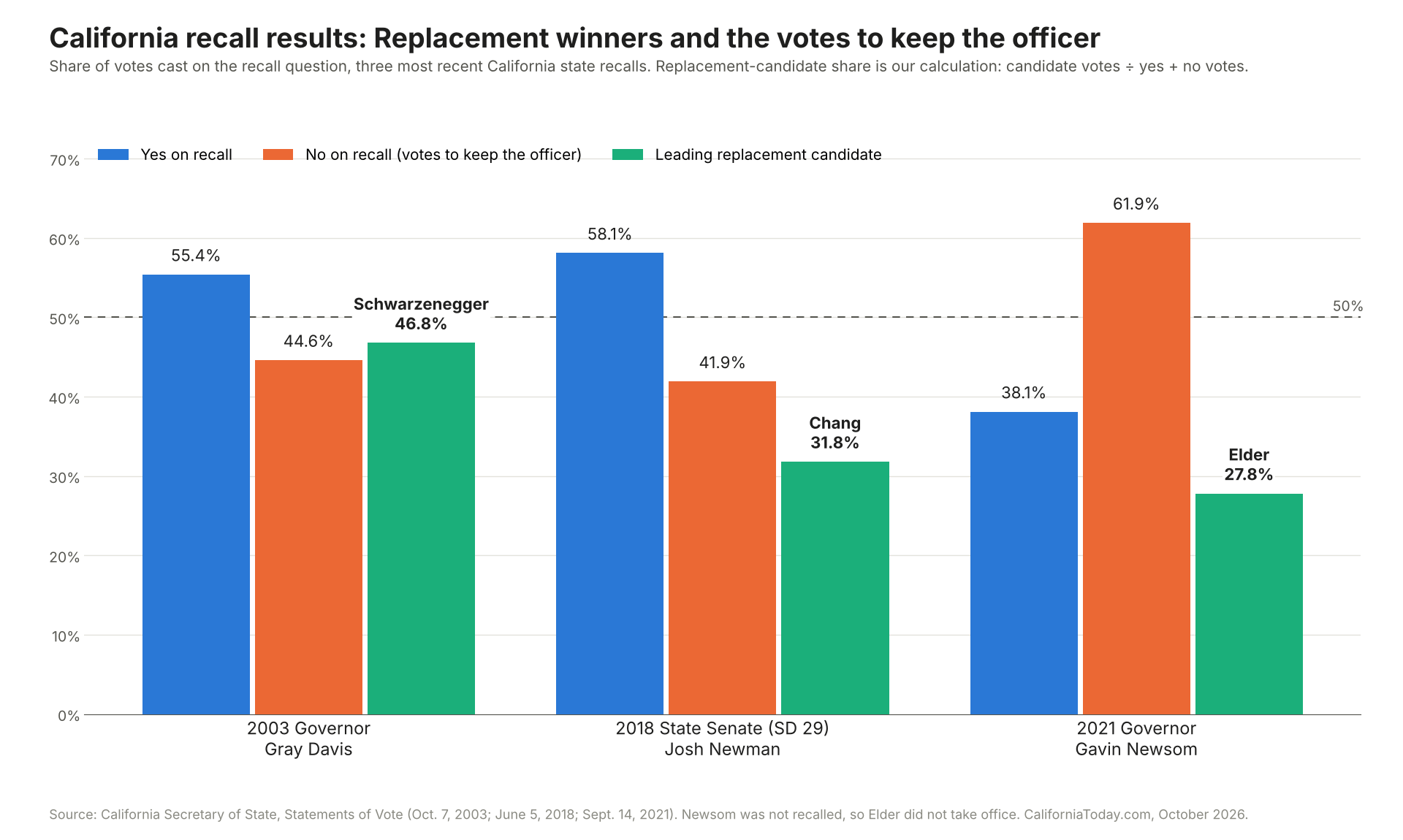
The three most recent recalls show what the replacement question does. In 2003, 55.4% voted to recall Davis, and Arnold Schwarzenegger won the replacement contest with 4,206,284 votes, 48.6% of the votes for a candidate and more than the 4,007,783 cast to keep Davis. In 2018, 58.1% voted to recall Newman in the 29th Senate District, and Republican Ling Ling Chang won the seat with 50,215 votes, 33.8% of the replacement vote and 15,982 fewer than the 66,197 cast for Newman to stay. In 2021, 61.9% voted against recalling Governor Newsom; the leading replacement candidate, Larry Elder, received 3,563,867 votes, which would have made him governor with 27.8% of the votes cast on the recall question had the recall passed. That is the "about 28%" figure in the Yes argument.
California is one of seven states that choose a successor on the same ballot as the recall, according to the National Conference of State Legislatures' survey of the 19 states that allow recall of state officials. Five others hold a separate special election and eight fill the vacancy by appointment, with some states mixing methods by office. Other reform ideas have taken different routes: the state's Little Hoover Commission recommended in 2022 a "snap" election in which "the targeted official is placed on the ballot with all potential replacements," plus a statewide signature threshold of 10% of registered voters. Prop 5 adopts neither.
Prop 5's cost: Savings or costs "in the range of millions of dollars," depending on the recall
The LAO's fiscal estimate is "unknown," because it depends on how often recalls happen and which offices they target. Removing the second question would save money on ballots and voter materials when no follow-up election is needed, which is the case for a governor recalled late in a term and for offices filled by appointment. A legislative recall would cost more if the follow-up special election "could not be consolidated with a scheduled election," at "millions of dollars per election." The LAO puts the net effect at "savings or costs potentially in the range of millions of dollars," less than 0.1% of the General Fund.
For scale, the Department of Finance's July 1, 2021 letter estimated $243.6 million for counties and $32.4 million for the Secretary of State, $276 million in all, of which the Legislature appropriated $250.2 million; the same letter estimated $90.6 million if the recall had been consolidated with a regular election. Prop 5 does not change the cost of the recall election itself, only of what follows it.
Proposition 5's author and the vote in the Legislature
Newman, a Fullerton Democrat, introduced SCA 1 in January 2023. It passed the Senate 31–7 on February 1, 2024 and, after amendment, the Assembly 59–17 on August 30, 2024; the Senate concurred 32–8 the next day, and it was filed with the Secretary of State on September 10, 2024, directed to this November's ballot. Constitutional amendments need two-thirds of each house. The Chronicle's editorial board notes that Newman was recalled in 2018, won the seat back in 2020 and lost again in 2024. Of the 2018 recall, which his opponents tie to his vote to raise gas taxes, he told CalMatters: "I didn't do anything other than cast a tough vote."
Nobody is spending money on the measure. The Secretary of State's contribution page for Prop 5 reports "No committees identified" on either side as of October 6, and no Prop 5 committee appears on the FPPC's top-contributor list, which covers committees that have raised $1 million. The Yes campaign's website is paid for by Californians For a Prosperous Golden State, the committee listed with Newman as the ballot contact. No opposition contact is listed in the Voter Information Guide.
The arguments: Majority rule versus the voters' pick
The Yes argument, signed by the League of Women Voters of California, California Common Cause and former FPPC chair Dan Schnur, says the two questions together create "a dangerous loophole": "An elected official can be removed by a narrow majority. Then, a candidate listed in question #2 can win the office with far less than 50% of the votes cast." It cites the 2021 recall's cost as "more than $200 million" and says Prop 5 would stop recalls being used "to 'redo' an election as a political or partisan scheme." The Department of Finance's figures above support the cost claim; the 28% figure matches the Statement of Vote.
The No argument, signed by Senate Minority Leader Brian Jones and Assemblymember Joe Patterson, says Prop 5 "will take away your voice" because "politicians themselves—not voters—would choose who fills the vacancy" in many cases, and other seats "would sit vacant until another costly election." It objects that "that failed politician you just ran out the door… they'd be allowed to run in that next election," and its rebuttal says the author wants to change the rules after being recalled "when he raised taxes after breaking campaign promises." Carl DeMaio, the Prop 39 proponent, told CalMatters voters could be "without a representative for months, if not longer." Under the Elections Code, a legislative seat would be vacant for at least 126 days after the governor's proclamation unless the election could be combined with a scheduled one. All ballot arguments carry the guide's note that they "have not been checked for accuracy by any official agency."
Polling and endorsements on Proposition 5
PPIC's September survey of likely voters, reading the ballot title "Changes Recall Election Process for Statewide Officers," found 35% yes, 59% no and 5% undecided, the weakest position of any measure on the ballot. Opposition crossed party lines: Democrats 40% yes to 54% no, Republicans 34% to 64%, independents 28% to 65%. Asked which of the 14 measures interested them most, 1% named Prop 5. No other independent poll has published a Prop 5 result.
The parties split along legislative lines: the California Democratic Party supports Prop 5 and the California Republican Party opposes it. Governor Newsom, the target of the 2021 recall, plans to vote yes, according to the San Francisco Chronicle's account of the positions his campaign released on October 9. The editorial boards are divided. McClatchy's California board, writing for the Sacramento Bee and four other papers, endorsed it on September 18 because it "respects the democratic norm of majority rule." The San Francisco Chronicle's board recommended a no vote on October 8: it agreed "the second question is problematic" but called the provision letting recalled officials run again "a completely unnecessary provision" and "reason enough for voters to reject this measure."
Proposition 5 after November 3: A one-question recall from mid-December or the 1994 rule
If Prop 5 passes, it takes effect under Article XVIII, section 4 on the fifth day after the Secretary of State files the statement of the vote, which is due December 11. Any state recall after that would ask a single question, and the Elections Code sections that still describe a successor contest, such as section 11385, would sit under an amended Constitution that no longer provides for one. If it fails, state recalls keep the two-question ballot and plurality winner that section 15 has required since 1994, while local recalls continue under the one-question rule in place since 2023. Either way, the signature thresholds that decide how often Californians face a recall are not on this ballot.
This article reflects the Voter Information Guide as published, Secretary of State and FPPC campaign-finance data as of October 6, 2026, endorsements as of October 12, 2026, and polling fielded through September 10, 2026.
What to Read Next:
 Mac Douglass | Editor
 Mac Douglass | Editor
 Mac Douglass | Editor