

California's 2026-27 budget is balanced, but it defers the deepest Medi-Cal cuts until Newsom leaves office
California enacted a balanced $351.7 billion budget with no deficit projected for two years, largely by scheduling its deepest Medi-Cal cuts for July 2027, after Gavin Newsom leaves office, and by leaning on revenue its own analyst calls fragile.


California enacted a $351.7 billion budget on June 27, and Governor Gavin Newsom signed it with a clear message: the state had balanced its books, with no projected deficit this year or next, while protecting schools, health care, and child care. On the state's own accounting, that claim holds. The 2026-27 general fund is balanced, reserves stand at $28.8 billion, and the budget projects a small positive balance for 2027-28 as well.
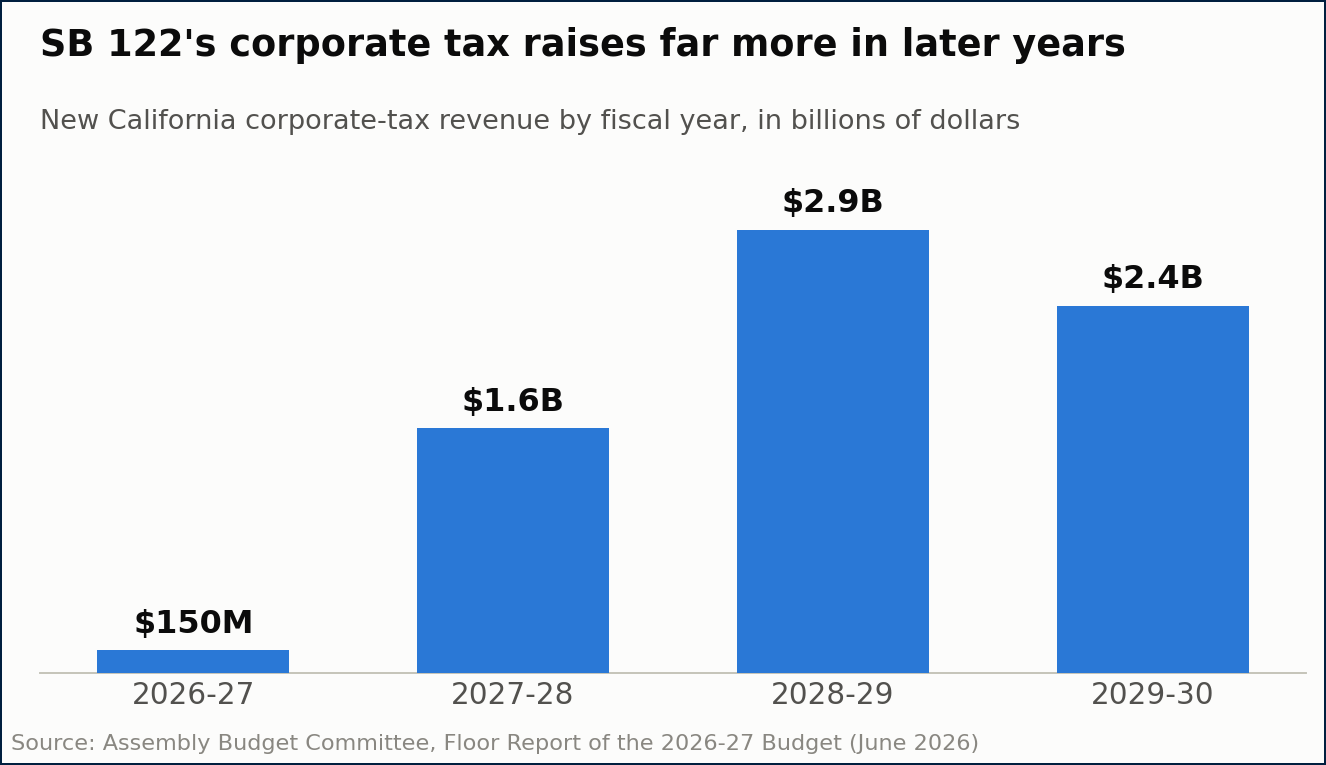
The question worth examining is not whether the budget is balanced, but whether the balance is durable. California reached zero through several moves at once: revenue assumptions more optimistic than its nonpartisan analyst uses, a new corporate tax that raises little now and more later, billions set aside in a holding account, and a set of cuts, most consequentially to Medi-Cal, that are written into law but do not take effect until July 2027, after Newsom leaves office.
The Legislative Analyst's Office, the Legislature's nonpartisan fiscal adviser, has separately warned that the state is in its fourth consecutive year of budget deficits during a period of revenue growth, and that the income taxes now filling the treasury lean heavily on stock-market gains it considers unsustainable.
 Mac Douglass | Editor
Sources & References
- Assembly Budget Committee — Floor Report of the 2026-27 Budget (June 27, 2026)
- Governor's Office — signed balanced budget (June 29, 2026)
- Governor's Office — final budget agreement (June 26, 2026)
- LAO — 2026-27 Fiscal Outlook (Report 5091)
- LAO — Overview of the Governor's Budget (Report 5101)
- Internal: 2026-27 California state budget guide · 2026-27 health budget guide · budget deal news
California runs budget deficits even as its revenue grows:
The strangest feature of California's finances is that the state has faced budget shortfalls for four years running while its revenue has generally been rising. The explanation is structural, and it has more than one part.
Much of California's spending grows automatically. Proposition 98 sets a minimum share of the budget for K-12 schools and community colleges, and Proposition 2 directs money to reserves and debt payments; both rise with revenue, so a good revenue year mechanically raises required spending. Health and human services costs climb on their own trajectory, from $76.2 billion in 2024-25 toward a projected $108.9 billion by 2029-30 in the LAO's outlook. Federal policy changes under H.R. 1 shift additional Medi-Cal and CalFresh costs onto the state. Against that, average annual spending growth of about 5.6 percent outpaces what revenue reliably delivers.
The revenue side is the more fragile half. California leans heavily on a progressive income tax, and the top of that tax depends disproportionately on capital gains, which rise and fall with the stock market. The LAO has been direct that recent income-tax strength is tied to market enthusiasm it does not expect to last, building into its forecast what it called "the strong risk that recent income tax gains are tied to an unsustainable stock market." When those gains are strong, as they have been, the treasury fills; when they reverse, the same volatility works in the other direction, and the automatic spending does not fall to match.
The Medi-Cal cuts California scheduled to begin in July 2027:
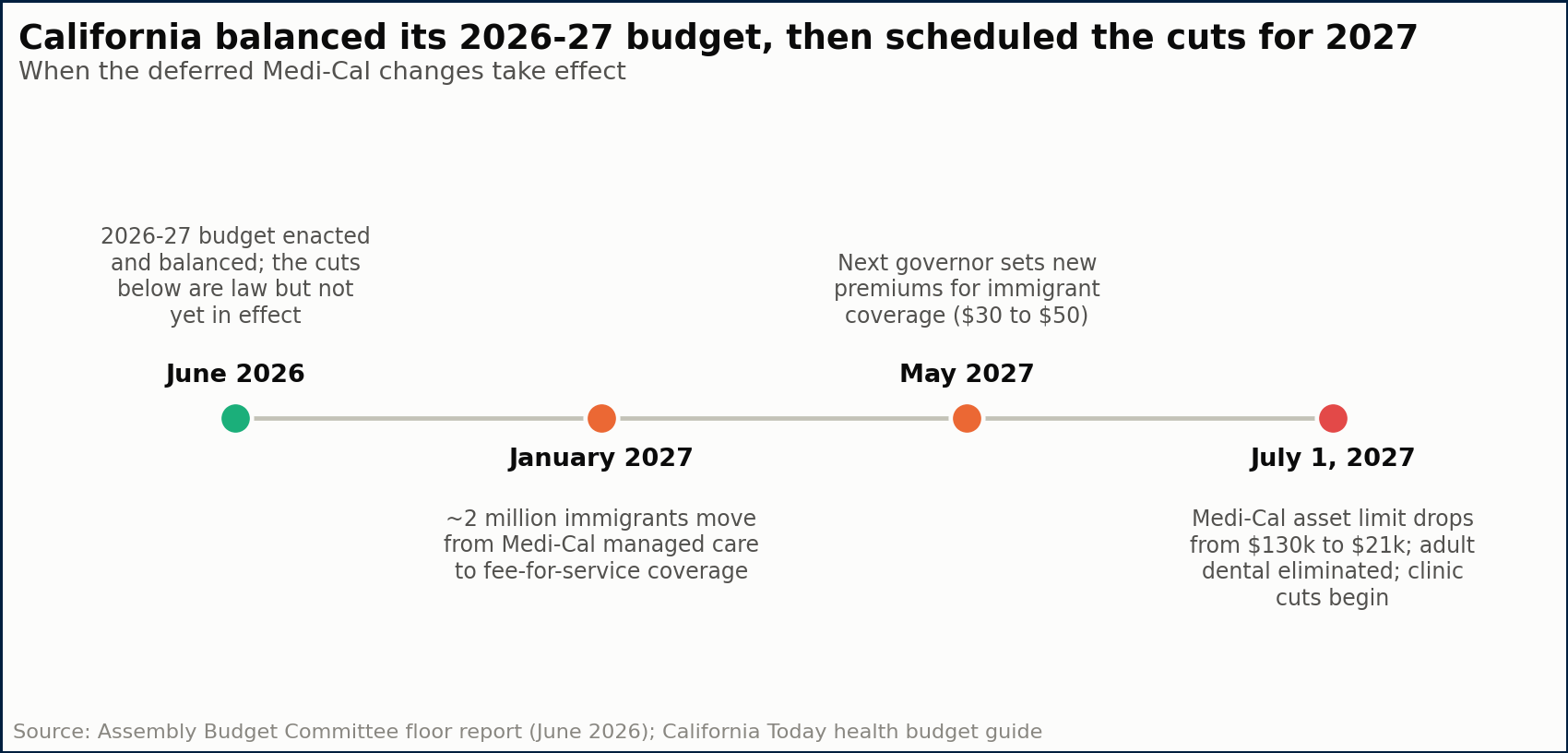
The budget's most consequential deferrals fall on Medi-Cal, and their timing is specific. The reductions are law, but they are dated to begin after the current administration ends.
The clearest example is the Medi-Cal asset limit. Today an individual can qualify while holding up to $130,000 in assets; on July 1, 2027, that limit drops to $21,000. Adult dental benefits are eliminated on the same date, and reduced community-clinic reimbursements take effect then as well, a delay the budget itself accounts for at roughly $1 billion. Earlier, in January 2027, about two million immigrants without legal status move from Medi-Cal managed care to fee-for-service coverage, losing case management and related benefits. A decision on new premiums for that group is left for May 2027, for the next governor to set.
Our health budget guide details each of these changes and their dates. The relevant point for the budget's durability is that a large share of the savings that help balance the books is not realized until a future fiscal year, under a future administration.
The Legislative Analyst says the balanced budget does not fix the deeper problem:
The LAO's assessment is not that the budget fails to balance, but that balancing it does not resolve the underlying imbalance. Reviewing the administration's earlier plan, the office wrote that the Governor "acknowledges these challenges, but proposes no material actions to address either challenge," and it recommended the Legislature identify at least $10 billion in ongoing solutions.
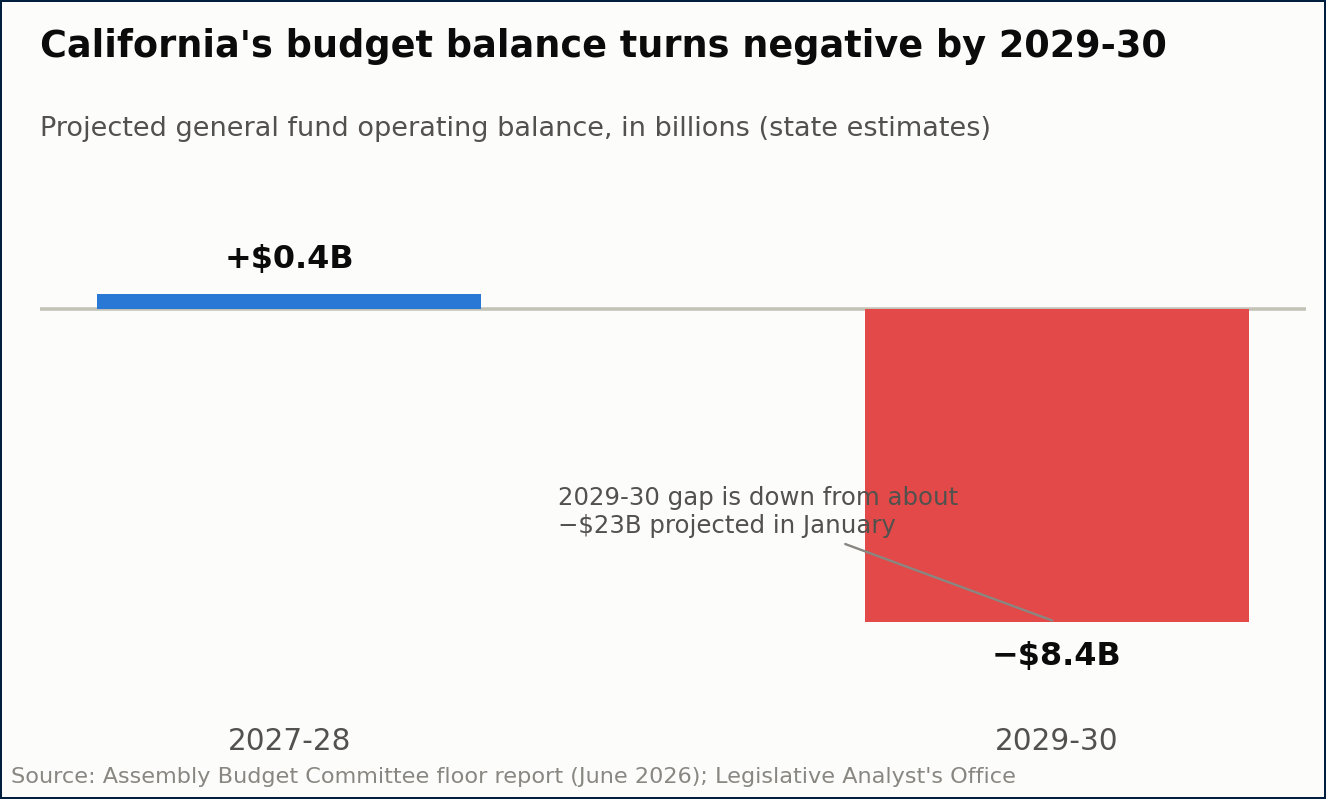
The enacted budget did improve the multiyear picture: the projected 2029-30 operating deficit fell to $8.4 billion, from roughly $23 billion in the January proposal. That is real progress, and it is worth stating plainly. But a gap remains, and the tools used to reach the near-term balance are largely non-recurring. Reserves stand at $28.8 billion, which the LAO notes is about half their peak after the state drew on more than $20 billion in borrowing and one-time solutions across recent years. A budget balanced with temporary measures tends to require another round of measures the next year.
A stock-market downturn would collide with California's deferred cuts:
Because the budget's balance depends on optimistic revenue, the clearest risk is the one the LAO named: a market downturn that pulls down capital-gains taxes. That risk is not hypothetical to the state's forecasters; they built it into their outlook rather than assuming the good years continue.
If those revenues fell, two problems would arrive together. The immediate one is a fresh shortfall in a budget already balanced on higher assumptions. The compounding one is timing: a downturn in 2027 or 2028 would land alongside the Medi-Cal reductions and other deferrals that begin in July 2027, so the state could be absorbing scheduled cuts and a new revenue gap at the same moment. The $28.8 billion in reserves exists precisely to cushion that scenario, and it is a substantial cushion, but it is smaller than it was, and it can be spent only once. None of this is a forecast that a downturn will occur; it is the reason the durability of the balance, rather than the fact of it, is the question that matters.
California's 2026-27 budget leaves the hardest choices to the next governor:
Newsom is termed out, and the budget he signed hands his successor a balanced ledger whose hardest elements activate months into the new term. The Medi-Cal cuts begin in July 2027. The premium decision for immigrant coverage is due in May 2027. The out-year deficit, though reduced, has not closed. Whoever wins the November election inherits both the balanced starting point and the deferred bill behind it.
That is not a verdict on the budget. Protecting school meals, child care, and health coverage through a difficult year is a defensible choice, and doing it without immediate deep cuts is what the administration said it set out to do:
"[Government] has to choose between balancing the books and investing in people," Newsom said, and "California proved that's a false choice."
The measured reading is narrower than either celebration or alarm: the books are balanced, the choice has been postponed rather than avoided, and whether the balance holds will be settled by revenue the state does not control and by decisions the next governor has not yet made. The clearest places to watch are the LAO's next fiscal outlook and the monthly cash reports from the State Controller, which will show whether the revenue the budget counts on is actually arriving.
Figures reflect the enacted 2026-27 budget as summarized in the Legislature's June 27 2026 floor report and the LAO's 2026-27 outlook. Multiyear projections are the state's own and will be revised in the next budget cycle.


