Yes, the "millionaire tax" is back on the California ballot: Proposition 3 would make the 2012 tax rates permanent
Proposition 3 would keep California's top income tax rates of 10.3% to 12.3% after 2030 instead of letting them drop to 9.3%. The brackets, what it means at $500,000 or $5 million, where the $5 billion to $15 billion goes, and who is paying for the campaign.


Proposition 3 would make California's highest income tax rates permanent. Since 2012, California's highest earners have paid 10.3%, 11.3% or 12.3% on the top slices of their income, rates that voters approved as Proposition 30 and extended as Proposition 55. Today those rates start at about $371,000 of taxable income for single filers and about $743,000 for joint filers. Those rates run through the 2030 tax year and then fall back to 9.3%. Prop 3, an initiative constitutional amendment placed on the ballot by petition, deletes the end date; one of its two proponents is the president of the California Teachers Association. It is one of 14 measures in this year's guide, and it leads in both public polls: 58% to 40% in PPIC's September survey and 54% to 34% in UC Berkeley's.
 Mac Douglass | Editor
The stakes are large and lopsided. The Legislative Analyst's Office estimates Prop 3 keeps $5 billion to $15 billion a year in the state budget, collected from the top 2% of taxpayers, who already pay about half of all state income taxes. Supporters frame a yes vote as no tax increase at all; opponents frame it as the "largest permanent state income tax increase in California history." Both descriptions refer to the same rates. This explainer sets out what the text changes, what the rates mean in dollars, where the money goes (the 89% school figure and the LAO's 40% figure are both right, and measure different things), and who is paying for each side.
Proposition 3 deletes the 2030 end date from the Prop 30 tax rates
The text of proposed law amends one section of the Constitution, Article XIII, section 36, which is where Prop 30 put the rates in 2012. The edits are deletions of dates:
- In the two paragraphs that set the higher rates, the words "and before January 1, 2031" are struck, so the rates apply "for any taxable year beginning on or after January 1, 2012" with no end.
- The line in each paragraph that says it "shall become inoperative on December 1, 2031" is struck.
- In the rules for the Education Protection Account, the fund that receives the money, end years such as "2030" and "2030–31" become "thereafter."
The rates themselves are unchanged. In the Constitution they are written in 2012 dollars: 10.3% on single-filer income over $250,000, 11.3% over $300,000 and 12.3% over $500,000, with parallel brackets for heads of household, all "recomputed" each year for inflation under the state's normal indexing. The Franchise Tax Board's 2025 rate schedules put those thresholds at $371,479, $445,771 and $742,953 for single filers; $742,958, $891,542 and $1,485,906 for joint filers; and $505,208, $606,251 and $1,010,417 for heads of household. Prop 3 does not touch the separate 1% tax on taxable income above $1 million that voters added for mental health services, now called the Behavioral Health Services Tax. Together the two make California's top marginal rate 13.3% today. If Prop 3 fails, the top rate in 2031 would be 10.3%.
The measure also includes a conflicting-measures clause: if another measure "that affects the tax rates for personal income" is on the same ballot and gets fewer yes votes, Prop 3 prevails "in their entirety" and the other measure is void. The LAO's notes on potential interactions for Props 40, 41 and 42, the billionaire tax and its two countermeasures, do not mention Prop 3.
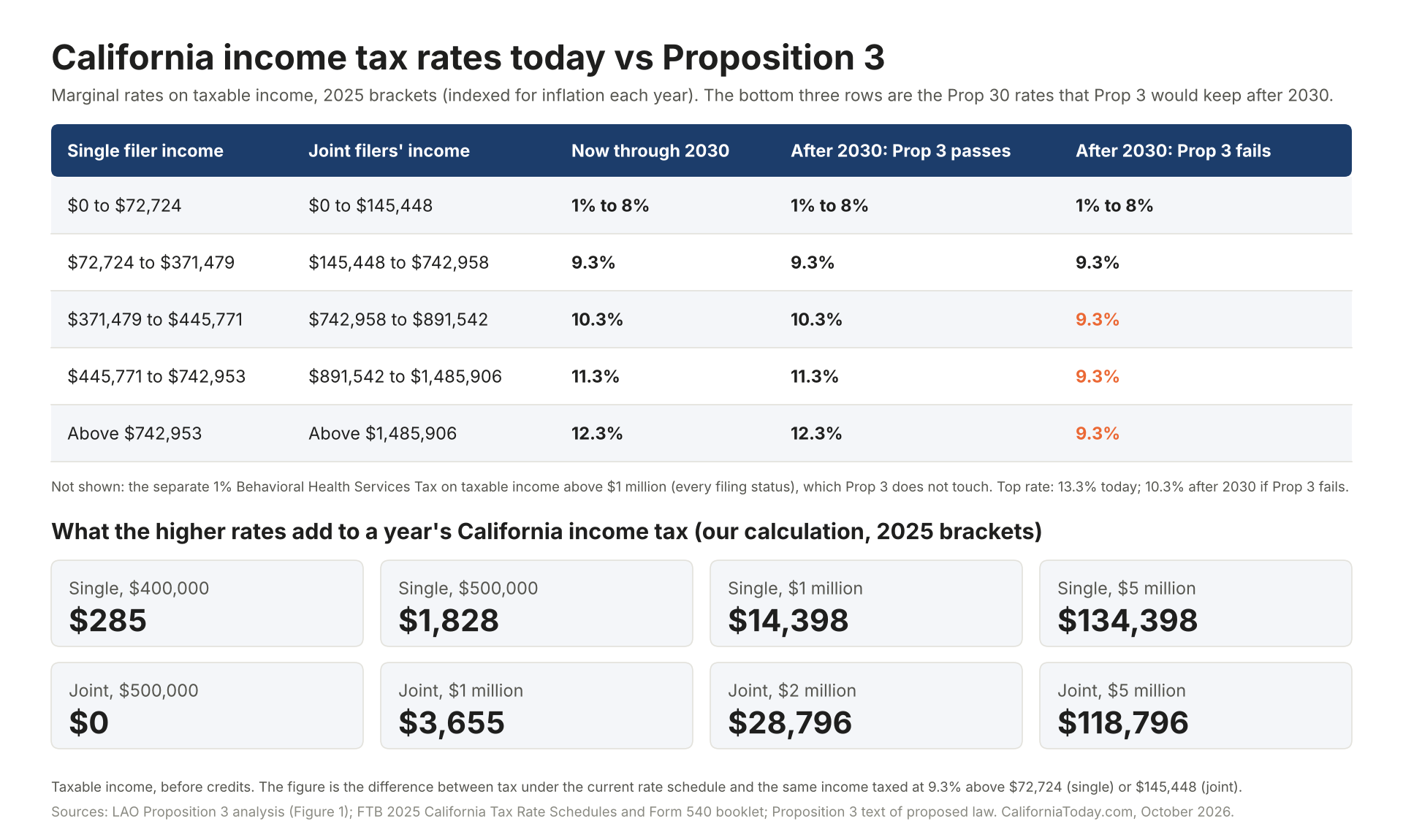
California income tax rates in dollars: $285 at $400,000, $134,398 at $5 million
The higher rates apply only to the slices of income above each threshold, so their effect starts small and grows quickly. Using the 2025 brackets, we calculated what the Prop 30 rates add to a year's state income tax compared with taxing the same income at 9.3% above the 9.3% threshold. A single filer with $400,000 of taxable income pays $285 more. At $500,000 the difference is $1,828; at $1 million, $14,398; at $5 million, $134,398. Joint filers' brackets are twice as wide: a couple with $500,000 pays nothing extra and a couple with $1 million pays $3,655 more, rising to $28,796 at $2 million and $118,796 at $5 million. These are illustrations at 2025 brackets; by 2031 the thresholds will be higher after inflation indexing.
That concentration is why the revenue is large but narrow. The LAO's analysis says the top 2% of taxpayers pay these rates and "pay about half of all state income taxes." Because much of their income comes from investments and capital gains, the yield swings with the stock market: "In a weak year, the proposition might bring in around $5 billion in revenue to the state. In a strong year, the proposition might bring in $15 billion." The state plans about $250 billion in General Fund spending this year, according to the same analysis; our 2026–27 state budget guide covers where it goes.
Prop 3's school money: 89% to K–12 schools, and about 40% of the total in practice
Two official figures about where Prop 3's money goes look contradictory and are both accurate. The Attorney General's summary says the measure "allocates tax revenues 89% to K–12 schools, 11% to community colleges." The LAO says "roughly 40 percent of the funding would go to schools and community colleges" and "the rest would go to other state programs," with part set aside in reserves.
The first figure describes the Education Protection Account. Section 36 sends the revenue there and splits it 89% to school districts, county offices and charter schools and 11% to community college districts, as general-purpose money that local boards spend "in open session" and may not use "for salaries or benefits of administrators or any other administrative costs." Each district must publish an annual accounting online, the account is audited, and the Attorney General or a district attorney can seek "civil or criminal penalties" for misuse.
The second figure describes the net effect on the budget. The same section deems the account's revenue "General Fund revenues" for Proposition 98, the constitutional minimum for school and community college funding. The account's money therefore counts toward that minimum rather than adding on top of it, and the state's other spending on schools adjusts around it. The LAO's October 2025 letter to the Attorney General puts the result at "typically, about 40 percent." The measure's own findings say as much: the revenue goes to schools, and "State funding is freed up to help balance the budget and provide for a Rainy Day Fund."
Prop 30 in 2012, Prop 55 in 2016, Prop 3 in 2026
Prop 30 passed in November 2012 with 7,014,114 votes, 55.4%; it also raised the state sales tax by a quarter cent from 2013 through 2016. Prop 55 passed in November 2016 with 8,594,273 votes, 63.3%, extending the income tax rates, but not the sales tax, through 2030. Prop 3 would be the third vote on the same rates and the first without an expiration date. Its findings say the tax "has raised more than $104 billion for schools and other essential services" and that letting it expire "would result in an immediate reduction to state revenues of over $10 billion"; those are the proponents' figures.
Proposition 3's backers and the $46 million campaign
The proponents of record are Benjamin Gevercer and David B. Goldberg, according to the Attorney General's active-measures list (file 25-0016, title and summary issued November 4, 2025). Goldberg signs the ballot argument as president of the California Teachers Association.
The money is almost entirely on one side. The Secretary of State's contribution page for Prop 3 reports $46,260,006 contributed in support through October 6, across four committees, and $5,500 in opposition, to a committee sponsored by the California Taxpayers Association. The FPPC's top-contributor list, updated October 12, puts support from top contributors at $49.7 million. The main Yes committee's largest donors are the California Teachers Association's issues committee ($33.4 million), the National Education Association ($7.5 million), the California School Employees Association ($2.6 million), the California Federation of Teachers ($1.75 million) and SEIU California ($1.5 million). No opposing committee has reached the list's $1 million threshold.
The arguments: "Not a new tax" versus "temporary" taxes made permanent
The Yes argument, signed by Goldberg, California School Nurses Organization president Katie Nilsson and Planned Parenthood Affiliates of California president Jodi Hicks, says "Proposition 3 is NOT a new tax and does NOT raise taxes on anyone" and that without it "millionaires and billionaires" would get "a massive tax cut at the expense of our classrooms, clinics and communities." It says the 8 million public school and community college students "face billions in cuts" without the revenue, and stresses that the money cannot be spent "on bureaucracy or administrative overhead," which the text supports for the Education Protection Account itself.
The No argument, signed by the presidents of the California Taxpayers Association, the Family Business Association of California and the California Hispanic Chambers of Commerce, says "Politicians told voters higher income taxes would be temporary" and that Prop 3 turns them into "PERMANENTLY higher income taxes." It argues that Californians already pay "the highest income taxes, highest sales taxes and highest gas taxes," that the state "turned a $100 billion budget surplus into a $30 billion budget deficit in just three years," and that "California doesn't have a revenue problem. We have a spending problem." The rebuttal, led by Howard Jarvis Taxpayers Association president Jon Coupal, calls the measure "the largest permanent state income tax increase in California history." The deficit and spending figures are the campaign's; all ballot arguments carry the guide's note that they "have not been checked for accuracy by any official agency."
Polling and endorsements on Proposition 3
PPIC's September survey of likely voters found 58% yes, 40% no and 2% undecided. The split is partisan: Democrats 82% to 16% in favor, Republicans 18% to 80% against, independents 57% to 41% in favor. Voters in households earning $100,000 or more backed it 55% to 43%. Asked which of the 14 measures interested them most, 17% named Prop 3. UC Berkeley's Institute of Governmental Studies poll, fielded September 15–20, found 54% yes, 34% no and 13% undecided, a "solid 20-point lead," in contrast with the 45–42 split it found on the Prop 40 billionaire tax.
The California Democratic Party supports Prop 3 and the California Republican Party opposes it. Governor Newsom plans to vote yes, according to the San Francisco Chronicle's account of the positions his campaign released on October 9. The supporters listed in the Voter Information Guide are the California Teachers Association, the California School Nurses Organization, the California State PTA and Planned Parenthood Affiliates of California; the opponents listed are the California Taxpayers Association, the Family Business Association of California and the California Hispanic Chambers of Commerce.
Proposition 3 after November 3: Permanent rates from 2031, or a return to 9.3%
If Prop 3 passes, it takes effect on the fifth day after the Secretary of State files the statement of the vote, which is due December 11, but nothing changes on anyone's tax bill: the same rates continue, and the difference first shows up in the 2031 tax year, when they would otherwise have ended. Because the rates would sit in the Constitution, changing them would take another statewide vote. If it fails, the rates still apply through the 2030 tax year, and from 2031 the top rate on income below $1 million becomes 9.3%, and the state budget would lose an estimated $5 billion to $15 billion a year.
This article reflects the Voter Information Guide as published, FTB 2025 rate schedules, campaign-finance data as of October 12, 2026 (FPPC) and October 6, 2026 (Secretary of State), party and governor positions as of October 12, 2026, and polling fielded through September 20, 2026.
Sources and References
- Voter Information Guide, Proposition 3—https://voterguide.sos.ca.gov/propositions/3/
- Voter Information Guide, Proposition 3, Official Title and Summary—https://voterguide.sos.ca.gov/propositions/3/title-summary.htm
- Voter Information Guide, Proposition 3, Legislative Analyst's analysis—https://voterguide.sos.ca.gov/propositions/3/analysis.htm
- Voter Information Guide, Proposition 3, arguments and rebuttals—https://voterguide.sos.ca.gov/propositions/3/arguments-rebuttals.htm
- Text of Proposed Laws, Proposition 3 (pp. 109–115)—https://vig.cdn.sos.ca.gov/2026/general/pdf/prop3-text-proposed-laws.pdf
- Legislative Analyst's Office and Department of Finance, fiscal review of initiative 25-0016, October 20, 2025—https://oag.ca.gov/system/files/initiatives/pdfs/fiscal-impact-estimate-report%2825-0016%29.pdf
- Franchise Tax Board, 2025 California Tax Rate Schedules—https://www.ftb.ca.gov/forms/2025/2025-540-tax-rate-schedules.pdf
- Franchise Tax Board, 2025 Form 540 Personal Income Tax Booklet (line 62, Behavioral Health Services Tax)—https://www.ftb.ca.gov/forms/2025/2025-540-booklet.html
- California Secretary of State, Statement of Vote summary, November 6, 2012 (Proposition 30)—https://elections.cdn.sos.ca.gov/sov/2012-general/06-sov-summary.pdf
- California Secretary of State, Statement of Vote summary, November 8, 2016 (Proposition 55)—https://elections.cdn.sos.ca.gov/sov/2016-general/sov/06-sov-summary.pdf
- Office of the Attorney General, Active Measures (file 25-0016)—https://oag.ca.gov/initiatives/active-measures
- California Secretary of State, 2026 Ballot Measure Contribution Totals, Proposition 3 (through October 6, 2026)—https://www.sos.ca.gov/campaign-lobbying/helpful-resources/measure-contributions/2026-ballot-measure-contribution-totals/proposition-3-provides-permanent-funding-schools-and-healthcare-extending-existing-tax-high-incomes-initiative-constitutional-am
- Fair Political Practices Commission, Top 10 Contributors List, November 2026 General Election (last modified October 12, 2026)—https://www.fppc.ca.gov/search-filings/top-10-contributors-list/november-2026-general-election/
- Legislative Analyst's Office, Proposition 40, 41 and 42 analyses (interaction notes)—https://lao.ca.gov/BallotAnalysis/Propositions?date=11%2F3%2F2026
- Public Policy Institute of California, September 2026 likely-voter crosstabs—https://www.ppic.org/wp-content/uploads/crosstabs-likely-voters-0926.pdf
- UC Berkeley Institute of Governmental Studies, Release #2026-20, September 25, 2026—https://escholarship.org/content/qt3w14s99c/qt3w14s99c.pdf
- California Democratic Party, 2026 General Election Endorsements and Ballot Measure Positions—https://cadem.org/wp-content/uploads/2026/08/FINAL-2026-General-Election-Endorsements.pdf
- California Republican Party, 2026 endorsements—https://cagop.org/endorsements/
- San Francisco Chronicle, "Here's how Gavin Newsom is voting on California's propositions" (October 9, 2026)—https://www.sfchronicle.com/politics/article/gavin-newsom-ballot-propositions-22470170.php
- California Today, guide to all 14 November 2026 propositions—https://californiatoday.com/guides/elections/2026-california-propositions-master-guide/
- California Today, "What, exactly, is California's 'billionaire tax'?"—https://californiatoday.com/news/elections/what-exactly-is-the-california-billionaire-tax/
- California Today, 2026–27 California state budget guide—https://californiatoday.com/guides/legal/2026-27-california-state-budget-guide/
What to Read Next:
 Mac Douglass | Editor
 Mac Douglass | Editor
 Mac Douglass | Editor
 Mac Douglass | Editor