


A "King Tide" is the highest tide of the year; here's when and how to see them in California
King tides are the highest tides of the year, when the sun, moon, and Earth align to pull the ocean to its extremes. Here's what causes California's king tides, when the next ones hit San Francisco and San Diego, where to watch them safely, and why they preview future sea level rise.

A king tide is the highest tide of the year—an unusually high high-tide that rolls in a few times each winter when the sun, moon, and Earth line up to maximize their pull on the ocean.
In California, king tides briefly push seawater over seawalls, into parking lots, and across low-lying roads from San Francisco Bay to San Diego. They're harmless on most days, dramatic to watch, and increasingly useful as a real-world preview of where the coastline is headed as the sea rises.
Here's what a king tide actually is, what causes it, when the next ones arrive in California, where to see them safely, and what they reveal about sea level rise.
What Is a King Tide?
"King tide" is a popular, non-scientific term for the highest tides of the year. As NOAA's National Ocean Service explains, it isn't a formal scientific term at all — it's the nickname coastal communities use for the most extreme high tides on the calendar. A king tide also brings the year's lowest low tides, which is why tide pools that are normally underwater suddenly lie exposed.
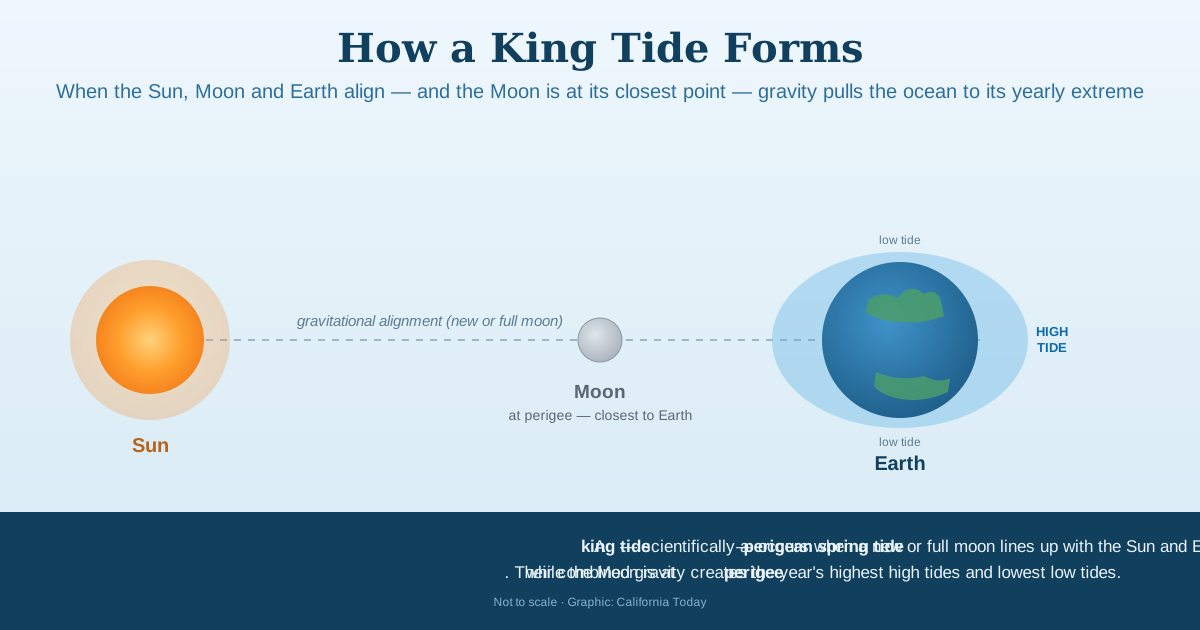
The scientific name for the most common king tide is a perigean spring tide — a term that bundles together the two astronomical events that create it. Understanding those two events explains everything about why king tides happen when they do.
King Tide vs. Spring Tide: What's the Difference?
A spring tide has nothing to do with the season. It's the larger-than-average tide that occurs about twice a month, around every full moon and new moon, when the sun and moon line up and their gravity combines. A king tide is simply the most extreme version of a spring tide — what you get when that twice-monthly alignment also lands at the moment the moon is closest to Earth. In short: every king tide is a spring tide, but only the strongest spring tides of the year earn the "king" label.
What Causes King Tides?
King tides are pure astronomy — predictable years in advance and entirely driven by the positions of the sun and moon. California Sea Grant calls them a "cosmic phenomenon" for good reason: they're the ocean's response to gravitational alignment in the solar system.
Two things have to happen at once. First, the sun, moon, and Earth align (at a full or new moon), so the sun's gravity reinforces the moon's — that's the spring tide. Second, the moon reaches perigee, the point in its monthly orbit when it's closest to Earth and its gravitational pull is strongest. When a new or full moon coincides with perigee, the combined gravitational tug produces a perigean spring tide — the highest tides of the year. According to NOAA, this lineup occurs roughly six to eight times a year, but only a handful produce tides extreme enough to be called king tides.
The Role of the Moon and Perigee
The moon is the main driver of all tides because it's so close to Earth. Its gravity pulls the ocean into a bulge on the side of the planet facing it (and, through inertia, a second bulge on the far side). At perigee, the moon is roughly 30,000 miles closer than at its farthest point — enough to noticeably amplify the bulge. Stack a perigee on top of a sun-moon-Earth alignment and you get the tidal extremes that define a king tide.
Are King Tides Caused by Climate Change?
No. King tides are astronomical and would happen with or without climate change. But the two are connected in an important way: as the baseline sea level rises, the same king tide reaches higher and floods more often. The flooding you see during a king tide today is a preview of what an ordinary high tide may look like decades from now — which is exactly why scientists pay attention to them.
When Are King Tides in California? 2026–27 Dates
California's king tides cluster in late fall and winter, typically across a few days in December and January. The most recent confirmed king tides ran December 4–5, 2025 and January 2–3, 2026, with additional extreme-tide dates of November 6 and December 6, 2025 in Southern California and parts of the north.
The next round is expected in December 2026 and January 2027. Exact dates and peak times are confirmed each fall through the California King Tides Project, and you can look up the precise high-tide time for any beach using NOAA Tides & Currents. Tides stay near their peak for several days on either side of the headline dates, so you don't have to catch the single highest hour to see the effect.
King Tides in San Francisco and the Bay Area
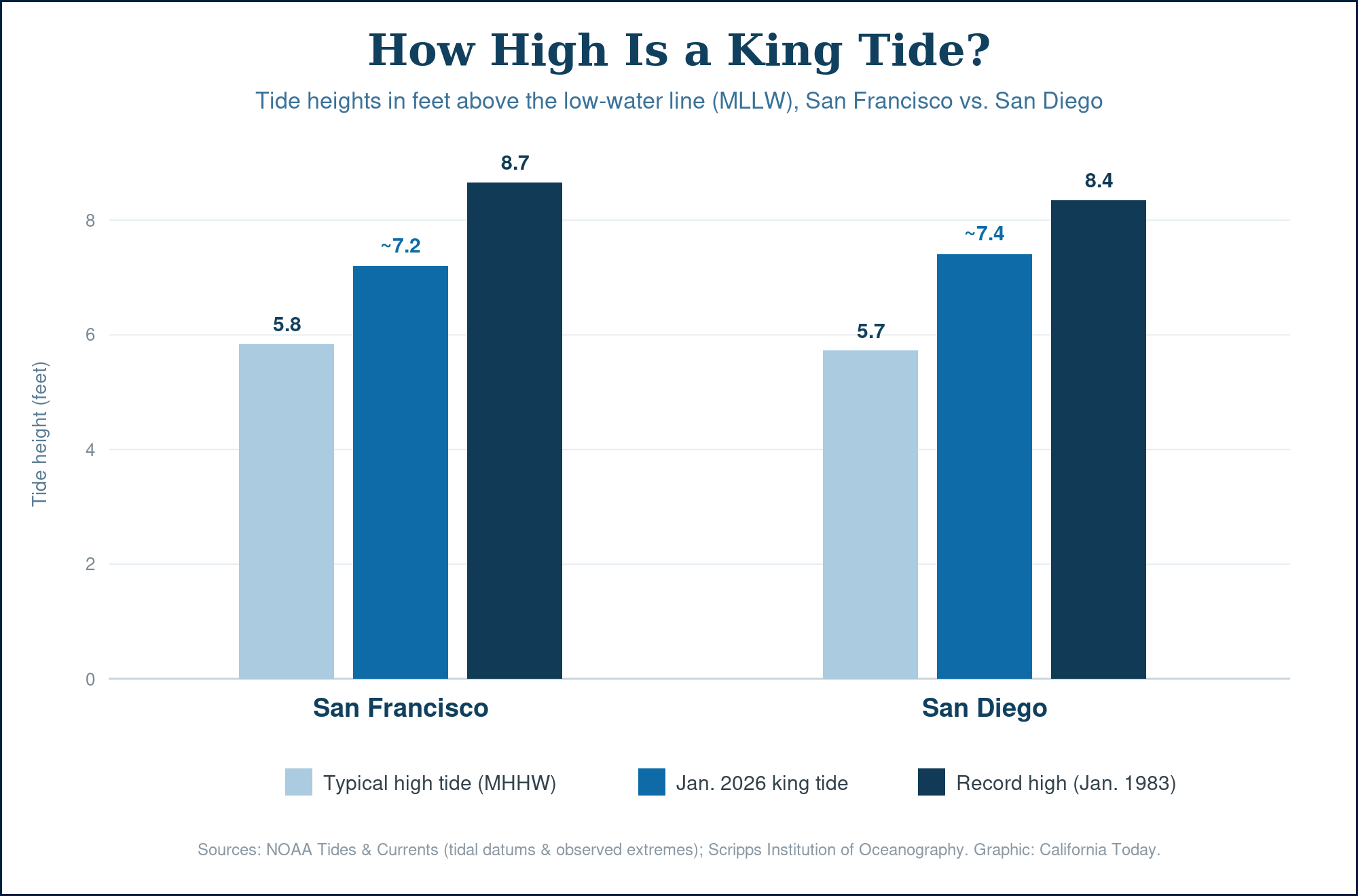
Around San Francisco Bay, the January 2026 king tides peaked near 7.0–7.2 feet, high enough to spill onto the Embarcadero promenade, flood low spots along the waterfront, and surge across Ocean Beach. Other Bay Area hot spots include Mill Valley and the Marin shoreline, the San Mateo bayfront, and the Berkeley and Emeryville marinas — all places where a king tide can briefly turn streets and paths into shallow water.
King Tides in San Diego and Southern California
In San Diego, the January 2–3, 2026 king tides topped out around 7.4 feet, according to tide predictions from the Scripps Institution of Oceanography. Ocean Beach is the area most prone to king-tide flooding, with water reaching the seawall and parking lots, while the bluffs at Sunset Cliffs and La Jolla put on the most dramatic show as waves crash against the rocks below.
Where to See King Tides in California (Safely)
Because a king tide also produces the year's lowest tides, it's two shows in one: towering high water in the morning or evening, and wide-open tide pools at the low. Check a local tide chart for the exact times before you go.
Best Viewing Spots
For high-tide drama in the Bay Area, head to the Embarcadero, Crissy Field, or the Pacifica Pier. In San Diego, Sunset Cliffs and the La Jolla bluffs offer safe, elevated vantage points. For the low-tide spectacle, the exposed reefs and tide pools at Cabrillo National Monument, Point Reyes, and the Fitzgerald Marine Reserve near Half Moon Bay are at their best during a king tide's extreme low.
King Tide Safety: Sneaker Waves and Flooded Roads
A king tide is mostly a slow, quiet flood — but it carries real hazards. Never turn your back on the ocean during high water; king tides raise the risk of sneaker waves that can sweep people off rocks, jetties, and beaches. Don't drive through flooded roadways, where saltwater can hide deep spots and damage your vehicle. And give crumbling bluffs a wide berth, since king tides accelerate the erosion that triggers cliff collapses.
King Tides and Sea Level Rise
The reason agencies track king tides so closely is that they're a free preview of the future. The water level a king tide reaches today is roughly the level that ordinary high tides will reach as the ocean climbs. As the California Ocean Protection Council puts it in its review of recent king tides, these events help communities see—and photograph—which roads, neighborhoods, and infrastructure will be most exposed to chronic flooding in the decades ahead.
The California King Tides Project: Citizen Science You Can Join
That preview is the whole idea behind the California King Tides Project, run by the California Coastal Commission. Anyone can take part: during each king tide, you photograph the shoreline — flooded paths, submerged seawalls, water lapping at familiar landmarks — and upload the images to build a public, statewide record of how high the water gets. Those photos help scientists and planners visualize sea level rise and decide where to focus coastal adaptation. It's one of the easiest ways for the public to contribute real data to climate science with nothing more than a phone.
King Tides FAQ
How often do king tides happen? A few times a year, almost always in the late fall and winter. NOAA notes that new- or full-moon perigees occur six to eight times annually, but only the most extreme — typically a couple of events each winter — are called king tides.
Are king tides dangerous? Usually not, but they raise the risk of sneaker waves, localized flooding, and bluff erosion. Stay back from the water's edge and out of flooded roads.
What is the highest tide of the year called? A king tide, known scientifically as a perigean spring tide.
Can you surf or fish during a king tide? You can, but conditions are unusual — extra water can flatten waves at high tide, while the extreme low exposes reefs and lengthens the paddle out. Time your session for a rising or falling tide rather than the peak.
Learn More About Kings Tides in California:
- NOAA, National Ocean Service — What is a king tide?
- NOAA, National Ocean Service — What is a perigean spring tide?
- California Coastal Commission — California King Tides Project
- California Ocean Protection Council — King Tides in California: What We Saw, What They Mean
- California Sea Grant — King Tides: A Cosmic Phenomenon
- Scripps Institution of Oceanography — Tide predictions and research
- NOAA Tides & Currents — Tide predictions by location


