


California wolf packs jump from nine to 12 in one quarter; CDFW confirms fastest growth on record
California's known wolf packs jumped from nine to 12 in a single quarter, with at least 23 pups born this spring, according to CDFW's latest tracking documents. Here are the current numbers, pack locations, and upcoming changes.

California's gray wolf population just recorded its fastest quarter of growth since wolves returned to the state. The California Department of Fish and Wildlife's latest quarterly report confirms 12 known packs, up from the nine on the department's books at the end of March, after three packs—Interstate, Long Valley, and Whitehorse—were confirmed in a single reporting period.
 Brian Douglass | Specialist
The pack count is one of three numbers that describe the recovery, and they measure different things. CDFW's confirmed floor is a minimum of about 50 wolves, counting only animals the department has individually verified. Our own live wolf map, built on the same CDFW collar data, carries a working estimate near 90 once uncollared animals and this spring's pups are included.
The quarterly report adds the third figure: a minimum of 23 pups born across four packs this season, which means the real population is larger than either count can pin down. All three numbers point the same direction.
California's wolves in 2026 at a glance:
Sources & References
California wolf packs grew from nine to 12 in a single quarter:
Pack confirmations usually arrive one at a time, often a year or more apart. The Shasta Pack, the first in modern California, appeared in 2015; the count reached nine by early 2026. Three confirmations in one quarter—Interstate, Long Valley, and Whitehorse—is the fastest expansion CDFW has recorded, and it reflects the mechanics of wolf recovery: each breeding pack produces pups that disperse, and enough dispersers eventually pair up and hold territory of their own.
One caution keeps the number honest in both directions. The Yowlumni pack in Tulare County, the state's southernmost, may be declared inactive if no wolves are detected in its territory next quarter, which would take the count back to 11 even as the overall population grows. Pack counts measure known, active, territorial groups—not total wolves.
 Brian Douglass | Specialist
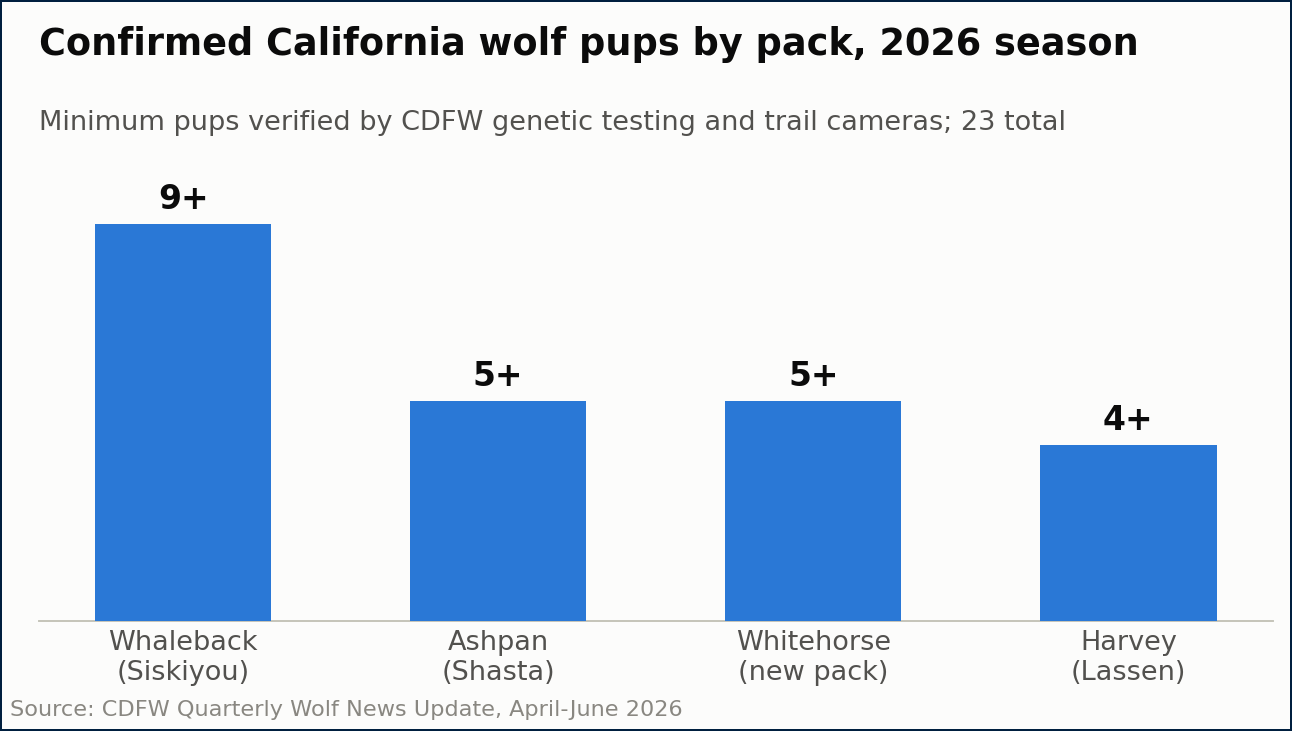
At least 23 wolf pups were born in California this spring:
Four packs produced confirmed litters this season, verified by genetic testing and trail cameras: a minimum of nine pups in the Whaleback pack, five each in the Ashpan and Whitehorse packs, and four in the Harvey pack. Because these counts include only pups CDFW could document, the true number is likely higher—the department treats every figure it publishes as a floor.
The Whitehorse litter is the notable one: a pack confirmed and breeding in the same reporting cycle, which is how quickly a pair of settled dispersers can become an established, reproducing pack.
Where California's 12 wolf packs live:
The recovery remains overwhelmingly a far-northern story. The nine established packs cluster across Siskiyou, Shasta, Lassen, Plumas, and Tehama counties, with a single outlier—Yowlumni—hundreds of miles south in Tulare County. CDFW has not yet published territory details for the three newly confirmed packs; they will be localized in future reports.
| Pack | Territory (counties) | 2026 note |
|---|---|---|
| Whaleback | Siskiyou | 9+ pups this spring |
| Ashpan | Eastern Shasta | 5+ pups |
| Harvey | Lassen | 4+ pups |
| Ice Cave | Shasta, Tehama, Lassen, Plumas | Broadest territory |
| Lassen | Southern Lassen / northern Plumas | Longest-running active pack |
| Diamond | Plumas, Lassen | Established |
| Grizzly | Plumas | Established |
| Tunnison | Central Lassen | Established |
| Yowlumni | Tulare | Southernmost; may be declared inactive next quarter |
| Interstate | Not yet published by CDFW | Newly confirmed Q2 2026 |
| Long Valley | Not yet published by CDFW | Newly confirmed Q2 2026 |
| Whitehorse | Not yet published by CDFW | Newly confirmed Q2 2026; 5+ pups |
Established-pack territories per CDFW's Gray Wolf program page; new-pack territories await CDFW publication. Source: CDFW.
Beyond the packs, collared and uncollared wolves range more widely—recent tracking recorded lone wolves in Modoc, Sierra, Mono, Inyo, and Kern counties. One of those journeys, a collared female's trek down the eastern Sierra to Kern County, is reshaping the map of where California wolves may settle next; we cover the southern expansion in detail in a companion piece. (Link Piece B here at publish.)
Wolf-livestock conflict remains concentrated in the far north:
Growth carries costs, and CDFW's 2026 depredation report keeps the ledger: 108 livestock-loss investigations statewide so far this year, of which 24 were confirmed wolf kills and 17 judged probable. The conflict is geographically narrow—Siskiyou County accounts for 21 of the 41 confirmed-or-probable cases—and the state funds a compensation program that paid producers $107,661 last quarter. Those figures update on a rolling basis and are current as of the department's August 10 report.
What changes next for California's wolf population:
Two administrative notes round out the quarter. As of July 1, CDFW assigns each newly identified wolf a sequential unique ID rather than a pack-based name—a system built for a population too large for the old convention. And the next quarterly report, due around November, will answer the two open questions this one leaves: whether Yowlumni survives on the books, and whether any of this year's dispersers have settled into pack number 13. Wolves remain endangered under the California Endangered Species Act, as they have been since 2014, and CDFW asks the public to file sighting reports—one of the main ways new activity is detected.
All figures are CDFW-documented minimums from the department's August 11, 2026 report package; depredation numbers are as of August 10, 2026 and revise on a rolling basis.


