


California's gray wolves had more pups in 2026 than any year since they returned to the state
California's gray wolves produced at least 42 pups in eight litters in 2026, more than in any year since the first pack formed in 2015. CDFW's October reports also show 10 packs, down from 12, and livestock losses at about half of 2025's pace.

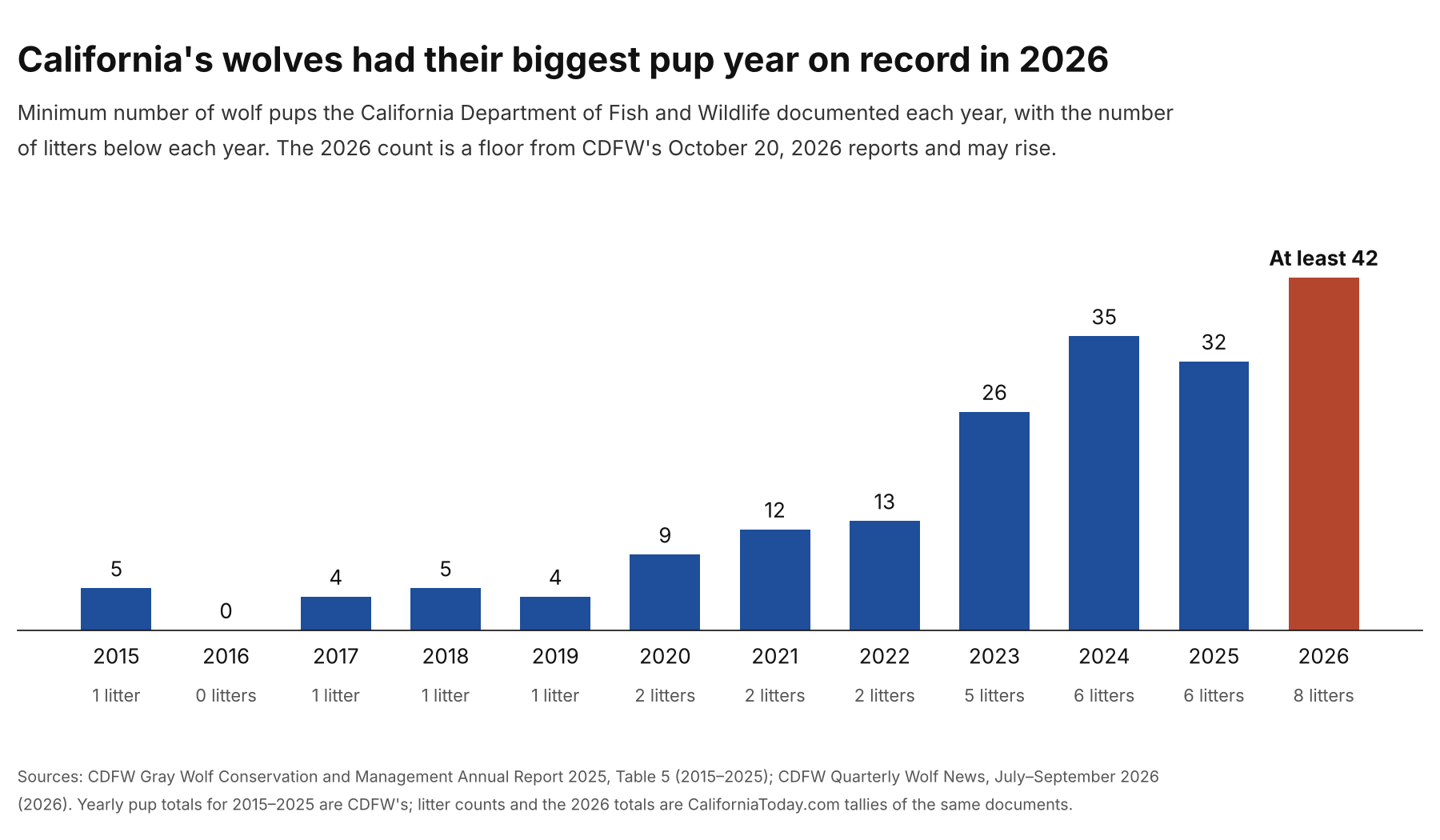
California's gray wolves had their biggest pup year on record in 2026. The California Department of Fish and Wildlife's quarterly wolf report for July through September, which the department posted October 20, documents at least 42 pups in eight litters. Both numbers are the highest since wolves returned to California in 2011.
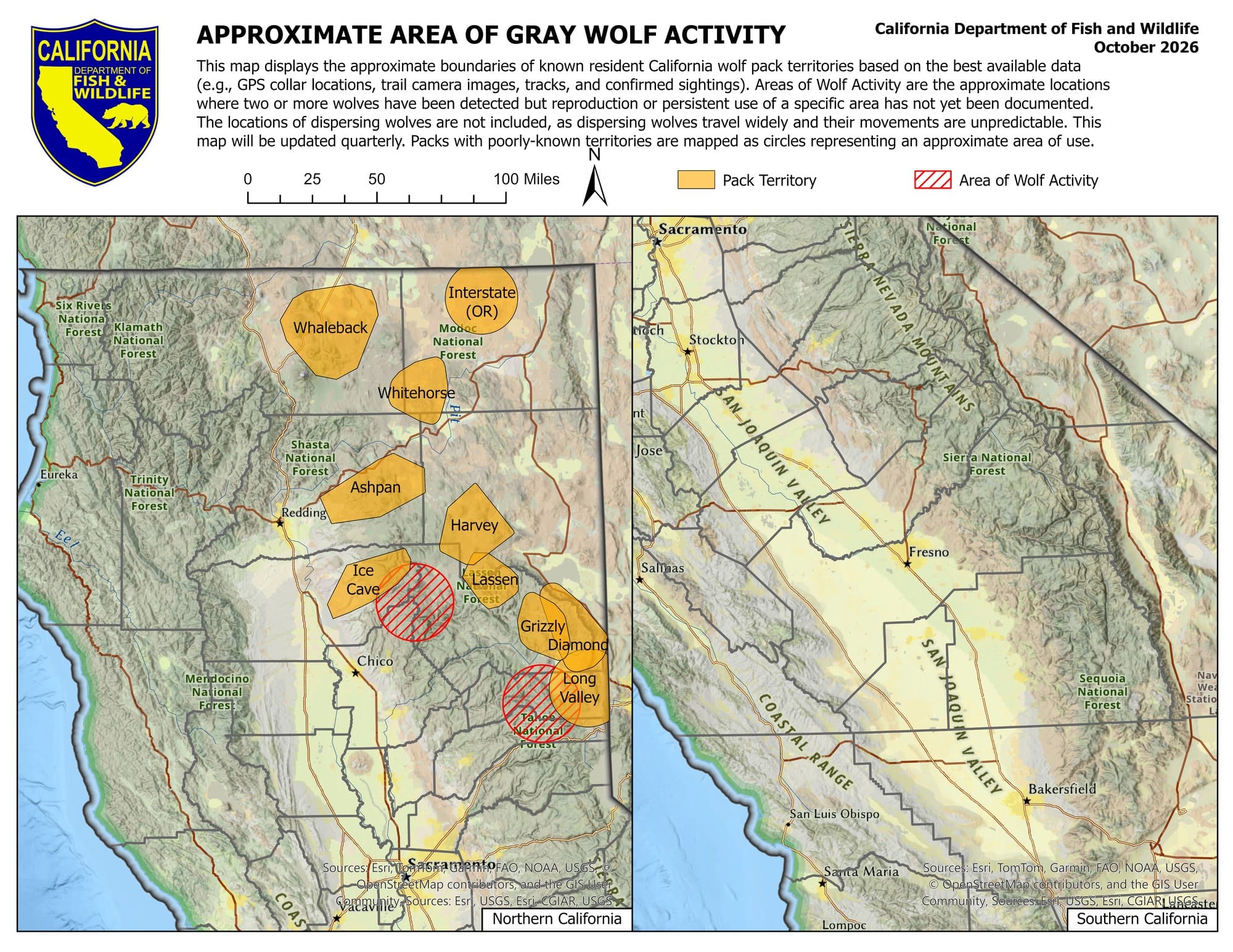
The same reports show fewer packs. CDFW listed 12 in July and lists 10 now. The Tunnison pack merged into a neighboring pack. The Yowlumni pack, the only pack ever established in the southern Sierra Nevada, now sits on the department's list of past wolf packs after a mange outbreak and a string of deaths.
Livestock losses have fallen sharply. CDFW's 2026 depredation report counts 79 animals confirmed or probably killed or injured by wolves from January through late September. That is about half the pace of 2025, when one Sierra Valley pack drove losses to a record before the state removed its adults. This year's conflict sits mostly in one county: Siskiyou.
In August we reported that the pack count had jumped from nine to 12 in a single quarter. The October documents update that picture pack by pack, below. CDFW's satellite collars, which feed our live map of California's gray wolves, were tracking 11 wolves as of October 30.
 Brian Douglass | Specialist
California's gray wolves produced at least 42 pups in eight litters in 2026:
CDFW confirms litters with genetic analysis of scat and hair, trail-camera and game-camera footage, visual observation and tracks. Every figure it reports is a minimum, the number of pups it could document, so the real count is likely higher. The Q3 report gives these 2026 minimums:
- Whaleback pack (eastern Siskiyou County): at least nine pups, by trail camera
- Ashpan pack (eastern Shasta County): at least five, by genetic analysis
- Grizzly pack (southern Plumas County): at least five, by genetic analysis
- Ice Cave pack (Lassen, Plumas, Shasta and Tehama counties): at least five, by trail camera
- Long Valley pack (eastern Sierra County into Plumas and Lassen): at least five, by genetic analysis
- Whitehorse pack (western Modoc and eastern Siskiyou counties): at least five, by genetic analysis
- Harvey pack (southern Lassen and eastern Shasta counties): at least four, by genetic analysis
- Lassen pack (northern Plumas and southern Lassen counties): at least four, by visual observation and tracks
The Diamond and Interstate packs showed no evidence of reproduction.
Together those minimums come to 42 pups. CDFW's 2025 annual report lists every documented litter since the first one in 2015. Its previous high was 35 pups, in 2024, and no earlier year had more than six litters. CDFW has not yet published a statewide total for 2026; that arrives in its next annual report. The first of those reports came out in May 2026.
Three of this year's litters show how packs replace and rebuild themselves. The Harvey litter came from the pack's breeding male and a female from the neighboring Tunnison pack. The Long Valley pack's breeding female, CA101, dispersed from the Beyem Seyo pack in early 2025, months before the state removed that pack's adults. The Whitehorse pack, recognized only in April, produced at least five pups in its first season on CDFW's list.
A pup count is not a population count. Wolf numbers swing through the year, the annual report explains, "due to the birth of pups in spring, followed by the deaths and/or dispersal of some pups and older wolves prior to winter." CDFW therefore measures the population once a year, on December 31, counting only wolves verified alive. At the end of 2025 that minimum was 55 wolves, up 10% from the year before.
The state's wolf conservation plan also tracks breeding pairs, which it defines as "at least one adult female and at least one adult male and at least two pups that survive until December 31." Only three of the nine packs active at the end of 2025 met that test. This year's pups will start showing up in those numbers when the 2026 year-end count is published.
California's wolf pack count fell from 12 to 10 between July and October:
CDFW recognizes a group of wolves as a pack when it detects multiple wolves and evidence of reproduction, or two or more wolves at least four times in the same area within six months. The July edition of California's Known Wolves listed 12 current packs. That was the most CDFW has listed at one time. Its annual report, published in May, had put the record at ten: "A maximum of ten packs have been reported."
Two packs have since dropped off the list, for very different reasons.
The Tunnison pack in central Lassen County ended through a merger. In July, genetic analysis showed that its female, CA055, had bred with the Harvey pack's breeding male and produced at least four pups. She stayed with the Harvey wolves, and the Tunnison male, CA128, a wolf from Oregon's Desolation pack, has not been detected since. CDFW now counts her with the Harvey pack and says the Tunnison pack "is no longer considered active."
The Yowlumni pack in Tulare and Kern counties is gone, for reasons covered in the next section.
The 10 packs that remain all live in seven northeastern counties: Siskiyou, Modoc, Shasta, Lassen, Plumas, Tehama and Sierra. The CDFW program page now lists the same ten.
California's 10 wolf packs in October 2026, with pups, collars and livestock losses:
| Pack | Where it lives | 2026 pups (minimum) | Working GPS collars | 2026 livestock losses |
|---|---|---|---|---|
| Lassen | Northern Plumas and southern Lassen counties | 4 | None | 1 |
| Whaleback | Eastern Siskiyou County | 9 | 4 (CA121, CA127, CA146, CA147) | 38* |
| Harvey | Southern Lassen and eastern Shasta counties | 4 | 2 (CA107, CA150) | 17* |
| Diamond | Eastern Plumas and southern Lassen counties | None recorded | None | 0 |
| Ice Cave | Western Lassen, northern Plumas, eastern Shasta and northern Tehama counties | 5 | None | 2 |
| Ashpan | Eastern Shasta County | 5 | 1 (CA124) | 3 |
| Grizzly | Southern Plumas County | 5 | 1 (CA131) | 5 |
| Interstate | Northern Modoc County, likely crossing into Oregon | None recorded | None | 0 |
| Whitehorse | Western Modoc and eastern Siskiyou counties | 5 | 1 (CA077) | 5 |
| Long Valley | Eastern Sierra, eastern Plumas and southern Lassen counties | 5 | 1 (CA195) | 2 |
| Tunnison | Central Lassen County; no longer active after its breeding female joined the Harvey pack in July 2026 | (counted under Harvey) | None | 5 |
| Yowlumni | Eastern Tulare and northern Kern counties; listed as a past pack in October 2026 | None | None | 0 |
| Packs are listed in the order they were established, as in CDFW's Known Wolves record. Pup counts are CDFW minimums confirmed by genetic analysis, trail cameras or tracks. Livestock losses are confirmed or probable dead or injured animals in CDFW investigations from January 1 through September 29, 2026. *CDFW attributes six April losses in eastern Siskiyou County to the Whaleback and Harvey packs jointly and counts them under both, so the pack figures (plus three losses to dispersing wolves and four to unidentified groups) add to 85 against CDFW's statewide total of 79. Sources: CDFW Quarterly Wolf News, July–September 2026; California's Known Wolves, October 2026; 2026 Wolf-Livestock Depredation Report (October 16, 2026). | ||||
The Yowlumni pack, the southern Sierra's only wolf pack, is no longer active:
CDFW confirmed the Yowlumni pack in eastern Tulare County in July 2023, after sightings and images from the public and from environmental consultants. Its home range covered eastern Tulare and northern Kern counties, including lands of the Tule River Tribe. It was the first pack in the southern Sierra Nevada, "over 200 miles from the nearest known pack in northern California," the annual report notes. The pack raised six pups in 2023 and seven in 2024.
Then the pack got sick. In 2025 CDFW documented sarcoptic mange in a California wolf for the first time. Mange is a highly contagious skin disease caused by a mite, and it is common in the state's coyotes, red foxes and endangered San Joaquin kit foxes. Three Yowlumni wolves that went through necropsy had it. The pack had no pups in 2025, and it shrank from nine wolves in 2024 to four in 2025. "These changes may have been influenced by the outbreak of this naturally occurring disease," the report says. It adds that mange "can result in high mortality, especially in pups and can cause localized population declines."
The deaths are recorded wolf by wolf in CDFW's Known Wolves document. Two collared Yowlumni wolves, CA084 and CA081, died in early 2025, and both deaths remain under investigation. The pack's breeding female, CA079, a direct descendant of OR7, the Oregon wolf whose 2011 arrival began California's recolonization, was found dead in September 2025. CDFW says she "likely succumbed to complications from a mange infection." The last detection of any Yowlumni wolf other than a lone female known as CA091 came in December 2025.
By summer, CDFW was putting the pack on notice. Its April–June report said CA091 had been the only wolf detected in the territory since January, and spelled out what would happen next:
"If additional wolves are not detected during the next quarter, this pack will no longer be considered an active pack."
CDFW Quarterly Wolf News, April–June 2026
None were. In October's Known Wolves document the Yowlumni pack moved to the "Past Wolf Packs" section.
CA091 is still there, alone. She was born into the Beyem Seyo pack in Plumas County, showed up on a CDFW trail camera inside the Yowlumni range in April 2025, and was collared that May. In February 2026 she briefly crossed into Los Angeles County. "She traveled further south in California than any other known contemporary gray wolf," CDFW wrote in its October Known Wolves record. In April and May she crossed into Inyo and Mono counties on the eastern side of the Sierra, then returned to Tulare and Kern. The Q3 report says she "continued to be observed without other wolves." CDFW's wolf location map still placed her in Tulare County on October 30.
CDFW's October activity map, like its July edition, shows no pack territory and no area of wolf activity anywhere on its Southern California panel. With the Yowlumni pack retired, the southern Sierra has no resident wolf pack for the first time since 2023.
Livestock losses to California wolves are running at about half of 2025's pace:
CDFW and its partners investigated 148 suspected wolf attacks on livestock from January 1 through September 29, 2026. They classified 79 animals as confirmed or probable wolf losses, dead or injured, according to the 2026 depredation report. Only confirmed and probable losses qualify for the state's compensation program.
2025 was far worse. The department ran 267 investigations that year and counted 198 animals lost, the highest annual total on record and about three times 2024's 64. The annual report also breaks 2025 down by month. January through September held 82.4% of that year's confirmed or probable losses, about 163 animals by our calculation. A tally of the department's 2025 investigation log by date lands within one animal of that figure. Against that baseline, 2026 is running about half as high.
One pack explains most of the difference. The Beyem Seyo pack in Sierra Valley accounted for 90 of 2025's 198 losses. CDFW set up a 24-hour strike team there in June 2025. USDA Wildlife Services added drone hazing in September, and lethal removal of the adults was approved in late September. Three adults were removed in October, and a juvenile was also killed inadvertently during the operation. It was, the annual report says, "the first lethal removal of wolves in California in recent history." Sierra County, where much of that conflict happened, recorded 56 losses in 2025 and two so far in 2026. Plumas County dropped from 48 to 11.
Siskiyou County went the other way. It recorded 40 of 2026's 79 losses, up from 25 in all of 2025. The rest of this year's total:
- Lassen County: 14
- Plumas County: 11
- Modoc County: 7
- Shasta County: 4
- Sierra County: 2
- Tehama County: 1
By pack, CDFW attributes 38 losses to the Whaleback pack, which raised at least nine pups this year in eastern Siskiyou County. That figure includes six April losses CDFW assigns jointly to the Whaleback and Harvey packs. It is already above Whaleback's totals for 2024 (31) and 2025 (25) and close to its 2023 peak of 39. The Harvey pack follows with 17.
Compensation follows the losses with a lag. CDFW paid livestock producers $179,687.10 in the first quarter of 2026, according to its January–March report, then $107,661.49 in the second and $40,943.55 in the third. That makes $328,292.14 so far this year, against $354,795.47 paid to 38 applicants in all of 2025. In the second quarter CDFW also awarded $1.9 million to the California Bountiful Foundation, two resource conservation districts and Working Circle, which will help provide compensation along with deterrence training and equipment for ranchers. On September 29, Gov. Gavin Newsom signed SB 1135, which will "codify a wolf-livestock coexistence and compensation program," the office of its author, Sen. Catherine Blakespear, said in announcing the signing. The law takes effect January 1, 2027.
New wolves turned up in Lake, Butte and Mono counties in 2026:
The newest detections are the most widely scattered. In August, CDFW detected a single black wolf in northern Lake County, its sex, identity and origin unknown, according to the Q3 report and Known Wolves. Lake County lies in the Coast Ranges north of the Bay Area, across the Sacramento Valley from the northeastern counties where every California pack lives. CDFW lists Lake County among its current survey areas for suspected wolf presence, along with Nevada and Siskiyou counties.
Closer to the established packs, CDFW opened a new area of wolf activity in northern Butte and northwestern Plumas counties, where at least two wolves were detected in August and September. In the central Sierra County area of wolf activity, multiple adults keep turning up in and around Sierra Valley, and two gray wolves were detected between Truckee and Sierra Valley. Earlier in the year, genetic samples placed two young Harvey pack males, CA111 and CA109, in Mono County in March and April.
CDFW defines an area of wolf activity on its map: "Areas of Wolf Activity are the approximate locations where two or more wolves have been detected but reproduction or persistent use of a specific area has not yet been documented." That label is often a pack's first step. Three of today's 10 packs (Interstate, Whitehorse and Long Valley) started out as areas of wolf activity and were recognized as packs in April 2026.
CDFW finds many of these wolves through the public. The department asks anyone who sees a wolf or wolf sign to file a sighting report, with photos if possible.
CDFW's wolf counts are minimums, and its collars cover a small share of the population:
Every number in this article is a floor. CDFW counts the pups, wolves and packs it can document, and it says an unknown number of uncollared dispersers "likely exist in the state at any time."
Collars fill in part of the picture. On October 30, CDFW's public collar map showed 11 collared wolves: 10 in six packs and CA091 in Tulare County. Four packs (Diamond, Ice Cave, Interstate and Lassen) had no working collar, so CDFW tracks them with cameras, genetic samples and field surveys. The collars "do attempt to send location data every morning," CDFW says on its location map page, and the map shows each position as a generalized hexagon rather than an exact point.
CDFW's October documents also note two deaths this year. The Harvey pack's breeding female, CA049, died unexpectedly during a helicopter capture in January. In September, biologists found the skull of CA156, the Ice Cave pack's 2025 breeding male, near a rendezvous site "with no sign of foul play." In 2025 CDFW documented 12 wolf deaths, the most since wolves recolonized the state. Four of those were the Beyem Seyo removals.
One figure on the department's own website is out of date. The FAQ on CDFW's gray wolf page still says "a minimum of 50 wolves are currently known to be in the state." The annual report, published since, puts the year-end 2025 minimum at 55. Neither figure includes this year's pups.
California's gray wolves head into winter with 10 packs and a record pup class:
Wolves breed once a year, in late winter, and give birth in dens in spring. So the next few months decide how many of this year's pups reach the December 31 count and which pairs produce the 2027 litters. CDFW's next quarterly report will cover October through December. The 2026 annual report will carry the year-end population and the official pup tally.
Federal policy could change around the wolves before then. Executive Order 14425, signed September 4, directs the Interior Secretary to "make a determination as to whether the gray wolf and the Mexican wolf have met the recovery criteria for delisting or downlisting" within 90 days, which is December 3. If the Secretary finds those criteria met, the order directs White House staff to encourage states "to delist gray wolves and Mexican wolves from any State-specific lists of protected species." Gray wolves in California are listed as endangered under the California Endangered Species Act, which has protected them since 2014, and under the federal Endangered Species Act. A federal decision would not change the state listing on its own. Our guide to California's endangered and threatened animals explains how the state and federal lists work.
For now, killing a wolf in California is a crime under state and federal law. CDFW asks anyone with information about a wolf killing to call CalTIP at 1-888-334-2258.
Status as of October 31, 2026: Pack, pup, map and detection figures are CDFW-documented minimums from the department's report package posted October 20, 2026. Livestock figures come from CDFW's October 16, 2026 depredation report, cover investigations through September 29, and are revised on a rolling basis. The collar count is from CDFW's public location data on October 30, 2026.
What to read next
- Live map: Where California's gray wolves are right now
- California wolf packs jump from nine to 12 in one quarter (August 2026)
- Every animal that's endangered or threatened in California
Sources and References
- California Department of Fish and Wildlife, Quarterly Wolf News Update: July–September 2026 (PDF).
- California Department of Fish and Wildlife, Gray Wolf Updates: October 2026 Wolf News Update (October 20, 2026).
- California Department of Fish and Wildlife, California's Known Wolves: Past and Present, October 2026 (PDF).
- California Department of Fish and Wildlife, California's Known Wolves: Past and Present, July 2026 (PDF).
- California Department of Fish and Wildlife, Approximate Area of Gray Wolf Activity, October 2026 (JPEG).
- California Department of Fish and Wildlife, 2026 Wolf-Livestock Depredation Investigations and Determinations (updated October 16, 2026) (PDF).
- California Department of Fish and Wildlife, 2025 Wolf-Livestock Depredation Investigations and Determinations (updated February 3, 2026) (PDF).
- California Department of Fish and Wildlife, California Gray Wolf Conservation and Management Annual Report 2025 (PDF).
- California Department of Fish and Wildlife, Quarterly Wolf News Update: April–June 2026 (PDF).
- California Department of Fish and Wildlife, Quarterly Wolf News Update: January–March 2026 (PDF).
- California Department of Fish and Wildlife, Gray Wolf program page and FAQ.
- California Department of Fish and Wildlife, Locations of Gray Wolves in California (Wolf Location Map).
- California Department of Fish and Wildlife, Gray Wolf Sighting Report.
- Office of Sen. Catherine S. Blakespear, "Governor Signs Legislation Creating Wildlife Coexistence Program" (September 29, 2026).
- Executive Order 14425, "Supporting America's Ranchers," 91 Fed. Reg. 57765 (September 10, 2026) (PDF).


