2026 California Prop 43 guide: Local tax measures proposed by voters would need a two-thirds vote to pass
Proposition 43 would require two-thirds approval for local special taxes residents place on the ballot by petition, starting in 2027. It replaces a broader Howard Jarvis initiative that would have voided existing taxes. Here is what it changes, what it costs and who is funding each side.


Proposition 43 would require a two-thirds vote to pass any local special tax that residents place on the ballot by petition, the same threshold that already applies when a city council, county board or special district proposes one. A special tax is one whose money is dedicated to a specific purpose, such as fire protection, parks, housing or schools. Since a series of court rulings that began in 2017, voter-proposed special taxes have needed only a simple majority. Prop 43 would end that for measures approved from January 1, 2027, and it leaves every tax already on the books in place.
 Mac Douglass | Editor
Prop 43 is a legislative constitutional amendment (ACA 22) that the Legislature placed on the ballot on June 25 as part of a deal with the Howard Jarvis Taxpayers Association, which withdrew a broader initiative the same day. It is one of 14 measures in this year's guide, and it trails in both public polls that have tested it: 43% yes and 51% no in PPIC's September survey, and 31% yes, 40% no in UC Berkeley's Institute of Governmental Studies poll. This explainer covers what the text does, the court rulings it responds to, the taxes that passed under the majority rule, the deal that produced it, what the Legislative Analyst's Office says it costs, and who is paying for each side.
Proposition 43 would require a two-thirds vote for voter-proposed local special taxes:
The text of the measure adds a single section, 4.5, to Article XIII A of the California Constitution, the article voters created with Proposition 13 in 1978. Its first subdivision reads: "Beginning on January 1, 2027, and notwithstanding Article II and Article XI, no local government, including the electorate of a local government exercising the initiative power, may impose, extend, or increase any special tax" unless it is "submitted to the electorate and approved by a two-thirds vote."
Three parts of that sentence do the work:
- "Including the electorate … exercising the initiative power." These words bring residents who propose a tax by petition under the same rule as the officials who govern them. Article II is the article that grants the initiative power, and the "notwithstanding" clause sets it aside for this purpose.
- "Impose, extend, or increase." The rule covers new taxes, higher rates and renewals. A voter-proposed special tax that passed by majority before 2027 keeps running, but extending it past its end date or raising its rate would need two-thirds.
- "Special tax." The measure borrows its definitions from Article XIII C, the article added by Proposition 218 in 1996: a special tax is one "imposed for specific purposes," and a "local government" is any county, city, city and county, including a charter city or county, any special district, or any other local or regional governmental entity. General taxes, whose money can be spent on anything, still pass by majority no matter who proposes them.
A second subdivision states that no local government, "including the electorate of a local government exercising the initiative power, may impose ad valorem taxes on real property," except the property tax Article XIII D already allows. The Legislative Analyst's Office does not discuss this clause as a separate change, and neither ballot argument mentions it.
The Attorney General's summary puts the timing plainly: the measure "applies to voter-proposed ballot measures approved after January 1, 2027." Local tax measures on the November 3 ballot are still decided under the current rules.
California's local special taxes follow two vote thresholds today, depending on who proposes them:
Under the State Constitution, a special tax that a local government places on the ballot needs two-thirds of the vote. That rule dates to Proposition 13 and was restated in Proposition 218. For decades it was widely assumed to apply to every special tax. The Legislative Analyst's Office describes the change in one line: "recent court decisions have allowed special taxes that are proposed by voters to be approved with a majority vote."
The first of those decisions was not about the vote threshold at all. In California Cannabis Coalition v. City of Upland (August 28, 2017), the California Supreme Court considered a local initiative that would have allowed three medical marijuana dispensaries in Upland and charged each $75,000 a year. The court held that Proposition 218's requirement to hold general-tax elections at a regularly scheduled general election "applies only to local governments and not to the electorate's initiative power without evidence that such was the intended purpose of the requirement," as a 2018 legislative hearing paper on the case quotes it. The court added a test for future cases: "Without a direct reference in the text of a provision—or a similarly clear, unambiguous indication that it was within the ambit of a provision's purpose to constrain the people's initiative power—we will not construe a provision as imposing such a limitation."
Appellate courts then applied that reasoning to special taxes. In June 2020 the First District Court of Appeal upheld San Francisco's November 2018 Proposition C, a business tax for homelessness services, reading the two-thirds requirements "as coexisting with, not displacing, the people's power to enact initiatives by majority vote." The Fifth District reached the same result for Fresno's parks tax in December 2020. The First District did so again in 2021 for two more San Francisco measures, a June 2018 commercial rent tax for child care and a parcel tax for teacher pay, noting that every appellate court to address the question had agreed. The California Supreme Court declined to review the ruling on the child care tax, which had passed with about 51%, according to the San Francisco City Attorney.
Prop 43 answers that test in its own words. Its text names "the electorate of a local government exercising the initiative power," the kind of "direct reference" the Upland court said a limit on voters would require.
Local special taxes today vs Proposition 43 and the withdrawn initiative:
| Rule | Today | If Proposition 43 passes | Withdrawn initiative #1983 (for comparison) |
|---|---|---|---|
| Special tax placed on the ballot by a city council, board or district | Two-thirds vote | Two-thirds vote (no change) | Two-thirds vote |
| Special tax placed on the ballot by citizen petition | Majority vote, under 2020 and 2021 appellate rulings | Two-thirds vote, for measures from January 1, 2027 | Two-thirds vote |
| General tax (money for any purpose) | Majority vote | Majority vote (no change) | Majority vote |
| Special taxes already passed by majority (Measure ULA, Fresno Measure P and others) | Stay in effect | Stay in effect; any later extension or increase needs two-thirds | Existing property-related special taxes passed below two-thirds voided two years after enactment |
| Charter-city real estate transfer taxes | Allowed at rates each city sets | Not addressed | Banned beyond the statewide documentary transfer tax, including existing ones |
| Legislative Analyst's fiscal estimate | Not applicable | Local tax revenue "could be lower in the future"; amount "unknown" | Annual loss of "up to a couple of billion dollars," mostly in charter cities |
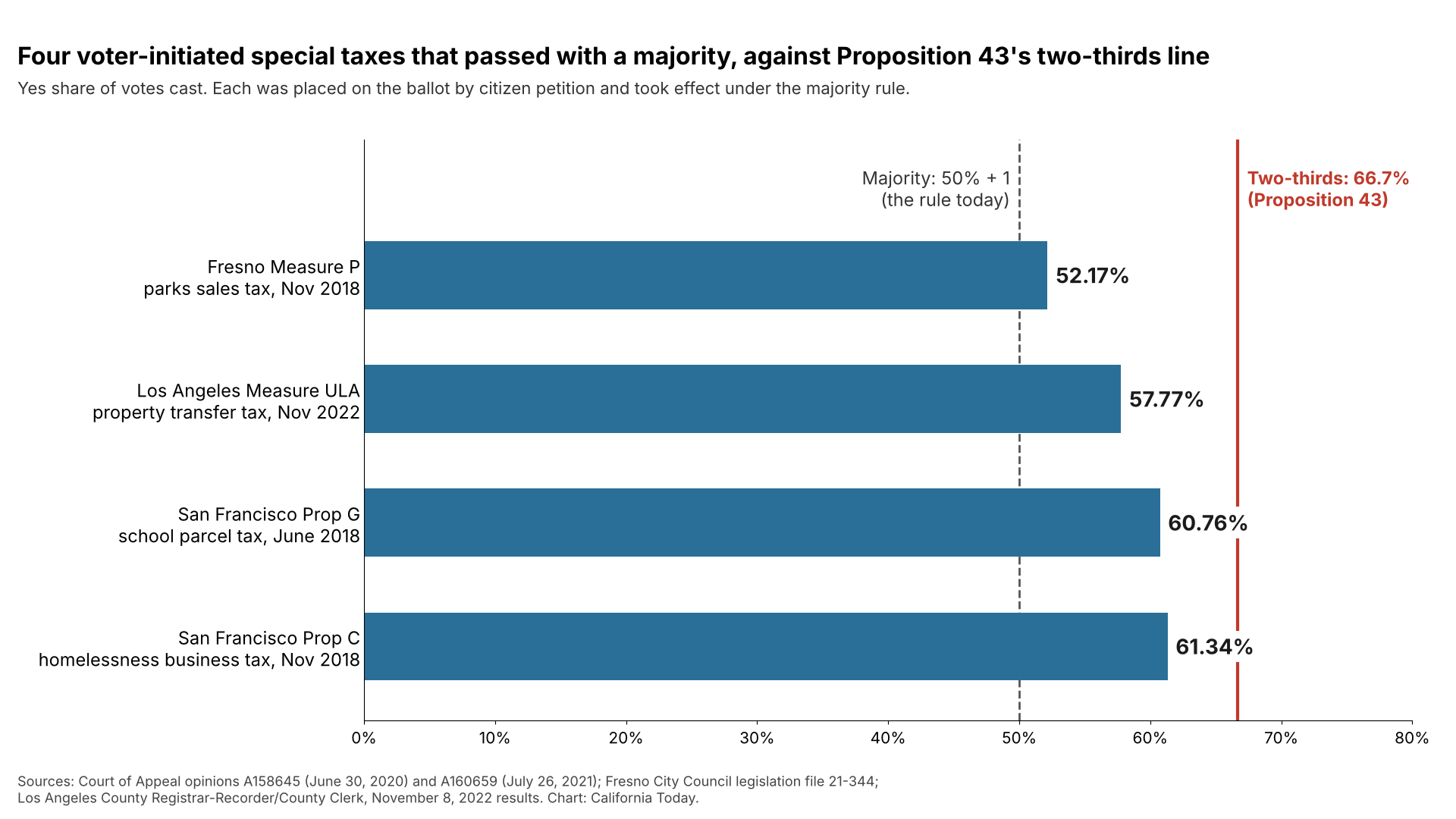
Four voter-initiated special taxes passed with 52% to 61%, all short of two-thirds:
The taxes that passed under the majority rule include some of the largest local revenue measures of the past decade. Four with public records of both their vote share and their citizen-initiative status:
- San Francisco Proposition C (November 2018), a gross receipts tax on large businesses for homelessness services, passed with 61.34% of 351,326 votes, according to the Court of Appeal's opinion.
- San Francisco Proposition G (June 2018), a parcel tax for San Francisco Unified School District teacher pay, passed with 60.76% of 238,133 votes.
- Fresno Measure P (November 2018), a 30-year sales tax for parks estimated at $37.5 million a year, passed with 52.17%. The city first declared it failed for lack of two-thirds and then certified it as passed in February 2021 after the appellate ruling, according to the Fresno City Council's legislative file.
- Los Angeles Measure ULA (November 2022), known as the "mansion tax," adds a 4% tax on sales of real property over $5 million and 5.5% on sales of $10 million or more, "until ended by voters." It passed with 512,808 votes to 374,934, or 57.77%, according to the Los Angeles County Registrar-Recorder. Under a two-thirds rule it would have needed 591,828 yes votes, 79,020 more than it received. The Los Angeles Housing Department says collections began April 1, 2023, with 70% of the money going to affordable housing and 30% to homelessness prevention. CalMatters reported that the thresholds, indexed to inflation, now stand at $5.3 million and $10.6 million and that the city says the tax has raised $1.4 billion.
Other measures followed the same path. CalMatters reports that 62% of Sonoma County voters backed a half-cent sales tax for wildfire response and emergency services in 2024, short of two-thirds. Neither campaign nor the LAO publishes a statewide count of voter-initiated special taxes passed by majority since 2017, so these examples are not a complete list.
None of these taxes would be repealed. Prop 43 applies from 2027 forward. What would change is the next one: a new citizen-proposed parcel tax, sales tax or transfer tax, or a renewal or increase of an existing one, would need two-thirds.
Proposition 43 came from a June 25 deal that replaced a broader Howard Jarvis initiative:
Prop 43 is the narrow survivor of a much larger fight. In 2024 the California Supreme Court unanimously removed the Taxpayer Protection and Government Accountability Act, which would have raised the thresholds for approving local taxes among other changes, from that year's ballot, ruling it an invalid revision of the Constitution rather than an amendment, the law firm Hanson Bridgett reported. The Howard Jarvis Taxpayers Association then qualified a new initiative for 2026, the "Local Taxpayer Protection Act to Save Proposition 13" (initiative #1983, A.G. file 25-0006). Its petition drive was paid for by Protect Prop. 13, a project of the association, according to the Secretary of State's top-funders filing.
That initiative went much further than Prop 43. It would have required two-thirds for voter-proposed special taxes, barred charter cities from imposing real estate transfer taxes beyond the statewide documentary transfer tax, and overturned existing property-related taxes that did not meet those rules two years after passage. The LAO's 2025 analysis estimated an "annual loss of revenues to local governments totaling up to a couple of billion dollars, predominantly affecting certain charter cities." That included about $300 million a year in existing parcel taxes approved with less than two-thirds, and the special-purpose transfer taxes that voters "recently" approved in Los Angeles and Santa Monica. Measure ULA was one of them.
The Legislature had its own measure on the 2026 ballot aimed at that initiative. ACA 13, passed in 2023, would have required any initiative that raises a vote threshold to pass by that same higher threshold, which in practice meant two-thirds for the Howard Jarvis measure.
Both came off the ballot on June 25, the last day an initiative could be withdrawn. The deal was announced by the initiative's proponents, Governor Gavin Newsom and legislative leaders, according to the California Special Districts Association. That day:
- ACA 21 (Resolution Chapter 131) removed ACA 13 from the November ballot, according to the Secretary of State.
- ACA 22 (Resolution Chapter 132), by Assemblymember Buffy Wicks, an Oakland Democrat, was introduced and adopted by both houses without committee hearings, according to the legislative record mirrored on LegiScan. It passed the Assembly 68–2 and the Senate 35–1 and became Prop 43.
- Jon Coupal, the association's president, withdrew initiative #1983 under Elections Code section 9604, according to a Secretary of State memo to county elections officials.
"Today the Legislature voted to make it harder to raise taxes," Coupal said in a joint release with the California Taxpayers Association. Wicks wrote the compromise language and days later said she was "adamantly opposed" to it, CalMatters reported. Her explanation, in a social media post the outlet quoted: "The clock was running out, and we had a choice to make: Leave a retroactive measure on the ballot that threatened billions in local funding, or accept a much narrower constitutional amendment that I still believed was bad policy."
LAO fiscal estimate says local tax revenue could be lower, by an unknown amount:
The LAO's analysis of Prop 43 is short. Because the measure "makes it harder for local governments to pass certain taxes," it says, "local governments' tax revenues could be lower in the future than they otherwise would be. The actual revenue impact is unknown and would depend on future decisions by local governments and voters." The ballot summary of the fiscal effect reads: "Possibility that local government tax revenues will not go up as much in the future due to a higher vote threshold for certain taxes."
The estimate has no dollar figure because Prop 43 touches no existing tax. Its effect depends on how many voter-proposed special taxes would win between 50% and 66.7% of the vote in future elections.
Proposition 43's Yes campaign reports $14.0 million from its top donors and the No side $6.7 million:
The Fair Political Practices Commission's top-contributor list, updated October 14, shows $14.0 million from the ten largest donors to the Yes committee, "Yes on Prop 43 – The Local Taxpayer Protection Act." The California Business Roundtable Issues PAC gave $9.87 million; the FPPC lists Peter Thiel and Kim DeGeorge as its top donors. Protect Prop. 13, the Howard Jarvis project, gave $1.04 million, and the real estate companies Kilroy Realty and Douglas Emmett Properties gave $1 million each.
The No committee, "No on Prop 43: Stop the Local Taxpayer Deception Act," reports $5.6 million from its ten largest donors. The SEIU California State Council gave $1.5 million. The California Teachers Association, two carpenters' councils, two SEIU locals, the Southern California Partnership for Jobs and the California Alliance for Jobs gave $500,000 each. The California Professional Firefighters gave $365,257, and the League of California Cities' CITIPAC gave $250,000. A third committee formed for several measures, Communities for an Affordable California (Yes on 3, No on 39 and 43), adds $1.09 million, which brings the FPPC's opposition total to $6.7 million. The FPPC marks that last figure with an asterisk because, for a committee covering more than one measure, "it is not possible to determine the amount of the contribution that was spent specifically on the campaign for any particular measure."
The Secretary of State's contribution tally, which counts all reported contributions through October 6 rather than the largest donors, shows $10.0 million for the two Yes committees and $8.0 million for the two committees opposing it. The Million Voters Project's committee also opposes Proposition 39 and supports Proposition 3.
The arguments over Proposition 43 pit "closing loopholes" against "minority rule":
The Yes argument, signed by the presidents of the California Taxpayers Association, the Family Business Association of California and the California Hispanic Chambers of Commerce, says "court decisions created loopholes that allow special interests to impose massive new tax increases by circumventing the taxpayer protections voters approved." It says local governments "have imposed over 2,000 new or higher taxes in the past decade" and that "some cities now charge real estate transfer taxes as high as 6%," which on a $900,000 home "would cost a homeowner $54,000 simply for selling their house." The argument does not say how many of those 2,000 taxes were voter-proposed special taxes, the only kind Prop 43 affects. The rebuttal, signed by Coupal and others, calls the Legislature's vote "nearly unanimous" and says it shows "activist courts exceeded voters' intent."
The No argument, signed by the presidents of the California Professional Firefighters and the California School Employees Association and the executive director of SEIU's Nurse Alliance, says Prop 43 "makes it harder for you to fund critical services like police and fire departments, fix and repair local roads, staff our local schools or backfill federal healthcare cuts." Its central objection is arithmetic: the measure lets "just over one-third of voters" block "what nearly 67% want," and "makes their NO vote count twice as much as a YES vote." It says "corporate donors who spend big in elections will benefit most." The No rebuttal adds that Prop 43 "doesn't cut your taxes a penny."
The campaigns' claims go beyond the guide. The No campaign's release of Governor Newsom's statement says communities "would have lost nearly $3 billion a year" if Prop 43 had been law, a figure the LAO does not estimate. The guide notes that ballot arguments "have not been checked for accuracy by any official agency."
Proposition 43 trails in both public polls, and Governor Newsom opposes it:
PPIC's September survey of likely voters, fielded September 4–10, found 43% yes, 51% no and 6% undecided. Republicans support it 61% to 35%. Democrats oppose it 60% to 33%, and independents 51% to 43%. Homeowners split 48% yes to 47% no, while renters oppose it 61% to 33%. Only 1% named it the measure they were most interested in. UC Berkeley's Institute of Governmental Studies, polling September 15–20, found 31% yes and 40% no, with the rest undecided.
Governor Newsom, who took part in announcing the June deal, now opposes the measure. "This dangerous corporate power grab would let big corporations avoid paying their fair share and threaten billions in funding for critical services like 911 response and wildfire prevention. Vote NO on 43," he said in a statement the No campaign released on October 9. Xavier Becerra, the Democratic nominee for governor, announced his opposition on September 9. The California Democratic Party opposes Prop 43, and the California Republican Party supports it.
The Voter Information Guide lists the California Taxpayers Association, the Family Business Association of California and the California Hispanic Chambers of Commerce in support, with the Howard Jarvis Taxpayers Association as the Yes campaign's contact. Opponents listed in the No argument are the California Professional Firefighters, Californians Against Waste, the California Federation of Teachers, the California School Employees Association, Communities for a Better Environment, AAPI Force, the Non-Profit Housing Association of Northern California, the Nurse Alliance of SEIU California and the Sierra Business Council. The Bay Area planning group SPUR recommends a no vote. The editorial boards we found have all recommended against it: the Santa Rosa Press Democrat (October 3), the Santa Barbara Independent (October 7) and the Sacramento Bee.
Proposition 43 after November 3 would mean a two-thirds rule from 2027 or no change to majority rule:
If Prop 43 passes, it takes effect on the fifth day after the Secretary of State certifies the results, which is due December 11, and its two-thirds rule applies to voter-proposed special taxes approved from January 1, 2027. Measure ULA, Fresno's parks tax, San Francisco's Propositions C and G, and every other tax already approved would stay in force, but a renewal or increase of any of them would need two-thirds. Campaigns for new local taxes could still pass a general tax by majority. If it fails, the court-made rule stands: residents who gather signatures can pass a special tax with a simple majority, while councils and boards still need two-thirds. Either way, the broader Howard Jarvis initiative will not be on this ballot. It was withdrawn under the June deal.
This article reflects the Voter Information Guide as published, campaign-finance data as of October 14, 2026 (FPPC) and October 6, 2026 (Secretary of State), party positions as of October 12, 2026, and polling fielded through September 20, 2026.
Sources and References
- Voter Information Guide, Proposition 43—https://voterguide.sos.ca.gov/propositions/43/
- Voter Information Guide, Proposition 43, Official Title and Summary—https://voterguide.sos.ca.gov/propositions/43/title-summary.htm
- Voter Information Guide, Proposition 43, Legislative Analyst's analysis—https://voterguide.sos.ca.gov/propositions/43/analysis.htm
- Voter Information Guide, Proposition 43, arguments and rebuttals—https://voterguide.sos.ca.gov/propositions/43/arguments-rebuttals.htm
- Text of Proposed Laws, Proposition 43 (p. 153)—https://vig.cdn.sos.ca.gov/2026/general/pdf/prop43-text-proposed-laws.pdf
- Voter Information Guide, Proposition 43 (title, summary, analysis and arguments, pp. 66–69)—https://vig.cdn.sos.ca.gov/2026/general/pdf/prop43.pdf
- Legislative Analyst's Office and Department of Finance, fiscal review of A.G. File 25-0006, Amendment #1, August 14, 2025—https://oag.ca.gov/system/files/initiatives/pdfs/fiscal-impact-estimate-report%2825-0006A1%29.pdf
- California Secretary of State, Official Top Funders, initiative #1983 (January 2026)—https://elections.cdn.sos.ca.gov/ballot-measures/top-funders/1983-top-funders-01-05-26.pdf
- California Secretary of State, CC/ROV Memorandum #26167, "Withdrawal of 1983, Related to Taxes" (June 25, 2026)—https://elections.cdn.sos.ca.gov/ccrov/2026/june/26167jh.pdf
- California Secretary of State, Qualified Statewide Ballot Measures (note on ACA 13 and ACA 21)—https://www.sos.ca.gov/elections/ballot-measures/qualified-ballot-measures
- LegiScan, ACA 22 (2025–26), "Local taxes: limitation," history and votes—https://legiscan.com/CA/bill/ACA22/2025
- Senate Governance and Finance Committee, Assembly Local Government Committee and Assembly Revenue and Taxation Committee, "Uproar over Upland: Assessing the California Supreme Court's Decision," joint informational hearing paper (March 7, 2018)—https://arev.assembly.ca.gov/sites/arev.assembly.ca.gov/files/hearings/Jt_Informational_Hearing_ALGC.pdf
- Court of Appeal, First District, City and County of San Francisco v. All Persons Interested in the Matter of Proposition C, A158645 (June 30, 2020)—https://cases.justia.com/california/court-of-appeal/2020-a158645.pdf
- Court of Appeal, First District, City and County of San Francisco v. All Persons Interested in the Matter of Proposition G, A160659 (July 26, 2021)—https://cases.justia.com/california/court-of-appeal/2021-a160659.pdf
- City of Fresno, legislation file 21-344, Measure P certification—https://agendas.fresno.gov/en/legislation/id-21-344-12830
- San Francisco City Attorney, statement on Proposition C (April 28, 2021)—https://sfcityattorney.org/?p=8889
- Los Angeles County Registrar-Recorder/County Clerk, November 8, 2022 General Election results, Measure ULA—https://results.lavote.gov/
- Los Angeles Housing Department, United to House LA (ULA)—https://housing.lacity.gov/ula
- Howard Jarvis Taxpayers Association and California Taxpayers Association, joint release (June 25, 2026)—https://www.hjta.org/press-releases/taxpayers-win-in-sacramento-with-unprecedented-support-for-two-thirds-vote-requirement-to-raise-special-taxes/
- California Special Districts Association, "Legislature cuts deal with vote threshold proponents" (June 29, 2026)—https://www.csda.net/blogs/morgan-leskody/2026/06/29/legislature-cuts-deal-with-vote-threshold-proponen
- Hanson Bridgett, "CA Supreme Court Bars Fall Ballot Measure" (June 20, 2024)—https://www.hansonbridgett.com/publication/240620-4000-ca-supreme-court-bars-fall-ballot-measure
- Fair Political Practices Commission, Top 10 Contributors List, November 2026 General Election (last modified October 14, 2026)—https://www.fppc.ca.gov/search-filings/top-10-contributors-list/november-2026-general-election/
- California Secretary of State, 2026 Ballot Measure Contribution Totals, Proposition 43 (through October 6, 2026)—https://www.sos.ca.gov/campaign-lobbying/helpful-resources/measure-contributions/2026-ballot-measure-contribution-totals/proposition-43-aca-22-wicks-local-taxes-limitation-res-ch-132-2026
- Public Policy Institute of California, September 2026 likely-voter crosstabs—https://www.ppic.org/wp-content/uploads/crosstabs-likely-voters-0926.pdf
- UC Berkeley Institute of Governmental Studies, Release #2026-20 (September 25, 2026)—https://escholarship.org/content/qt3w14s99c/qt3w14s99c.pdf
- No on Prop 43, statement from Governor Gavin Newsom (October 9, 2026)—https://www.noprop43ca.com/news/statement-governor-newsom-announces-opposition-to-proposition-43
- No on Prop 43, statement from Xavier Becerra (September 9, 2026)—https://www.noprop43ca.com/news/becerra-announces-opposition-to-proposition-43
- California Democratic Party, 2026 General Election Endorsements and Ballot Measure Positions—https://cadem.org/wp-content/uploads/2026/08/FINAL-2026-General-Election-Endorsements.pdf
- California Republican Party, 2026 endorsements—https://cagop.org/endorsements/
- SPUR, "California Prop 43: Local Tax Threshold"—https://www.spur.org/voter-guide/2026-11/ca-prop-43-local-tax-threshold
- Santa Rosa Press Democrat editorial board, "Endorsement: Prop. 43 wants to fix a system that isn't broken" (October 3, 2026)—https://www.pressdemocrat.com/2026/10/03/endorsement-prop-43-wants-to-fix-a-system-that-isnt-broken/
- Santa Barbara Independent, endorsements for the November 3, 2026 general election (October 7, 2026)—https://www.independent.com/2026/10/07/the-santa-barbara-independent-endorsements-for-the-general-election-november-3-2026/
- Sacramento Bee editorial board, Proposition 43 endorsement—https://www.sacbee.com/opinion/election-endorsements/article316956235.html
- CalMatters, "Prop. 43 would make special taxes harder to pass. That's the point, say anti-tax advocates" (October 9, 2026)—https://calmatters.org/politics/2026/10/california-prop-43-election-2026/
- California Today, guide to all 14 November 2026 propositions—https://californiatoday.com/guides/elections/2026-california-propositions-master-guide/
- California Today, Proposition 39 explainer—https://californiatoday.com/guides/elections/yes-voter-id-laws-are-on-the-california-ballot-proposition-39s-rules-costs-and-court-fights/
- California Today, Proposition 3 explainer—https://californiatoday.com/guides/elections/what-exactly-is-the-california-millionaire-tax-proposition-3/
What to Read Next:
 Dr. Jennifer Trimpey | Specialist
 Mac Douglass | Editor
 Mac Douglass | Editor
 Mac Douglass | Editor
 Mac Douglass | Editor
 Mac Douglass | Editor