California Prop 44 guide: A 90% spending rule for community health clinics, backed by a union and opposed by the clinics themselves
Proposition 44 would require California’s nonprofit community health clinics to spend at least 90% of their revenue on patient services or pay the shortfall as a penalty. Here is how the ratio works, what it shows for seven large clinics, what the LAO says it costs, and who is funding each side.


Proposition 44 would require California's nonprofit community health clinics to spend at least 90% of their revenue each year on patient services and the work that supports them, or pay the difference to the state as a penalty. The clinics it covers are Federally Qualified Health Centers: the network of safety-net clinics that provide primary, dental and mental health care to low-income and uninsured patients, many of them on Medi-Cal. Prop 44 is an initiative statute placed on the ballot by petition, and its sponsor and sole funder is SEIU United Healthcare Workers West, a health care workers union. It is one of 14 measures in this year's guide, and it trails by 27 points in the only poll that has tested it: 34% yes and 61% no in PPIC's September survey, with nearly identical margins among Democrats, Republicans and independents.
The fight is between a union and the clinics it would regulate. The Legislative Analyst's Office says California's safety-net clinics report spending "an average of about 80 percent" of revenue on health care services, so most would start below the line. Supporters say the rule moves money from executive pay and overhead to patients; opponents, led by the clinics' own trade association, say it would close clinics. This explainer covers what the text requires, how the 90% ratio is calculated, what it shows for seven of the clinics paying to defeat it, what the LAO says it costs, and who is funding each side.
Sources and References
- Voter Information Guide, Proposition 44—https://voterguide.sos.ca.gov/propositions/44/
- Voter Information Guide, Proposition 44, Official Title and Summary—https://voterguide.sos.ca.gov/propositions/44/title-summary.htm
- Voter Information Guide, Proposition 44, Legislative Analyst's analysis—https://voterguide.sos.ca.gov/propositions/44/analysis.htm
- Voter Information Guide, Proposition 44, arguments and rebuttals—https://voterguide.sos.ca.gov/propositions/44/arguments-rebuttals.htm
- Text of Proposed Laws, Proposition 44 (pp. 153–157)—https://vig.cdn.sos.ca.gov/2026/general/pdf/prop44-text-proposed-laws.pdf
- Legislative Analyst's Office, Proposition 44 analysis (November 3, 2026 ballot)—https://lao.ca.gov/ballot/2026/prop44-110326.pdf
- Legislative Analyst's Office and Department of Finance, fiscal review of initiative 25-0008, Amendment #1, September 22, 2025—https://oag.ca.gov/system/files/initiatives/pdfs/fiscal-impact-estimate-report%2825-0008A1%29.pdf
- Office of the Attorney General, Active Measures (file 25-0008A1)—https://oag.ca.gov/initiatives/active-measures
- California Secretary of State, 2026 Ballot Measure Contribution Totals, Proposition 44 (through October 6, 2026)—https://www.sos.ca.gov/campaign-lobbying/helpful-resources/measure-contributions/2026-ballot-measure-contribution-totals/proposition-44-requires-community-health-clinics-spend-90-percent-revenue-program-services-initiative-statute
- Fair Political Practices Commission, Top 10 Contributors List, November 2026 General Election (last modified October 13, 2026)—https://www.fppc.ca.gov/search-filings/top-10-contributors-list/november-2026-general-election/
- AltaMed Health Services Corp., IRS Form 990 for 2024 (ProPublica Nonprofit Explorer)—https://projects.propublica.org/nonprofits/organizations/952810095/202533219349322468/IRS990
- Family Health Centers of San Diego, IRS Form 990 for fiscal 2024–25—https://projects.propublica.org/nonprofits/organizations/952833205/202621339349308577/IRS990
- WellSpace Health, IRS Form 990 for fiscal 2024–25—https://projects.propublica.org/nonprofits/organizations/941713704/202611359349300211/IRS990
- North East Medical Services, IRS Form 990 for 2024—https://projects.propublica.org/nonprofits/organizations/941722562/202523019349302247/IRS990
- North County Health Project (TrueCare), IRS Form 990 for 2024—https://projects.propublica.org/nonprofits/organizations/952847102/202531639349300618/IRS990
- Clinicas de Salud del Pueblo (Innercare), IRS Form 990 for 2024—https://projects.propublica.org/nonprofits/organizations/952657324/202513089349301626/IRS990
- Neighborhood Healthcare, IRS Form 990 for fiscal 2024–25—https://projects.propublica.org/nonprofits/organizations/952796316/202611329349305926/IRS990
- Public Policy Institute of California, September 2026 likely-voter crosstabs—https://www.ppic.org/wp-content/uploads/crosstabs-likely-voters-0926.pdf
- California Democratic Party, 2026 General Election Endorsements and Ballot Measure Positions—https://cadem.org/wp-content/uploads/2026/08/FINAL-2026-General-Election-Endorsements.pdf
- California Republican Party, 2026 endorsements—https://cagop.org/endorsements/
- San Francisco Chronicle, "Here's how Gavin Newsom is voting on California's propositions" (October 9, 2026)—https://www.sfchronicle.com/politics/article/gavin-newsom-ballot-propositions-22470170.php
- San Diego Union-Tribune editorial board, "Vote no on Prop. 44, SEIU bid to shake down community clinics" (August 28, 2026)—https://www.sandiegouniontribune.com/2026/08/28/vote-no-on-prop-44-the-seius-attempt-to-shake-down-community-clinics/
- Orange County Register editorial board, "No on Proposition 44, a cynical attack on community health clinics" (September 8, 2026)—https://www.ocregister.com/2026/09/08/endorsement-no-on-proposition-44-a-cynical-attack-on-community-health-clinics/
- San Francisco Chronicle editorial board, "Prop 44 uses vulnerable patients as cannon fodder" (September 19, 2026)—https://www.sfchronicle.com/opinion/editorials/article/prop-44-california-health-clinic-22433656.php
- Sacramento Bee editorial board, "How Prop. 44 could force California clinics to close"—https://www.sacbee.com/opinion/election-endorsements/article317472706.html
- CalMatters, "The same union supporting a billionaire tax wants voters to limit clinic spending" (October 7, 2026)—https://calmatters.org/health/2026/10/union-billionaire-prop-44-clinic/
- KQED, "Prop 44: Requires Health Clinics to Spend More on Patient Care" (October 8, 2026)—https://kqed.org/news/12102004/prop-44-requires-health-clinics-to-spend-more-on-patient-care
- LegiScan, AB 1113 (2025–26), "Federally qualified health centers: mission spend ratio"—https://legiscan.com/CA/bill/AB1113/2025
- California Today, guide to all 14 November 2026 propositions—https://californiatoday.com/guides/elections/2026-california-propositions-master-guide/
- California Today, "What, exactly, is California's 'billionaire tax'?"—https://californiatoday.com/news/elections/what-exactly-is-the-california-billionaire-tax/
- California Today, 2026–27 California health budget guide—https://californiatoday.com/guides/state-budget/2026-27-california-health-budget-guide-medi-cal-updates-cuts-coverages-and-timelines/
Proposition 44 sets a 90% "Mission Spend Ratio" for nonprofit community health clinics
The text of proposed law introduces a single number, the "Mission Spend Ratio": the total a clinic spends on "activities that accomplish each clinic's exempt purpose" divided by its total revenue. A clinic below 90% owes a penalty.
The measure applies to private nonprofit clinic corporations that are Federally Qualified Health Centers under federal Medicaid law, including "FQHC look-alikes," clinics that meet the federal program's requirements without receiving its grant. It excludes clinics run by federally recognized tribes, tribal organizations and urban Indian organizations. Public clinics, such as those run by counties, are not covered; the LAO describes the rule as applying to "private nonprofit safety net clinics."
The starting figures come from each clinic's federal tax return. The text says spending on the clinic's purpose "will be based on" the "total program service expenses" on line 4e of Part III of IRS Form 990, and revenue on line 12 of Part I, both "as of calendar year 2024." From there the Attorney General may issue "binding guidance" that adjusts both numbers: counting some spending the 990 does not classify as program services, excluding some that it does, and tightening the reporting of payments to "related parties" such as management companies, landlords and affiliated foundations, so that money routed through them cannot inflate the ratio. The Attorney General must publish findings explaining that guidance and can issue it through bulletins rather than formal regulations.
Each clinic files the data with the Attorney General's Registry of Charities and Fundraisers every year. Within 90 days the Attorney General calculates every clinic's ratio, sends it to the clinic and the California Department of Public Health, and posts it online. Clinics pay a new annual fee set to cover the cost of running the program.
The 10% left over must cover administration and any surplus
Because the ratio is measured against revenue rather than spending, the remaining 10% has to absorb two different things: everything the clinic spends outside program services, such as administration, finance, human resources and fundraising, and any money it takes in but does not spend that year. A clinic that runs a surplus to build reserves or save for a new building lowers its ratio by exactly that amount, even if its spending is all on patient care.
That design is deliberate. The measure's findings say some clinics report management and administrative expenses of "30 to 40 percent of total revenue" while others spend under 10%, and that "many clinics are highly profitable, sometimes reporting annual surpluses of as much as 20 percent of total revenue, rather than spending the funds in a manner consistent with their charitable mission." Its stated intent is "a reasonable minimum standard of mission-directed spending as a proportion of total revenue."
What counts as patient care is the contested part. The Yes campaign's rebuttal says qualifying spending "CAN INCLUDE" transportation, interpretation, care coordination, outreach, nurse managers, medical equipment and information technology. The No argument says the measure "restricts clinics from funding mammogram, X-ray and CT machines, information technology and expanding or upgrading clinics." The text settles neither claim; it leaves the line to the Attorney General's guidance. The LAO says the outcome of that guidance is one of two things its cost estimate depends on.
| Rule | Today | Under Proposition 44 |
|---|---|---|
| Spending floor | No minimum share of revenue that must go to patient services | At least 90% of total revenue on “program services” each fiscal year |
| What counts | Clinics classify their own expenses on IRS Form 990 | Form 990 program expenses divided by total revenue, adjusted by binding Attorney General guidance |
| Falling short | No state penalty tied to a spending ratio | Penalty equal to the gap to 90%, paid to the Department of Public Health |
| Getting money back | Not applicable | Refund if the clinic reaches 90% within five years and agrees on a spending plan; otherwise the money goes to clinic workforce programs |
| Public reporting | Form 990 to the IRS and annual reports to the Attorney General’s Registry of Charities | Plus Mission Spend Ratio data; the Attorney General posts each clinic’s ratio within 90 days |
| Relief | Not applicable | One-year waivers for unexpected circumstances or a threat to the clinic’s survival as a going concern |
| Enforcement | Attorney General oversight of charities | Any patient may sue for breach of charitable trust; fines of $5,000, then $10,000 a month, for late reports; jail for knowing misreporting |
| Who is covered | Not applicable | Private nonprofit FQHCs and FQHC look-alikes; tribal and urban Indian clinics excluded |
| Start date | Not applicable | Each clinic’s first full fiscal year beginning at least six months after passage |
Seven clinics funding the No campaign: Mission Spend Ratios from 64.5% to 83.9%
To show what the ratio looks like in practice, we applied the measure's starting formula to the 2024 Form 990s of seven clinics on the No campaign's list of top contributors at the Fair Political Practices Commission. Together they reported $3.28 billion in revenue. On the measure's starting numbers, none reaches 90%: their combined ratio is 77.4%, and the gap to 90% totals $412.5 million.
AltaMed, the No campaign's largest donor and the largest of the seven at $1.72 billion in revenue, spent $1.44 billion on program services, a ratio of 83.9% and a gap of $105.2 million. Family Health Centers of San Diego has the lowest ratio, 64.5%, and the largest gap, $124.6 million. The others: WellSpace Health 77.9% ($20.7 million), TrueCare 73.8% ($21.2 million), North East Medical Services 73.5% ($63.5 million), Neighborhood Healthcare 72.0% ($48.7 million) and Innercare 64.7% ($28.6 million).
The reasons differ, which is why the revenue breakdown matters. Innercare's management and fundraising expenses equal 29.8% of its revenue, the highest of the seven. WellSpace Health spent 93.5% of its total expenses on program services but ran a surplus equal to 16.6% of revenue, so its ratio falls to 77.9%. Family Health Centers of San Diego (16.3%) and Neighborhood Healthcare (14.4%) also ran double-digit surpluses. AltaMed's surplus was 4.0% of revenue.
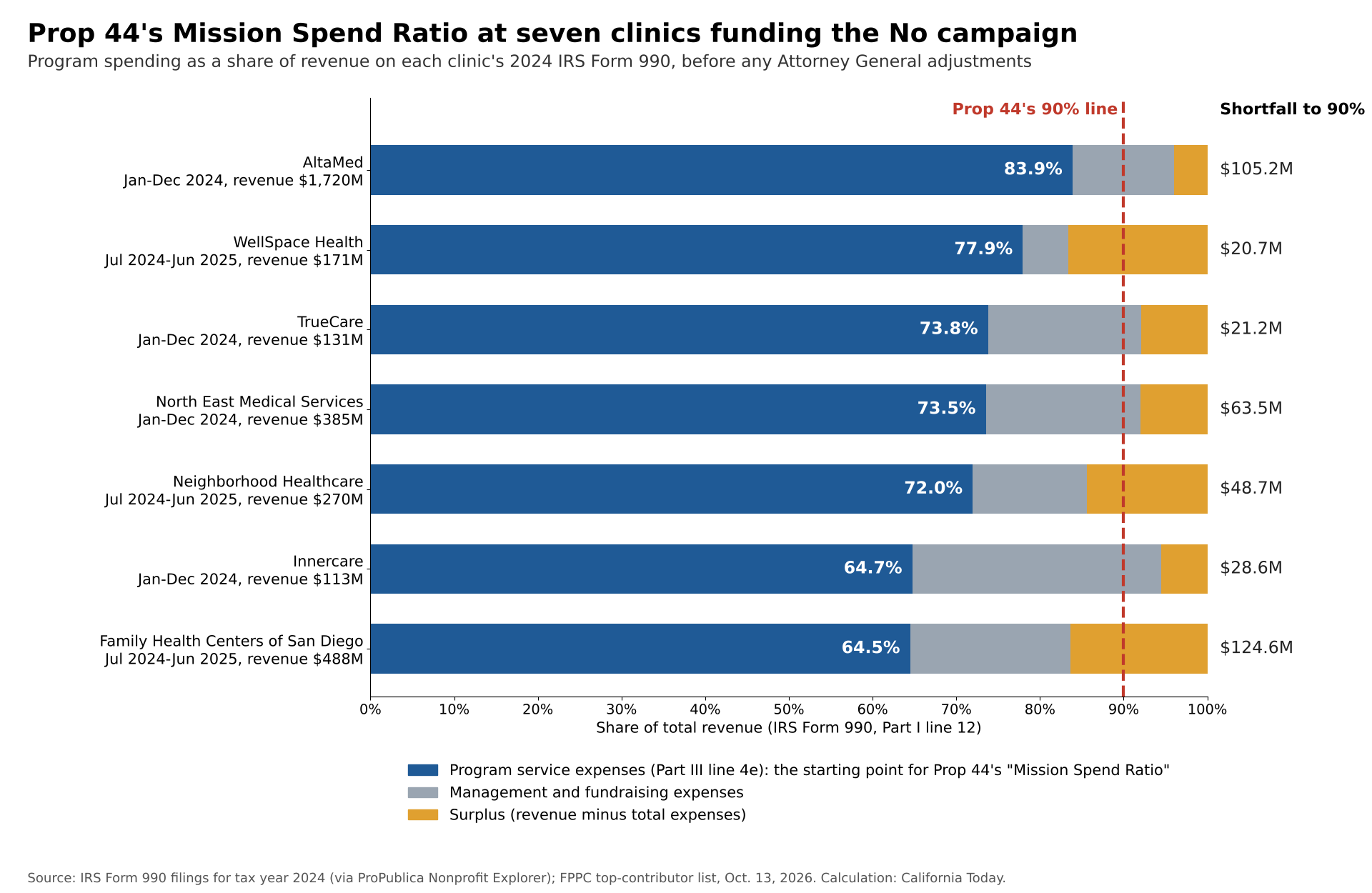
These figures come with limits. They are the measure's starting point, before any guidance from the Attorney General, which could raise or lower every ratio. The seven are large clinics that chose to fund the opposition, not a sample of California's health centers. Three report on a July–June fiscal year, so their "2024" return covers July 2024 through June 2025. And a single year's revenue can include capital grants or investment gains that swell the surplus. The statewide reads come from the LAO: an average of about 80% on health care services, and "most FQHCs spend less than 90 percent," in the words of its September 2025 letter to the Attorney General.
The same filings report executive pay, the Yes campaign's main target. AltaMed's president and chief executive, Castulo de la Rocha, received $1,949,272 in total compensation in 2024, according to the return's Schedule J. North East Medical Services reported $1,950,174 for its president and chief executive, Eddie Chan, $1,054,094 of it retirement and deferred compensation. The chief executives of TrueCare, Neighborhood Healthcare and Innercare reported $667,101 to $729,864.
Proposition 44's penalties: Refundable for five years, then spent on the clinic workforce
A clinic below 90% receives a notice from the Department of Public Health within 30 days of the Attorney General's calculation and must pay a penalty equal to the gap: 90% of its revenue minus what it spent on its mission. It can pay within 30 days or appeal to both agencies and get a hearing.
The money is held in escrow for five years. A clinic gets it back if it reaches 90% and agrees with the department on a plan to spend the refund on mission-directed expenses. Money not reclaimed after five years goes to the Legislature to spend on "clinical worker training, recruitment, and retention." Penalties paid and refunds received are excluded from later ratio calculations so they do not distort them.
The Department of Public Health can grant one-year waivers, renewable, that pause the 90% rule or set a different ratio. A clinic qualifies by showing "unexpected or exceptional circumstances," or by showing that meeting the rule "would raise doubts about the clinic's ability to continue as a going concern," with the department weighing likely closures, lost services and jobs, whether the clinic is small, rural or frontier, and whether a closure would cut access in its region.
Enforcement goes beyond the penalty:
- Reporting fines. A clinic that fails to file owes $5,000 for a first violation and $10,000 for each further month.
- Patient lawsuits. If a clinic fails to report, or falls below 90% without a waiver, "any patient of that FQHC" can sue to remedy a breach of charitable trust. "Good faith" is not a defense, and the business judgment rule that normally protects nonprofit boards does not apply.
- Criminal penalties. A director, officer or agent who knowingly misreports, or routes money through related parties, "with intent to artificially increase their Mission Spend Ratio," faces up to a year in county jail or a term under the state's realignment sentencing law.
The rule starts with each clinic's "first full fiscal year beginning at least 6 months after passage." On our reading of that clause, that is July 1, 2027 for clinics with a July–June fiscal year and January 1, 2028 for calendar-year clinics. The Legislature can amend the law only "to further the purposes of this act."
LAO cost estimate: Low tens of millions a year in enforcement, covered by clinic fees
The LAO's analysis puts state enforcement costs, reviewing financial reports and investigating clinics, "in the low tens of millions of dollars per year," paid by the fees the measure charges clinics. The larger effects are ones it cannot size. They depend, it says, on "(1) how the state Attorney General would define health care-related expenses and (2) whether affected clinics would meet the spending minimum." Clinics that spend more on direct care to comply could raise state Medi-Cal costs, because many of their patients are Medi-Cal members; the analyst's earlier letter notes the state already spends "a few billion dollars annually" on clinic services for them. "Some clinics that could not meet the minimum spending requirement might close instead," which would shift costs to public providers. The letter's summary: the net effect "could range from limited to extensive." Our 2026–27 health budget guide covers the Medi-Cal changes already under way.
The LAO uses two counts that look inconsistent and are not. Its ballot analysis refers to "about 2,000 safety net clinics," most private nonprofits and the rest public. Its 2025 letter counts "over 1,000 FQHCs." The first is every safety-net clinic site; the second is the subset that are federally qualified health centers, which is what Prop 44 covers.
SEIU-UHW sponsors Proposition 44; community clinics are paying to defeat it
The proponents of record are Shawna Brown and Sean Fleming, according to the Attorney General's active-measures list (file 25-0008, title and summary issued October 7, 2025). The Yes campaign's contact in the Voter Information Guide is SEIU-UHW, and Brown signs the ballot argument as "Initiative Proponent" alongside a community clinic worker. A bill with a similar aim, AB 1113, titled "Federally qualified health centers: mission spend ratio," died on January 31, 2026, the deadline for that year's two-year bills to pass their house of origin; CalMatters reported that the union tried "last year" to pass a bill with nearly the same effect. SEIU-UHW is also the sponsor of Prop 40, the billionaire tax.
The two money sources measure different things. The Secretary of State's contribution page reports $10.8 million contributed to the Yes committee through October 6, and $21.6 million to the No committee, which is sponsored by California Primary Care Association Advocates, the clinics' trade group. The FPPC's top-contributor list, updated October 13, shows $16.9 million to the Yes committee, all of it from SEIU-UHW's political issues committee, but marks the figure with an asterisk. The FPPC uses that mark when a contribution went to a committee formed for more than one ballot measure, where "it is not possible to determine the amount of the contribution that was spent specifically on the campaign for any particular measure." On both sources the No side's committee has raised more.
The No committee's ten largest donors gave $17.4 million, almost all of it from clinics. AltaMed leads with $6.1 million, followed by the California Primary Care Association Advocates' issues committee ($2.1 million), Family Health Centers of San Diego ($1.5 million), WellSpace Health and North East Medical Services ($1.5 million each), San Ysidro Health ($1.0 million), TrueCare and Innercare ($1.0 million each), Neighborhood Healthcare ($0.9 million) and the Community Health Center Network/Alameda Health Consortium ($0.8 million).
The fight has also moved to court. The California Primary Care Association and several clinics sued SEIU-UHW in federal court in September, CalMatters reported, alleging that the union offered to drop Prop 44 in exchange for more union membership at clinics or for the association to drop its opposition to the billionaire tax; a union spokesperson called the allegations "categorically false." An earlier association lawsuit seeking to remove the measure from the ballot was dismissed.
The arguments: "Put patients first" versus "Stop the attack on patients"
The Yes argument, signed by Brown and clinic worker Brisa J. Barrera, says clinics "receive billions of taxpayer dollars" yet "some clinics spend less than half of their funding on patient care and services, while large portions of their revenue go to bloated CEO salaries and other wasteful spending." It says the measure "does not cut clinic funding or reduce services," that "clinics that meet the standard keep every dollar," and that with "massive federal healthcare cuts expected," "every healthcare dollar matters more than ever." Its rebuttal calls the opposition's warnings "scare tactics" by "highly paid clinic executives."
The No argument, signed by the presidents of the American Academy of Pediatrics California, the California School Nurses Organization and the California Medical Association, calls Prop 44 "a dangerous, poorly drafted measure" and says it will "cut $1.7 billion from health clinics in the first year alone" and "cause 88% of all clinics in the state to operate at a loss." That figure comes from a study the California Primary Care Association commissioned, according to CalMatters. It says clinics "serve 1 in 4 Medi-Cal patients" and are already "strictly regulated," with "regular mandatory public audits" and patient board members. Its rebuttal describes the measure as "written and funded entirely by one special interest" and says the union has backed "three unsuccessful dialysis propositions that voters overwhelmingly rejected." The guide notes that ballot arguments "have not been checked for accuracy by any official agency."
Polling and endorsements on Proposition 44
PPIC's September survey of likely voters, fielded September 4–10, found 34% yes, 61% no and 6% undecided. Prop 44 shows almost no partisan split: Democrats oppose it 62% to 33%, Republicans 59% to 35% and independents 61% to 34%. Support was strongest among naturalized citizens (51% yes) and voters in households earning under $40,000 (43%). Only 2% named it the measure they were most interested in.
Prop 44 is the only measure on the ballot that both major parties oppose. The California Democratic Party opposes it, as does the California Republican Party on its endorsement list, and Governor Newsom plans to vote no, according to the San Francisco Chronicle's account of the positions his campaign released on October 9. Editorial boards that have weighed in all recommend a no vote: the San Diego Union-Tribune (August 28), the Orange County Register (September 8), the San Francisco Chronicle (September 19) and the Sacramento Bee. The Voter Information Guide lists no organizational supporters; KQED's voter guide lists the California Labor Federation alongside SEIU-UHW. The No argument lists the American Academy of Pediatrics California, the California School Nurses Organization, the California Medical Association, the California Primary Care Association, the American College of Obstetricians and Gynecologists District IX, Planned Parenthood Affiliates of California, the National Association of Social Workers California Chapter, the American College of Emergency Physicians California and the California Academy of Family Physicians.
Proposition 44 after November 3: Published ratios from 2027, or no spending floor
If Prop 44 passes, it takes effect on the fifth day after the Secretary of State certifies the results, which is due December 11. The Attorney General would then write the guidance that decides what counts as patient care, and clinics would file their first Mission Spend Ratio data, with the 90% rule first applying to fiscal years that begin in mid-2027 or January 2028. Penalties would be refundable for five years, and every clinic's ratio would be public. If it fails, nothing changes: nonprofit clinics keep filing Form 990s with no minimum spending share, and the question of overhead and executive pay returns to the Legislature, where AB 1113 died this year.
This article reflects the Voter Information Guide as published, IRS Form 990 filings for tax year 2024, campaign-finance data as of October 13, 2026 (FPPC) and October 6, 2026 (Secretary of State), party and governor positions as of October 12, 2026, and polling fielded through September 10, 2026.
What to Read Next:
 Mac Douglass | Editor
 Mac Douglass | Editor
 Mac Douglass | Editor
 Mac Douglass | Editor
 Mac Douglass | Editor