California’s Proposition 38 would borrow $8.4 billion for immunology research and send half to one UCLA-affiliated institute
Proposition 38 would borrow $8.4 billion for immunology research. The measure's seven criteria for the institute that receives half the money match the California Institute for Immunology and Immunotherapy, whose co-founder has given the campaign at least $50 million. Here is the full picture.


Proposition 38 would let California borrow $8.4 billion to pay for research in immunology and immunotherapy, the science of using the body's immune system to prevent and treat disease. Half of the money would go to a single nonprofit research institute chosen by the state Department of Public Health under seven criteria written into the measure. The other half would be awarded as competitive grants by a council of university representatives. At least $2.1 billion of each half must be spent on cancer, heart disease and Alzheimer's disease. The Legislative Analyst's Office puts the cost at $500 million to $600 million a year from the General Fund for about 20 years.
Prop 38, the "California Immunology Research and Cures Initiative," is an initiative statute placed on the ballot by petition. It is one of 14 measures in this year's guide and the most one-sided money race among them: $76.2 million in top-donor support against an opposition committee that has reported $3,782. It led 55% to 42% in PPIC's September survey, the only public poll to test it. Governor Gavin Newsom and both major parties support it; every newspaper editorial board we could read opposes it.
 Mac Douglass | Editor
This guide covers what the text does, the three research bonds California has already approved or scheduled, the organization the institute criteria describe, the measure's transparency rules, the royalty and discount provisions, the cost, the money behind each side, the arguments and the polling.
Proposition 38 would borrow $8.4 billion and split it between one institute and a grant council:
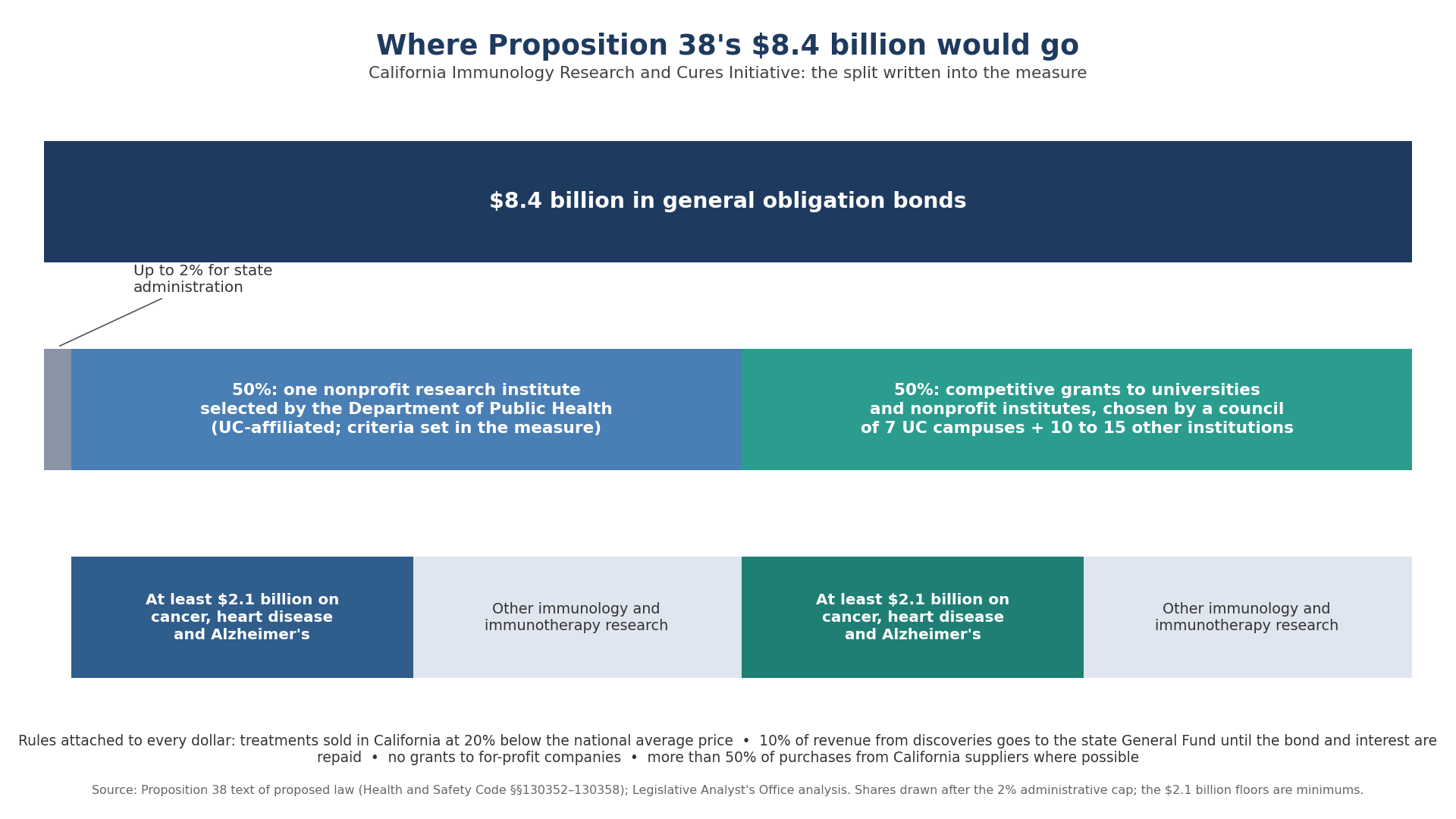
The text of the measure adds a new division to the Health and Safety Code authorizing $8.4 billion in general obligation bonds, the kind the state repays from the General Fund with interest. After bond costs and a cap of 2% for state administration, the proceeds are split two ways:
- 50% to "a single nonprofit medical research institute" selected by the Department of Public Health "for the purpose of conducting or directing health science research in the fields of immunology and immunotherapy." The department must sign a funding agreement with the institute within 90 days of the measure taking effect and review it every five years. The measure also appropriates $100 million from the General Fund as a start-up loan to the institute, to be repaid from bond proceeds.
- 50% to competitive grants for public and nonprofit universities and nonprofit research institutions, awarded "as individualized grants for specific research projects through an application process," not as block grants. An Advisory and Accountability Research Council decides who gets them. Its seven-member executive committee is appointed by the chancellors of UC Berkeley, Davis, Irvine, Los Angeles, Riverside, San Diego and San Francisco, and that committee appoints 10 to 15 more members from other California nonprofit universities and research institutions, for a council of 17 to 22. UCLA's appointee serves as the council's first chair.
Each half carries a floor: "not less than" $2.1 billion must be spent on "the prevention, treatment, and cure of cancer, heart disease, and Alzheimer's disease." Grants are limited to researchers and projects "primarily located within this state," indirect costs are capped at 20% of a grant, and no money may go to for-profit companies. Every grant recipient must offer the selected institute "the opportunity to substantially participate in and collaborate on the funded research," and must offer UCLA the same opportunity on any clinical trials.
The measure can be amended only by a two-thirds vote of the Legislature, and never on "the allocation and disbursement of bond proceeds or the purposes for which bond proceeds may be expended."
California has borrowed for medical research twice before and has a third research bond scheduled for 2028:
The Legislative Analyst's Office notes that funding for medical research and development in the United States "totaled about $300 billion in 2023," most of it from companies and the federal government. Its December 2025 letter to the Attorney General put industry's share at about 65% and the federal government's at about 25%, with philanthropy and state governments playing "a much smaller role."
California is the exception among states. Voters approved Proposition 71 in 2004, which authorized $3 billion in bonds for stem cell research and created the California Institute for Regenerative Medicine, and Proposition 14 in 2020, which added $5.5 billion. Both were citizen initiatives. CIRM describes itself as a "taxpayer-funded agency" with a public governing board, and its revenue-sharing rules sent the state its first royalty check, for $190,345.87, in February 2018, 14 years after Prop 71 passed.
A third research bond is already on the calendar. Senate Bill 895, by Senator Scott Wiener, passed both houses on August 31 and was signed by Governor Newsom on September 30 as the last bill of the session. It places a $7.5 billion science and health research bond on the March 7, 2028 primary ballot and creates a California Foundation for Science and Health Research inside the Government Operations Agency to award grants, loans and contracts across "biomedical, behavioral health, and climate research" and other fields, with the Bagley-Keene Open Meeting Act applying to its council, according to the chaptered bill. If Prop 38 passes, voters will have been asked to approve $15.9 billion of research bonds in 16 months.
California's research bonds compared, from Proposition 71 to the 2028 SB 895 bond:
| Feature | Propositions 71 (2004) and 14 (2020) | Proposition 38 (November 2026) | SB 895 bond (March 2028 ballot) |
|---|---|---|---|
| Amount borrowed | $3 billion, then $5.5 billion ($8.5 billion combined) | $8.4 billion | $7.5 billion |
| Field | Stem cell research | Immunology and immunotherapy; at least $4.2 billion on cancer, heart disease and Alzheimer's | Biomedical, behavioral health, climate and other research fields |
| How it reached voters | Citizen initiatives | Citizen initiative (petition paid for by a Michelson-sponsored committee) | Legislature; signed September 30, 2026 |
| Who awards the money | CIRM, a state agency with a public governing board | Half to one nonprofit institute chosen by the Department of Public Health; half as competitive grants chosen by a council of 17 to 22 university representatives | A new state foundation in the Government Operations Agency, through grants, loans and contracts |
| Open-records and open-meeting laws | Apply (state agency) | The institute "shall not be deemed a public agency for any purpose under state law"; the council is covered by the Political Reform Act | Bagley-Keene Open Meeting Act applies to the council and peer-review panels |
| Money back to the state | Revenue sharing; first royalty check of $190,345.87 arrived in 2018, 14 years after Prop 71 | 10% of revenue from funded discoveries goes to the General Fund until the bond plus interest is repaid | Council sets intellectual-property standards so the state can "benefit" from inventions and royalties |
| Legislative Analyst's cost | Not applicable | $500 million to $600 million a year for about 20 years | Not yet analyzed for the ballot |
The measure's seven criteria for the institute describe the California Institute for Immunology and Immunotherapy at UCLA:
Prop 38 does not name the institute that would receive half its money. Instead, section 130353 of the text lists seven criteria the Department of Public Health must apply. The institute must:
- Be a 501(c)(3) medical research institute "in existence as of January 1, 2025" that was "founded for the primary purpose of, and specializes specifically in" immunology and immunotherapy research.
- Have an affiliation agreement, signed "not later than January 1, 2025," with a University of California campus that has a graduate program in immunology, a public health care system that runs its own clinical trials, and "a hospital and clinic volume of greater than 35,000 inpatient admissions and 3,500,000 outpatient visits each year."
- Be governed by a board whose bylaws, adopted by January 1, 2025, include "multiple members who are senior-level representatives" of that campus or its health system.
- Own or lease, as of January 1, 2026, a site of at least 200,000 square feet intended as its research facility.
- Agree to conduct collaborative research with other California nonprofit centers, including multi-institutional clinical trials.
- Have identified, in the affiliation agreement, at least $250 million in philanthropic donations or fundraising commitments.
- Have secured at least $50 million for "a rapid vaccine development program" and at least $50 million for "a microbiome research program."
The LAO's December letter counted "at least ten research centers in California" working in the field, "at least three" of which specialize in it. The public record on one of them lines up with the list.
On August 28, 2024, UCLA announced a $120 million commitment from Dr. Gary Michelson, a retired spinal surgeon and inventor, and his wife Alya to the California Institute for Immunology and Immunotherapy, a 501(c)(3) "governed by an independent board that includes UCLA representatives." The release described $50 million for a rapid vaccine development entity and $50 million for a microbiome entity within the institute, plus a $20 million endowment for young scientists, and said the institute would occupy 360,000 square feet of the 700,000-square-foot UCLA Research Park on the site of the former Westside Pavilion mall, which UCLA acquired in January 2024 with the help of a $200 million state appropriation. Michelson is the institute's co-founder and board chair; the release lists Meyer Luskin, Dr. Eric Esrailian, Dr. Arie Belldegrun, Michael Milken and Sean Parker as co-founders.
UCLA Health's September 2026 fact sheet reports more than 46,000 inpatient admissions and more than 4.4 million outpatient clinic visits a year across five hospitals. CalMatters reported in July that UCSF's medical center had 3.4 million outpatient visits, below the measure's 3.5 million line, and that UCLA spokesperson Phil Hampton confirmed the California Institute for Immunology and Immunotherapy is the only UCLA-affiliated nonprofit that could meet the criteria. Yes on 38 spokesperson Claudia Briggs told the outlet: "We wrote the measure to ensure a highly qualified nonprofit could receive funding," and "We can't speak to the specific institutes that may or may not qualify across California."
The institute's own tax filings, which the IRS makes public, fill in the rest. The IRS recognized it as tax-exempt in August 2022. Its Form 990 for the year ending June 30, 2025, filed May 1, 2026, discloses that it "signed an affiliation agreement with the Regents of the University of California … by and on behalf of UCLA and UCLA Health," under which its board consists of six "Founders Directors" and four "UCLA Directors" appointed by the university, with the UCLA directors holding veto rights over actions that could harm the university. The ten unpaid directors include Michelson as chair, Esrailian as president, Luskin as treasurer, UCLA Health chief executive John Mazziotta and UCLA Chancellor Julio Frenk.
The same filings show how small the institute's own operation still is. It reported revenue of $1.1 million in the year ending June 2023, $1.0 million in the year ending June 2024, and $20 million, all contributions, in the year ending June 2025, against expenses of $1.6 million that year. It ended June 2025 with net assets of $19.1 million and reported no employees. Michelson's $120 million commitment does not appear on those books because, as UCLA's release states, "The David Geffen School of Medicine at UCLA receives the gift." CalMatters reported that the institute told it it had $250 million in philanthropic support, the amount criterion six requires.
Gary Michelson is also the measure's official proponent, listed by the Attorney General on A.G. File 25-0026, and the principal funder of both its petition drive and its campaign.
The institute would not be a public agency under California's open-records and open-meeting laws:
Section 130363 of the text states that "the institute shall not be deemed a public agency for any purpose under state law," and names three laws by their code sections: the California Public Records Act, the Bagley-Keene Open Meeting Act and the Political Reform Act. The grant council, by contrast, is covered by the Political Reform Act, with two carve-outs: a member may vote on grants to entities in the same field as their employer, and may vote on research into a disease they or a family member has. Government Code section 1090, the conflict-of-interest law for public contracts, applies to the council only when a grant directly benefits a member and the member fails to recuse.
The measure attaches its own accountability rules in place of those laws. The institute must publish an annual report on its website and commission an independent audit each year, which the Controller reviews at a public meeting. The council must do the same, with audits of a random 10% of grantees. A six-member Citizens' Financial Accountability Oversight Committee, chaired by the Controller with appointees of the State Auditor, Treasurer, Senate leader, Assembly Speaker and council chair, reviews the audits and issues its own annual report. The No campaign, co-chaired by former National Institutes of Health associate director Robert Kaplan and health-policy consultant David Panush, makes the public-agency exemption one of its four main arguments.
Proposition 38's repayment promise rests on a 10% royalty to the state and a 20% California discount:
The Yes campaign's claim that the bond is "designed to pay for itself" comes from section 130358. Any recipient of research funds must pay the state 10% of "all revenues" from selling or licensing intellectual property that arises from funded research, within 30 days of receiving the money, "without regard to whether the research … was funded wholly or only in part" by the measure. Those payments go into the General Fund until they equal the bonds' principal plus interest, then into the research fund for future grants. Licensing deals must return royalties of at least 10% of gross revenues to the recipient (the Department of Public Health can approve as low as 5%), and joint ventures must return at least 25% of gross profits. The selected institute, "in consultation with the department," runs a licensing program to "maximize the revenue" and serves as "a clearinghouse and approval center" for every commercialization agreement under the measure.
The discount works in two stages. For the first 12 months of commercial sales, California patients, hospitals and insurers may not be charged more than the price anywhere else in the United States. After that, the first nine months of sales data set a "national average price, excluding California," and the California price must sit at least 20% below it, recalculated every year.
The LAO does not treat the royalty as a repayment plan. Revenue "is uncertain but could be significant," its analysis says, and "the timing of these revenues and how long it would take to offset the state's bond cost is also uncertain, but could take decades." Its ballot summary says the state "could recover part or all of this cost in subsequent decades." The reference point in California's own history is CIRM's first royalty check, $190,345.87, 14 years after Prop 71.
LAO fiscal estimate changed from $500 million a year for 25 years to $500 million to $600 million for about 20 years:
The LAO's ballot analysis estimates the General Fund cost of repaying the bond at "$500 million to $600 million annually for about 20 years," about one-quarter of 1% of the state's General Fund budget, with the total cost "about 10 percent more (after adjusting for inflation)" than paying up front. Its December 17, 2025 letter to the Attorney General, written when the measure was still a petition, said "about $500 million each year over a 25-year period." That earlier figure is the one printed on the petition and in the ballot argument against the measure, which says taxpayers "would be committed to roughly $500 million in annual debt payments for the next 25 years." The two are different versions of the same estimate, not a disagreement.
The LAO also flags indirect effects it cannot size: new treatments could raise or lower costs for Medi-Cal, and the in-state purchasing rule could lift employment and taxable income. The Voter Information Guide's Overview of State Bond Debt puts the measure in context: the state is repaying about $80 billion of General Fund bonds, has about $40 billion more authorized but unsold, and pays about $6 billion a year in debt service, about 3% of General Fund revenue. Propositions 1 and 38 together would add about $1 billion a year, about half of 1%.
Proposition 38's Yes side reports $76.2 million from its top donors and its only opposition committee $3,782:
The Fair Political Practices Commission's top-contributor list, updated October 14, shows $76.2 million in support of Prop 38 from two committees, the largest support figure for any measure on the ballot except Proposition 42. The main committee, "Yes on 38: Californians for Life-Saving Immunology Research and Cures, sponsored by the Michelson Center for Public Policy," lists four top contributors: Gary K. Michelson, $40 million; the Michelson Center for Public Policy's own Yes on 38 committee, $21.2 million, whose top contributor is Michelson; Meyer Luskin, $5 million; and the California Democratic Party, $15,595.20. The Center's committee lists one contributor, Michelson, at $10 million. Luskin is the institute's co-founder and treasurer.
The FPPC lists no opposing committee because none has reached the $1 million reporting threshold. The Secretary of State's contribution tally, which counts all reported contributions through October 6, shows $64.2 million for the two Yes committees and $3,782 for the committee "No on Proposition 38." The petition that qualified the measure was paid for by "Californians for Immunology Research and Cures, sponsored by the Michelson Center for Public Policy," with major funding from Michelson, his affiliated entity and Luskin, according to the Secretary of State's Official Top Funders filing.
The arguments over Proposition 38 pit federal research cuts against ballot-box science:
The Yes argument, signed by Susan Disney Lord of Alzheimer's Los Angeles, Eugene P. Brandon of the ALS Association and Dr. Brian Shuch of the Kidney Cancer Association, says "massive federal funding cuts and uncertainty are disrupting vitally needed medical research" and that Prop 38 "creates a stable source of funding." It says the measure "is designed to pay for itself WITH NO NET COST TO THE STATE OR TAXPAYERS," cites the 20% discount, the 2% administrative cap, the audits and the bar on for-profit grantees, and promises "tens of thousands of good-paying jobs." Quoted supporters include Stanford immunologist Mark Davis and cancer survivor Laurie Adami. The rebuttal to the No argument repeats that "YES ON 38 IS DESIGNED TO PAY FOR ITSELF."
The No argument, signed by Robert M. Kaplan of Stanford's Clinical Excellence Research Center, says the measure "continues the use of ballot initiatives to direct research funding toward selected topics" when California "has already created separate funding programs for stem cell research and precision medicine." It argues that borrowing "is an inappropriate way to finance scientific research," that "universities rarely commercialize new therapies on their own," and that the discount "could incentivize companies to prioritize selling these products in other states." It points to Senator Wiener's proposal for "a state-funded research agency modeled on the National Institutes of Health," adding, "Although the legislation has not advanced, it received support from the University of California." Arguments were filed before the Legislature acted; the bill has since been signed and will appear on the March 2028 ballot. Kaplan's rebuttal calls the pay-for-itself claim "speculative."
Neither argument names the institute. The guide notes that ballot arguments "have not been checked for accuracy by any official agency."
Proposition 38 leads 55% to 42% with Newsom and both parties in support and editorial boards opposed:
PPIC's September survey of likely voters, fielded September 4–10, found 55% yes, 42% no and 3% undecided. Democrats support it 76% to 21%, independents 54% to 43%, and Republicans oppose it 76% to 23%. Voters aged 18 to 34 back it 68% to 30% while those 55 and older split 50% to 47%. Renters support it 68% to 31% and homeowners 51% to 46%. Only 1% named it the measure they were most interested in. UC Berkeley's September poll did not ask about it.
Governor Newsom's campaign released his positions on October 9: yes on Prop 38, as on the ballot's two other bond measures, Propositions 1 and 37. The California Democratic Party and the California Republican Party both support it, which makes it one of two measures the parties agree on; the other is Prop 44, which both oppose. The Republican endorsement runs against the party's own voters in PPIC's poll. Xavier Becerra's July list of positions covers six measures and does not mention Prop 38.
The Voter Information Guide lists the Michael J. Fox Foundation, Alzheimer's Los Angeles, the Kidney Cancer Association and the American Nurses Association\California in support, and Kaplan alone against. The editorial boards we read all recommend a no vote: the Sacramento Bee and McClatchy's other California papers (September 30), the San Francisco Chronicle (October 3), the Mercury News and East Bay Times (October 13) and the Press Democrat (October 14). The No campaign lists six more boards, including the San Diego Union-Tribune and the Orange County Register, along with the League of Women Voters of California, the Howard Jarvis Taxpayers Association and California Common Cause.
Proposition 38 after November 3 would mean bond sales from 2027 or a 2028 vote on the SB 895 research bond instead:
If Prop 38 passes, it takes effect on the fifth day after the Secretary of State certifies the results, which is due December 11. The Department of Public Health would then have 90 days to sign a funding agreement with an institute meeting the seven criteria, the $100 million start-up loan would become available, and the Treasurer could begin selling bonds on the institute's written request. Repayment of $500 million to $600 million a year would begin as bonds are sold and run for about 20 years. If it fails, no immunology bond is authorized, CIRM continues under Proposition 14's authorization, and the next decision on research borrowing comes on March 7, 2028, when SB 895's $7.5 billion bond goes to voters. Either way, that 2028 vote is already scheduled.
This article reflects the Voter Information Guide as published, campaign-finance data as of October 14, 2026 (FPPC) and October 6, 2026 (Secretary of State), the institute's tax filing for the year ending June 30, 2025, party and gubernatorial positions as of October 17, 2026, and polling fielded September 4–10, 2026.
Sources and References
- Voter Information Guide, Proposition 38—https://voterguide.sos.ca.gov/propositions/38/
- Voter Information Guide, Proposition 38, Official Title and Summary—https://voterguide.sos.ca.gov/propositions/38/title-summary.htm
- Voter Information Guide, Proposition 38, Legislative Analyst's analysis—https://voterguide.sos.ca.gov/propositions/38/analysis.htm
- Voter Information Guide, Proposition 38, arguments and rebuttals—https://voterguide.sos.ca.gov/propositions/38/arguments-rebuttals.htm
- Text of Proposed Laws, Proposition 38 (pp. 123–133)—https://vig.cdn.sos.ca.gov/2026/general/pdf/prop38-text-proposed-laws.pdf
- Voter Information Guide, Proposition 38 (title, summary, analysis and arguments, pp. 44–47)—https://vig.cdn.sos.ca.gov/2026/general/pdf/prop38.pdf
- Voter Information Guide, Overview of State Bond Debt—https://voterguide.sos.ca.gov/voter-info/overview-state-bond-debt.htm
- Legislative Analyst's Office and Department of Finance, fiscal review of A.G. File 25-0026, Amendment #1 (December 17, 2025)—https://oag.ca.gov/system/files/initiatives/pdfs/fiscal-impact-estimate-report%2825-0026A1%29.pdf
- Office of the Attorney General, Active Measures (A.G. File 25-0026A1, proponent Gary K. Michelson)—https://oag.ca.gov/initiatives/active-measures
- California Secretary of State, Official Top Funders, initiative #2006 (February 25, 2026)—https://elections.cdn.sos.ca.gov/ballot-measures/top-funders/2006-top-funders-02-25-26.pdf
- Fair Political Practices Commission, Top 10 Contributors List, November 2026 General Election (last modified October 14, 2026)—https://www.fppc.ca.gov/search-filings/top-10-contributors-list/november-2026-general-election/
- California Secretary of State, 2026 Ballot Measure Contribution Totals, Proposition 38 (through October 6, 2026)—https://www.sos.ca.gov/campaign-lobbying/helpful-resources/measure-contributions/2026-ballot-measure-contribution-totals/proposition-38-authorizes-bonds-immunology-research-initiative-statut
- Public Policy Institute of California, September 2026 likely-voter crosstabs—https://www.ppic.org/wp-content/uploads/crosstabs-likely-voters-0926.pdf
- UCLA, "UCLA receives $120 million from Alya and Gary Michelson for new California Institute for Immunology and Immunotherapy" (August 28, 2024)—https://externalaffairs.ucla.edu/?p=3572
- UCLA Health, Fact Sheet (updated September 2026)—https://www.uclahealth.org/sites/default/files/documents/07/2026-09-30-1734700-ucla-health-fact-sheet-2026-final-digital.pdf
- ProPublica Nonprofit Explorer, California Institute for Immunology and Immunotherapy (EIN 87-2786093), Forms 990 for fiscal years ending June 2023, 2024 and 2025—https://projects.propublica.org/nonprofits/organizations/872786093
- Senate Bill 895 (Wiener), California Science and Health Research Bond Act, as chaptered (Ch. 1040, 2026)—https://elections.cdn.sos.ca.gov/ballot-measures/pdf/sb895-ch1040.pdf
- California Secretary of State, Qualified Statewide Ballot Measures (SB 895 listed for March 7, 2028)—https://www.sos.ca.gov/elections/ballot-measures/qualified-ballot-measures
- Office of Governor Gavin Newsom, "At the top of the Golden Gate Bridge, Governor Newsom signs his final bill" (September 30, 2026)—https://www.gov.ca.gov/2026/09/30/at-the-top-of-the-golden-gate-bridge-governor-newsom-signs-his-final-bill-investing-in-californias-next-generation-of-innovation/
- California Institute for Regenerative Medicine, About Us—https://www.cirm.ca.gov/about-cirm/
- CIRM blog, "California gets first royalty check from Stem Cell Agency investments" (February 12, 2018)—https://blog.cirm.ca.gov/2018/02/12/california-gets-first-royalty-check-from-stem-cell-agency-investments/
- Voter Information Guide archive, Proposition 14 (November 2020)—https://vigarchive.sos.ca.gov/2020/general/propositions/14/
- CalMatters, "Is this proposition a $4 billion giveaway to a billionaire-backed LA research center?" (July 31, 2026)—https://calmatters.org/politics/elections/2026/07/proposition-38-california
- ABC10 via Yahoo News, "Gov. Newsom announces position on statewide ballot propositions" (October 9, 2026)—https://www.yahoo.com/news/politics/articles/gov-newsom-announces-position-statewide-185935591.html
- California Democratic Party, 2026 General Election Endorsements and Ballot Measure Positions—https://cadem.org/wp-content/uploads/2026/08/FINAL-2026-General-Election-Endorsements.pdf
- California Republican Party, 2026 endorsements—https://cagop.org/endorsements/
- Xavier Becerra for Governor, ballot measure positions (July 31, 2026)—https://www.xavierbecerra2026.com/?p=551
- Sacramento Bee / McClatchy California editorial board, "Proposition 38 is a sleeper on the ballot. California voters should beware" (September 30, 2026)—https://www.sacbee.com/opinion/election-endorsements/article317166634.html
- San Francisco Chronicle editorial board, No on Prop 38 (October 3, 2026)—https://www.sfchronicle.com/opinion/editorials/article/prop-38-money-california-22453646.php
- Mercury News and East Bay Times editorial boards, "No on California Proposition 38, an $8.4 billion money grab" (October 13, 2026)—https://www.mercurynews.com/2026/10/13/endorsement-no-on-california-proposition-38-an-8-4-billion-money-grab-immunotherapy-ucla-research-ballot-measure/
- Santa Rosa Press Democrat editorial board, "Props. 1 and 38 would only bring more debt for California" (October 14, 2026)—https://www.pressdemocrat.com/2026/10/14/endorsement-props-1-and-38-would-only-bring-more-debt-for-california/
- No on Proposition 38 (committee #1495405), home page and endorsements—https://votenoonprop38.org/ ; https://votenoonprop38.org/endorsements
- Yes on 38, campaign site—https://yeson38.com/
More November '26 Election Guides:
 Mac Douglass | Editor
 Dr. Jennifer Trimpey | Specialist
 Mac Douglass | Editor
 Mac Douglass | Editor
 Mac Douglass | Editor
 Mac Douglass | Editor
 Mac Douglass | Editor