


2026 California Prop 4 guide: "Public financing" measure would let state and local governments give candidates public money for their campaigns
Proposition 4 repeals the 1988 ban that keeps the state, counties and most cities from funding campaigns. It creates no program itself; any government that wants one would set the amounts, under rules on spending limits, small-donor support and money for schools, roads and public safety.

Proposition 4 would repeal the California law that bars the state, counties and most cities from giving candidates public money for their campaigns, a ban voters approved in 1988.
It would not create a public financing program or spend money on any campaign. It would let the state and local governments build their own programs, under conditions written into the measure: candidates who take public funds must accept spending limits and show broad support in their district, typically through small donations, and no money earmarked for education, transportation or public safety can be used. The Legislative Analyst's Office puts the state's direct cost at "a few hundred thousand dollars each year" for the Fair Political Practices Commission to answer questions, and says the cost of any program a government chooses to create "could be significant." The measure also raises the maximum fine for illegal campaign contributions from foreign sources.
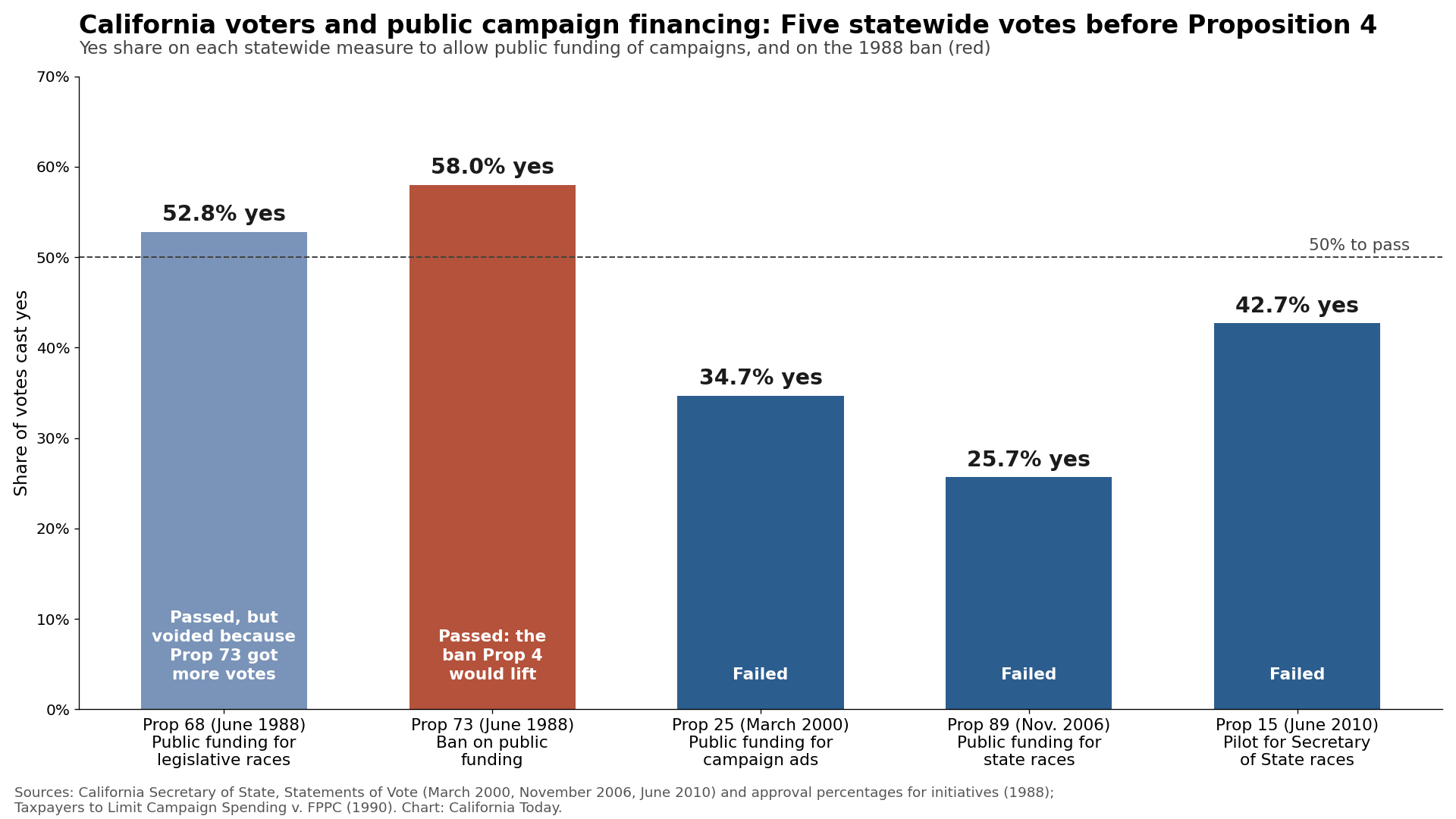
Prop 4, the California Fair Elections Act of 2026, is a legislative statute placed on the ballot by SB 42, which Senator Tom Umberg wrote and Governor Gavin Newsom signed on October 2, 2025. It is one of 14 measures in this year's guide and one of three that change how California runs elections, alongside Proposition 5's recall changes and Proposition 39's voter ID rules. California voters have turned down three earlier measures that would have lifted the ban, in 2000, 2006 and 2010, each of which also created a program; this is the first to ask only whether the ban should go. PPIC's September survey found 42% yes and 53% no, and UC Berkeley's found 35% on each side. Almost no money has been raised on either side. This explainer covers what the measure changes, the 1988 ban and the court fight over an earlier attempt to lift it, the cities that already fund campaigns, the cost, the arguments and the polling.
 Mac Douglass | Editor
Proposition 4 replaces California's ban on public campaign funds with conditions for any future program:
The text of the measure rewrites Government Code section 85300, the one-sentence ban in the Political Reform Act. Today that section says a public officer "shall not expend, and a candidate shall not accept, any public moneys for the purpose of seeking elective office." Prop 4 keeps the prohibition only for funds "earmarked by any state or local entity for education, transportation, or public safety," which opens every other public source to a program a government chooses to create by statute, ordinance or charter.
It then sets the ground rules. Candidates "shall abide by expenditure limits and meet strict criteria to qualify for public funds." The measure defines strict criteria as requirements that make candidates "demonstrate broad-based support in their district, such as by requiring candidates to receive small-dollar contributions or vouchers from a specified number of voting-age residents." A program that counts small donors cannot require any donor to give more than $10 to be counted, and it cannot require candidates to collect signatures or reach a total dollar amount above $10 per contributor. Programs may not "discriminate based on party or according to whether a candidate is a challenger or an incumbent."
Three uses of the money are banned outright. Public funds cannot pay legal defense fees or fines, and no candidate can use them to repay a personal loan to their own campaign. A candidate who takes public funds also cannot repay such a loan from any source once the campaign ends.
The measure sets no dollar amounts. It does not say how much a candidate can receive, what a match would be or how high a spending limit must be; those are left to each statute, ordinance or charter. It does cap one thing: a program may raise a participating candidate's spending limit when opponents or outside groups outspend them, but only up to a formula in the text, the highest "net supportive funds" of any other candidate in the race plus outside spending against the participating candidate, minus outside spending for them.
Public campaign financing today and under Proposition 4 compared:
| Rule | California law today | Under Proposition 4 |
|---|---|---|
| Who may offer public campaign funds | Only charter cities (Johnson v. Bradley, 1992). The state, all counties, general law cities and special districts are barred by Government Code section 85300. | The state and any local government, by statute, ordinance or charter |
| Money that can be used | None outside charter cities | Any public funds except money earmarked for education, transportation or public safety |
| How candidates qualify | Not applicable | "Strict criteria" showing broad-based support in the district, such as small-dollar contributions or vouchers from a set number of voting-age residents. No signature requirement, and no contribution larger than $10 can be required for a donor to count. |
| Spending limits | Not applicable | Participating candidates must accept spending limits set by each program. A program may raise a candidate's limit when opponents or outside groups outspend them, up to a formula in the measure. |
| Neutrality | Not applicable | Programs may not discriminate by party or between incumbents and challengers |
| Barred uses of public money | Not applicable | Legal defense fees, fines and repaying a candidate's personal loan to the campaign. A publicly funded candidate may never repay such a loan from any source after the campaign ends. |
| Oversight | FPPC enforces the ban | FPPC answers questions but is not responsible for running or enforcing local programs |
| Foreign campaign money fine | Misdemeanor with a fine equal to the amount given or spent | Misdemeanor plus a fine of at least the amount and up to three times it |
| Changing the rules later | Not applicable | Definitions, spending-limit increases and the FPPC clause can be changed by a two-thirds vote of the Legislature that furthers the Political Reform Act; everything else needs voter approval |
| Compiled by California Today from the text of Proposition 4 (SB 42, Chapter 245 of 2025), the Legislative Analyst's analysis and the Assembly Elections Committee analysis of SB 42 (July 2, 2025). Dollar amounts, contribution matches and spending limits are not set by Proposition 4; each program would set its own. | ||
The Fair Political Practices Commission would advise on Prop 4 programs but would not enforce local ones:
The FPPC, which enforces the Political Reform Act today, gets a limited role. The text says the commission "is not responsible for the administration or enforcement of a system of public funding of candidates established by a local governmental agency." The LAO's analysis expects state and local officials to ask the commission how to design programs that fit the new rules, which "likely would require the Fair Political Practices Commission to hire more legal staff." The FPPC told the Legislature it would need one attorney at a cost of $205,000 in the first year and $198,000 a year after that, according to the Assembly Elections Committee's analysis of SB 42, and noted possible additional enforcement costs.
The measure also splits how its own rules can be changed later. The definitions, the spending-limit formula and the FPPC clause can be amended by the Legislature under the Political Reform Act's usual standard, a two-thirds vote in each house for a change that furthers the act's purposes. Every other part of the new section 85300, including the earmark exclusion and the ban on using public funds for fines and loan repayment, could be changed only with voters' approval.
Prop 4 also amends section 85320, the state's ban on contributions and spending by foreign governments, foreign principals and foreign nationals in state and local elections. Violating it is a misdemeanor today with a fine equal to the amount given or spent. Under Prop 4 the fine would be at least that amount and up to three times it. The committee analysis notes that this misdemeanor, unlike the act's general criminal penalty, does not require proof that a violation was knowing or willful.
California's ban on public campaign funds dates to Proposition 73 in 1988:
The ban came out of a head-to-head contest. In June 1988, voters faced two initiatives that would have rewritten campaign finance law in opposite directions. Proposition 68 offered contribution limits and state matching funds for legislative candidates who accepted spending limits. Proposition 73 offered contribution limits and a flat prohibition: "No public officer shall expend and no candidate shall accept any public money for the purpose of seeking elective office." Both passed, Prop 68 with 52.8% and Prop 73 with 58%, according to the Secretary of State's records. Because they conflicted, the California Supreme Court held in 1990 that only the measure with more yes votes could take effect, and Prop 68 was voided.
Federal courts later struck down Prop 73's contribution limits, but the public-funding ban survived. In 2000, voters approved Proposition 34, a Legislature-written campaign finance measure whose title promised contribution limits "Without Taxpayer Financing"; its ballot argument told voters that "our tax money is better spent on schools, roads and public safety."
The ban has one large exception. In 1992, in Johnson v. Bradley, the California Supreme Court upheld a Los Angeles charter measure that partly funded campaigns for city office, under the home-rule provision of the state Constitution. A 1990 appellate ruling held that the ban still applies to charter counties. The result, as the Assembly Elections Committee summarized it, is that "general law cities, all counties, all districts, and the state government are covered by the current ban," while charter cities can fund campaigns if they choose.
Three earlier measures to lift California's public financing ban failed between 2000 and 2010:
Each earlier attempt bundled the repeal with a specific program. Proposition 25 in March 2000 would have publicly funded campaign advertising and voter information for candidates and ballot committees that accepted spending limits; it drew 34.7%. Proposition 89 in November 2006 would have created a public financing system for candidates for state office; it drew 25.7%, the lowest of the three. Proposition 15 in June 2010, placed on the ballot by the Legislature, would have run a public financing pilot for Secretary of State races; it drew 42.7%.
Prop 4 is built differently. It asks voters only to remove the ban and set conditions, and it leaves the decision to start a program, and how to pay for it, to each government.
SB 1107's 2016 attempt to lift the ban without a vote was struck down in court:
The Legislature has tried to remove the ban without a statewide vote before. In 2016 it passed SB 1107, by Senator Ben Allen, and Governor Jerry Brown signed it. The bill rewrote section 85300 to allow public funding when a government set up a dedicated fund open to all qualified candidates regardless of party or incumbency. Because Prop 73 had made the ban part of the voter-approved Political Reform Act, the Legislature could amend it without a vote only if the change furthered the act's purposes, and SB 1107 declared that it did.
The Howard Jarvis Taxpayers Association and former Senator Quentin Kopp, one of Prop 73's proponents, sued. A Sacramento judge invalidated the law, and on August 26, 2019 the Third District Court of Appeal affirmed the judgment, finding that SB 1107 "directly conflicts with a primary purpose and mandate of the Act, as amended by subsequent voter initiatives, to prohibit public funding of political campaigns." The judgment bars the FPPC from enforcing it. SB 1107's wording stayed in the code, but the FPPC continues to enforce the ban. Prop 4 deletes that wording and replaces it, which is why it needs voters' approval to take effect.
Two earlier versions of the current measure, AB 270 and SB 24 in the 2023–24 session, died in the appropriations committees. SB 42 was introduced on December 5, 2024 and passed the Senate 28–10 on June 2, 2025. The Assembly passed it 59–20 on September 12, the Senate concurred 29–8 the next day, and Newsom signed it on October 2 as Chapter 245 of the Statutes of 2025.
Los Angeles, San Francisco, Berkeley and Oakland already fund campaigns under the charter-city exception:
The Assembly Elections Committee counts at least seven charter cities with public financing programs: Berkeley, Long Beach, Los Angeles, Oakland, Richmond, Sacramento and San Francisco, though Richmond's and Sacramento's were not funded for recent elections. Most use matching funds, where the city multiplies small contributions from residents. Oakland's voters chose vouchers instead.
Four California charter cities fund campaigns with public money:
| City | Program and origin | How candidates qualify | What candidates can receive |
|---|---|---|---|
| Los Angeles | Matching funds, enacted by city voters | At least 100 contributions of $5 or more from district residents, at least $12,857 in qualified contributions, a $40,000 cap on self-funding, spending limits and a debate or town hall (2024 council rules) | $6 for every $1 of a qualified contribution, matched up to $129 per donor; up to $174,000 in the primary and $217,000 in the general for a council candidate (2024) |
| San Francisco | Public financing, created by Proposition O in November 2000 | Supervisor candidates who are not incumbents need 100 resident contributions of $10 to $100 totaling $10,000; mayoral candidates who are not incumbents need 500 totaling $50,000; spending limits and three debates | An initial grant, then $6 for every $1 raised; up to $255,000 for supervisor and $1.2 million for mayor (incumbents slightly less) |
| Berkeley | Berkeley Fair Elections Act, approved by voters in 2016 | At least 30 contributions of $10 or more from Berkeley residents totaling at least $650; a $60 cap on any one contribution and no loans (2026 rules) | $6 for every $1 on contributions of up to $60; capped at $52,000 for City Council and $155,000 for mayor |
| Oakland | Democracy Dollars, created by Measure W in November 2022 | Candidates who opt in can collect vouchers from residents | Each eligible resident gets $100 in vouchers to assign; the program is not funded for 2026 and is being prepared for 2028, with a limited public financing program in place for 2026 |
| Compiled by California Today from the Los Angeles City Ethics Commission's 2024 Matching Funds FAQ, the San Francisco Ethics Commission's program overview, Berkeley's 2026 Public Financing Program guide and the Oakland Public Ethics Commission's Democracy Dollars page. Long Beach, Richmond and Sacramento have also enacted programs; the Assembly Elections Committee reports Richmond's and Sacramento's were not funded for recent elections. | |||
San Francisco's program shows what one of these costs. City law requires a General Fund appropriation of $2.75 per resident each year into the Election Campaign Fund, capped at a $7 million balance. In the November 2024 mayoral and supervisorial races, the program paid out a record $8,840,187 to 27 candidates, $4.1 million of it to four mayoral candidates, according to the San Francisco Ethics Commission's post-election report. The same report found that outside groups spent $19.0 million on those races, also a record. Oakland shows the other side of the ledger: voters approved its $100-per-resident Democracy Dollars program in November 2022, and the city has not funded it for 2026.
Proposition 4 costs the state a few hundred thousand dollars a year and leaves program costs to local choices:
The LAO's estimate covers only the state's direct cost: the FPPC's added legal staff, "much less than one-tenth of 1 percent" of the General Fund. Anything larger depends on what governments do afterward. "The cost of these programs could be significant for governments that choose to create them," the analysis says, and "the total cost would depend on which governments created such programs and how those programs were designed." Prop 4 does not require any government to create a program, and it does not say where the money would come from beyond excluding the three earmarked categories.
The two sides frame that open question differently. The Yes argument says that if a community adopts a program, "the cost is as little as $1 per resident each year." San Francisco law sets aside $2.75 per resident a year. The No argument says the measure "has NO LIMIT on how much taxpayer money a candidate can receive"; the text indeed sets no dollar amount and leaves it to each program, which must also impose spending limits on the candidates it funds.
The Prop 4 campaign has raised $235,157 with no opposition committee:
Prop 4 is one of the quietest campaigns on the ballot. The Secretary of State's contribution tally, which runs through October 6, lists one committee, Movement Voter PAC's committee supporting Prop 4, with $235,157, and "No committees identified" in opposition. No committee on either side has raised the $1 million that puts it on the FPPC's top-contributor list, last updated October 14. The Voter Information Guide lists the Yes campaign as Californians for Fair Elections, sponsored by Government Reform Advocates, and the No contact as the California Taxpayers Association.
The arguments on Proposition 4 split over special-interest money and taxpayer cost:
The argument in favor, signed by Lorrel Plimier of the League of Women Voters of California, Catherine Kennedy of the California Nurses Association and Senator Umberg, is headed "Elections should be won, not bought." It says "more than $1 billion has been spent on California state candidate races alone" since 2020, that "thousands of candidates from different backgrounds have been elected in fourteen states and 26 localities using similar systems," and that Prop 4 "does not create a public financing program." Its rebuttal adds that "California is the ONLY state that bans public funding of campaigns."
The argument against, signed by former FPPC chair Dan Schnur, former FPPC commissioner Colleen McAndrews and Julian Canete of the California Hispanic Chambers of Commerce, says the measure "allows politicians to use your taxpayer money to fund their campaigns." It says Prop 4 sets "NO LIMIT on the number of candidates who can get taxpayer money and NO LIMIT on how much money they can get," quotes the measure's definition of strict criteria to argue that "there is no current statute, ordinance or charter setting any criteria," and says candidates "can raise money from special interests AND get public funding too." Its rebuttal, signed by Robert Gutierrez of the California Taxpayers Association, Jon Coupal of the Howard Jarvis Taxpayers Association and Schnur, points to "more than 60 candidates" for governor in the June primary. The guide notes that arguments "have not been checked for accuracy by any official agency."
The guide's index lists the League of Women Voters, the California Nurses Association, Mental Health Advocacy, Social Security Works and Consumer Watchdog as supporters, and the California Taxpayers Association, the Howard Jarvis Taxpayers Association, the Family Business Association of California and United Latinos Action as opponents. In its letter to the Legislature, the California Taxpayers Association also raised a First Amendment objection, arguing that taxpayers "would be forced to finance political speech they do not wish to support."
Campaign voices on both sides have made the same points to reporters. Trent Lange, president of the California Clean Money Campaign and co-chair of the Yes campaign, said candidates should be able "to run and win without having to raise big money," and Dora Rose of the League of Women Voters said Prop 4 "sets basic safeguards and then lets communities learn from the evidence," CalMatters reported. Assemblymember Carl DeMaio, a San Diego Republican, said on the Assembly floor that "the voters have been quite clear they don't want taxpayer money being used for politics." CalMatters also cites a National Conference of State Legislatures count of 15 states and Washington, D.C. with some form of statewide public financing, and describes the research on whether such programs reduce donors' influence as mixed.
Proposition 4 trails 42% to 53% in PPIC polling with Newsom and Democrats in support:
PPIC's September survey of likely voters, fielded September 4–10, found 42% yes, 53% no and 5% undecided, making Prop 4 one of the weakest measures on the ballot. Republicans oppose it 78% to 19% and independents 54% to 41%, while Democrats support it 55% to 39%. Self-described liberals back it 62% to 34%. Renters split 50% yes to 48% no while homeowners oppose it 55% to 39%, and households earning under $40,000 lean yes, 50% to 46%. One percent of likely voters named it the measure they are most interested in. UC Berkeley's Institute of Governmental Studies, polling September 15–20, found 35% yes and 35% no with the rest undecided. PPIC's October survey had not been released as of October 18.
Governor Newsom included a yes on Prop 4 in the ballot slate he announced on October 9. The California Democratic Party supports it and the California Republican Party opposes it. Among editorial boards, the Sacramento Bee recommends yes and the San Diego Union-Tribune, the Orange County Register and the San Francisco Chronicle recommend no, according to CalMatters' roster. The Chronicle argued that the measure's rules "are only meaningful if they're enforced by independent, nonpartisan bodies. And Prop. 4 offers no guarantee they will be." The Union-Tribune called Prop 4's "only certain effect" the creation of "a new category of government spending that taxpayers could be required to pay for."
Proposition 4 after November 3 would hand the public financing decision to each government:
If Prop 4 passes, nothing changes on election day. The ban would end for the state, counties, general law cities and special districts, and any of them could then propose a program through its own statute, ordinance or charter, deciding the matching rate or voucher amount, the spending limits and the budget, within the measure's conditions. The FPPC would field questions, and a local program would be policed by whatever body that government sets up. Charter cities that already run programs would keep them. If it fails, the 1988 ban stays in place outside charter cities, as it has through three earlier repeal attempts and one struck-down law.
This article reflects the Voter Information Guide as published, the text of SB 42 (Chapter 245, Statutes of 2025), campaign-finance data as of October 6, 2026 (Secretary of State) and October 14, 2026 (FPPC), party and candidate positions as of October 18, 2026, and polling fielded September 4–20, 2026.
Sources and References
- Voter Information Guide, Proposition 4—https://voterguide.sos.ca.gov/propositions/4/
- Voter Information Guide, Proposition 4, Official Title and Summary—https://voterguide.sos.ca.gov/propositions/4/title-summary.htm
- Voter Information Guide, Proposition 4, Legislative Analyst's analysis—https://voterguide.sos.ca.gov/propositions/4/analysis.htm
- Voter Information Guide, Proposition 4, arguments and rebuttals—https://voterguide.sos.ca.gov/propositions/4/arguments-rebuttals.htm
- Text of Proposed Laws, Proposition 4 (pp. 116–118)—https://vig.cdn.sos.ca.gov/2026/general/pdf/prop4-text-proposed-laws.pdf
- California Legislative Information, SB 42 bill history—https://leginfo.legislature.ca.gov/faces/billHistoryClient.xhtml?bill_id=202520260SB42
- California Legislative Information, SB 42 chaptered text and Legislative Counsel's Digest—https://leginfo.legislature.ca.gov/faces/billTextClient.xhtml?bill_id=202520260SB42
- Assembly Committee on Elections, analysis of SB 42 (hearing of July 2, 2025)—https://aelc.assembly.ca.gov/media/2586
- Court of Appeal, Third District, Howard Jarvis Taxpayers Assn. v. Newsom, No. C086334 (filed August 26, 2019)—https://www.courts.ca.gov/opinions/archive/C086334.PDF
- California Secretary of State, approval percentages of initiatives—https://elections.cdn.sos.ca.gov/ballot-measures/pdf/approval-percentages-initiatives.pdf
- California Secretary of State, Statement of Vote, March 7, 2000 Primary, measures summary—https://elections.cdn.sos.ca.gov/sov/2000-primary/sum_measures.pdf
- California Secretary of State, Statement of Vote, November 7, 2006 General Election, measures—https://elections.cdn.sos.ca.gov/sov/2006-general/measures.pdf
- California Secretary of State, Supplement to the Statement of Vote, June 8, 2010 Primary, ballot measures summary—https://elections.cdn.sos.ca.gov/sov/2010-primary/ssov/ballot-measures-summary.pdf
- Los Angeles City Ethics Commission, Matching Funds FAQ for 2024 Candidates—https://ethics.lacity.org/wp-content/uploads/Matching-Funds-FAQ-2024.pdf
- San Francisco Ethics Commission, Public Financing Program overview—https://sfethics.org/guidance/campaigns/candidates/public-financing-program/public-financing-program-overview
- San Francisco Ethics Commission, 2024 Post-Election Report on the Public Financing Program (March 14, 2025)—https://sfethics.org/wp-content/uploads/2025/03/2025.03.14-Agenda-Item-6-2024-Post-Election-Report.pdf
- City of Berkeley, Public Financing Program supplemental guide, 2026 election—https://berkeleyca.gov/sites/default/files/documents/Public%20Financing%20Program%20Guide%202024%20-%20FINAL_1.pdf
- City of Oakland Public Ethics Commission, Democracy Dollars Program—https://www.oaklandca.gov/Government/Boards-Commissions/Public-Ethics-Commission/Democracy-Dollars-Program
- California Secretary of State, 2026 Ballot Measure Contribution Totals, Proposition 4 (through October 6, 2026)—https://www.sos.ca.gov/campaign-lobbying/helpful-resources/measure-contributions/2026-ballot-measure-contribution-totals/proposition-4-sb-42-umberg-political-reform-act-1974-public-campaign-financing-california-fair-elections-act-2026-ch-245-2025
- Fair Political Practices Commission, Top 10 Contributors List, November 2026 General Election (last modified October 14, 2026)—https://www.fppc.ca.gov/search-filings/top-10-contributors-list/november-2026-general-election/
- Public Policy Institute of California, September 2026 likely-voter crosstabs—https://www.ppic.org/wp-content/uploads/crosstabs-likely-voters-0926.pdf
- UC Berkeley Institute of Governmental Studies, Berkeley IGS Poll, Release #2026-20 (September 2026)—https://escholarship.org/content/qt3w14s99c/qt3w14s99c.pdf
- ABC10 via Yahoo News, "Gov. Newsom announces position on statewide ballot propositions" (October 9, 2026)—https://www.yahoo.com/news/politics/articles/gov-newsom-announces-position-statewide-185935591.html
- California Democratic Party, 2026 General Election Endorsements—https://cadem.org/wp-content/uploads/2026/08/FINAL-2026-General-Election-Endorsements.pdf
- California Republican Party, 2026 endorsements—https://cagop.org/endorsements/
- CalMatters, "Proposition 4: Allow public financing of political campaigns," 2026 Voter Guide—https://calmatters.org/california-voter-guide-2026/proposition-4-public-fundraising/
- CalMatters, "Would Prop. 4 curb the influence of money in California politics?" (October 2026)—https://calmatters.org/politics/2026/10/california-proposition-4-explainer/
- San Francisco Chronicle editorial board, Proposition 4 endorsement (October 6, 2026)—https://www.sfchronicle.com/opinion/editorials/article/endorsement-prop-4-public-financing-22426379.php
More November 2026 California Election Guides:
 Pat Sharyon | Editor
 Dr. Jennifer Trimpey | Specialist
 Mac Douglass | Editor
 Dr. Jennifer Trimpey | Specialist
 Mac Douglass | Editor
 Mac Douglass | Editor
 Mac Douglass | Editor
 Mac Douglass | Editor
 Mac Douglass | Editor


