

California’s Proposition 37 would let buyers put 3% down on a new home, with a state loan covering the other 17%
Proposition 37 would let CalHFA sell $25 billion in revenue bonds and lend buyers of newly built homes up to 17% of the price, so they can put 3% down. The loan is a fixed-rate second mortgage with monthly payments. Here is who qualifies, the county price caps, the cost and who is behind it.


Proposition 37 would let the California Housing Finance Agency borrow up to $25 billion from investors and lend it to buyers of newly built homes as a second mortgage covering up to 17% of the price. The buyer puts in at least 3%, a conventional first mortgage covers the rest, and the state loan is repaid monthly at a fixed rate that the agency sets high enough to pay the bondholders back. Anyone who has lived in California for a year and earns no more than twice the area median income can apply, with no first-time-buyer requirement. The home must be new, the buyer must be its first owner, and its price cannot exceed 125% of the county's conforming loan limit, which works out to about $1.04 million in 41 counties and about $1.56 million in the ten most expensive ones in 2026. The Legislative Analyst's Office finds "no direct state or local costs," because borrowers' payments, not the General Fund, repay the bonds.
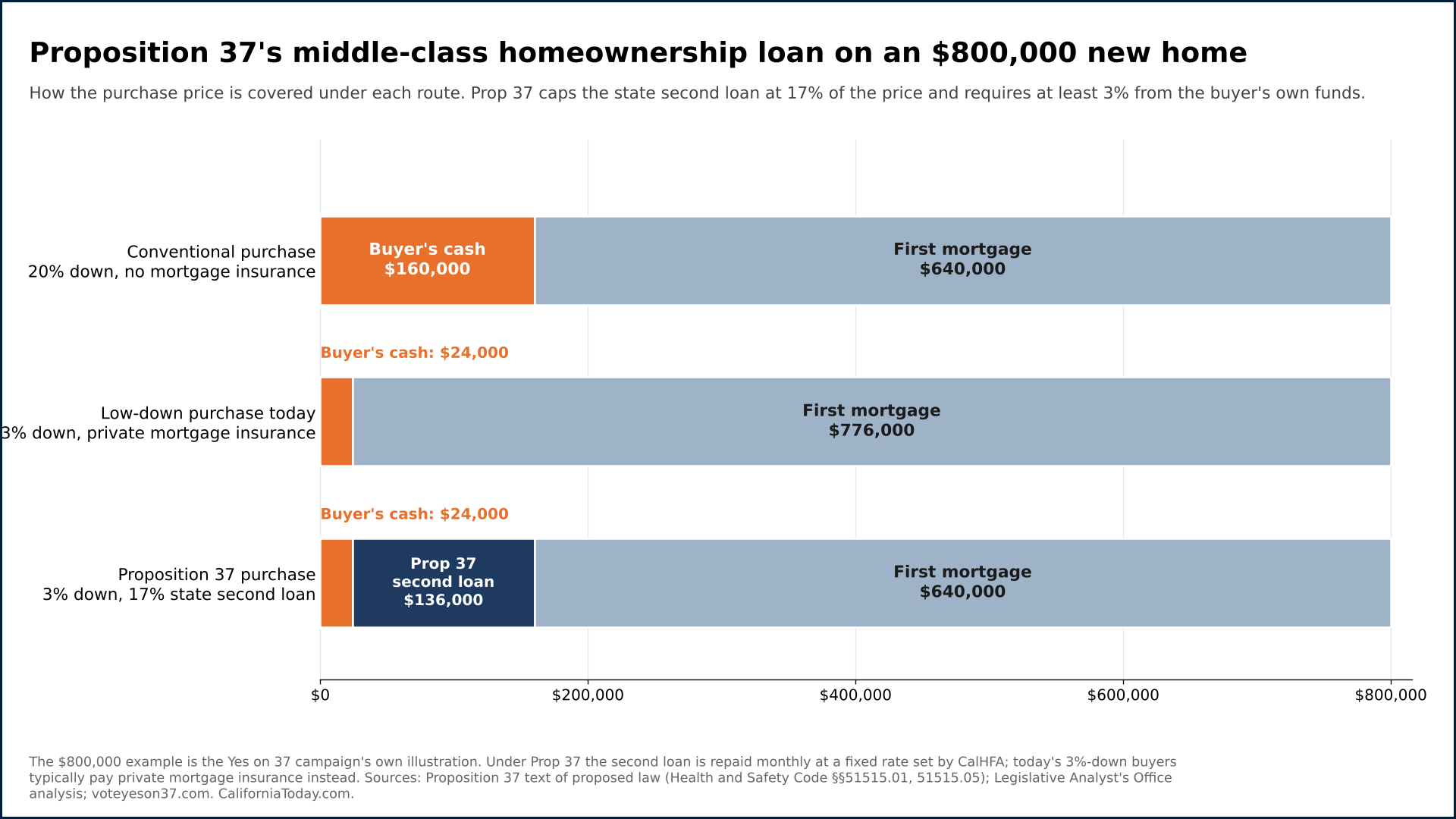
Prop 37, the "California Middle-Class Home Ownership and Family Home Construction Act of 2026," is an initiative statute placed on the ballot by petition. It is one of 14 measures in this year's guide and the best-polling of them: 61% yes to 35% no in PPIC's September survey. No argument against it was filed, no opposition committee exists, and its Yes side reports $30.9 million from top donors, led by the state's Realtors, the carpenters' unions and the Brin-and-Doerr-funded Building a Better California. Governor Gavin Newsom, Xavier Becerra and the California Democratic Party support it, the California Republican Party is neutral, and the editorial boards split two to two. This explainer covers what the text does, who qualifies and at what price, how the loan compares with the help CalHFA already offers, the builder option, the consumer rules, the cost, the money, the argument and the polling.
 Mac Douglass | Editor
Proposition 37 would let CalHFA sell $25 billion in revenue bonds and lend buyers up to 17% of a new home's price:
The text of the measure adds a chapter to the Health and Safety Code directing CalHFA to run a "Middle-Class Home Ownership Loan Program" and authorizing it to sell up to $25 billion in revenue bonds, the kind repaid by the program's own income rather than by the state. Each loan "shall finance no more than 17 percent of the purchase price" and must be secured by a second mortgage behind the buyer's primary loan. The agency has to launch the program within one year of the measure taking effect, and it decides how many bonds to sell and when, "in a manner that minimizes interest costs and encourages broad investor participation."
The repayment design is in section 51515.05. CalHFA sets the interest rates, amortization schedules and payment terms "on terms the agency determines practical and favorable to applicants and at levels necessary, to the greatest extent possible, to pay the principal, interest, and other amounts due with respect to the bonds," plus "all costs of administration." The loans must be fixed-rate, the agency may let a borrower use the loan for closing costs if that "balances the interests of borrowers and bond investors," and every bond must state on its face that it "shall not be deemed to constitute a debt or liability or a pledge of the faith and credit of the State of California." The Legislative Analyst's Office notes that CalHFA "also would be required to keep interest costs for homebuyers as low as possible," and that the measure leaves the rate itself to the agency.
The program is restricted to new homes. A "qualified new home" is a newly built house, townhome, row house, condominium or manufactured home, or a unit in a former nonresidential building converted to housing, in either case "where the borrower is the first purchaser." Builders may sell qualified homes to anyone; only buyers using the loan must meet the program's rules. The measure also says these homes are not "public works," so prevailing-wage law does not attach to them by default, and it lets CalHFA write its program rules without going through the Administrative Procedure Act, subject to its own board.
Prop 37's borrower rules set a one-year residency, a 200% of area median income ceiling and a 3% minimum down payment:
Section 51515.01 lists four tests. The applicant must have been "a resident of the State of California for at least one year," must agree to occupy the home as a primary residence within 60 days of closing, must have a family income that "does not exceed 200 percent of the area median income for a family of the same size in the county or metropolitan statistical area where the qualified new home is located," and must pay at least 3% of the price "from a source other than a grant or borrowed money." CalHFA may add minimum credit scores and debt-to-income limits to satisfy Fannie Mae, Freddie Mac or FHA standards, and it may set a longer residency requirement. The LAO's October 2025 letter to the Attorney General makes the point the ballot summary leaves out: an applicant "would not need to be a first-time homebuyer."
The price cap is a formula rather than a dollar figure: 125% of the one-unit conforming loan limit the Federal Housing Finance Agency publishes for the county each year. The FHFA set the 2026 baseline at $832,750, up 3.26% from 2025, with a ceiling of $1,249,125 in the highest-cost areas. Applying the measure's formula to the FHFA's county table gives a 2026 cap of $1,040,938 in the 41 counties at the baseline, from Sacramento and Fresno to Riverside and San Bernardino, and $1,561,406 in the ten counties at the ceiling: Los Angeles, Orange, San Francisco, San Mateo, Santa Clara, Alameda, Contra Costa, Marin, Santa Cruz and San Benito. Seven counties sit between, including San Diego at $1,380,000 and Ventura at $1,293,750. The income ceiling moves with local incomes in the same way. Using the Department of Housing and Community Development's 2026 State Income Limits as an illustration, a family of four could earn up to $216,200 in Los Angeles County, $261,800 in San Diego County, $401,600 in San Francisco and $194,200 in Fresno or Kern and still qualify. The measure does not say which income table CalHFA must use, so those figures show the shape of the rule rather than the agency's eventual numbers.
Proposition 37's 2026 price caps and income ceilings in 12 California counties:
| County | FHFA 2026 conforming loan limit | Prop 37 price cap (125% of limit) | HCD 2026 area median income (family of 4) | Prop 37 income ceiling (200% of AMI) |
|---|---|---|---|---|
| Los Angeles | $1,249,125 | $1,561,406 | $108,100 | $216,200 |
| Orange | $1,249,125 | $1,561,406 | $138,600 | $277,200 |
| San Diego | $1,104,000 | $1,380,000 | $130,900 | $261,800 |
| San Francisco | $1,249,125 | $1,561,406 | $200,800 | $401,600 |
| Santa Clara | $1,249,125 | $1,561,406 | $205,500 | $411,000 |
| Alameda | $1,249,125 | $1,561,406 | $162,800 | $325,600 |
| Ventura | $1,035,000 | $1,293,750 | $135,600 | $271,200 |
| Sacramento | $832,750 | $1,040,938 | $124,000 | $248,000 |
| Riverside | $832,750 | $1,040,938 | $106,500 | $213,000 |
| San Bernardino | $832,750 | $1,040,938 | $106,500 | $213,000 |
| Fresno | $832,750 | $1,040,938 | $97,100 | $194,200 |
| Kern | $832,750 | $1,040,938 | $97,100 | $194,200 |
| Price caps are our calculation from the measure (125% of the county conforming loan limit in the FHFA's annual report). Forty-one counties sit at the 2026 baseline limit of $832,750, so their cap is $1,040,938; ten Bay Area and Southern California counties sit at the $1,249,125 ceiling, so their cap is $1,561,406. Income ceilings use HCD's 2026 State Income Limits as an illustration; the measure says CalHFA will apply "the area median income for a family of the same size in the county or metropolitan statistical area," adjusted for family size, and the agency has not yet said which income table it would use. | ||||
PPIC's Eric McGhee calculated in October that 91% of California renters would have met the income test in 2024, the most recent Census year, and that the price cap "would have covered a home sold for as much as $1.15 million in 2024," about 50% above that December's statewide median. Eligibility, he wrote, "is not purchasing power": at 7% mortgage rates and Fannie Mae's 36% debt-to-income ceiling, an entry-level new home was out of reach for 56% of renters even with the down payment solved.
California's existing down payment programs defer repayment while Prop 37's loan is repaid monthly:
CalHFA already runs down payment help, and the comparison explains most of the debate. Its MyHome Assistance Program is a "deferred-payment junior loan" of up to 3.5% of the price on an FHA loan or 3% on a conventional one, for first-time buyers within CalHFA's income limits, with nothing due until the home is sold, refinanced or paid off. Its Dream For All Shared Appreciation Loan lends up to 20% of the price, capped at $150,000, to first-generation and first-time buyers, and is repaid with the original amount plus 20% of the home's appreciation (15% for buyers at or below 80% of area median income) when the home changes hands. Dream For All is funded by budget appropriations and rationed by lottery; the 2026 application portal closed on March 16 and vouchers went out in May. Proposition 1 on the same ballot would add $1.1 billion in general obligation bond money for homeownership programs of this deferred kind, aimed at low- and moderate-income first-time buyers.
Prop 37's loan is different in three ways. It is open to anyone under 200% of AMI, not only first-time buyers. It is repaid monthly, because the bonds behind it have to be serviced from borrowers' payments. And it is limited to new construction. The California Budget & Policy Center's analysis puts the first two together: the silent-second structure of today's programs "ensures that the downpayment assistance doesn't compete with the first mortgage, groceries, utility bills, or other basic needs in a family's monthly budget," while Prop 37's second mortgage "could also likely carry higher interest rates above conventional first mortgage rates," because investors in bonds backed by second liens "may therefore require a higher return." The measure's hardship clause lets a borrower ask CalHFA to defer "monthly interest payments" temporarily, which the Budget Center reads as confirmation that monthly payments are the design.
Down payment help in California today vs Proposition 37:
| Feature | CalHFA MyHome Assistance (today) | CalHFA Dream For All (today) | Proposition 37 middle-class homeownership loan |
|---|---|---|---|
| Help with the down payment | Up to 3.5% of the price (FHA) or 3% (conventional) | Up to 20% of the price, capped at $150,000 | Up to 17% of the price; buyer puts in at least 3% from their own funds |
| How it is repaid | Deferred-payment junior loan: nothing due until the home is sold, refinanced or paid off | Deferred: original amount plus 20% of the home's appreciation (15% for buyers at or below 80% of AMI) when the home is sold or the first mortgage is paid off | A fixed-rate second mortgage with monthly payments sized to repay the bonds and CalHFA's costs; hardship deferral of interest only on request |
| Who qualifies | First-time homebuyers within CalHFA income limits, paired with a CalHFA first mortgage | First-time and first-generation homebuyers; CalHFA income limits; vouchers by random drawing | Any buyer resident in California for a year, earning up to 200% of area median income, who occupies the home within 60 days; no first-time-buyer rule |
| Which homes | Single-family homes, approved condominiums and manufactured homes, new or existing | New or existing | Newly built homes, or units converted from nonresidential buildings, where the buyer is the first purchaser; price capped at 125% of the county conforming loan limit |
| Where the money comes from | CalHFA program funds | State budget appropriations, distributed in limited rounds (the 2026 application portal closed March 16) | Up to $25 billion in CalHFA revenue bonds sold to investors; no General Fund repayment |
| Builder rules | None specific | None specific | Optional "qualified builder" track: labor standards from the 2025 infill-housing law in exchange for modified construction-defect procedures and a 30% cap on homeowner attorneys' contingency fees |
The proponents' case for monthly repayment is the cost it replaces. Buyers who put down less than 20% usually pay private mortgage insurance until they build equity, and the McClatchy editorial board, which recommends a yes vote, wrote that proponents "have modeled relatively high second-mortgage rates and found buyers could still save money compared with private mortgage insurance." Nothing in the text guarantees a below-market rate; the argument in favor promises "below-market, fixed-rate loans," and the Orange County Register's editorial board wrote that the claim "rests on the assumption that foundations and non-profits will be willing to buy the bonds at a below-market interest rate of 3%," failing which CalHFA "will sell the bonds in the market and pay market interest rates."
Prop 37's qualified builder option trades labor standards for modified construction-defect rules:
Any developer can sell homes into the program. Section 51515.02 adds a voluntary "qualified builder option" for those who certify to CalHFA that their homes will meet the program's eligibility rules; the agency must confirm participation within 30 days, and the letter can be used to market and finance the project. A participating builder takes on the labor and enforcement provisions of Public Resources Code section 21080.66, the 2025 infill-housing CEQA exemption, which require prevailing wages on fully affordable projects, apply the state's skilled-workforce standards to buildings over 85 feet, extend wage-theft liability under Labor Code section 218.8 to the developer, and let joint labor-management committees sue contractors on workers' behalf. The builder also becomes liable for its contractors' and subcontractors' unemployment-insurance, workers' compensation and licensing violations.
In exchange, homes built under the option get a modified version of the Right to Repair Act's pre-litigation process. A defect notice must identify each home and each alleged violation and be signed by each homeowner; the builder may communicate directly with homeowners during the process; the builder may obtain a written release for completed repairs, which current law, as the LAO's letter notes, does not allow; a builder may move to dismiss a stayed case if the homeowner has not acted within 120 days; and the builder must disclose the special rules in writing before escrow closes. For any qualified new home, built under the option or not, attorneys' contingency fees in a defect case are capped at 30% of the recovery unless a court approves more. The modified procedures fall away if a builder sells a home for more than 25% above the price cap, a point proponent Robert Hertzberg confirmed to the Register's board. The California Conference of Carpenters is a signer of the ballot argument and its affiliates have given $1.7 million to the campaign.
Proposition 37's second mortgages are exempt from a 2025 foreclosure-protection law and carry a 0.5% fee cap:
Section 51515.04 sets the consumer rules. CalHFA must limit lender fees, ban prepayment penalties and require fixed rates. A lender may charge an origination fee of no more than 0.5% or $290, whichever is greater, and no other fee without the agency's approval. An applicant whose credit score falls short may submit bank statements, pay stubs and rent history for "cashflow underwriting." Every applicant must retain a licensed California real estate agent or broker "to ensure that the home buyer receives adequate representation." CalHFA must require homeowner education where it would help and provide for an independent annual audit.
One clause runs the other way. Subdivision (g) states that Civil Code section 2924.13 "shall not apply to any middle-class home ownership loans made under this chapter." That section, added by AB 130 in June 2025, targets dormant second mortgages: it makes it an unlawful practice for a subordinate-mortgage servicer to go three years without writing to the borrower, to skip required transfer notices, or to foreclose on a debt it has reported as written off or after the statute of limitations has run, and it requires a recorded certification of compliance before any nonjudicial foreclosure. Prop 37 loans, which are subordinate mortgages serviced by CalHFA's contracted lenders, would sit outside those rules. The text does not say why.
The Legislative Analyst finds no direct state cost and three unknowns for Proposition 37:
The LAO's ballot analysis and its October 6, 2025 letter reach the same conclusion in nearly the same words: because the measure "uses the payments from homebuyers to repay bond investors, it would not result in direct state or local costs." The letter adds that the $25 billion "is in addition to the revenue bonds CalHFA already issues" for its other programs. Both documents then list what cannot be known yet: "the extent to which investors want to buy the bond," "how much the loans available under this proposed program cost homebuyers compared with other down payment assistance options," and "whether the program results in increased home construction and homebuying."
The Voter Information Guide's Overview of State Bond Debt does not count Prop 37 at all. It lists two General Fund-supported bonds on this ballot, Propositions 1 and 38, at about $1 billion a year combined, against the roughly $6 billion a year the state already pays on about $80 billion of outstanding bonds. The closest precedent for a self-repaying housing bond is in Prop 1 itself: its $1.25 billion veterans' home-loan bond is repaid by borrowers, and the LAO notes those payments "have always covered the amount owed on the bonds." The difference is that veterans' bonds are general obligation bonds the state stands behind if payments fall short; Prop 37's are revenue bonds that, by their own terms, it does not. The McClatchy board raised the political version of that risk: borrowers in trouble "will quickly discover that their second mortgage exists because California created and authorized this program," which "could create an expectation that the state bears some responsibility for protecting them."
Proposition 37's reach depends on interest rates and new construction, according to PPIC and the Budget Center:
The campaign says the measure "is expected to spur construction of roughly 190,000 new homes." California YIMBY, which took no position, worked the arithmetic the other way: $25 billion over 190,000 homes is about $130,000 of bond money per home, and the group argued "there is no shortage of buyers" for new ownership housing, so the subsidy would mostly raise prices unless it reached weaker markets. PPIC's McGhee estimated that if every loan went to a home at the maximum price with the full 17%, $25 billion would reach about 113,000 buyers; at the full 17% on entry-level homes, about 560,000, which he called "a reasonable central estimate." California would have needed 1.35 million more owner households in 2024 to match the rest of the country, and the 560,000 figure would close about 41% of that gap.
The homeownership gap is the proponents' starting point. The Census Bureau's state table puts California's homeownership rate at 54.3% in the second quarter of 2026, the lowest of the 50 states except New York (52.4%), against a national rate of 65.0%. The argument in favor says a 20% down payment on a median home "can require saving over $186,000"; the California Association of Realtors' latest report put the median existing single-family price at $901,420 in August 2026, which makes 20% about $180,000 and 3% about $27,000. The Budget Center notes that the median California household held "just over $18,000" in checking and savings in 2025, so even 3% "could still almost or entirely clear out" what a typical family has, and that new homes more often carry HOA dues, Mello-Roos assessments and insurance problems in fire-prone areas.
Proposition 37's Yes side reports $30.9 million from Realtors, carpenters and Building a Better California with no opposition committee:
The Fair Political Practices Commission's top-contributor list, updated October 14, shows $30.9 million in support of Prop 37 across two committees and no opposition committee large enough to appear. The main committee, "Yes on 37—California Homeownership," lists $23.9 million from its top contributors: $14.85 million from Homeownership for Families, a committee sponsored by the California Association of Realtors whose own top donors are the Realtors' Issues Mobilization PAC and the National Association of Realtors; $6 million from Building a Better California, the committee funded by Sergey Brin and John Doerr that is also the main opponent of the billionaire tax; $1.25 million from the National Association of Realtors; $1.7 million from three carpenters' union committees; $50,000 from California Forever, the Solano County new-town developer; and $30,358 from the California Democratic Party. The Realtors' Homeownership for Families committee is listed separately with $7 million from the Realtors' PAC and the national association.
The Secretary of State's contribution tally, which runs through October 6, shows $19.6 million for the Yes committee and "No committees identified" in opposition; the FPPC's later date accounts for the gap. The petition that qualified the measure was paid for by "CA Homes Committee," with major funding from Building a Better California, the California Association of Realtors and the United Brotherhood of Carpenters, according to the Secretary of State's Official Top Funders filing. The Attorney General lists Robert M. Hertzberg, the former Assembly Speaker and Senate majority leader, as proponent on A.G. File 25-0013A1, titled October 21, 2025. The Budget Center observes that because revenue bonds need no voter approval, the program "could have been enacted legislatively."
The argument for Proposition 37 promises zero taxpayer cost and no argument against was filed:
The argument in favor, signed by Danny Curtin of the California Conference of Carpenters, Treasurer Fiona Ma as a CalHFA board member and David West of the California State Commanders Veterans Council, says the measure "creates affordable homeownership opportunities for working and middle-class Californians and encourages new home construction—with ZERO COST TO TAXPAYERS." It says California "has the second-worst homeownership rate in the nation," that "a traditional 20% down payment can require saving over $186,000," and that the program "is not a handout" because borrowers "must qualify for a mortgage, meet income requirements, pay at least 3% down, occupy the home as their primary residence, make monthly payments, and fully repay their loans." It quotes Controller Malia Cohen: "downpayment assistance loans are funded by private bond investors and repaid by home borrowers, not taxpayers." The guide's index lists the United Nurses Associations of California, the California Conference of Carpenters and Ma as supporters.
The page for the argument against reads: "NO ARGUMENT AGAINST PROPOSITION 37 WAS SUBMITTED." CalMatters' voter guide lists Reform California and the League of Women Voters of California as opponents, summarizing their case as objections to the state entering the mortgage business and to helping buyers only by adding debt. The guide notes that arguments "have not been checked for accuracy by any official agency."
Proposition 37 leads 61% to 35% with Newsom, Becerra and Democrats in support and editorial boards split:
PPIC's September survey of likely voters, fielded September 4–10, found 61% yes, 35% no and 3% undecided, the strongest support for any of the 14 measures. Democrats back it 76% to 20% and independents 62% to 35%, while Republicans oppose it 62% to 35%. Renters support it 70% to 28% and homeowners 59% to 38%; voters under 35 back it 69% to 26% and those 55 and older 54% to 42%. Five percent named it the measure they are most interested in. UC Berkeley's September poll did not ask about it, and PPIC's October survey had not been released as of October 18.
Governor Newsom endorsed the measure on October 9, saying in the campaign's release that it is "a historic opportunity to expand homeownership opportunities for generations of working families—at zero cost or risk to taxpayers." Xavier Becerra listed it among his yes votes on July 31. The California Democratic Party supports it and the California Republican Party is neutral, one of two measures on which it takes no side; the other is Proposition 1. The campaign's site lists Controller Cohen, Treasurer Ma, Superintendent Tony Thurmond, San Jose Mayor Matt Mahan, Darrell Steinberg, Antonio Villaraigosa, Katie Porter and SEIU among its endorsers.
Editorial boards divided on the second-mortgage question. McClatchy's California papers recommend yes, with stated reservations, on the ground that low-down buyers already pay for private mortgage insurance and that the program "connects assistance to new housing," while asking CalHFA to build a public dashboard of rates, defaults and foreclosures. The San Francisco Chronicle recommends a yes vote, according to CalMatters' roster of editorials. The San Diego Union-Tribune recommends no, writing that the measure "doesn't do in the slightest" anything about "shelter's extreme cost," and the Orange County Register recommends no, calling it "a risky $25 billion housing experiment" that leaves income-limited families with "two mortgage payments."
Proposition 37 after November 3 would give CalHFA a year to launch the middle-class homeownership loan:
If Prop 37 passes, it takes effect on the fifth day after the Secretary of State certifies the results, which is due December 11, and CalHFA would have until late 2027 to adopt its rules, sign up lenders and begin selling bonds. The agency would then set the interest rate, the credit standards and the pace of bond sales, which is where the measure's unknowns get answered: whether investors buy second-lien revenue bonds at a rate that undercuts private mortgage insurance, whether builders enroll in the qualified builder option, and whether buyers who can clear 3% and a first mortgage at current rates appear in the numbers the campaign projects. The Legislature could amend the statute only by a 60% vote of each house and only in ways that "further the purposes" of the act. If it fails, CalHFA keeps running MyHome and Dream For All, and the only new homeownership money on this ballot is Proposition 1's $1.1 billion for its deferred-loan programs.
This article reflects the Voter Information Guide as published, the FHFA's 2026 conforming loan limits and HCD's 2026 income limits, campaign-finance data as of October 14, 2026 (FPPC) and October 6, 2026 (Secretary of State), party and gubernatorial positions as of October 18, 2026, and polling fielded September 4–10, 2026.
Sources and References
- Voter Information Guide, Proposition 37—https://voterguide.sos.ca.gov/propositions/37/
- Voter Information Guide, Proposition 37, Official Title and Summary—https://voterguide.sos.ca.gov/propositions/37/title-summary.htm
- Voter Information Guide, Proposition 37, Legislative Analyst's analysis—https://voterguide.sos.ca.gov/propositions/37/analysis.htm
- Voter Information Guide, Proposition 37, arguments and rebuttals—https://voterguide.sos.ca.gov/propositions/37/arguments-rebuttals.htm
- Text of Proposed Laws, Proposition 37 (pp. 118–123)—https://vig.cdn.sos.ca.gov/2026/general/pdf/prop37-text-proposed-laws.pdf
- Voter Information Guide, Proposition 37 (title, summary, analysis and arguments, pp. 40–43)—https://vig.cdn.sos.ca.gov/2026/general/pdf/prop37.pdf
- Voter Information Guide, Overview of State Bond Debt—https://voterguide.sos.ca.gov/voter-info/overview-state-bond-debt.htm
- Voter Information Guide, Proposition 1, Legislative Analyst's analysis—https://voterguide.sos.ca.gov/propositions/1/analysis.htm
- Legislative Analyst's Office and Department of Finance, fiscal review of A.G. File 25-0013, Amendment #1 (October 6, 2025)—https://oag.ca.gov/system/files/initiatives/pdfs/fiscal-impact-estimate-report%2825-0013A1%29.pdf
- Office of the Attorney General, Active Measures (A.G. File 25-0013A1, proponent Robert M. Hertzberg)—https://oag.ca.gov/initiatives/active-measures
- California Secretary of State, Official Top Funders, initiative #1990 (February 2, 2026)—https://elections.cdn.sos.ca.gov/ballot-measures/top-funders/1990-top-funders-02-02-26.pdf
- Fair Political Practices Commission, Top 10 Contributors List, November 2026 General Election (last modified October 14, 2026)—https://www.fppc.ca.gov/search-filings/top-10-contributors-list/november-2026-general-election/
- California Secretary of State, 2026 Ballot Measure Contribution Totals, Proposition 37 (through October 6, 2026)—https://www.sos.ca.gov/campaign-lobbying/helpful-resources/measure-contributions/2026-ballot-measure-contribution-totals/proposition-37-creates-loan-program-middle-income-buyers-qualified-new-homes-initiative-statute
- Public Policy Institute of California, September 2026 likely-voter crosstabs—https://www.ppic.org/wp-content/uploads/crosstabs-likely-voters-0926.pdf
- Public Policy Institute of California, Eric McGhee, "How Many Might Actually Use the Down Payment Assistance in Proposition 37?" (October 7, 2026)—https://www.ppic.org/blog/how-many-might-actually-use-the-down-payment-assistance-in-proposition-37/
- Federal Housing Finance Agency, "FHFA Announces Conforming Loan Limit Values for 2026" (November 25, 2025)—https://www.fhfa.gov/news/news-release/fhfa-announces-conforming-loan-limit-values-for-2026
- Federal Housing Finance Agency, 2026 conforming loan limits by county—https://www.fhfa.gov/sites/default/files/2025-11/FullCountyLoanLimitList2026_HERA-BASED_FINAL_FLAT.xlsx
- California Department of Housing and Community Development, Revised 2026 State Income Limits (June 23, 2026)—https://www.hcd.ca.gov/sites/default/files/docs/grants-and-funding/income-limits-2026.pdf
- California Housing Finance Agency, MyHome Assistance Program—https://www.calhfa.ca.gov/homebuyer/programs/myhome.htm
- California Housing Finance Agency, Dream For All Shared Appreciation Loan—https://www.calhfa.ca.gov/dream/index.htm
- Public Resources Code §21080.66 (leginfo)—https://leginfo.legislature.ca.gov/faces/codes_displaySection.xhtml?lawCode=PRC§ionNum=21080.66
- Civil Code §2924.13 (leginfo)—https://leginfo.legislature.ca.gov/faces/codes_displaySection.xhtml?lawCode=CIV§ionNum=2924.13
- U.S. Census Bureau, Housing Vacancies and Homeownership, Table 3, Homeownership Rates by State: 2005 to 2026—https://www.census.gov/housing/hvs/data/rates/tab3_state05_2026_hmr.xlsx
- U.S. Census Bureau, Quarterly Residential Vacancies and Homeownership, Second Quarter 2026—https://www.census.gov/housing/hvs/files/qtr226/Q226press.pdf
- California Association of Realtors, August 2026 home sales and price report (September 16, 2026)—https://www.car.org/en/aboutus/mediacenter/newsreleases/2026releases/august2026sales
- California Budget & Policy Center, "Will Prop. 37 Make Homeownership More Affordable? It's Not Guaranteed"—https://calbudgetcenter.org/resources/will-proposition-37-make-homeownership-more-affordable-its-not-guaranteed/
- California YIMBY, "Proposition 37: No Recommendation" (September 23, 2026)—https://cayimby.org/blog/proposition-37-2026/
- Yes on 37, "Governor Newsom Supports Prop 37" (October 9, 2026) and Get the Facts—https://voteyeson37.com/press-release-governor-newsom-supports-prop-37-to-expand-homeownership-in-california/ ; https://voteyeson37.com/get-the-facts/
- ABC10 via Yahoo News, "Gov. Newsom announces position on statewide ballot propositions" (October 9, 2026)—https://www.yahoo.com/news/politics/articles/gov-newsom-announces-position-statewide-185935591.html
- Xavier Becerra for Governor, ballot measure positions (July 31, 2026)—https://www.xavierbecerra2026.com/?p=551
- California Democratic Party, 2026 General Election Endorsements—https://cadem.org/wp-content/uploads/2026/08/FINAL-2026-General-Election-Endorsements.pdf
- California Republican Party, 2026 endorsements—https://cagop.org/endorsements/
- CalMatters, "Proposition 37: Homebuyers loan," 2026 Voter Guide—https://calmatters.org/california-voter-guide-2026/proposition-37-homebuyers-loan/
- McClatchy California editorial board, "Prop. 37 puts California's homeownership crisis on the ballot. Here's our endorsement" (October 2, 2026)—https://www.sacbee.com/opinion/election-endorsements/article317470188.html
- San Francisco Chronicle editorial board, "Buying a home in California is a grim enterprise. Can Prop 37 help?" (October 3, 2026)—https://www.sfchronicle.com/opinion/editorials/article/prop-37-housing-home-loans-22422795.php
- San Diego Union-Tribune editorial board, "Props. 2, 37 wouldn't yield saner state budgets, more housing" (October 2, 2026)—https://www.sandiegouniontribune.com/2026/10/02/endorsements-props-2-37-wouldnt-yield-saner-state-budgets-more-housing/
- Orange County Register editorial board, "No on Proposition 37, a risky $25 billion housing experiment" (September 20, 2026)—https://www.ocregister.com/2026/09/20/endorsement-no-on-proposition-37-a-risky-25-billion-housing-experiment/
More November 2026 California Election Guides:
 Dr. Jennifer Trimpey | Specialist
 Mac Douglass | Editor
 Dr. Jennifer Trimpey | Specialist
 Mac Douglass | Editor
 Mac Douglass | Editor
 Mac Douglass | Editor
 Mac Douglass | Editor
 Mac Douglass | Editor


