

California Prop 2 guide: Expanded "Rainy Day Fund" would double amount saved for state budget reserves
Proposition 2 doubles the cap on California's rainy day fund to 20% of General Fund taxes, sets aside more of a capital gains surge, extends required debt payments to 2040 and stops counting deposits against the Gann spending limit until withdrawn.


Proposition 2 would double the cap on California's rainy day fund, the reserve the state draws on when a recession or stock market slump cuts tax revenue. Today the state must keep saving until the fund holds 10% of General Fund taxes.
Prop 2 raises that ceiling to 20%, requires larger deposits in years when capital gains revenue surges, and keeps the state making extra payments on its debts through 2040 instead of 2030. It also changes how savings count against the state's voter-approved spending limit, known as the Gann limit: deposits would no longer count when they are made, only when the money is taken out. The measure raises no taxes and spends no money. The Legislative Analyst's Office sums up its fiscal effect in six words: "State budget reserves would be higher."
Prop 2, the Save for California's Future Act, is a legislative constitutional amendment that the Legislature placed on the ballot as ACA 20, by Assembly Budget Chair Jesse Gabriel, on June 25. It rewrites the rules voters adopted in 2014, also as Proposition 2, and is one of 14 measures in this year's guide. PPIC's September survey found 60% of likely voters in favor and 39% opposed, one of the strongest results on the ballot. No campaign committee has registered on either side. This explainer covers what the measure changes, how the fund has been used since 2014, the spending-limit fight at the center of the opposition, the arguments and the polling.
 Mac Douglass | Editor
Proposition 2 doubles the cap on California's rainy day fund to 20% of General Fund taxes:
The rainy day fund's formal name is the Budget Stabilization Account. Voters created it in 2004 with Proposition 58 and gave it its current rules in 2014. Under those rules, the state sets aside 1.5% of General Fund revenues every year. Through 2029–30, half goes into the rainy day fund and half goes to paying down debts. The state must also set aside capital gains tax revenue above a threshold in boom years, split the same way. Once the fund reaches 10% of General Fund taxes, required deposits stop and the money that would have gone in must be spent on infrastructure.
The text of the measure amends Article XVI, sections 20 and 22 of the California Constitution. Its central change is one number: the cap on required deposits rises from 10% to 20% of General Fund taxes. In its April 2025 report on the state's reserves, the Legislative Analyst's Office put the 10% cap at "about $21 billion." At that level of revenue, a 20% cap would be about $42 billion. The new rules apply from the 2027–28 fiscal year, and the money already in the fund stays there.
The 1.5% annual set-aside does not change. Neither do the rules for getting money out. The Governor still has to declare a budget emergency before deposits can be suspended or money withdrawn, and no more than half the fund can be withdrawn in a year unless money was also withdrawn the year before. The measure also says it does not change the minimum funding guarantee for schools under Proposition 98, and the separate school reserve keeps its own rules.
California's rainy day fund rules today and under Proposition 2 compared:
| Rule | California law today (Proposition 2 of 2014) | Under Proposition 2 of 2026 |
|---|---|---|
| Cap on required rainy day fund savings | 10% of General Fund taxes. Required deposits above the cap must go to infrastructure. | 20% of General Fund taxes. Required deposits above the cap still go to infrastructure. |
| Annual set-aside | 1.5% of General Fund revenues, half to the rainy day fund and half to paying down debts | Unchanged |
| Capital gains set-aside | Capital gains tax revenue above 8% of General Fund taxes, counted dollar for dollar | Revenue between 8% and 10% counted dollar for dollar; revenue above 10% counted at 150% |
| Required debt payments | Required through 2029–30, then optional | Required through 2039–40 |
| Debts the payments can cover | Pension and retiree health debts, budget loans outstanding on January 1, 2014, school funding owed as of July 1, 2014, and old mandate claims | The same list without the 2014 cutoffs, plus federal loans to the state's unemployment fund and early payment of two costs now scheduled for later years: loans to a Medi-Cal provider payment fund and a school funding obligation under Education Code section 41206.04 |
| State spending limit | Rainy day fund deposits count toward the limit in the year they are made | Deposits do not count when made; withdrawals count in the year they are taken out. The same treatment applies to the temporary surplus holding account, up to 10% of General Fund taxes a year. |
| Declaring a budget emergency | The Governor issues a proclamation, which is required before deposits can be suspended or money withdrawn | A May Revision that proposes a suspension or withdrawal counts as the proclamation, when the conditions for a budget emergency exist |
| Withdrawal limits | No more than half the balance in a fiscal year, unless money was also withdrawn the year before | Unchanged |
| School funding (Proposition 98) | Minimum guarantee and the separate school reserve | Unchanged; the measure states it does not change the guarantee's calculation |
| Compiled by California Today from the text of Proposition 2 (ACA 20, Resolution Chapter 130 of 2026), the Legislative Analyst's analysis and the Assembly floor analysis of ACA 20 (June 22, 2026). The new rules apply from the 2027–28 fiscal year; money already in the rainy day fund stays there. | ||
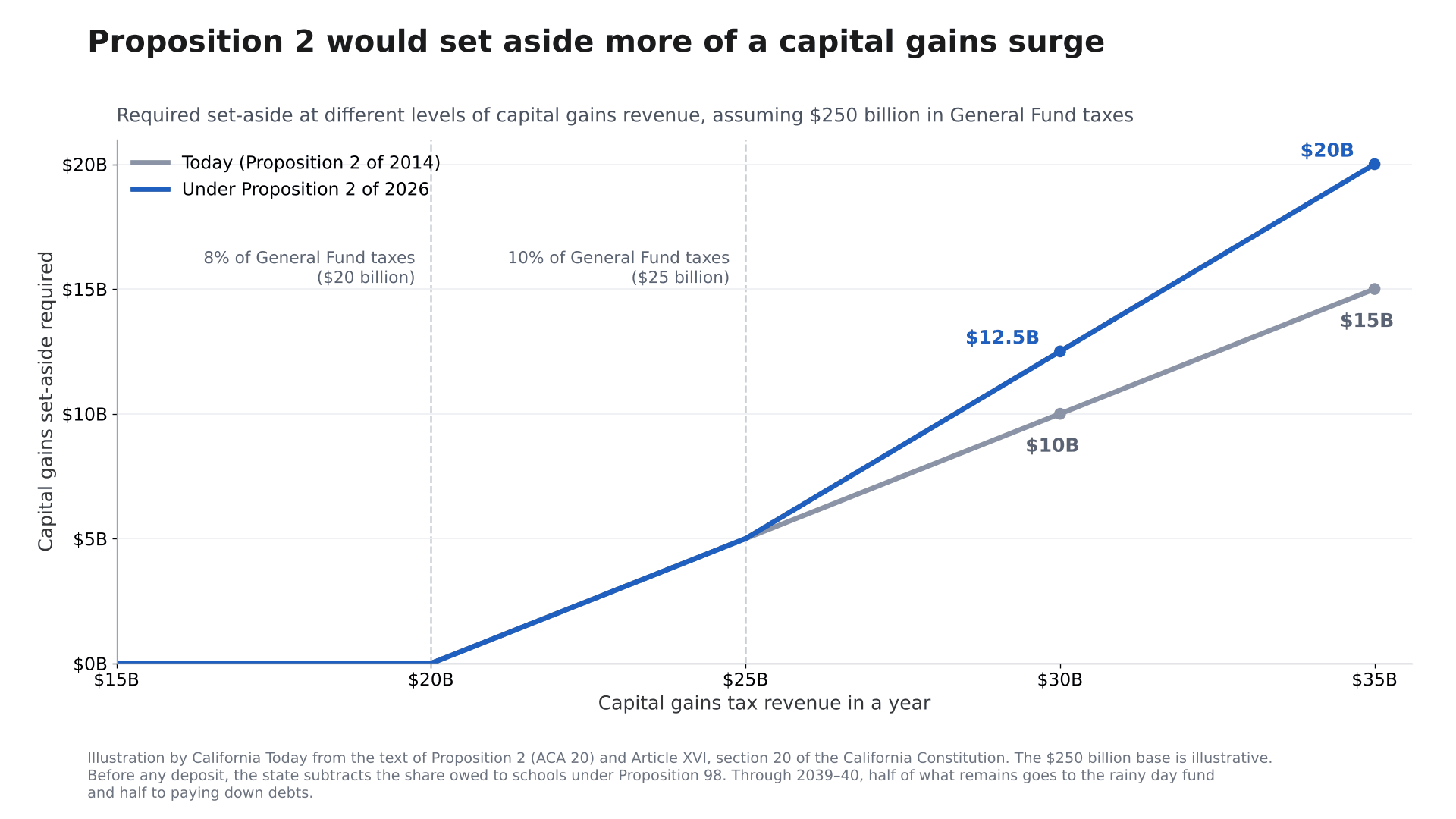
Proposition 2 would set aside 150% of capital gains revenue above 10% of General Fund taxes:
California's income tax leans on high earners, whose income often includes gains from selling stock, so state revenue rises and falls with the market. The LAO's analysis notes that in a bad recession or market crash, revenue declines over a few years "can equal 50 percent or more of annual General Fund revenues." The capital gains rule is the part of the rainy day fund meant to catch a boom before it is spent. Proposition 3 on the same ballot, which would make the current high-earner income tax rates permanent, concerns the same high-income tax base.
Today, when capital gains tax revenue exceeds 8% of General Fund taxes, the amount above 8% is set aside dollar for dollar, after subtracting the share that goes to schools under Proposition 98. Prop 2 splits that excess into two tiers. Revenue between 8% and 10% of General Fund taxes is still set aside dollar for dollar. Revenue above 10% is counted at 150%, so a $1 billion surge above that line requires a $1.5 billion set-aside. Through 2039–40, half of each year's total still goes to the rainy day fund and half to debts.
The Department of Finance estimated that if the new rule had applied from 2019–20 through 2021–22, the pandemic-era stock boom, about $4.7 billion more would have gone into the rainy day fund, according to the Assembly's floor analysis of ACA 20. Looking back further, the California Budget & Policy Center, a nonpartisan research group that takes no position on ballot measures, found the change would have required extra set-asides in six of the 14 years from 2010–11 through 2023–24.
Required debt payments under Proposition 2 would run through 2040 and cover federal unemployment loans:
The half of the annual set-aside that goes to debts has been restricted to a short list since 2014: pension and retiree health debts, school funding the state owed as of July 1, 2014, budget loans outstanding on January 1, 2014, and old claims from local governments for state-mandated costs. The requirement ends after 2029–30. After that, the Legislature could put the money into the rainy day fund instead.
Prop 2 keeps the requirement through 2039–40 and widens the list. It drops the 2014 cutoffs for school funding owed and for budget loans between state funds. It allows early payment of two costs the state has scheduled for later years: loans to a Medi-Cal provider payment fund and a school funding obligation under Education Code section 41206.04. It also adds federal loans to the state's Unemployment Fund. California has borrowed from the federal government to pay unemployment benefits since 2020, and the Employment Development Department projects that balance at $22.1 billion by the end of 2026. Any money set aside for debts beyond what the listed debts need would go into the rainy day fund.
The Budget Center questions the unemployment addition. It says the debt is an employer cost and that paying it from the General Fund shifts that cost to the state without fixing how the unemployment fund is financed.
Rainy day fund deposits would stop counting toward the state appropriations limit under Proposition 2:
The state appropriations limit, adopted by voters in 1979 and often called the Gann limit after its sponsor Paul Gann, caps how much tax revenue the state can spend each year. Its purpose, as the Senate Budget Committee describes it, is to keep inflation-adjusted spending per person under 1978–79 levels. Money put into reserves counts against the limit in the year it is deposited, just as spending does. If revenue exceeds the limit over two consecutive years, the excess is split between schools and taxpayer rebates. The state has issued a rebate once: in 1986–87 it exceeded the limit and returned $1.1 billion to taxpayers, according to an LAO history of the limit.
Prop 2 changes when savings count. Deposits into the rainy day fund would not count against the limit when they are made. They would count in the year the money is withdrawn and spent. The measure gives the same treatment to the state's temporary surplus holding account, a statutory account where the state parks revenue that may not last, up to 10% of General Fund taxes in a year. The state put $6.4 billion into that account for 2026–27, according to the LAO's overview of the budget, which says neither it nor the Department of Finance treats the account as a reserve.
The practical effect is that in a boom year, when the state is most likely to be near the limit, saving would no longer use up room under it. The Budget Center estimates the change could add up to a few billion dollars of room in some years. The state is not near the limit now: the LAO puts the 2026–27 budget $27.3 billion below it.
This is the change opponents focus on. They argue that taking deposits out of the calculation lets the state collect revenue it would otherwise have to refund. Supporters argue that the current rule penalizes saving. The Department of Finance said in 2025 that the interaction between the 10% cap and the spending limit had kept the state from saving more during upswings, according to the Senate Budget Committee's February 2026 hearing agenda on reserves. A separate measure on the same ballot, Proposition 41, also concerns the spending limit, but it targets new taxes whose revenue is excluded from the limit rather than reserve deposits. It is one of the two countermeasures to the billionaire tax.
Proposition 2 would let the Governor's May Revision count as a budget emergency proclamation:
Under current rules, deposits can be suspended or money withdrawn only after the Governor proclaims a budget emergency. That requires either a disaster or a finding that available money falls short of the highest spending level in the last three budgets, adjusted for inflation and population. Prop 2 adds a new subdivision (c) to section 22. When those conditions exist, the Governor's May Revision of the budget would itself count as the proclamation if it proposes suspending a deposit or withdrawing money. The Budget Center notes that in 2025 the Governor issued a separate proclamation on June 27, after the Legislature had passed the budget. The definition of a budget emergency does not change.
California's rainy day fund peaked near $23 billion and holds $15.1 billion after two years of withdrawals:
The 2014 Proposition 2 passed with 69.1% of the vote, according to the Secretary of State's Statement of Vote. The fund was first tapped in 2020–21, when the pandemic opened a budget gap, and then rebuilt with the revenue boom that followed. The 10% cap was operative in only two years, 2022–23 and 2023–24, and the LAO estimates that without it the state would have deposited about $2 billion more. The fund peaked at about $23 billion.
The state then drew it down. Over 2024–25 and 2025–26, it withdrew about $12.2 billion and suspended deposits in both years, according to the Senate Budget Committee. The LAO's figures show the balance at $18.6 billion at the end of 2024–25 and $11.5 billion at the end of 2025–26. The 2026–27 budget suspended a further $5.4 billion deposit owed for 2025–26, on top of a $1.6 billion deposit already suspended for that year, and ends 2026–27 with $15.1 billion in the fund. The Legislature passed ACA 20 on June 25 and the budget was chaptered on June 29, according to the Senate Republican Caucus office's summary of the enacted budget. Counting the Special Fund for Economic Uncertainties, the state's other general reserve, the LAO puts reserves available for any program at about $20 billion. The school reserve under Proposition 98 holds another $9.2 billion.
Legislative Analyst's Office recommended a 50% rainy day fund cap by 2055; Proposition 2 sets 20%:
Raising the cap has been on the table since early 2025. Governor Gavin Newsom's January 2025 budget proposed a 20% cap and taking deposits out of the spending limit, which is the core of Prop 2. The Legislature's own 2025 budget plan floated a 25% cap. Neither passed that year.
The LAO's April 2025 report modeled how often reserves would cover the gap between revenue and spending in future downturns. It found that the current rules would cover about one-third of funding shortfalls over 50 years and that the Governor's 2025 version would cover about half. It recommended going further: a cap phased up to 50% of General Fund taxes by 2055, starting at 20% "immediately after the next statewide election," then 25% in 2030 and 5 more points every five years, along with larger deposit rules. Prop 2 adopts the first step and a stronger capital gains rule. It does not schedule further increases.
Proposition 2 has no campaign committee on either side:
The Secretary of State's contribution page lists "No committees identified as of 10/06/2026" in support or in opposition, and Prop 2 does not appear on the FPPC's top-contributor list, last updated October 14. The Voter Information Guide lists a Yes on Prop. 2 campaign in Los Angeles and names Assemblymember David Tangipa as the contact for the opposition.
The arguments on Proposition 2 split over savings and taxpayer rebates:
The argument in favor, signed by Darrell Roberts of the California Professional Firefighters, Assemblymember Gabriel and Maria S. Salinas of the Los Angeles Area Chamber of Commerce, says the state's economy "swung our state budget from a $100 billion surplus to a $50 billion deficit in just a few years." It says Prop 2 will "DOUBLE THE STATE'S RESERVE REQUIREMENT" and "STOP SACRAMENTO POLITICIANS FROM OVERSPENDING" by requiring the state "to bank more of that windfall instead of committing it to new ongoing spending." It points out that the LAO "has recommended that the state should be saving significantly more than current rules require." Its rebuttal, signed by State Board of Education President Linda Darling-Hammond, California Hospital Association CEO Carmela Coyle and California Primary Care Association CEO Francisco J. Silva, calls the rebate opponents describe "theoretical" and says it "relies on a 50-year-old accounting gimmick that rewards spending instead of saving."
The argument against, signed by Assemblymember Tangipa, vice chair of the Assembly Budget Committee, Senator Steven Choi and Assemblymember Carl DeMaio of Reform California, says Prop. 2 "allows the politicians to gut the voter-imposed spending limit." It calls the fund "a SLUSH FUND" and says the measure "creates loopholes and accounting gimmicks so politicians can eliminate any chance of you getting your tax rebate." It also says the state budget "has grown by 76% since 2018." Both the argument and its rebuttal say that within 24 hours of placing Prop 2 on the ballot, its backers voted to suspend more than $5 billion in required deposits. The rebuttal adds that the measure "doesn't dedicate any new dollars" to education, health care or public safety. The guide notes that arguments "have not been checked for accuracy by any official agency."
On the facts underneath: the enacted budget did suspend a $5.4 billion deposit, as described above. The LAO's analysis identifies no new spending; its only fiscal finding is that reserves would be higher. Rebates depend on revenue exceeding the limit over two years, which has not happened since 1986–87, and the state is $27.3 billion under the limit this year.
Proposition 2 leads 60% to 39% in PPIC polling with Newsom and Democrats in support:
PPIC's September survey of likely voters, fielded September 4–10, found 60% yes, 39% no and 1% undecided. Democrats back it 82% to 17% and independents 60% to 38%, while Republicans oppose it 77% to 22%. Renters support it 71% to 28% and homeowners 56% to 43%. One percent of likely voters named it the measure they are most interested in. UC Berkeley's Institute of Governmental Studies did not poll Prop 2 in September. PPIC's October survey had not been released as of October 18.
Governor Newsom listed a yes on Prop 2 in the ballot slate he announced on October 9, and he and former Health and Human Services Secretary Xavier Becerra are listed as supporters in the Voter Information Guide. The California Democratic Party supports it and the California Republican Party opposes it. The Legislature's final votes were 29–2 in the Senate and 59–8 in the Assembly. Among editorial boards, the Sacramento Bee recommends yes and the San Diego Union-Tribune and the Orange County Register recommend no, according to CalMatters' voter guide.
Proposition 2 after November 3 would take effect for the 2027–28 budget:
If Prop 2 passes, the new rules first apply to the budget the Governor proposes in January 2027 for the 2027–28 fiscal year. The cap on required savings rises to 20%, larger capital gains set-asides start in boom years, deposits stop counting against the spending limit until withdrawn, and required debt payments continue to 2040. The $15.1 billion now in the fund stays there, and nothing in the measure requires a deposit beyond the existing formulas. How fast the fund grows toward the new cap depends on revenue and on whether future budgets suspend deposits. If it fails, the 2014 rules stay in place, with the cap at 10% and required debt payments ending after 2029–30.
This article reflects the Voter Information Guide as published, the text of ACA 20 (Resolution Chapter 130, Statutes of 2026), the 2026–27 enacted budget as described by the Legislative Analyst's Office on August 26, 2026, campaign-finance data as of October 6, 2026 (Secretary of State) and October 14, 2026 (FPPC), party and candidate positions as of October 18, 2026, and polling fielded September 4–10, 2026.
Sources and References
- Voter Information Guide, Proposition 2—https://voterguide.sos.ca.gov/propositions/2/
- Voter Information Guide, Proposition 2, Official Title and Summary—https://voterguide.sos.ca.gov/propositions/2/title-summary.htm
- Voter Information Guide, Proposition 2, Legislative Analyst's analysis—https://voterguide.sos.ca.gov/propositions/2/analysis.htm
- Voter Information Guide, Proposition 2, arguments and rebuttals—https://voterguide.sos.ca.gov/propositions/2/arguments-rebuttals.htm
- Text of Proposed Laws, Proposition 2 (pp. 106–109)—https://vig.cdn.sos.ca.gov/2026/general/pdf/prop2-text-proposed-laws.pdf
- Assembly floor analysis, ACA 20 (Gabriel), as introduced June 22, 2026—https://abgt.assembly.ca.gov/media/8124
- Legislative Analyst's Office, "Rethinking California's Reserve Policy" (April 10, 2025)—https://www.lao.ca.gov/Publications/Report/5028
- Legislative Analyst's Office, "The 2026-27 Budget: Overview of the Spending Plan" (August 26, 2026)—https://lao.ca.gov/Publications/Report/5197
- Legislative Analyst's Office, "The 2017-18 Budget: Governor's Gann Limit Proposal" (March 2, 2017)—https://lao.ca.gov/Publications/Report/3596
- Senate Committee on Budget and Fiscal Review, "Review of California's Reserve Policy: Looking to the Future," hearing agenda (February 18, 2026)—https://sbud.senate.ca.gov/media/3464
- Senate Republican Caucus, "2026-27 Enacted Budget: Initial Summary"—https://src.senate.ca.gov/content/2026-27-enacted-budget-initial-summary
- California Secretary of State, Statement of Vote, November 4, 2014 General Election, summary pages—https://elections.cdn.sos.ca.gov/sov/2014-general/pdf/06-summary.pdf
- Employment Development Department, January 2026 Unemployment Insurance Fund Forecast—https://edd.ca.gov/siteassets/files/unemployment/pdf/january-2026-ui-fund-forecast.pdf
- California Budget & Policy Center, "Should Voters Approve Proposition 2? How California's Rainy Day Fund Would Be Updated" (August 2026)—https://calbudgetcenter.org/resources/should-voters-approve-proposition-2-how-californias-rainy-day-fund-would-be-updated/
- Voter Information Guide, Proposition 41—https://voterguide.sos.ca.gov/propositions/41/
- California Secretary of State, 2026 Ballot Measure Contribution Totals, Proposition 2 (as of October 6, 2026)—https://www.sos.ca.gov/campaign-lobbying/helpful-resources/measure-contributions/2026-ballot-measure-contribution-totals/proposition-2-aca-20-gabriel-save-californias-future-act-res-ch-130-2026
- Fair Political Practices Commission, Top 10 Contributors List, November 2026 General Election (last modified October 14, 2026)—https://www.fppc.ca.gov/search-filings/top-10-contributors-list/november-2026-general-election/
- Public Policy Institute of California, September 2026 likely-voter crosstabs—https://www.ppic.org/wp-content/uploads/crosstabs-likely-voters-0926.pdf
- ABC10 via Yahoo News, "Gov. Newsom announces position on statewide ballot propositions" (October 9, 2026)—https://www.yahoo.com/news/politics/articles/gov-newsom-announces-position-statewide-185935591.html
- California Democratic Party, 2026 General Election Endorsements—https://cadem.org/wp-content/uploads/2026/08/FINAL-2026-General-Election-Endorsements.pdf
- California Republican Party, 2026 endorsements—https://cagop.org/endorsements/
- CalMatters, "Proposition 2: Rainy day fund," 2026 Voter Guide—https://calmatters.org/california-voter-guide-2026/proposition-2-rainy-day-fund/
More November 2026 California Election Guides:
 Mac Douglass | Editor
 Pat Sharyon | Editor

 Dr. Jennifer Trimpey | Specialist

 Mac Douglass | Editor

 Dr. Jennifer Trimpey | Specialist

 Mac Douglass | Editor
 Mac Douglass | Editor

 Mac Douglass | Editor

 Mac Douglass | Editor
 Mac Douglass | Editor


